I set up a backyard fitness area, some free weights, a weight bench. I went for daily walks, sometimes running or hiking.
Then I returned to the gym after the “danger” had passed. I returned to a new world of fitness which resembled nothing of the one that had existed before.
I’m not going to name the gym I go to. But through the magic of AI, I bring you some of what the modern work out looks like.
I hate the place but I agreed to meet a friend who lives in Silver Lake down at the expensive, pretentious coffee house where there are many nice dogs and many mean people.
It was a random Tuesday in Los Angeles. The 101 was packed with cars and trucks. But when I drove down Hollywood to Sunset, I passed less than five people walking on the streets.
They were repairing the electrical wires on Sunset, on the year 1888 wooden poles, so I turned up Hyperion and found parking across the street from a man sleeping on the sidewalk in front of the two-million-dollar wooden bungalow.
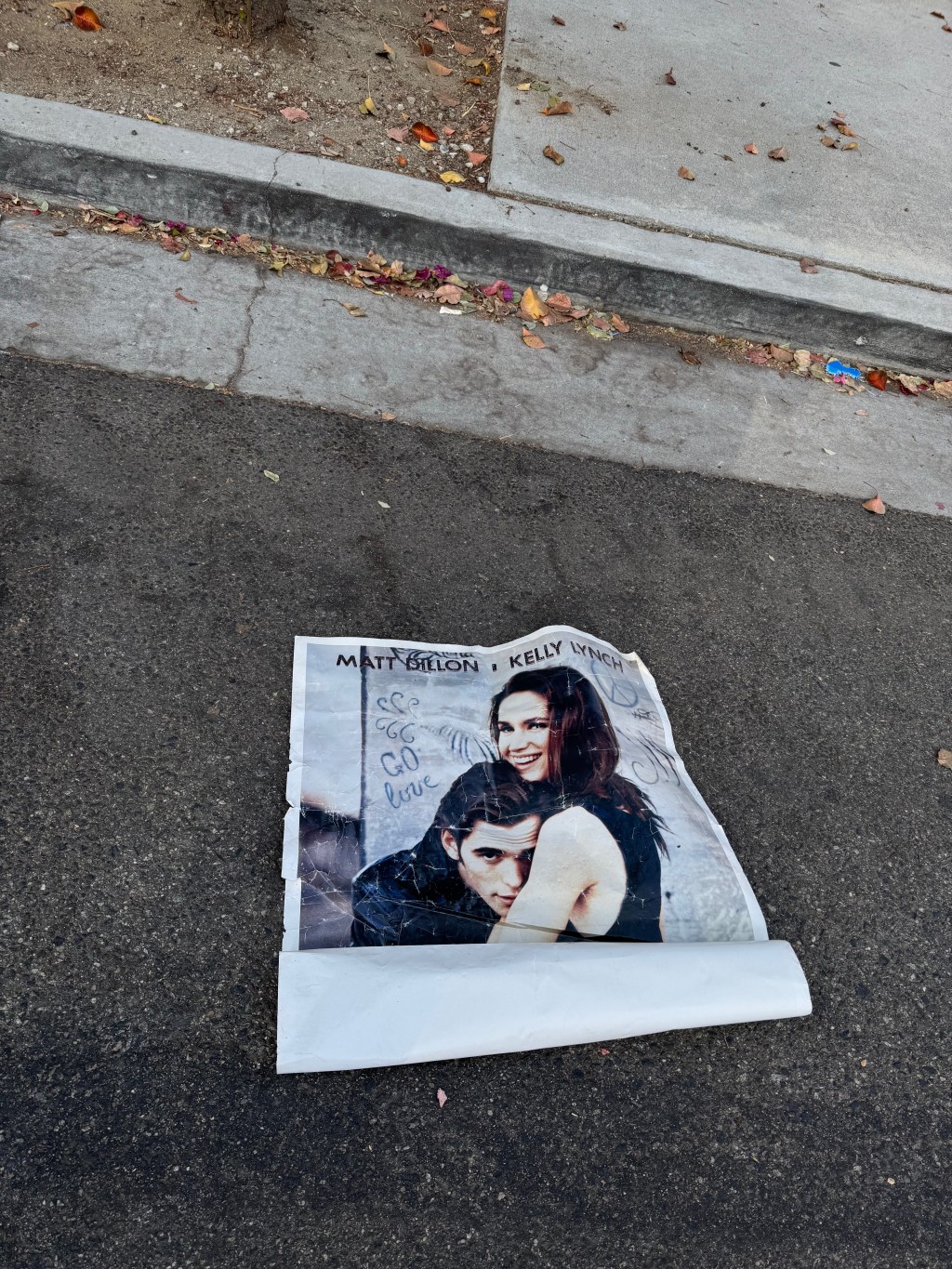
A discarded, half rolled out movie poster from the Matt Dillion/Kelly Lynch picture, “Drugstore Cowboy” (1989) was thrown on the street. An unemployed, 60-year-old gaffer on that film probably threw it out before moving back to Naperville.
I had to pee badly so I made a mad dash to Intelligentsia and found that the bathrooms were allegedly out of service. Quick thinking and I ran down to the other coffee place, La Colombe, which has better coffee, nicer servers and a clean, open restroom. I bought a croissant which was pretty good and walked back down to Intelligentsia to meet my friend.
There were angry political posters taped to every pole I passed:
We need and demand a whole new way to live, a fundamentally different system.
LA’s Best Restaurants Are Feeding You a Lie.
And there was even a quotation from Black Conservative Thomas Sowell:
“The fact that so many politicians are such shameless liars is not only a reflection on them, it is also a reflection on us.”
Perhaps the progressive person who posted Sowell’s quote didn’t know that Sowell is an ardent opponent of racial quotas.
Two artfully outfitted Japanese guys were taking photos of the coffee shop exterior to document their visit to this legendary place. I felt excited for them being so excited.
I found a seat outside across from a large black French Poodle and his bearded owner in a baseball cap imprinted with the flag of a foreign country.
A small, middle-aged man emerged carrying an espresso cup balanced on a saucer, carrying a pastry, holding a dog leash attached to a large, gray Weimaraner.
“Do you mind dogs?” he asked as he sat down and attempted to fit his large animal between the petite table and the flat wood bench.
I was still waiting for my friend as more dogs arrived. It was an excellent seat for dog watching, looking at their fur colors, admiring their leashes, listening to their barking. The whole patio was dogs, tied up to the table legs, emptied of their owners who were inside ordering drinks.
Finally, my friend arrived. He is about 50, a short Filipino graphic designer who carried Age of Revolutions: Progress and Backlash from 1600 to the Present by Fareed Zakaria.
He told me he had a crazy dream about losing expensive camera equipment. It inspired me to tell him about a camera store in St. Moritz I had recently seen that kept hundreds of thousands of dollars of electronics in their store window overnight without fear of theft.
We got our coffees and new seats and sat on the outdoor patio where no loud humans could be heard, only the occasional bark from one of 12 dogs.
Suddenly, a foul faced young woman holding a saucer of water for her rust bulldog threw the water bowl liquid on the patio inches from where we were sitting. She might have walked to the numerous plant containers and politely dumped her dog water there, but since this was Los Angeles, not Switzerland, consideration for others was highly unlikely.
We talked more about travel, politics, international affairs, apartments, real estate, and everything that might have involved Donald Trump, but his name was never mentioned. My friend asked if I wanted to walk down Sunset, perhaps to a park, to sit and talk, so we left Intelligentsia, the dog motel with coffee drinks.
“Are you still hungry?” he asked. I assumed he was going to buy me a sandwich.
We walked into Bravo Toast, a place with gourmet toasts. He ordered one with thin slices of bananas and a power drink. He paid for his sandwich and drink and got a number.
“Hey, should I order something Ross?” I asked.
“Oh, I’m sorry Andrew. Go ahead,” he said.
But since this was Los Angeles, not Switzerland, consideration for others was highly unlikely.
I got one with ricotta cheese for $12.50, plus $1.50 tip, my treat, for me.
We were conversing, quietly, enjoying our food and ruminating about life, ideas, dreams.
Then the noise began.
Two skinny, female presenting things somewhere north of 20 with many piercings and 18-inch waists sat down nearby. As they screamed and laughed not even the fire engines with sirens speeding down Sunset could be heard. I briefly considered asking them to talk softer, but since this was Los Angeles, not Switzerland, consideration for others was highly unlikely.
We left Bravo Toast and said good-bye on Sunset.
“Next time I’ll come up to Van Nuys and you can show me around,” Ross said.
On the day we walked here, a few hours after we left, a 68-year-old woman, fighting a purse snatcher, was stabbed 8 times but survived. Her attacker was tackled by others and kept down until police arrived and arrested him.
One can sense the presence of danger here even though it may not be knifing you in the chest. You wouldn’t just rationally wander here at midnight. Maybe if you were drunk.
North Spring Street is neglected. There are burned out buildings, empty storefronts, and lots waiting for life to return. New High Street between Alpine and Ord is made of one-story buildings and 50% asphalt parking lots.
What a struggle to run a business in Los Angeles, especially a restaurant. How have any survived the pandemic, taxation, crime, inflation, food costs, employee wages? It’s a wonder anything is functioning.
My architectural imagination wonders why many streets in this district, adjacent to downtown, are so depleted of apartments above stores, why there are still one-story buildings and acres of parking lots all around.
Along Alameda Street, there are gas stations, and a concrete building from the late 1960s housing The Los Angeles County Fleet Services. Against the brutal and blank façade are shrubs, a mid-century idea of environmental eyeliner.
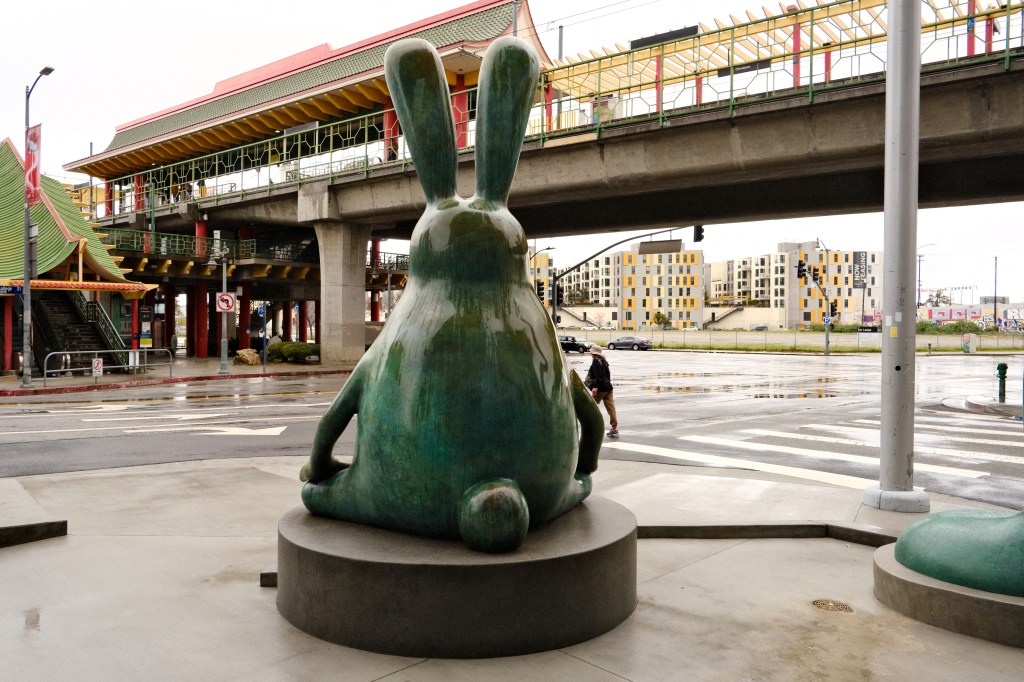
The light rail station is good looking with bright colors of red, green and yellow and decorative chinoiserie. There is a whimsical, large bunny statue on a pedestal standing guard across from the train.
There are handsome new buildings nearby but I hadn’t taken any photos of them. I will, perhaps, return here and photograph them someday.
Before the rains came, we went to visit the La Brea Tar Pits and the outdoor grounds adjacent to the Los Angeles County Museum of Art and the new Academy of Motion Pictures.
Despite having lived in Los Angeles, close to 30 years, I don’t remember ever walking around the La Brea Tar Pits.
It was Christmas Eve and there was parking along 6th Street just east of Fairfax, past many homeless tents. We pulled into a free spot, got out of the car and walked into the park.
The first thing we encountered was a man under the giant rock screaming his head off while two amused security guards watched him from a distance.
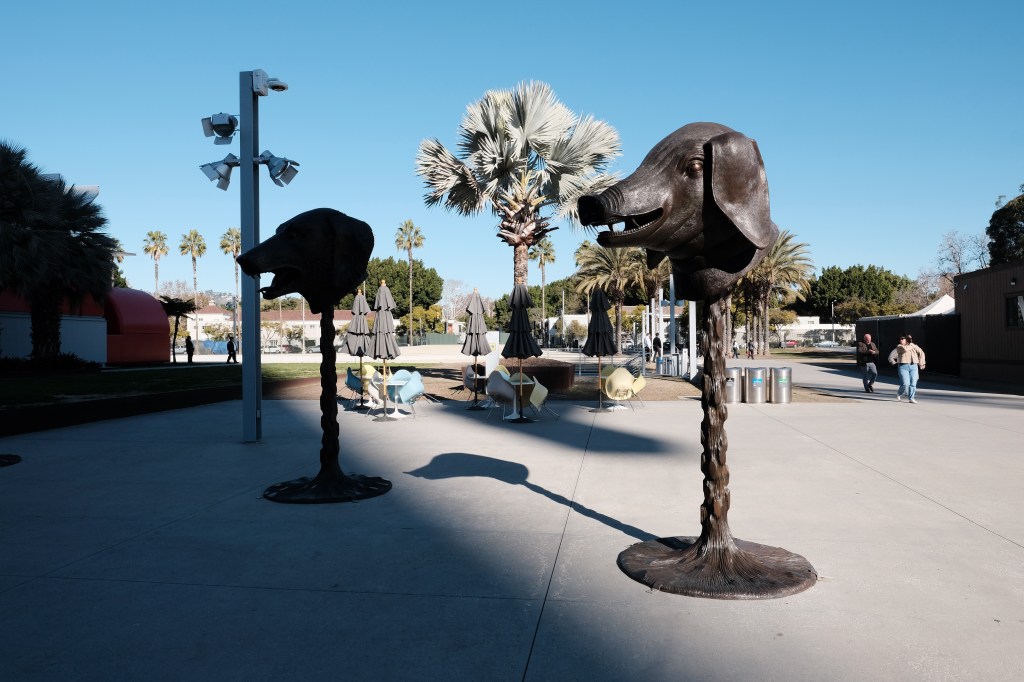
We walked on, into a sculpture garden of enormous steel animal heads on steel posts arranged in decorative circles around a concrete patio. (The Zodiac Project by Ai Weiwei, his first major public sculpture.) It felt like a religious installation but the gods were animals, toylike and comical. Their creator is currently in prison in China. We are free to laugh at his genius and liberated to be ignorant of its meaning.
Further we went along the red columned walkway that connects various art galleries and the new Academy of Motion Pictures built inside the old May Company Department Store where Bette Davis played a washed-up actress working as a sales clerk in “The Star” (1952).
There were nice looking families dressed in nicer clothes, out for a holiday walk or visit to the museums or motion picture halls. You could believe right there that LA was a normal city with civilized citizens taking part in the arts like people do in any other city outside of the United States, forgetting the woman on life support shot in her car, December 17th, on the 101 in Tarzana, a kind of gruesome violence that is our everyday normality, and nothing special to speak of, only one human life.
The crazy screaming man walked past us still screaming, trailed by two security guards, and there were so many security guards in every part of the property, inside museums, at the entrances, around the park, and you knew they were there to provide security in an insecure city where mad people wander and sleep in tents and on bus benches in the tens of thousands. And drivers fire guns at other drivers.
We saw many smiling, delighted Indonesian tourists taking pictures next to the decorative lampposts on Wilshire near Ogden. Their bus waited with open door as the happy group posed in the sunshine. What did they think of this city and this nation, so much abundance, so much squalor?
The future of Wilshire was all around us: the demolished museum buildings and the new construction for the concrete exhibition rooms that will catapult over Wilshire and connect via an indoor sky bridge filled with rooms of paintings.
The new subway is pummeling along below, and there will soon be underground trains taking people from east to west and west to east just like every other modern city around the world where people take public transport to get around. But here it was a novelty, opposed for years by the most powerful and influential leaders in politics and business, but somehow, now, in the 2020s, we are getting a subway along the most important boulevard in Los Angeles.
Priorities of this city. So meaningful and so confounding. What we hold dear, what we think matters.
Traffic, car chases, murders, helicopters, homeless.
We walked west and saw the ugly but beloved, closed down coffee shop on the corner of Wilshire and Fairfax where Senator Bernie Sanders had a campaign office in 2016. His name and murals still decorate the building.
Into the Academy of Motion Picture Museum we went, past more friendly, young security guards, (aspiring screenwriters?) guiding us to a gift shop where they sell “The Godfather” memorabilia and nice sweatshirts, t-shirts, film posters and music albums.
The Renzo Piano designed lobby is perfectly proportioned modernism with crisp polished concrete floors and exposed steel ceilings, pipes and vents. There are also many precisely hung blood red signs to bring life to all the gray steel and tan concrete.
It’s all very well done, very architectural and quite elegant. In Copenhagen or Stockholm this would probably be a subway station.
There are some very nice restrooms and we went down to use them, past many masked security guards who ensure that urinating visitors come, like us, from the proper stratum of society. (I have a BA from Boston University.)
After peeing and handwashing we went outside in the La Brea Tar Pits Park walking past fenced in oil pools with signs explaining the stories of animals who walked here 10,000 or 20,000 years ago and were caught unwittingly in the tar for eternity.
Almost all the old LACMA buildings from the 1960s, 70s, and 80s have been torn down to make way for the latest incarnation of faddishness, but they somehow allowed one of the ugliest to escape death: the Pavilion for Japanese Art, a monstrously grotesque, green rocked assemblage of artificiality, concrete ramps and gigantic shoji screens; asymmetric, tangled up, psychotic and tortured, mumbling to itself, whose only real quality is being outdated.
The George C. Page Museum at the La Brea Tar Pits was our last stop. “A fiberglass frieze depicting Pleistocene mammals runs around the top of the building, held up by a black aluminum web called the “space frame,” writes the LA Conservancy.
It is also a 1977, Charlie’s Angels era building sunk into the ground and rising up with a sculpted mural along the horizontal façade, kind of monumentally casual and pop art significant in the mode of Hall and Oates in concert or Kristy McNichol skateboarding.
What are these years and what do they matter? And what are the plans for Los Angeles and what do they matter?
Tear down, erect, tear down, erect, tear down, erect. Make big plans, wait a few decades. Discard.
Spend millions, spend billions, spend it lavishly, tell a story about a story and what have you got for a city?
The dead animals in the tar, the homeless on the streets, and the fenced in realm of enlightenment.
This is our civic space: a tar pit, an old department store, and a policed park. Maybe one day it will evince as much humanity as it aspires to, but for now, the answer to what Los Angeles will become is buried with the fossils.
Artsy has a number of artworks for sale, some quite expensive (over $2,000), with Van Nuys as the subject.
The variety of mediums and styles is fascinating.
Compulsion by Alex Prager 2012Drive in Theater Hwy 5 Van Nuys CA 1973 Steve FitchLeaving Van Nuys Amy Bernays 2009Lobby Cards VNB 1979Van Nuys 2018 Sinziana VelicescuVan Nuys CA 2016 Sinziana VelicescuVan Nuys Paradise 2018 Lindsey WarrenVN Monotype Series No 6 Makoto Fujimura
Regretful, nostalgic, curious, melancholy, I recently opened my 15 years of Facebook Messenger to look at old messages, sent and received.
2007-2022.
Who were these people? What did I want with them? What was I hoping for?
I found a vast wasteland of forgotten names, broken connections and lost memories.
On August 9, 2012, I sent Christian L. a photo from a party. On November 3, 2016, he opened it. That was the end of our conversation. Who was Christian? What photo did I send? I’ll never know.
15 years ago, like 15 minutes ago, I was looking for work. Or thinking of sex. Or trying to connect to someone for some reason involving either reason.
Zokai was a muscular black trainer from the gym. He was a potential protagonist in my short story, “Decline Press.” I thought I would photograph him. Have him read dialogue from the story. I sent him a message on August 14, 2016. What became of that? Nothing. Maybe I was to blame for spelling his name as “Zaikai.”
I unearthed a buried trail of dead ends, leads that lead nowhere, communications dreamt up out of my hopes, longings and imagination.
I was always thanking someone.
On June 14, 2012, I thanked Samson whom I talked to at the Raymer Street Bridge. I have no recollection of the man or the conversation, but I do have a good friend with that last name who lives near Raymer Street.
But he is not that Samson.
Then there was Satoshi, the hermetic, buzz cut Japanese model who brought me to a chanting worship service at his Buddhist temple in North Hollywood. I spent two hours gasping for breath as I repeated the same indecipherable chant over and over again.
I tried to contact him after the service, but he never returned my messages. Angered, I sent him one of my petulant texts, and then attempted to apologize. I felt bad for him because his mother died. And then I met a man whose mother also died, me.
I was forever striking out and asking for forgiveness.
I was always trying to fix what I fucked up.
I often attempted to go back in time before I offended, to find my way back to paradise before my fall.
Does everyone have a life like mine? Is it mere honesty or self-flagellation which propels me to air out long forgotten messages that don’t mean anything?
Should I even air my dirty laundry? Aren’t we all saints in our own mind? FB Messenger begs to differ.
Ambitious, directed, soul cycling, tanned and glistening fashion executive Glynis who I worked with at Ralph Lauren in 1989-90. I owed her an apology before she asked for one. That was 2013. I haven’t spoken to her in ten years, but here I was asking for her forgiveness.
I look again at 15 years of long-gone messages that went out to strangers, friends, acquaintances, co-workers,hotties, cousins, aunts, brothers, lovers, ex-friends and permanent enemies. I review notes of infinitesimal pettiness, penitential pleading, glib emotionality.
I see myself in the mirror, cracked, crazy and unhinged. Or kind, forgiving, funny, ridiculous, self-effacing.
My father died in 2009 at age 76. He grew up in Chicago’s Hyde Park neighborhood and his boyhood pals included Norm Jacobs, who took over Baseball Digest in 1969. Jacobs is 89 and a silent partner with Jerry Reinsdorf in the syndicate that owns the Chicago Bulls.
Norm is also a multi-millionaire publisher and owner of a sports team. His pal, my dad, spent his life going from mediocre job to job in publishing and advertising, battling epilepsy, raising a retarded kid. Norm never hired my dad, never looked after his well-being, really never knew a thing about my father’s life after 1950.
After my father died Norm was annoyed was me. I had let his teammates down.
During the pandemic death was all around. Carol had died. She was a girl, then a woman, who moved with her family from Wilmette, IL to Woodcliff Lake, NJ the same year we did. Our families were friends. I lost touch with her. Now she was dead.
I sent a condolence message to her surviving partner Katherine in Chicago who never answered.
Did it matter I cared enough to send a kind note to a grieving person I had never met, 40 years after I last spoke to their dearly departed?
Yet my condolence note on March 19, 2018, to Patrick, concerning the death of our mutual friend Trout, mattered.
I found a long-forgotten request to Councilwoman Nury Martinez to clean up a trash heap. When the distinguished history of Van Nuys in the early 21st Century is written who will memorialize my contributions and my plaintive emails and texts to correct the filth that befouls our district?
Was the trash cleaned up? Did the trash come back? Or did it persist, like my messages, under a smoldering heap?
There are many messages to people that fell out of friendship. Chris was offended when I said his kitchen wall was hollow. Jacque, friend of 40 years, crucified me for not stopping off to say good-bye when I left Chicago after a two-day visit. “You were always selfish!” she said.
And Kristy McNichol. I sent her a FB message when I finished writing my novel about two families in 1980s Pasadena, “Exiles Under the Bridge.” Surely, she would be interested in it, having starred in a late seventies TV show, Family, which was set in that town.
How the imagination works, and tortures, and devises improbabilities, spun out of fantasy, to keep us alive and hopeful.
Sweet Anita. We met through my blog. She lives nearby. We always laughed, she always complimented me, we had dinner at her house, she came to mine for wine and cheese.
I pulled her off FB when we moved to opposite ends of the political fence. Yet I still miss her, wish I could crawl back into her good graces, for surely, we have done nothing to offend one another, and what happens in the voting booth, should stay in the voting booth.
I grew up when it was unspeakable to desire the same sex. Now it is blasphemous to desire a person from the other political party.
On May 30, 2019, I waved to Christina. Who is she? I don’t know.
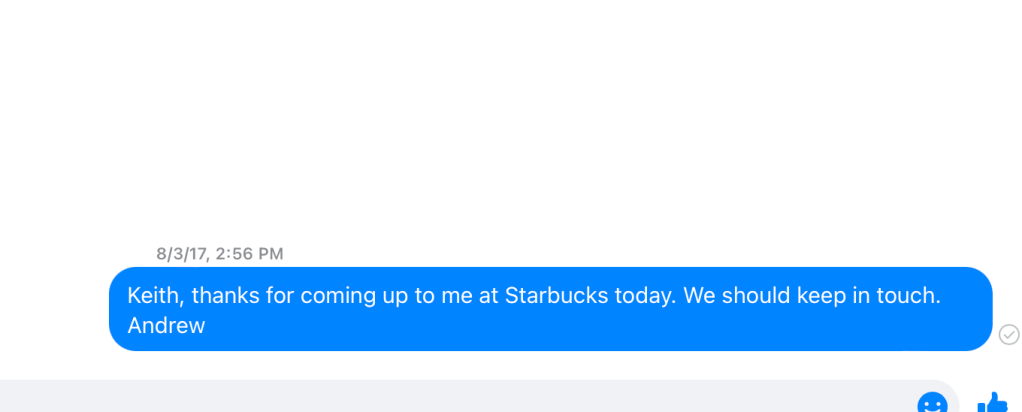
Keith B. came up to me at Starbucks on August 3, 2017.
Cary apologized for “getting pretty boisterous” at MacLeod Ale on April 6, 2015, and how things may have gotten a bit out of hand, and damn if I don’t remember anything about it.
MacLeod’s beer and my intoxication, was another instigator of trouble when I made a joke at the brewery about Sam W.’s “$250 sweater.” He didn’t take offense.
In 2015, just like 2022, and 1994, I was wondering who an agent for my writing might be. An obscure life prepping for a recognized life that will never be.
Producer, director, writer, political activist, and Married to a Millionaire Melissa of Nyack, NY let me know my short stories had no money in it.
Brad sent me a message on October 9, 2013, asking if I knew where Matt was? (Matt was a hustler/model I photographed a few years earlier.)
You must be logged in to post a comment.