Valley Plaza Declared a Nuisance.


Anyone driving past the ugliness and waste that is Valley Plaza has never failed to notice how forlorn it is.  Or maybe it is so bad that nobody notices. Perhaps that explains why only now are the people in power proclaiming it’s time to demolish it.

A classic of mid-20th-century convenience, the one-story buildings, centered around an interior parking lot, once held a variety of affordable places to shop, eat and see movies. You went here to buy sneakers, donuts, corned beef or get your shoes repaired. It was humble and tidy, probably until the 1980s.

The quaint idea of entering a place of business by placing it on the sidewalk, along Laurel Canyon Boulevard, with a storefront and parking in back, was utilized by architects.

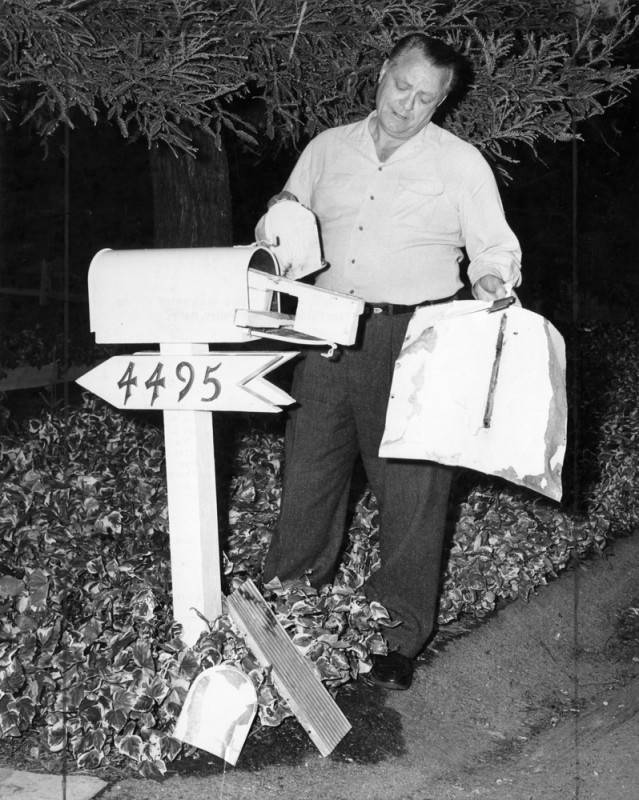
Photograph caption dated April 3, 1957 reads, “At strategic points in the Valley Plaza shopping area are these attractive new signs. Viewing the completed project are, left to right, Norman Caldwell, manager of May Co., Valley; Bob Symonds, realtor; John Hawkins, manager of Sears Valley store; Miss Anita Gordon, honorary mayor of Valley Plaza, and Verne Tullberg, manager Alexander’s Market.” (LAPL/Valley Times)


Photograph caption dated June 14, 1955 reads “Serving first customers at newly opened Schaber’s Cafeteria, 12141 Victory Blvd., Valley Plaza, is E. A. Schaber, owner. In line, from left, are George Thatcher of Occidental Bank; Bob Marsch, vice chairman of Valley Plaza Retail Merchants Association; Pearl Winter, association secetary (sic), and North Hollywood Chamber of Commerce Vice President John Hawkins, manager of Sears. Schaber’s cost $500,000 to build, will seat $350 (sic).” (LAPL)

Then the 1994 earthquake struck and it was downhill for the next 31 years. 

Of course nobody shops in person anymore, nobody enters a store to pay for something, they just walk out with it. And then there was Covid which made it normal to destroy commerce in the name of safety. And then there is safety which doesn’t exist when 100,000 vagrants sleep on the streets and camp out in public to make mockery of anything resembling human dignity, civic pride or law and order. 

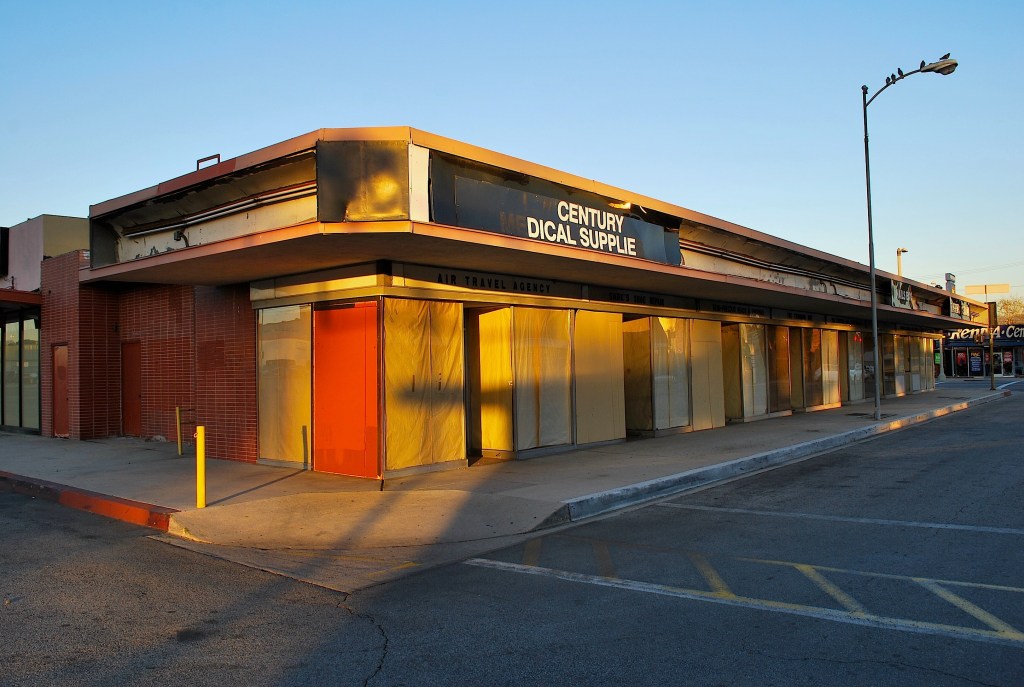
Now the powers that be, the esteemed “Board of Building and Safety Commissioners voted to declare Valley Plaza, a once-popular mall, a public nuisance,” wrote the LA Times on August 19, 2025, nearly 16 years after the photographs at the end of this page were taken.

When it comes to cynicism about how poorly Los Angeles functions, so many big, egregious problems come to mind: Drag racing takeovers, mass shoplifting parties, red light running, speeding, vandalism, arson, burglaries, fires, trash camping, influencer parties in mansions up in the hills, the nightly car chases, the daily shootings, the dumped furniture in the streets, the fuck you every teacher hears in their classroom. 

Valley Plaza, a 17-acre site of wasteful nothingness besides the 170 freeway, is yet another example of an LA non-use of land that might otherwise be a pleasant community of housing, shops, parks, and nature. 

Nobody would come here during the day, nor would they come at night, and why nobody in power, for more than 3 decades, cared for the residents who live nearby is beyond contempt. 

“The empty structures of Valley Plaza are a burden on the city’s police and fire departments, which continually respond to calls, said City Councilmember Adrin Nazarian at a Building and Safety Department Commission hearing Tuesday,” was another quote from the LA Times.

It’s also a burden aesthetically, and functionally, to have dozens of boarded up stores and an empty high rise right next to a freeway. 

Today it’s 102 degrees in North Hollywood and wouldn’t it be nice to go to the Valley Plaza Community Swimming Pool or sit and sip an iced tea at Starbucks Valley Plaza, or go up to your spanking new apartment overlooking the village green at Valley Plaza? And those beautiful, landscaped grounds with so many lovely flowers and noble oak trees, alongside brick walking paths and wooden benches. It’s 2025. Maybe we can look at 18th Century Savannah, Georgia for some futuristic ideas of city planning.

What might it be to have civilization on site for the residents of North Hollywood who live near Laurel Canyon and Victory? We can never know the answer because we live in a syndicate of corruption, filth and double dealing, a malicious playland of bribery, lawsuits, zoning, political espionage and wanton inhumanity.

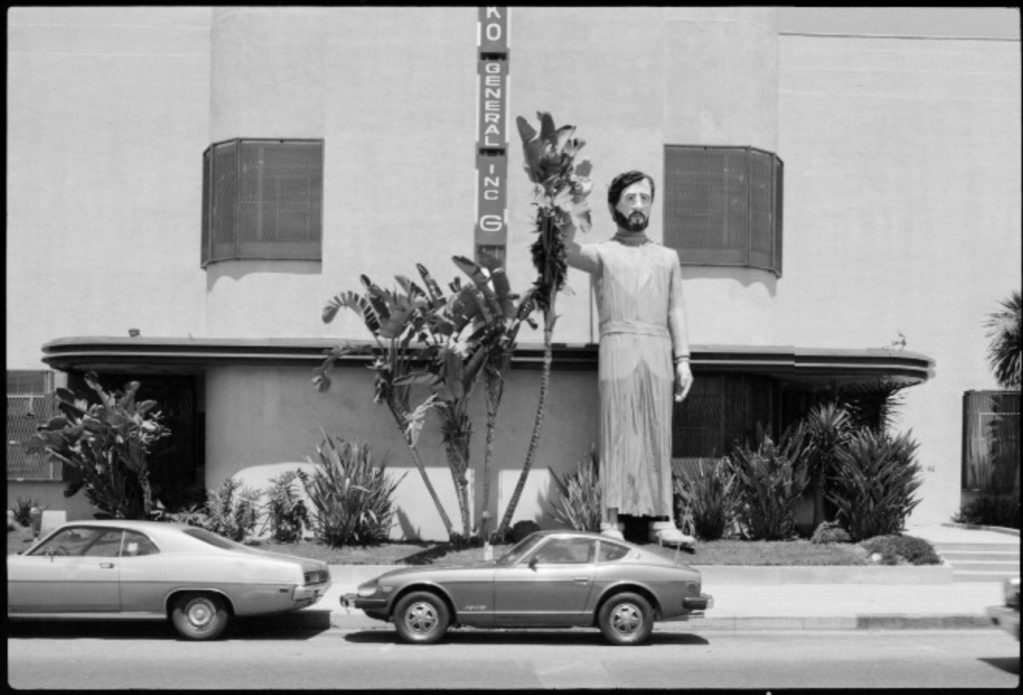
I went there as a curious wanderer on December 23, 2009 to photograph the boarded-up buildings as they closed out another day, unaware that this urban cemetery would still be alive a decade and a half into the future.

December 1956: Disastrous Malibu Fire


As front liners, on foot or flying aircraft, are still fighting the worst fires in Los Angeles history, it is instructive to see that this is the inheritance of living in this region.

In late December 1956, Malibu was ablaze. Many homes were lost. The same aspects we witness today applied: heroism, narrow escapes, families in terror, and brutal conditions of fire fighting.

Though the vast majority of people who lost homes were obscure middle class people, the headlines then, as now, announced celebrities who also suffered property destruction.

Ralph Edwards, TV personality, loses $75,000 beachfront home!”

In 1956, one helicopter was in service, and after the fire, more were purchased. The militarization of fighting fires, and the use of the most advanced technology and highly trained professionals became the norm.

Here are some photos with their original captions found in the archives of the Los Angeles Public Library:

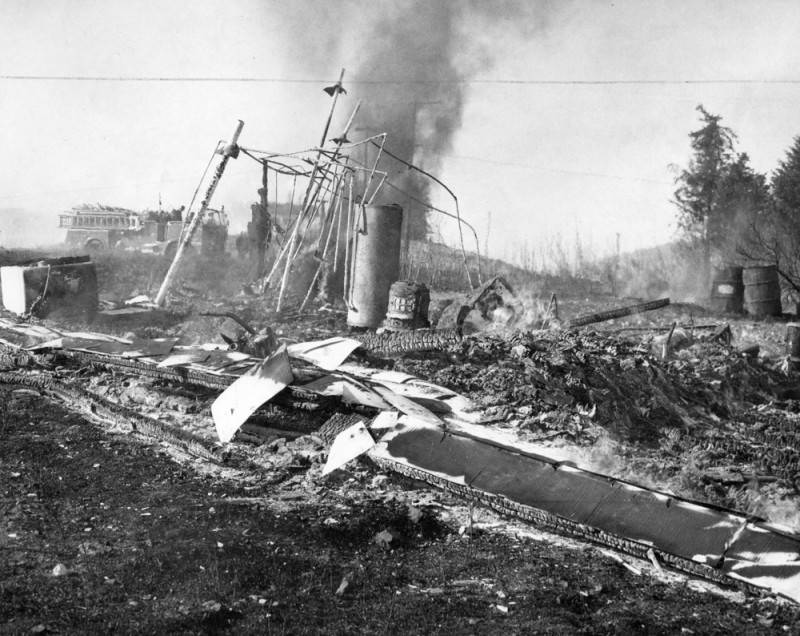
  1. Photograph dated December 26, 1956 shows debris from an unknown structure after the fast-moving mountain blaze burned through the Paradise Cove area in Malibu.
  2. “This is view of fire taken from top of Escondido Canyon looking toward ocean.  Shortly after picture was snapped, flames and smoke rolled down beach burning expensive waterside homes at Paradise Cove and Escondido Beach.  Today, flames are moving north and threaten to jump Mulholland Highway near Lake Malibu.  Army of men and mechanized equipment are massed on this highway in an effort to halt advance of flames over Santa Monica Mountains into plush lake resort area.”
  3. “Volunteer American Red Cross nurse pulls covers up over one sleeping youngster brought into Webster School which was set up as disaster station shortly after flames began threatening resort area near Malibu Beach.  Flames forced more than 1,000 persons to flee for their lives.  Evacuees with only clothes on their backs beat a path to school door to receive lodging and food for night.  Fire officials today fear that school will also be evacuated as flames loomed overhead near Malibu Canyon road.”
  4. Dennis Szigeti looks dazedly at all belongings he managed to salvage from home before it burned to ground in Latigo Canyon drive.  All six of Szigeti’s children were evacuated from home before it was consumed. Szigeti family was luckier than some which had to get out without time to save any of household belongings.”  The article partially reads, “The catastrophic fire which continued to race wildly out of control through the Malibu mountains today threatened to leap over Mulholland Highway near Malibu Lake and burn into the western end of the San Fernando Valley above Calabasas.  The fire has already jumped Mulholland Highway at Decker Canyon and advanced west into Ventura County toward the exclusive Lake Sherwood area.”
  5. “Helmeted John Durbin, 20, volunteer fireman from nearby Thousand Oaks, carries patio chair from plush $32,500 Lake Sherwood home of Mrs. Jean Robison.  Flames fueled by escaping butane gas burned all night.  Hoover home was across road and was first hit by blaze as flames moved inland from Triunfo Ranch, one-quarter mile south of Ventura boulevard near Thousand Oaks.”
  6. “Mrs. Charles Clarke, 5903 Ramirez Canyon, holds her son Billy, 1, closely as she looks up blackened canyon from Paradise Cove.  She, like hundreds of others, became refugee as brush fire inferno swallowed up more than 20,000 acres near beach area.  Her husband brought family to safety and went back to try to save home with help of firemen.”  The article partially reads, “The catastrophic fire which continued to race wildly out of control through the Malibu mountains today threatened to leap over Mulholland Highway near Malibu Lake and burn into the western end of the San Fernando Valley above Calabasas.  The fire has already jumped Mulholland Highway at Decker Canyon and advanced west into Ventura County toward the exclusive Lake Sherwood area.”

“The Malibu fire of December 27, 1956, apparently started on Backus Summit, inland from Zuma Beach. It destroyed 35 homes, killed one person, and injured thirty-three others – both firemen and civilians. Flames shot high enough to be seen from miles away, and the heat was so intense that rocks exploded, and embers and sparks showered down out of the hills across Pacific Coast Highway. Several of the homes destroyed were those of Hollywood personalities, including television’s Ralph Edwards. The Malibu fire was described as the worst Los Angeles County fire since 1938.”

  1. “Fire houses, etc. near Malibu Mountains Inn, Latigo Canyon Rd and Ocean View Drive, at head of Latigo & Ramirez Canyons.”

      2. “Groups of evacuees from S. Rambla Orieta (?) — Mr. and Mrs. Frank Hyatt, left, & Mr. & Mrs. A.W. Rebard, & family”.

      3. “Mrs. Joe Stephens Sr., right, and Red Cross nurse Mrs. Ralph Peterson, left, support Mrs. Nellie Stephens as they carry her to bed in Webster School disaster center. She and other members of family left home at 20641 Malibu Rd. as blaze came dangerously close.”

      4. December 29, 1956 reads: “Skeleton is all that remains of lakeside home belonging to Roy Hoover in Lake Sherwood fire which raced through community. More than 3,000 acres have been reported burned in this area alone. House at time of blaze was occupied by Jack Jones Jr., his wife and their three sons. They all fled to safety. Two firemen suffered injuries while fighting for lake homes.”

      5. “Reporter examines burned-out fire chief’s car”.

      Chinatown in the Rain. Part I.


      Chinatown is particularly poignant in the rain. 

      The old and tired streets are washed in puddles. Pagodas, lanterns and the color red are reflected in asphalt. 

      Everywhere there are old signs, some neon and some plastic, reminding us of families and times from long ago. 

      There are old people with canes, umbrellas and face masks out shopping for hot soup and vegetables.

      And packs of visitors waiting in line for take-out dim sum.

      There are many empty parking lots selling parking spaces for $5 a day.

      A big sign advertises Grandview Gardens, Cantonese Food next to a grass filled lot that might have once contained a restaurant. A history of this place is found online. It closed in 1991. 

      Thirty-three years ago.

      Grandview Gardens: an old sign like a cemetery headstone. Should it not be another restaurant or apartment or apartments over a restaurant? 

      Don’t we have a critical, crying need for housing?

      Everything moves so fast in Los Angeles. We come here young and eager and wake up neither.

      But everything vital and necessary for the humane needs of humanity is tied up in litigation, neglect, bureaucracy, politics and abuse. For years and decades things decline but politicians are always promising the end of homelessness, the end of pedestrians dying in crosswalks, the end of hate, the dawn of tolerance, a new city of walkable, clean, affordable and safe neighborhoods. But I don’t have the funds to move to Vienna, Austria and neither do ten million other Angelenos.

      Yet we drive fast, passing thousands sleeping in tents on garbage filled streets and tell ourselves that everything is normal. Another day of murder, another day of car crashes on the news, another walk through a community that has some thriving businesses and many others dying or dead. Have a smoke, get high, meditate. What else can you do?

      In the civic imagination, Chinatown is one of Los Angeles’s happier places. Nobody thinks ill of it, they long to come this neighborhood, hobbling along in D- condition, months out of a pandemic that still haunts it. 

      City Hall is a ten minute walk away.

      1954: Korean boy adopted by Van Nuys GI


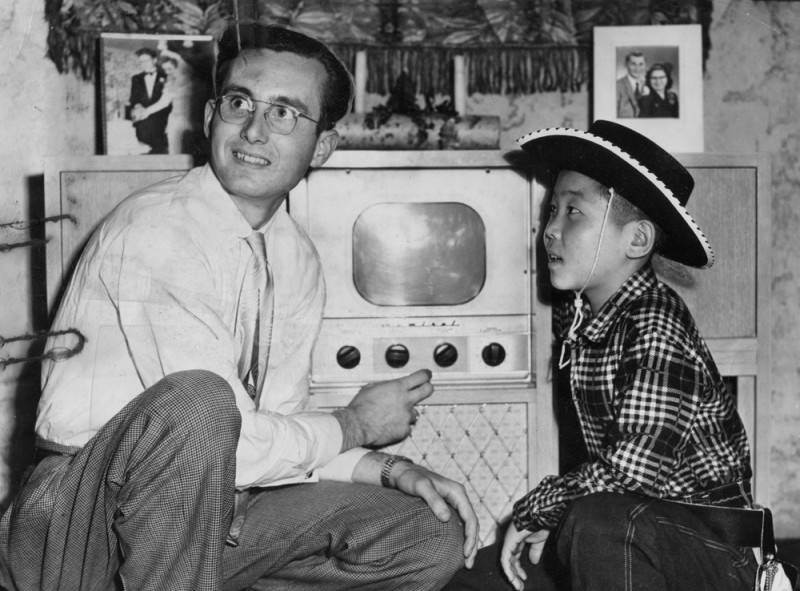
      Photograph caption dated January 6, 1954 reads, “Johnny Vanek, of Van Nuys, turns on Roy Rogers for Kwak Young Chul, Korean orphan whom he met in Seoul while GI and plans to adopt. Youngster is taking rapidly to American ways.” 

      A Proposal to Build Angels Stadium in Van Nuys


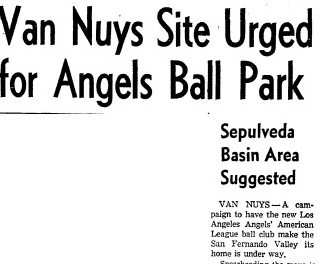
      In December 1960, the Van Nuys Chamber of Commerce thought it would be a grand idea to have the recently conceived American League LA Angels play in a brand new stadium constructed right in Woodley Park Van Nuys. 

      In the heart of flood basin. But conveniently located next to the 405 and the 101.

      They wrote a telegram to club owners Gene Autry and Bob Reynolds imploring them to think about the “level and vacant” 100 acres “available for little or no cost” and adjacent right next to the just completed San Diego Freeway.

      “We expect no local opposition to the plan,” said Nelson LaVally, secretary-manager of the chamber, confident that no families would object to the destruction of their local park.

      There were two city-owned golf courses and a model airplane field. And the rest of the land “was leased out for agricultural use.”

      LA Mayor Norris Poulson (R) supported the idea and liked the idea of a permanent home for the LA Angels in the heart of the largest park, flood zone and bird sanctuary in the San Fernando Valley. 

      Councilman Patrick McGee (R) was also in favor of the idea of building a large 50,000 seat stadium with thousands of parking spaces in the middle of Woodley Park. He had given tours of the Sepulveda Basin a few years earlier to another LA ball club owner.

       “I made the same suggestion to Walter O’Malley and Del Webb and the NY Yankees before the Dodger contract was adopted,” Councilman McGee said. 

      In 1958, McGee had vehemently opposed the Dodgers’ Chavez Ravine project (which displaced hundreds of Latino families) because it did not provide enough revenue to the city and would give oil revenues to a Dodger youth program, “spending public money for private individuals.”

      The councilman thought the hotter valley weather more ideal. Most games would be played at night, and warmer temperatures in the SFV was appealing. Chavez Ravine and Wrigley Field in South LA were “20 degrees cooler”.

      But the Angels ruled out the move. And the city’s Recreation and Park Department had other plans to add more 18-hole golf courses, tennis courts and several baseball diamonds.

      Once again, visionary Van Nuys business minds and politicians came up with a shallow, ill-conceived and brilliantly self-destructive scheme that produced no results.

      A pattern they would follow for the next 60 years. 

      Color photos of Woodley Park: Credit to John Sequeira.

      Toluca Lake and Sherman Oaks in 1948


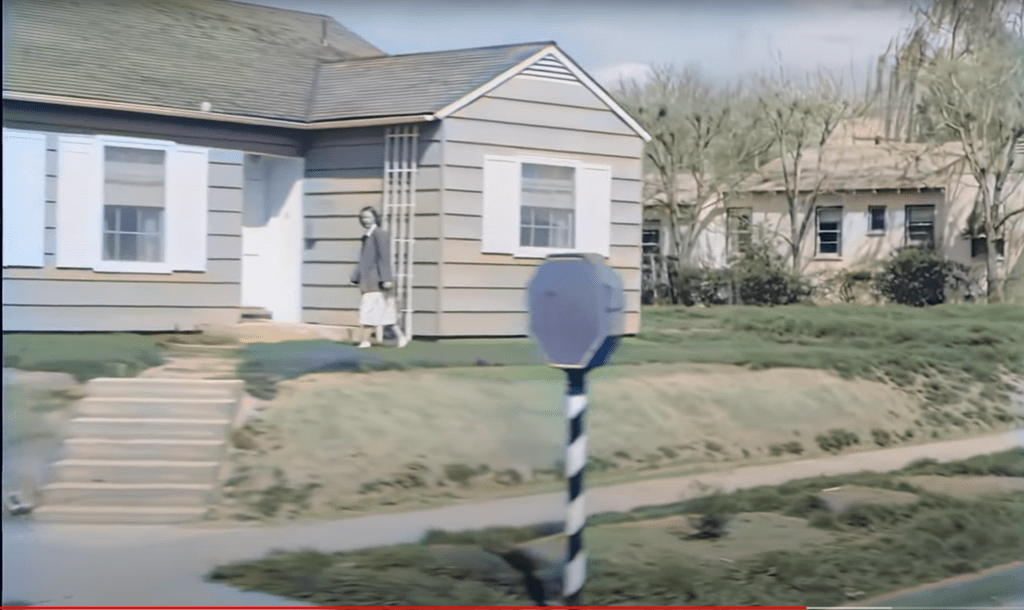
      This is a 1948 colorized video, most likely filmed by a movie studio for projection background footage “process shots” in automobile scenes.

      It was shot in Toluca Lake and Sherman Oaks.

      Toluca Lake was the most comely, gracious and affluent neighborhood in the San Fernando Valley, handily nearby Warner Brothers, Universal and Disney studios.

      Driving along Valley Spring Lane, Navajo and Forman, near the Lakeside Golf Club, the viewer sees an endless procession of estates, tree lined streets, gardeners, people on bikes, thin women in below the knee skirts. There is some open land, still undeveloped.

      The architecture was eclectic, freely borrowing from Spain, France, England into a hybrid Southern California style set along enormous lawns, with flowers, trellises, window boxes, picket or ranch fencing. Cars are few and parked in driveways, occasionally on the street.

      No house is gruesome, ostentatious, unbalanced, grotesque, hostile or ugly. They fit into their surroundings. And even when a Tudor house is next to a Spanish casita both houses seem proper and well-mannered. There are no steel gates, no concrete front yards, no Home Depot vinyl windows sliced into stucco.


      The Sherman Oaks section of the video begins at 4:45 at the corner of Hazeltine and Greenleaf. The footage proceeds west through Beverly Glen, Van Nuys Bl. and Cedros.

      Greenleaf St. in 1948 was a street of small houses, some older Spanish or Mission, some newer ranches. They were embellished with shutters, trellises, neat lawns, shade trees, classical street lights on concrete posts.

      I used Google Maps Street View to try and pick out the homes which were there in 1948. Sadly, most of the houses have been torn down or obliterated with the fads of 60s and 70s, and the gigantism and massiveness that characterize modern Los Angeles.


      Here is my timeline to watch the video:

      Toluca Lake:

      2:27 Valley Spring Ln and Navajo St.

      West on Navajo St.

      Turn left on Forman

      3:30 Valley Spring Ln and Forman

      Turn right, head west on Valley Spring Ln.

      3:54 Ledge Av at Valley Spring Ln.

      4:31 10451 Valley Spring Ln. Spanish house with second floor balcony and rounded tower.

      4:33 Strohm Av at Valley Spring Ln. Corner house is still there but Tudor style wood on facade is gone.

      4:39 10515 Valley Spring Ln. Spanish house with arched front window and arched entrance.

      Sherman Oaks: 

      4:45  14100 Greenleaf St.  at Hazeltine, 4204 Hazeltine background house with shutters and window box. 

      4:51    4203 Hazeltine. Back of house and wooden garage, both still existing in 2022.

      4:58 14101 Greenleaf St. Newly built home. (2/24/48 building permit taken out.)

      5:04. 14115 Greenleaf St.

      5:12  Stansbury Av and Greenleaf St. heading west.

      5:15 4205 Stansbury Av.

      5:32 14223 Greenleaf St

      5:39. 14244 Greenleaf St.

      5:52  14273 Greenleaf St. heading west

      5:55 14279 Greenleaf St.

      6:16 14345 Greenleaf St at Beverly Glen

      6:20 14403 Greenleaf St. at Beverly Glen old mission style house with wide overhangs and trellis.

      6:48 14479 Greenleaf St. corner of Van Nuys Bl.

      6:58  14507 Greenleaf St

      7:02  14519 Greenleaf St

      7:04  14525 Greenleaf St.

      7:05  14529 Greenleaf St trellis over driveway

      7:20.  14567 Greenleaf St

      7:26.  14579 Greenleaf St cor Cedros Av.