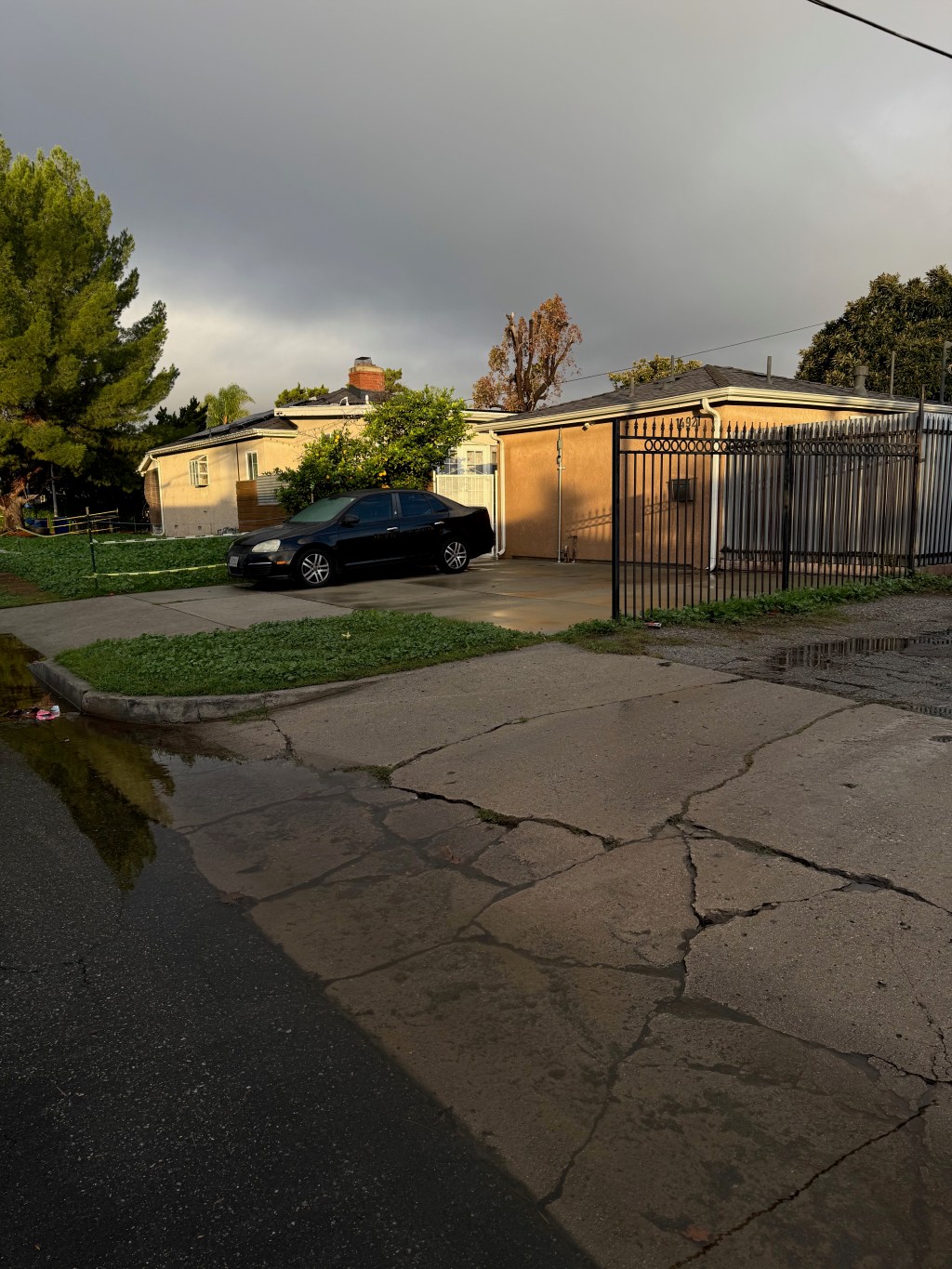
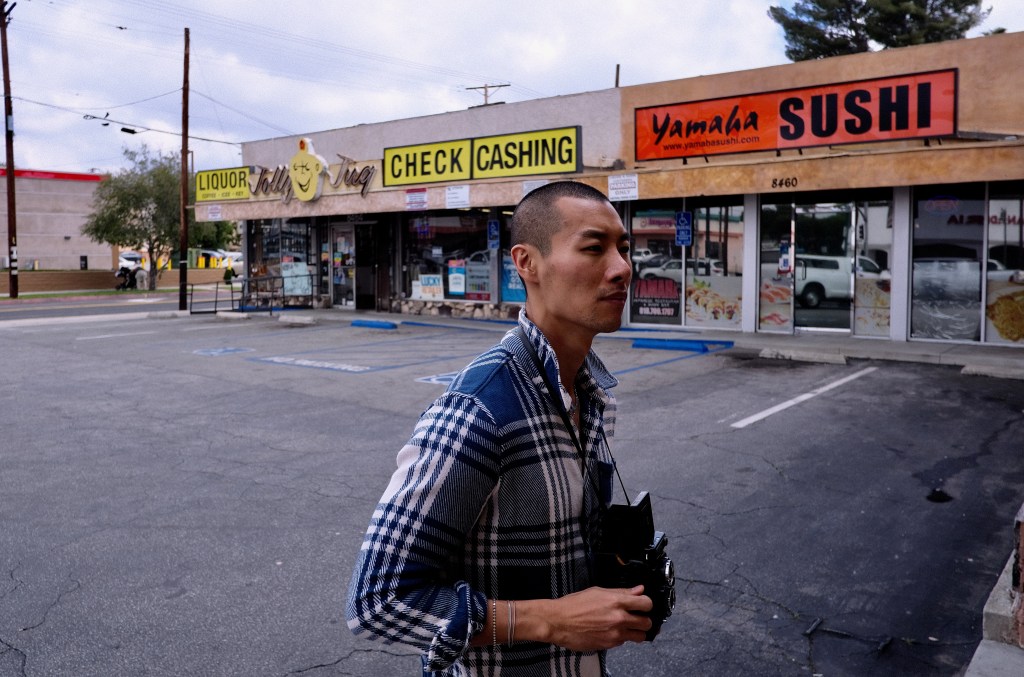
Yesterday seemed like a good day to drive up to Santa Clarita or thereabouts for photos, a destination I hardly visit though it’s only 30 minutes away.
There were dark clouds in the sky which excited me.
My friend and I got on the 405 north, driving next to the vehicles speeding by at 70, 80 and 90 miles per hour.
The freeways intersected, and we got onto the 5, and then exited Magic Mountain Parkway and turned north up The Old Road.
The names sounded magical and mythical and western, and you half expected to meet Wyatt Earp and drive into some town with wooden sidewalks, saloons and horses tied to posts, but all I saw were office buildings, shopping centers, and hills covered in mass housing with stage names; motels, hotels, and industrial parks with white siding on roads and no people. In fact, there were hardly any people anywhere, just cars, trucks, buildings and gray skies.
We drove on, looking for some abandoned bridge over the Santa Clara River, but we never found it.
We looked, in vain, for a vantage point, a scenic rest, a hiking trail. Were there no public lands set aside for hiking or walking or biking or strolling?
Out in the distance, across the Santa Clara River, at the end of the eight-lane wide Commerce Center Drive, crossing under Highway 126, we stopped at Henry Mayo Drive where a “No Trespassing’ sign affixed to a steel fence guarded the riverbed and unusable paved trail. Green hills, yellow flowers, mesas and a panorama of Western Sky, unlawful to enter. A homely trailer park behind by a tall vinyl fence shielded its inhabitants from having to look beyond their entrapped dwellings.
Was this that trailer park that regularly floods during heavy rains? I couldn’t recall.
Not far away was the Chiquita Canyon Landfill, another toxic site in the news, infamous for sickening its neighbors with poisonous fumes.
We had passed many churches along the way, but for such a spirit rich area, the environs seemed godless, a place where powerful ignoramuses in charge of money and land had defiled God’s natural beauty and turned everything into an enterprise of private capital, and failed to erect anything with a soul, an architecture or an emotion.
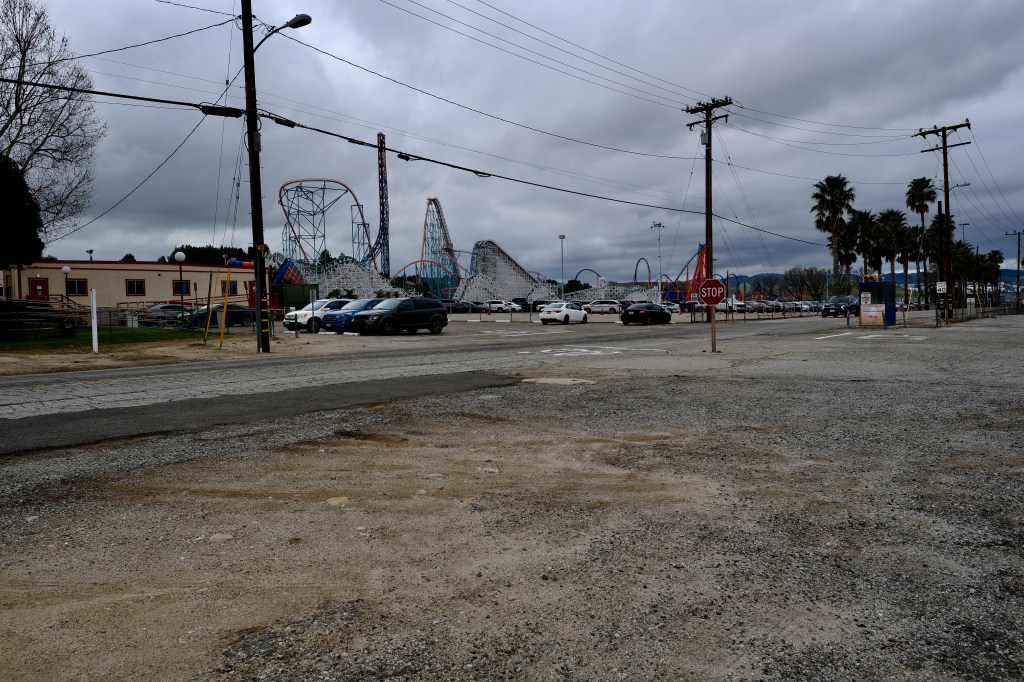
Still looking for a nice photo, we drove into the rear end of Magic Mountain, up an untraveled road that ended at the security entrance of the theme park. A stop sign was marooned in asphalt. More scary signs warned visitors they had to yield to authority and stay off forbidden land. I took some photos from the lot, beyond the property, where nature, somewhat defiled, still reigned, in a bed of trash and abandoned steel parts.
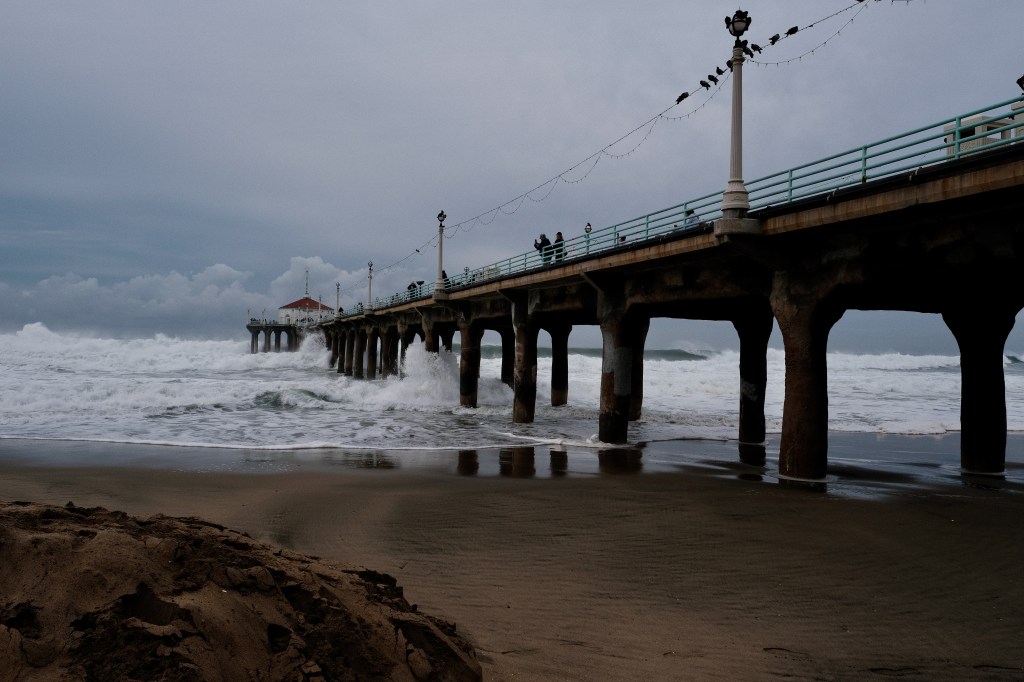
Yesterday, in Manhattan Beach, the low pressure storm that had blown in a few days earlier lingered. Evident in the sky were dark clouds. Visible in the ocean were enormous waves. The sand was wet and filled with debris, for the high tides had come ashore the night before, and soaked everything along the beach.
It was New Year’s Eve, the last day of 2023, a year of personal growth in a world that seemed to be going backward intellectually, morally and ethically. All I could to steady myself was to tune out much of the noise, especially online, and for the first time in decades I didn’t watch the news, and I limited how many opinions I read.
I try and do my best and hope for a positive outcome.
On a few blocks between S. Barrington Avenue and Bundy Drive, north of Olympic Blvd. the streets are dotted with “light industrial” buildings that most likely manufacture digital media.
It’s a flat place, with the oldest buildings dating back to WWII, many parking structures, and a generous amount of architecture, in the Eccentric Faddish style which encompasses everything from steel to wood to concrete and whose only commonality is expensiveness in land, material, rents and value to landowners and tax assessors.
Despite the liberal feeling of the district, everything is guarded, policed, and patrolled. We walked past a building, on the public sidewalk, and a robotic voice ominously announced: “You are being video recorded!”
There are still a few RVs housing unhoused people.
And everywhere there are asphalt parking lots.
You will look in vain for any park, organic garden, or affordable housing. Is this the best we can do? As long as the streets are clean it seems so.
I’ve been a member of the photo site Flickr since about 2005.
During those early years, well before the postage stamp sized galleries of Instagram, I was posting high quality photography.
I made friends on there, I found contacts, I met fellow photographers. Way more people, in fact, who shared my interests.
People would leave “endorsements” on my page, and comment, and you could download high quality photographs from other photographers. Some of these, in fact, I framed and hung in my living room.
It cost about $24.95 to join, and every year, for 13 years, it would renew and I would happily continue the service.
I used it in 2008 to upload many slide images, scanned from my father’s Kodak carousels.
There was a way to organize all of one’s photos in albums and later collections (a number of albums could become a “collection.”)
The interface was somewhat clumsy, with a page called “Organize” where your entire photo collection was stored. You could come here and change the dates on a photo, or place a picture on a map at the exact place you took that photo.
For all these years, the map function has never worked properly.
Last week, for example, I was down in Hermosa Beach, and later I uploaded photos to Flickr, and typed in “Hermosa Beach, CA” and the map came up with “No Results Found.”
The map below shows the last location I used in Zug, Switzerland. When I typed “Hermosa Beach, CA” the map didn’t recognize that location.
Every year since 2018, they’ve increased the price. Even as Flickr has declined in popularity, even as the use of Flickr belongs to the era of Yahoo, MySpace and AOL.
For renewal in September 2023, Flickr sent me an email:
$71.99, a 20% increase from $59.99. And a 188% increase from $24.99 which was the yearly renewal fee as recently as 2018. I know there is a war going on in Ukraine, there are grain shortages, and the pandemic exacerbated oil, housing and raw materials prices. But what raw materials does Flickr use to make its product?
So I have made the decision to end my Flickr subscription next month.
One sweltering day, sometime in July 2012, I left Van Nuys with my camera to escape the 105 degree heat.
I got off the 405 and drove west, towards the ocean, along San Vicente, until I came into a picturesque canyon, shrouded in fog. I parked my car and ventured on foot to photograph the trees and the architecture in cool, refreshing tranquility.
I walked up East Rustic Road where there was, indeed, rusticity in nature and architecture. I stopped on the sidewalk along the street and beheld the glory of clouds coming down from the hills. All around were birds and flowers, fragrance and song.
And then, suddenly, a shrill voice yelled at me, “Why are you photographing mailboxes on this street!”
Dazed, stunned, I was speechless.
Who the hell was screaming at me? I looked around and an old woman came out of a garage of a house.
“I was driving up the street and saw you taking pictures of all the mailboxes! What are you doing here!” she demanded.
Now pissed off that I was being interrogated, and my right to walk and photograph on a public street was being infringed upon; appalled at her lying and false charges; I talked back. I said something like who are you to ask me? Did I need a permit to take a photo? Did I need to ask your permission to photograph a cloud?
“I have a right to know!” she screamed again.
Then an old man (her husband?) came out the front door and yelled, “If you don’t get off our street we are calling the Santa Monica Police!”
Not eager to incite, I walked away.
My beautiful, serene, moment of enjoyment was spoiled by these two irrational people.
I vowed that one day I would come back here and shoot photos again, perhaps some portraits of an actor.
This past weekend, nine years later, I did just that. Without incident.
You must be logged in to post a comment.