The Streets Were Spotless


On Sunday I went to Burbank to take photos of a 25-year-old actor. 

We met at Chili John’s, a “World Famous” landmark, now out-of-business, a spot of streamline slickness with a neon sign, all of its recent Covid signs still intact. Somewhere I had read that preservationists were fighting developers on this site but could not pull up any stories to verify.

It was Burbank so there were no people around, just an empty parking lot, spotless, without litter, tagging or anything vandalized. The rains had washed the skies. In the distance, past Glendale, sharp and clear, stood the eternal San Gabriel Mountains. 

I got there before he did, and I walked along Burbank Boulevard where the cherry trees bloomed, and one specialty liquor store was open for contactless delivery. Through the window, I saw a $24 bottle of Riesling and moved on.

On Sundays, in Burbank, there are always old, spotless cars driving around. I saw a VW Beetle turn right. 

After that notable vehicle sighting, the actor from Springfield, MO appeared. 

He had just taken a Zoom acting class. He had long pandemic locks and beard and was quite chippy and happy with himself as he ran his hand through his hair and made goofy expressions with his face. He took out a guitar, which he doesn’t play, and he soulfully strummed it for our shoot. 

He had a backpack, a wool driving cap, zip up boots, tight pants, overcoat, trim denim shirt. We shot some photos of him along the long white wall where its red painted parking in rear. He talked about his end days Christian friends from Missouri and trimming his chest hair and how he comes from the same town as Brad Pitt.

He said he was happy in Hollywood, happy to meet cool people, happy for people who were signing him up and taking him to Peru for work. I think.

He told me he had access to a super high resolution Blackmagic Production 4k Camera, and if I wanted to use it on some other day I could. 

He left his stuff in the back, behind the store, and we walked up front to the sidewalk. I had no fear any of it would be stolen. But he went back to retrieve it and then rejoined me on the sidewalk where I directed him to slump down into the doorway and look down the street as if he were a tired, exhausted traveler.

We had free reign, with nobody nearby.

There was also no trash, no litter, no fast-food wrappers, no condoms, no homeless, no shopping carts; just an empty place all around, with store windows and shuttered businesses. After two hours, one masked pedestrian walked by.

That Sunday, Burbank was the Los Angeles that once existed, the hygienic wonderland of donuts and burgers and whimsical cars, chlorinated swimming pools, empty sidewalks and freshly washed streets.  It was dead but it was a delight, and somewhere nearby I imagined a crew-cut kid with blonde hair and plaid shirt riding his Schwinn.

When I was done, I drove through North Hollywood and crossed back into chaos, filth and disorder, past an invisible wall between dreams and reality, past and present, Los Angeles and Burbank. 

Around the Neighborhood.


Since the pandemic began, in earnest, last March, one of our routines is the morning walk around our neighborhood.

The fact that most of us live and work at home, self-incarcerated by choice or duty, has produced a strange life. Beside the societal disasters that befell our nation in 2020, the ordinary existence of the citizen is to wander out and wander back in.

Wandering out, in the morning, or when the light is beautiful in the late afternoon, I captured some images of our area with my mobile and edited these on VSCO.

Kester Ridge is basically a 1950s creation of good, solid ranch houses between Victory and Vanowen, Sepulveda and Kester. On Saloma, Lemona, Norwich, Noble, Burnett, Lemay and Archwood the houses have endured, and only a few have been completely demolished or aggrandized. 

But the persistent trend is the ADU, the conversion of garages and backyards to multi-family dwellings. Many of these houses are rentals, and the ones that are owned also rent to others who may live beside the owners.

A few years ago this seemed problematic, and the idea that our backyard behind would sprout a second house four feet from our property line was unimaginable. But now we also have a gray box 4 feet behind us, 30 feet long and 15 feet high and we are OK with it, as long as the dogs, the noise, and the marijuana don’t also move in. 

Meanwhile, the ranch houses, the sidewalks, and the garages without cars stand silently and passively, unaware of their portraits.

Mike Mandel, Photographer, San Fernando Valley, 1970s


________________________________________________________________________

The New Yorker has a photo essay about Mike Mandel, who was born in 1950, studied at CSUN, and made a large body of photography here in the 1970s.

His work reminds me of the people who grew up here during that time, kids who were lucky to live a good life in houses with swimming pools, competent neighborhood schools, low cost college, and the ability to just do nothing, or everything, on foot, on bike, in car. Some are alive today, living in Encino or Woodland Hills or Studio City, inheritors of $2 million houses with $780 a year property taxes. These photos are their youth.

They had a rollicking good time in the past 70 years: getting high, going to concerts, having lots of sex, traveling everywhere and coming back to a freeway and shopping center universe in a city where only making yourself happy was considered the most profound errand in life. 

The late 60s and early 70s was a subversive time with the Vietnam War, racial protests, and the Generation Gap. Anyone under 30 was thought angelic and gifted with great insights into human nature. Anyone over 30 was held responsible for all the hypocrisies and injustices of society.  The Baby Boomers blamed their parents for conformity, environmental ruin, war and segregation. Yet these pissed off kids truly enjoyed a lucky period in the world, partaking of all the freedoms and leaving the bill for future generations.

The late 60s and early 70s imitated the time we live in now with cooler temperatures, unfiltered cigarettes and the insulted assurance that this country and state worked well for white people, and if everyone just got down, baby, and spoke their, like, mind, why, hey man, there was nothing that couldn’t be achieved, like even landing on the moon or dating Jane Fonda.

In the arts it was a time of blunt honesty, just showing things as they were, in music, movies and photography. There was group therapy, of just saying what was on your mind, no matter how embarrassing or crude or cruel. “Bob, Carol, Ted & Alice” captured that quintessential Southern California moment with its wry satire and takedown of the sexual revolution within married couples.

But there is nothing malicious or mean in Mandel’s work. It’s childlike in its openness, sweetness and curiosity.

If you had a camera, and practiced photography professionally, you went out and shot photos of suburbia, of people driving in cars, or you were goofy and put yourself, like Mike Mandel, in the middle of the photo with strangers. You saw the humor in ridiculous juxtapositions of people and environment: the shirtless slab of guy in the butcher shop, the suede coated beauty next to the space laser game, the old lady on her driveway with her boat and garbage can, the double cowboy hatted dude with a box of popcorn next to the bumper cars.

Now these images are a historical record of a lost time. And we value their freedoms, dearly, as we endure temporary incarceration and social isolation during this pandemic. 

1975 Los Angeles by Ed Ruscha


The Getty has 45,856 digitized photographs of Los Angeles by Edward Ruscha.

I went to look at just a part of it, May 1975 (3,724 images). 

There are black and white photographs of entire stretches of streets in our city, for example every structure along Melrose Avenue for miles.

Many who possess far greater insights than I will concoct profundities about these pictures, connecting them to politics or music or the decline of the West.

They will project onto the photos whatever template of modern ideology they wish. 

But I think these photos just are. They are the exact thing they show. And that is what makes them brilliant. For they are the essence of Los Angeles, a homely and free place of ambition and anomie.

There is 3910 Melrose Avenue with a circa 1964 Pontiac parked in front of a 1920s Spanish Style house with arched windows, topiary and a cement walled lawn.

At 7168 Melrose there is a commercial building, with a 1960s decorative screen covering over a 1920s red tiled roof and stucco façade.

Most of the photographs juxtapose car and architecture. That is the recipe. It makes us long for youth, ache for what has passed, and imagine what it might be like to drive a ’74 Camaro down spotless Melrose, listening to a Doobie Brothers 8-Track, and stopping off to pick up a bag of gourmet Brazilian nuts at Iliffili.

Sex was open and advertised in 1975. Cock of the Walk had live sexy males in private rooms. It was next door to Madam’s Cat House with sexy girls in private rooms. If you messed up your clothes you could slip in quickly next door and change into a new pair of old jeans at Hollywood Used Clothing

Bundi’s at 8525 Melrose had stylish looking clothes. Just outside, a bus bench advertises the Jewish funeral services of Malinow Silverman.

Along 8650 Melrose, a 1969 Cadillac convertible, and a 1964 Chevy Impala coupe, are parked on the curb in front of several young, hip stores offering haircutting, needlework, a rock gallery, and Ruthe Lee Richman’s Art in Flowers.

A few doors down, Irving’s Coffee Shop served Pepsi-Cola. What kind of menu did they have ? Imagine your dining choices in 1975 Los Angeles, a 90% white city prior to the mass immigration and cuisines of Vietnamese, Filipino, Burmese, Persian, Haitian, Korean, Guatemalan, Honduran, Brazilian, Malaysian, and Sri Lankan peoples.

Imagine a city where so much was tolerated but where nobody lived under bridges or slept alongside freeways, and bus benches were used by bus riders.

Having trouble sleeping? Stop by International Water Beds. Writing letters to friends? Pick up some custom letterhead at Melrose Stationers. Is your cane chair falling apart? Frank Lew at 706 N. Orange Grove will repair it.

There are a lot of photos to look at. Like everything else these days we compare it to 2020. Even 2019 seems more like 1975 in the take-for-granted-liberties we had before the pandemic. 

And now we close with these lyrics:

Freedom’s just another word for nothin’ left to lose

Nothin’, don’t mean nothin’ hon’ if it ain’t free, no no

And, feelin’ good was easy, Lord, when he sang the blues

You know, feelin’ good was good enough for me

Good enough for me and my Bobby McGee[1]


[1] Kris Kristofferson-songwriter

Janis Joplin-singer

Why You Taking Picture?


A housing and planning blog I read, Granola Shotgun, recently had a post about how the author is hassled for taking photos in public for such elements as parking lots, buildings, encampments or anything structural connected to a human.

In the past 15 years, since I started this blog, I have had similar experiences of being confronted when diligently just recording any exterior anywhere because it captured my imagination.

As recently as March 2020, on the last night I went out to drink at MacLeod Ale, I left the brewery. I was with a friend, who also had a camera. The sun was setting. The light was golden and glorious. I had my Fuji XE3. While walking on Calvert towards Cedros, I started photographing many things that the light was hitting, including the exterior of an auto body shop. 

Several tough, menacing looking men were conversing across from the shop. One yelled at me, “Hey! Why you taking picture?” he said.

I had a few beers so I answered, “Because I want to. I’m not on private property and the sun looks beautiful on that building.”

“What building? What sun? What you talking about?” he answered.

We walked over to Bessemer St. through the trash of a block long homeless encampment, (which I wouldn’t dare shoot) which once would have been illegal and immoral, but is now normal. People living, shitting, drinking, sleeping on the street. By the tens of thousands. OK in Garbageciti.

On Bessemer, as we got into the car, a tinted window Mercedes SUV drove by slowly, eyeing us, letting us know we were under his surveillance. Nothing happened, but we drove away chilled at the implicit threat. 

I write and photograph about the urban condition of my neighborhood. I do it with the intent of telling the truth, not to promote my product or sell a political dogma. A billboard on Kester at the golden hour is just a billboard.

In 2006, I was photographing the exterior of the historic Valley Municipal Building on a Monday morning. An older woman came out, not a security guard, just an older woman, and she screamed, “What are you doing! Why are you shooting this building!” She had a car, and she drove up to me as I walked along Sylvan St. asking again what I was doing. 

 “There are people who want to harm this country!” she said through her window.

Like her. Opponents of constitutionally protected free speech.

Photography is politicized now, like everything else. A public photo in Los Angeles is assumed to be:

  1. ICE finding undocumented people.
  2. TMZ trailing a celebrity.
  3. Location scouting for a porn.
  4. A developer intent on building something.
  5. A Karen uncovering a violation.

Will a photograph ever just be a photograph again? Could Robert Doisneau or Henri-Cartier Bresson shoot children on the street today? Or would they be confronted by parents or teachers or strangers asking what the hell they were doing?

How did it come to be that a joyful, celebratory, observant act, public photography, become so reviled and feared? We live in a time when every person has a camera on their phone, so anyone can really take a photo anywhere at any time, yet the deliberate, artistic, considered flaneur, strolling through the city after a few glasses of wine, can be confronted if he carries a traditional camera and aims it at strangers.

Then there is the aspect of shame. We have no public shame anymore. People dress, eat and behave in ways that would largely be considered shameful by 1945 or 1970 standards.  So shame is employed as a tool by the weak, sometimes used against others who are weak, but often to gather like minded bullies together to defeat free-thinkers.

These examples of 21st C. public dress and obscene signs would have probably been against law or custom 60 years ago. Just as today it would be unthinkable for grown man with a camera going up to a children crossing the street and photographing them, as Henri Cartier Bresson did in Paris 80 years ago.

The public no longer knows what is properly public and what is not.

When private people prohibit public photography, they often think they are exercising the rule of law. Security guards fall into this category. Yet they stand on weak ground. No building, other than a military installation, has the right to not be photographed.

And we live in time of political intention. Every act is political. One can identify with a political party by wearing or not wearing a virus guarding mask, or drinking soda with a plastic straw, living in a gated McMansion, expressing sympathy for the police, or wearing a red baseball cap. All can get you harmed or doxxed.

At the 2017 Woman’s Rights March, I went out with several older neighbors and of course I had my camera. It was a historic moment. And I photographed a crowd near Universal City. Which provoked a young guy, masked in bandana, to walk up and demand to know why I was photographing.

There is nothing illegal about photographing people in publicOr buildings. Even outside a schoolyard, even families picnicking in the park, even photographing a parking lot in a poor area of Van Nuys. These are all legal and protected by law.

But no law protects against widespread public fear of freedom of speech. When enough mobs band together to ban something you can be sure it will be. Photography by photographer is on the list of once free rights that face censoring, cancelling and expulsion. 

Photographing Near the Sepulveda Dam.


Tim Schneider:  Sepulveda Dam

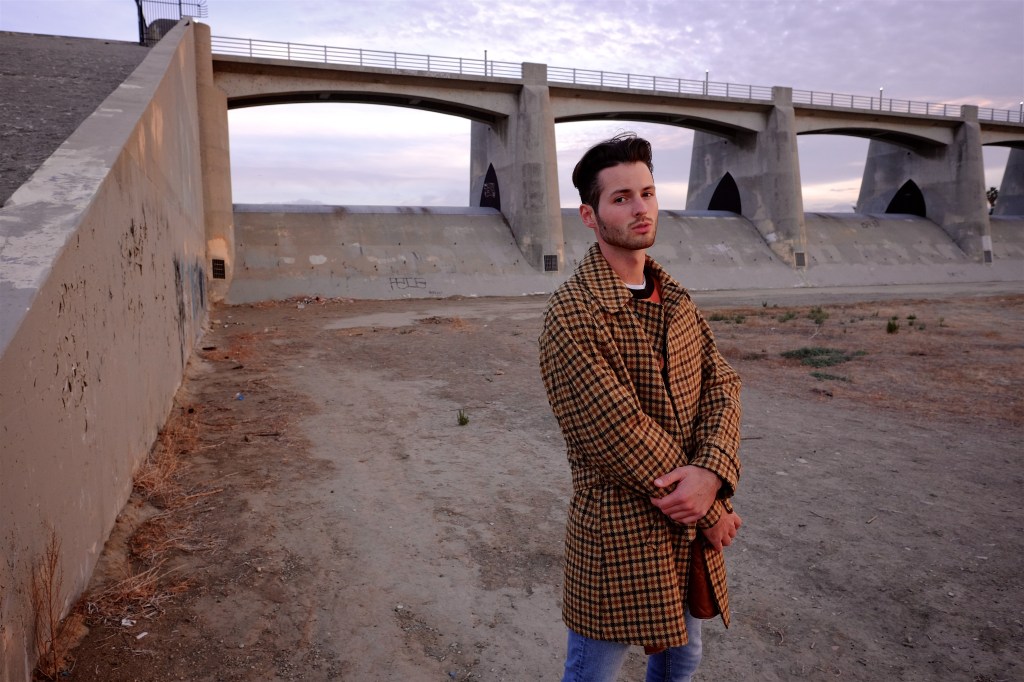
Recently, I photographed Tim near the Sepulveda Dam.

He was visiting North America from Muenster, Germany, spending a few months traveling around from Cuba to Toronto to Chicago. He bought a used van in the Windy City and rode out to California, criss-crossing the country through Illinois, Missouri, Kansas, Colorado, Arizona and finally ending up in California.

Tim was “discovered” one day outside a fashion show in downtown Los Angeles and signed to a small model agency whose owner hired me to photograph Tim.

He was in California tasting wine in the Santa Ynez Valley when a gunman burst into a Pittsburgh synagogue and killed twelve parishioners. I know because we were leaving the winery when a friend of mine from Pittsburgh texted.

Tim was in California, staying at our home, on November 7, 2018 when a gunman opened fire in Thousand Oaks, CA and killed thirteen people at the Borderline Bar and Grill. 

Tim was here for the Woolsey, Hill and Camp Fires and he walked and biked and lived among us under the smoky skies. 

A friend of mine let Tim visit him in San Francisco and the young German arrived in the most polluted city on Earth on Wednesday, November 14, 2018 when you needed a face mask to walk outside and the hazardous air reading was 300 near the Golden Gate, and only 29 in Van Nuys. 

Tim went to the Huntington Gardens, to Pasadena. He rode electric scooters with me in Santa Monica. And one morning I jokingly used Google Translate to wake him behind his closed door with a German woman saying, “Angela Merkel requests you to wake up.”

He came with us to our pot-luck Thanksgiving where we went to three neighbors’ homes for appetizers, wine, beer, the main course and an array of desserts. 

He celebrated our holiday of thanks, of gratitude, of wonderment, for our American blessings.  Blessings often forgotten or wasted or trampled upon by the ungrateful.

Tim Schneider: Sepulveda Dam

Tim worked as a landscaper in Germany so he came into our backyard, inspected our young trees and set about anchoring them in the correct way according to how he had been taught.

Anchoring a tree.

He is a vegetarian, so for almost a month there was no meat, chicken or fish served at home.  One night he fried potatoes and onions just like his grandmother in Schapdetten.

He was neat, polite, punctual, funny, good-natured, and open to advice. He eschewed the crowd thinking of his generation, preferring to use his own mind to navigate his own tastes in music, movies and pop culture. 

Unique to my experience in Los Angeles, he never didn’t show up on time, or fail to keep an appointment. He kept his word. When I brought him to Koreatown to meet a so-called filmmaker with 10,000 followers on Instagram and that person didn’t arrive, or text or email why,  I told Tim that was how people normally behave in this city. If they think there is nothing in it for them they don’t bother to show up.

He had stayed in crappy AIRBNB’s in a $20 a night place with three strangers. He had slept in his van in the parking lot of a Home Depot in Kansas City. He had stayed with someone he met on the road who allowed him to crash in El Monte. And then he was photographed by a hustler who called himself a photographer and never gave Tim photos because Tim kept his honor and his heterosexuality intact. 

The liars and the con-men and the grifters somehow passed over him without harming him.

This was the 20-year-old German man’s first visit to the United States. And he saw how we live, how we treat one another, how we co-exist. 

Often this nation recalls wistfully its battles against fascism and how freedom prevailed in 1945. We love to replay that song over and over again, thinking of the atrocities of the Nazis and how horrible that time was. 

Yet now we have a different kind of improvisational cruelty in the United States that happens suddenly with violent surprise. We think we are better, yet we tear gas women and children fleeing violence at the border and think we are defending our nation by keeping 5-year-olds separated from their parents.   We go on, living our lives, after random shootings, after walking past homeless people sleeping on the street, and play Christmas songs in the car while others pick food out of the alley dumpsters.

And now a young German man visits and reminds me of what civilized behavior and expectations are. And how sorely lacking in those we are in the City of Angels. But what can I do to correct that? We are what we are as the American Nation.

So I go back to photography, and writing, and lamentations.

Tim Schneider: Sepulveda Dam

Sometimes our city shows off a side of its environment that is at once sublime, cinematic, and, perhaps lonely in its vast arid spaces. Sometimes something noble sprouts up in the ground and manifests its greatness before your eyes like the old Sepulveda Dam with its repeating arches and graceful artfulness. 

And sometimes, a friend is made out of the most unlikely of strange and wondrous coincidences, because they showed up at your house, and you took them in, treated them with respect and kindness, and reaped some reward of brotherhood and international understanding and even love.

Last week, before he left town, before the rain came, we hiked over to the Sepulveda Dam before sunset to capture the late afternoon light.

And then the next day, at Burbank Airport, we said goodbye.