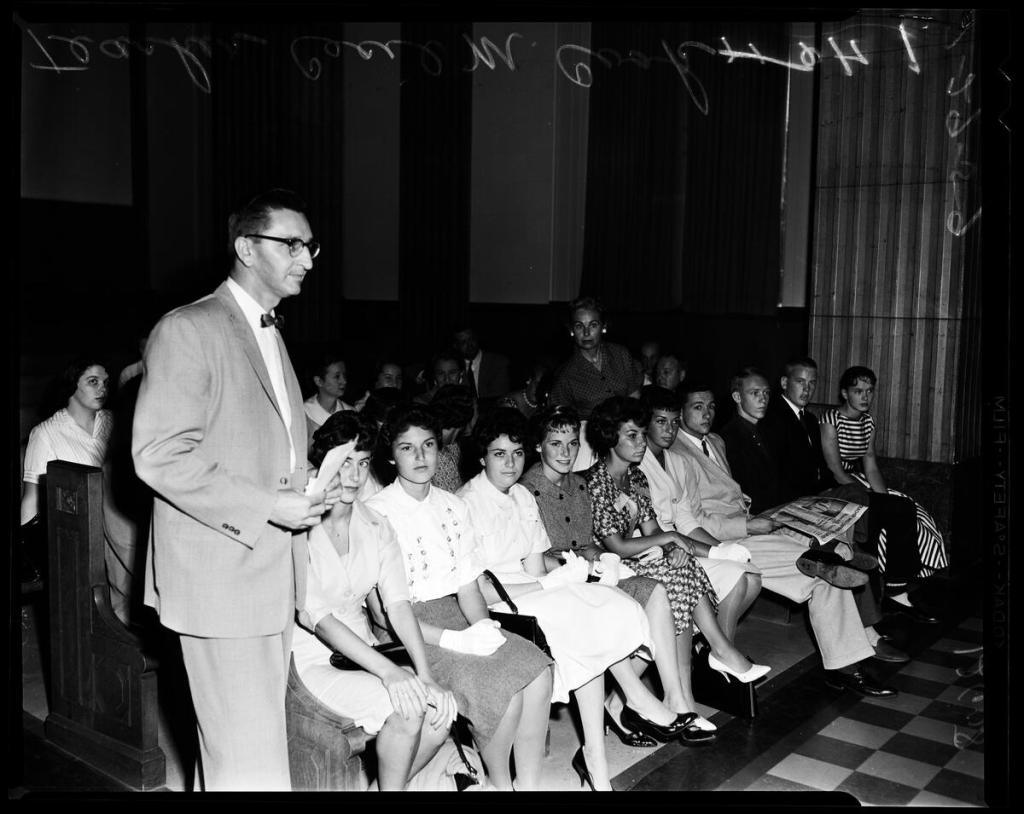
I came across these photographs of a public hearing with parents, students, teachers and community leaders who were gathered to talk about the introduction of sex education at Van Nuys High School in the summer of 1959.
The photos were taken by a photographer for the Los Angeles Herald Examiner and featured in stories about these meetings.
Men in suits, women in tailored skirts, dresses, and jackets, and young men and women smiling, conversing, socializing all under civilized and orderly processes.
Educators were trusted, parents were thought to know better than youngsters. All of this would be overturned in the coming decade.
This was the America we all knew back then, the America that showed the world what democratic debate and public behavior was all about. This was a gathering to talk, listen and expound upon the proper educational methods for the teaching of human reproduction.
Look at it, think of our current lunacy, and weep.
Title Teacher hearing on sex instruction at Van Nuys school, 1959
2 images. Teacher hearing on sex instruction at Van Nuys school, 28 July 1959. Charles H. Bobby; John Fox; Lowell McGinnis; Diane Asness — 16 years; Cecil M. Cook (teacher); Clair Eberhard; Bonnie Gottleib — 16 years.; Caption slip reads: “Photographer: Snow. Date: 1959-07-28. Reporter: Slates. ASsignment: Teacher hearing. 3-4: L/R Diane Asness, 16; Cecil M. Cook; Clair Eberhard; Bonnie Gottlieb, 16. 51-52: L/R Charles H. Bobby; John G. Fox; Lowell McGinnis”.
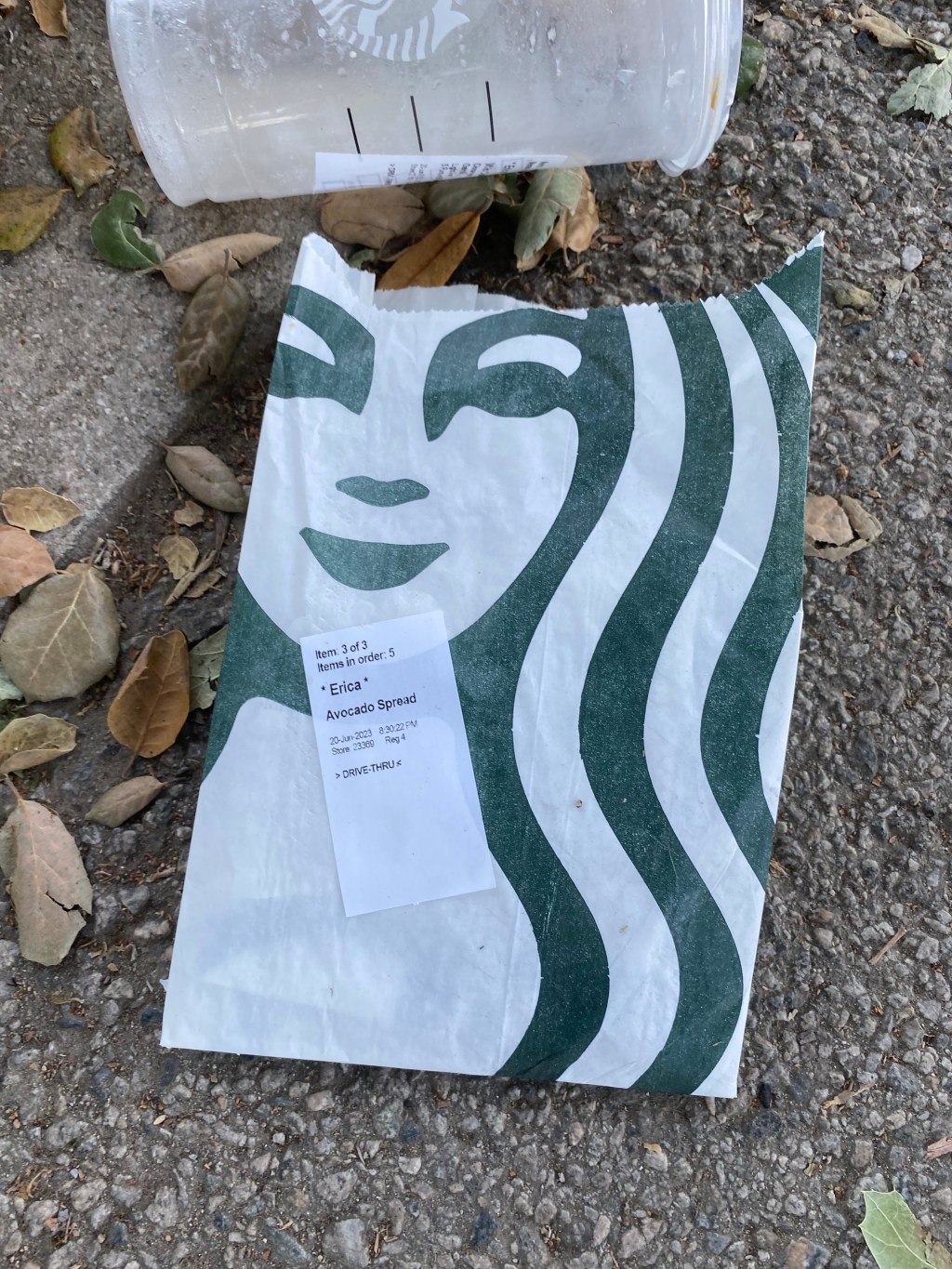
Last night, around 8:30 PM, Erica picked up her Avocado Spread and two drinks from a Starbucks Drive-Thru (6833 Van Nuys Blvd, Van Nuys, CA 91405). Store #23369.
Then she (or they, meaning two persons in the traditional sense of the word) drove to the 15000 Block of Hamlin Street, parked her vehicle, and devoured (her/their) meal.
When (she/they) were done (she/they) threw everything out of (her/their) car, and left (her/their) mess on the street where (she/they) had parked under the exquisite oak trees and had enjoyed a quiet dinner in the peaceful shade of dusk.
(She/they) are, unfortunately, typical of Van Nuys.
These are also the people who speed through red lights, who play their music at full blast in their car, who also steal packages from front porches, and for many people these are our friends, families and neighbors.
Do I care if these people are any particular ethnic group or wounded victim group? Does their identity matter?
Not in the least. Because identity is not a matter of character. You are born with identity but you learn character. I just care that people I live near destroy my surroundings with their ignorant selfishness.
There is no elected leader, no parent, no law enforcement person who can police this kind of selfish behavior.
It is purely a matter of individual conscience and character.
Many of us who care deeply about education in the humanities can only feel despair at the state of our institutions of “higher” learning. Enrollment in these subjects is plummeting, and students who take literature and history classes often come in with rudimentary ideas about the disciplines. Interviewed in a recent New Yorker article, Prof. James Shapiro of Columbia said teaching “Middlemarch” to today’s college students is like landing a 747 on a rural airstrip. Technology such as messaging apps, digital crib sheets and ChatGPT, which will write essays on demand, has created a culture of casual cheating.
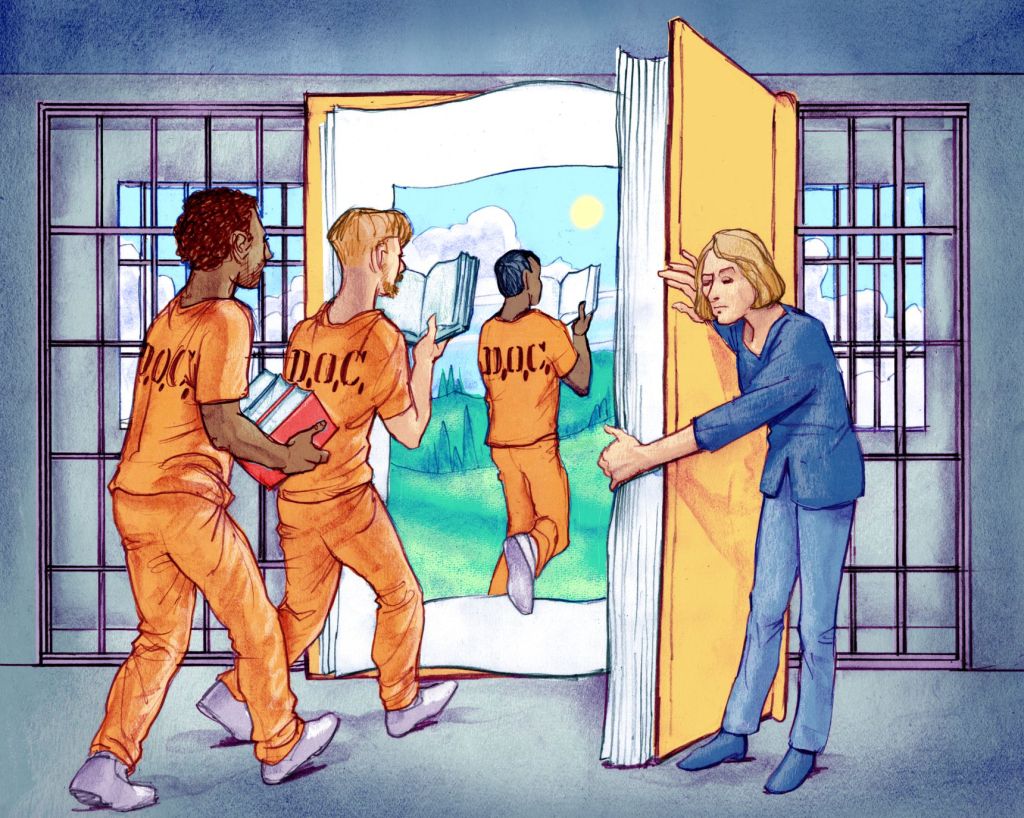
Never have I been more grateful to teach where I do: at a men’s maximum-security prison. My students there, enrolled in a for-credit college program, provide a sharp contrast with contemporary undergraduates. These men are highly motivated and hard-working. They tend to read each assignment two or three times before coming to class and take notes as well. Some of them have been incarcerated for 20 or 30 years and have been reading books all that time. They would hold their own in any graduate seminar. That they have had rough experiences out in the real world means they are less liable to fall prey to facile ideologies. A large proportion of them are black and Latino, and while they may not like David Hume’s or Thomas Jefferson’s ideas on race, they want to read those authors anyway. They want, in short, to be a part of the centuries-long conversation that makes up our civilization. The classes are often the most interesting part of these men’s prison lives. In some cases, they are the only interesting part.
Best of all from my selfish point of view as an educator, these students have no access to cellphones or the internet. Cyber-cheating, even assuming they wanted to indulge in it, is impossible. But more important, they have retained their attention spans, while those of modern college students have been destroyed by their dependence on smartphones. My friends who teach at Harvard tell me administrators have advised them to change topics or activities several times in each class meeting because the students simply can’t focus for that long.
My students at the prison sit through a 21⁄2-hour class without any loss of focus. They don’t yawn or take bathroom breaks. I have taught classes on the Enlightenment, the Renaissance, Romanticism, George Orwell, South Asian fiction. We’ve done seminars on Adam Smith and Alexis de Tocqueville. Together we have read Montaigne, Rousseau, Keats, Erasmus, Locke, Montesquieu, Wollstonecraft, Byron, Goethe, Petrarch, Rabelais, Saadat Hasan Manto, Rohinton Mistry. The students write essays in longhand; during the pandemic I taught a correspondence class via snail mail. Some of them do read “Middlemarch,” and their teacher finds the experience far more gratifying than trying to land a 747 on a rural airstrip. We encourage them to treat different societies in history as experiments in time travel, where they try to understand the mores of particular eras as though from the inside. They are very open to that approach, unlike university students, who tend see the past only as one long undifferentiated era of grievous unenlightenment: not just one damn thing after another, but one damn oppressive thing after another.
Like students at elite institutions, most of my incarcerated scholars are politically liberal. Unlike them, many are religious, and that proves surprisingly enriching in studying these authors, who would have been amazed to know they would one day be read by classrooms full of atheists. One of my more devout students, a Protestant who converted to Islam, was so distressed by Voltaire’s disrespect for established creeds that he had to be comforted by other class members. They informed him that he was exactly the sort of person Voltaire was aiming his polemic at, and therefore he could understand the force of it in a way his irreligious peers couldn’t.
My hours at the prison are rich in such moments. In many ways, it is the Platonic ideal of teaching, what teaching once was. No faculty meetings, no soul-deadening committee work, no bloated and overbearing administration. No electronics, no students whining about grades. Quite a few of our students are serving life sentences and will never be able to make use of their hard-won college credits. No student debt, no ideological intolerance, no religious tests— whoops, I mean mandatory “diversity” statements. And in our courteous, laughter-filled classroom there is none of the “toxic environment” that my friends in the academy complain about, and that I experienced during my own college teaching career.
If prison inmates, many of whom have committed violent crimes, can pay close attention for a couple of hours, put aside their political and personal differences, support one another’s academic efforts, write eloquent essays without the aid of technology and get through a school year without cheating, is it too much to ask university students to do the same? Or ask professors to try to create an atmosphere where these habits can prevail? Perhaps prison education can serve as a model of how to return to true learning and intellectual exchange.
Ms. Allen reviews books and film for the Hudson Review, the New Criterion and other publications.
Appeared in the March 6, 2023, print edition as ‘College Should Be More Like Prison’.
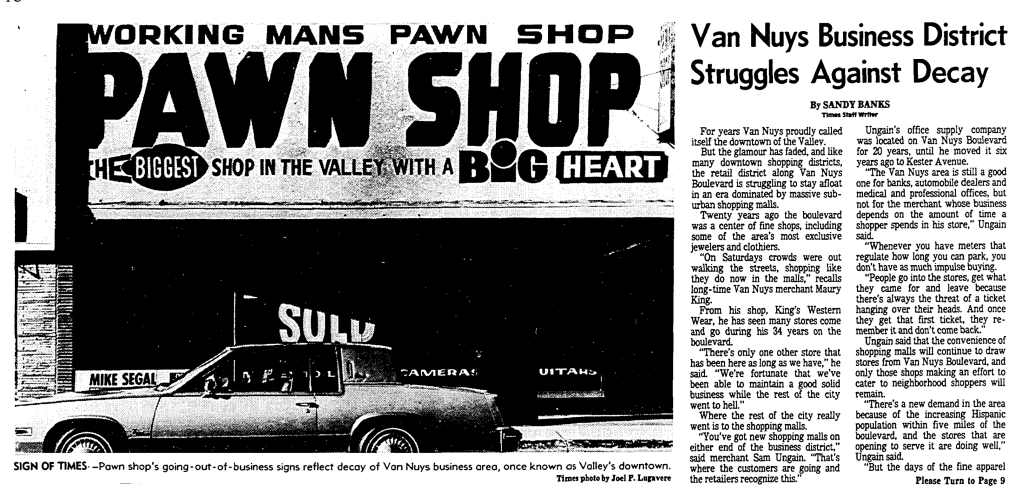
43 years ago the situation of the Van Nuys Business District was quite abysmal. The good shops had closed down and the street was full of bail bonds and pawn shops. Merchants complained about street racing, and the negative affects of parking meters which discouraged shoppers from spending more time in stores.
On Wednesday nights the street came alive as thousands converged to watch cruise nights. But the crowds blocked streets and left behind trash. The businesses didn’t like it.
In 1977, “Vitalize Van Nuys” began, a privately financed, community-based redevelopment organization. It sought to revitalize businesses, generate more employment and upgrade the surrounding residential community.
34-year-old Bruce Ackerman operated the Greater Van Nuys Chamber of Commerce after working with the San Fernando Chamber of Commerce. He promoted a resurgence of retail.
“Van Nuys really hit rock bottom in 1977,” recalled Dick Lithgow of Agency Insurance.
There were 23 massage parlors back then.
Hopeful signs in 1979 included a $14 million dollar government complex with new courthouses, post office and police station. There were also new studies forecasting “a tremendous demand for office space in Van Nuys.”
Legitimate businesses such as Nahas Department Store complained that vagrants harassed customers in the parking lot.
Owner Richard Smith said the neighborhood was increasingly elderly and Hispanic. “We were concerned with the growth of the barrio around 1975-76, but that has not caused any problems for us,” he said.
Another positive sign for Van Nuys in 1979 was the 100 businesses that had spent more than $4 million dollars ($4,000 per business) upgrading their properties.
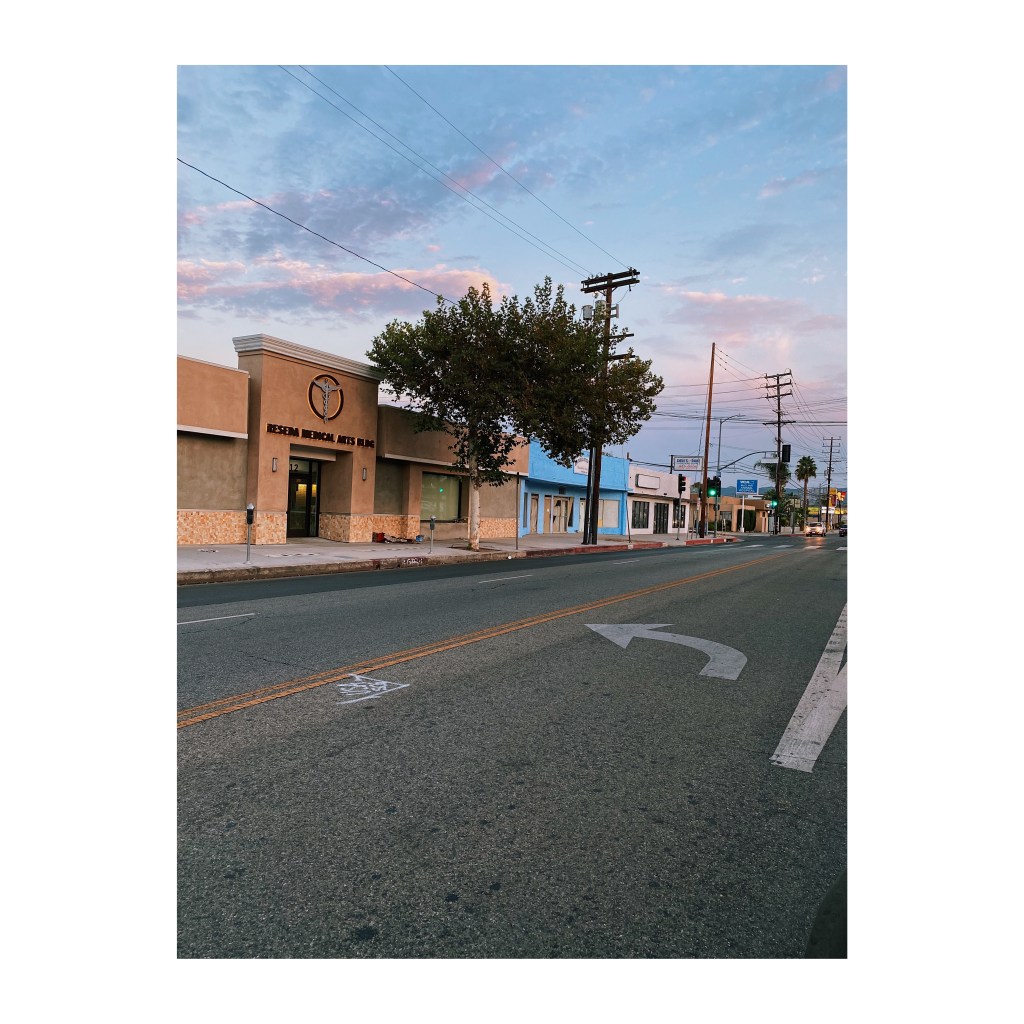
In 2022, it is hard to imagine the challenges Van Nuys faced in 1979.
Fortunately, those far sighted visionaries gave us a truly spectacular urban boulevard we can all be proud of: clean, safe, thriving, walkable, architecturally magnificent, the jewel of the San Fernando Valley.
Thank you especially goes to Councilwoman Nury Martinez and Mayor Eric Garcetti for their leadership!
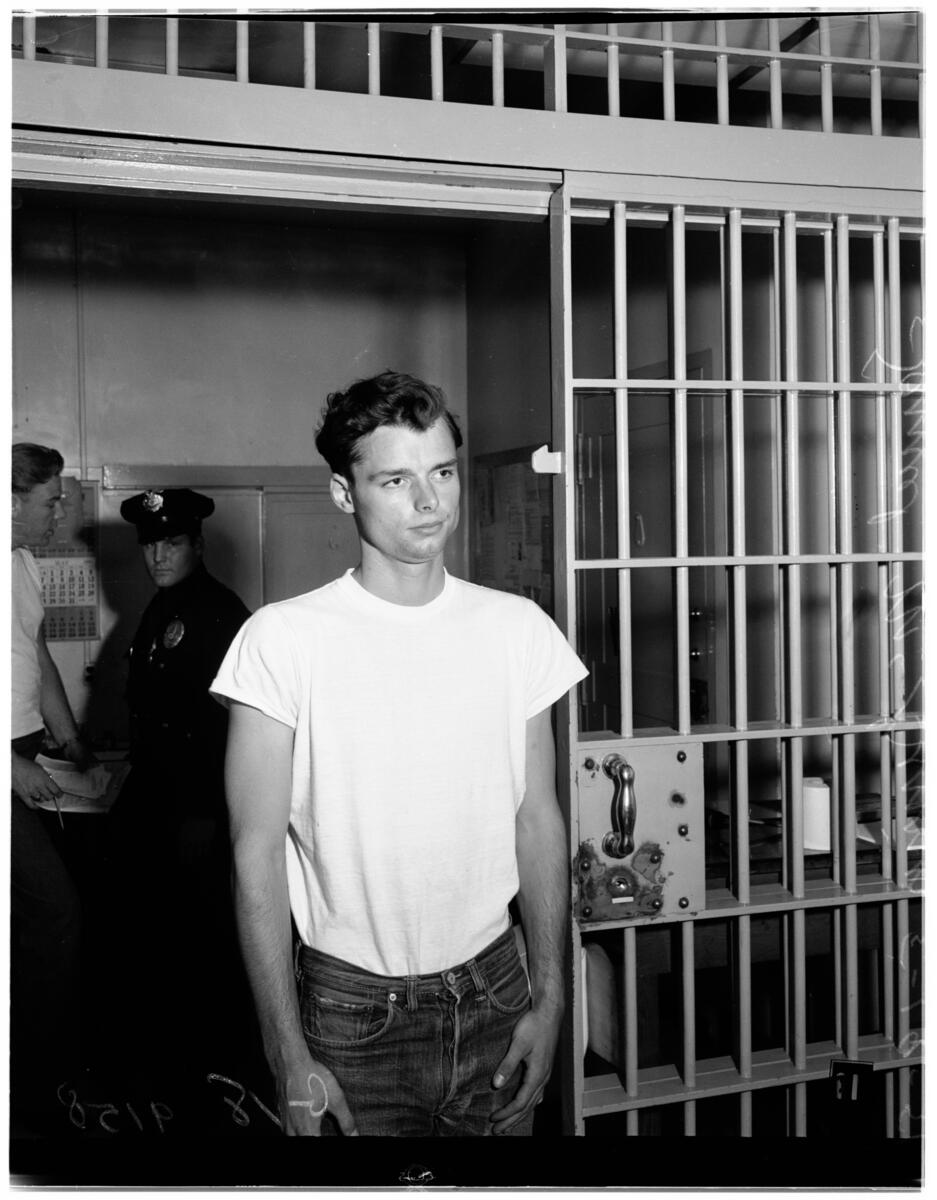
On May 19, 1951 there was a holdup of a grocery store on Burbank and Van Nuys Bl.
The robbers were caught, booked and taken up the street to the jail in the Valley Municipal Building.
Two of the three suspects are pictured here, and are quite a handsome bunch: Samuel McGinnis; Charles Gordon; John Maroney.
John Maroney wears a tight white t-shirt tucked into unbelted jeans. Curly haired, brown-eyed, lean bodied, he had engaged in something stupid and could not have known how lucky he was to live in a time when the best selvedge loomed jeans were $3 and made in America. He could have worked as a house painter and bought a nice little ranch house around the corner with $500 down. He also wore his leather bomber jacket ($15?) in another photo.
His buddy (McGinnis?) is also a nice looking red haired guy in a wool camp shirt, finely tailored and elegant for an afternoon of armed robbery in Van Nuys. He looks almost like the son of the cop handcuffing him.
Source Los Angeles Examiner Negatives Collection, 1950-1961 (subcollection), Los Angeles Examiner Photographs Collection, 1920-1961 (collection), University of Southern California (contributing entity)
You must be logged in to post a comment.