New York’s Revival and LA’s Future.


New York City: 1983

In a recent post about why the LA Times is underachieving its readership and investors, John Stodder asks if the problem lies not with the paper, but with the city of Los Angeles itself:

“Something’s gone out of Los Angeles — confidence, a sense of identity, a belief in the future. A thriving newspaper is, at some level, a product of boosterism. Los Angeles has a lot of paid advocates, but few boosters. That’s a big change, historically.

Los Angeles has had a tough couple of decades since the triumph of the 1984 Olympic Games. Once upon a time, we accepted progress as a given. Nowadays, we accept decline and the intractability of our problems. Schools, traffic, housing costs, the environment — who is telling us these things can get better? Well, sure, lots of people say so, especially when there’s an election coming up. But who really believes?”
++++++++++++++++++++++++++++++++++++++++++++++++++++++++++++++++++++++++++++++

But how horrible are things in LA anyway? Is the situation so dire and awful?

In the 1970’s and 80’s, New York City was in decline as Los Angeles is today. The New York Times sat in the midst of a slum called “Times Square” and said absolutely nothing about the appalling condition of the district which it gave birth to. Newspapers do not take a lead in cleaning up a city, nor should they become “boosters” of the area that they serve. Their job is to report the events around them in an objective and realistic way. If the Times becomes the biggest megaphone lauding a revival of Los Angeles, then it will cease to be a credible newspaper.

However, Mr. Stodder is dead on correct in stating that this city lacks a confidence and vision. The events of life here seem to take place in a fun house of extremes: either people shooting each other in the street or the red carpet premiere. We see men and women eating out of garbage cans on Ventura Boulevard as $80,000 SUV’s plow down the street. There is great cruelty in Los Angeles. Yet 40 or 50 years ago, it was a progressive city with fantastic schools, a growing economy and a sense that it was leading the world in technology, music, and something called leisure time.

But look at the 1983 photos of New York City. Is LA that bad? If they can pull themselves back up from the bottom……..

European Thoughts.


PHOTOS: Amsterdam on carfree.com

We have heard enough news from Europe in these past few weeks to understand that their society is not utopian. Cradle to grave welfare and subsidized health insurance are buckling under the weight of aging societies and declining birth rates. The Islamic revival in Europe is neither religious nor a revival but fascism under a new banner. Yet even in the tense and crowded landscape of the Old World, there are architectural and transportation forms to admire. And even wonder if they might be transplanted to Los Angeles……

THE SMALL PARK

Why do parks in Los Angeles have to be so huge? Griffith Park is enormous, and Balboa Park in the SF Valley is oversized and amorphous. In European cities, one often sees small green spaces surrounded by low rise apartments. Why can’t Van Nuys have some small parks with five story townhomes on all four sides? As Jane Jacobs once explained, parks are successful not based on what they are, but what is around them. If you put them in the midst of freeways surrounded by industry, how can that park be a pleasant place? Think of how LA destroyed many of the nicest parks in the Valley when the 170 rammed its hideous concrete through the green spaces in the early 1960s. Some of the monstrous parking lots along Sherman Way or along the perimeter of Valley College might serve as pocket parks with townhouses and pedestrian oriented uses around them.

CLASSICAL ARCHITECTURE

The proportions of some of our new buildings are crude and splattered with plastic ornament. Geometry, balance, context, elegance…they are absent in about 90% of LA’s new ‘condos’. A drive around the Valley is a horror show of cinderblock stucco palaces perched atop parking garages with $29 Home Depot lights. Why are new buildings so mediocre? Quality has been replaced by “luxury” but what luxury is there without integrity? Observing how Europe built and continues to build could instruct Americans who are still overflowing with (to quote Mencken) a “libido for ugliness”.

BIKING TO WORK

The Busway is a fantastic step ahead in our thinking because it integrates landscaping, public transportation and the bike lane. There should be even more protected bike lanes around Los Angeles that are shielded from vehicular traffic. A painted line on the side of a ten lane boulevard is not a safe place to bike.

One radical idea would be to convert the aged 110 freeway from South Pasadena to Downtown LA to a permanent bike route. The highway is unsafe for cars with its outmoded design, but it is perfectly suited to bike riders because of its relatively short length and thrilling curves.

MINI MALL APARTMENTS

The pock marked, cancerous clone “mini-mall” has disfigured this city for the last 25 years with garish signs, too few parking spaces and the disappearance of the “street wall”. These one story, plastic signed atrocities should be torn down and replaced with five-ten story corner apartment buildings with underground parking and pedestrian sidewalk retail activity.

THE AMBASSADOR

Last month, they tore down a historic landmark, one of the oldest and loveliest hotels in the United States. It represented the last vestige of a gracious and dignified city. One that lived a balance between work and leisure, where people dressed up for dancing and dining.

Imagine if Paris knocked down the Hotel de Crillon or London leveled The Dorchester. Great cities preserve great buildings.

The Ambassador was shut down for many years, but the impoverished city of Geffen, Cruise, Spielberg and Hanks (director of “That Thing You Do”, filmed at the late hotel) could have pulled $200 million dollars together to refurbish and preserve it for posterity. There were other places to build a new school. It didn’t require the demolition of a beloved landmark.

We can tell ourselves that the world envies our nation, but maybe they are just watching us in amazement: fools dancing ourselves to death in pursuit of nothing.

$7 Billion for Big Oil. Zero for Hurricane Homeless.


February 14, 2006
Government May Waive Near $7 Bln in Oil, Gas Royalties: Report
By REUTERS

Filed at 2:08 a.m. EST

NEW YORK (Reuters) – The government may waive up to $7 billion in royalty payments from companies pumping oil and natural gas on federal territory in the next five years, the New York Times reported on Tuesday, citing administration officials and budget documents.

The royalty relief would amount to one of the biggest giveaways of oil and gas in U.S. history, even though the administration assumes oil prices will remain above $50 a barrel throughout that period, the Times report said.
++++++++++++++++++++++++++++++++++++++++++++++++++++++++++++++++++
Storm Victims to Get Money but no Hotels.
By THE ASSOCIATED PRESS

Filed at 6:53 a.m. ET

NEW ORLEANS (AP) — About 12,000 families made homeless by last year’s hurricanes began checking out of their federally funded hotel rooms around the country Monday after a federal judge let FEMA stop paying directly for their stays.

The Federal Emergency Management Agency promised the evacuees from Hurricanes Katrina and Rita that they will still receive federal rent assistance that they can put toward hotel stays or other housing. But the agency will no longer pay for their hotel rooms directly.

Latin color.


Mexican images (top 3): J Pride

Kester Avenue (bottom 2): hereinvannuys

In Central and Latin America many buildings are colorful and joyous. The entire spectrum is used, and the result is that people live among works of art. Many of the communities are not rich, but life is lived more richly.

By contrast, a lot of sunny Los Angeles is miserably gloomy and colorless. There are exceptions in certain neighborhoods like Silver Lake and East Los Angeles.

But the Valley carries the dull, pale stamp of the Eisenhower years when much of this smoggy bowl was over-developed. Burbank is a classic example of an area where a fear of strong hues (on stucco and skin) keeps the housing stock safely bland. Here in Van Nuys, along Kester Street and many, many other streets, 1955 lives on….the facades are beige and tan and off white–or whatever is considered least offensive. In the land of the free, we are imprisoned by a lack of imagination in our environment.

Dunn-Edwards should pay painters to come and redo these drab buildings in vivid shades. “Pinte su casa. Pagaremos a pintor.” It would be a community service that might earn the venerable paint company the respect of thousands who wait outside their doors every morning hoping to get a day of work.

Why not use the artistic and craft skills of the recent immigrants to create life, color and happiness in our communities? Even if that life speaks another language?

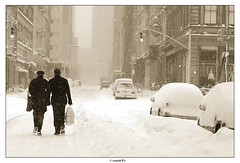
Alone in the Streets


Alone in the Streets
Originally uploaded by Arnold Pouteau’s.

New York City the day after the biggest blizzard on record.

Photo by Arnold Pouteau.

Hop-shit-pho.


There is a new blog in town packed full of information about this city and how it works. LA City Nerd knows a lot about a lot of things, including the source of some Van Nuys odors:

“Many communities in L.A. have distinctive visuals; many have identifiable sounds. But only one that I know of has a distinctive smell – actually, TWO smells.

When most people think of a community that smells, they think of New Jersey. Ok, that’s a state, but when I say “New Jersey,” don’t you think of a funky smell? (Most folks do!)

For me though, I’m not thinking of a bad smell, just one that is distinctive in the region. That community: Van Nuys. What Van Nuys smells like is, well, hops. Anheuser-Busch Brewery on Roscoe gives a strong aroma that is the most distinctive in the region.

(Did you also know that the largest buyer of water from the L.A. Department of Water & Power is Anheuser-Busch?)

And since I brought up water, the other smell that defines Van Nuys is the water that comes out of the Donald C. Tillman Water Reclamation Plant. All that the Valley flushes gets treated and released to Lake Balboa, the Los Angeles Japanese Garden, & L.A. River. So, if you’re down stream – say near Burbank/Griffith Park – you can smell Van Nuys.

That’s something to which other communities may turn up their nose, but Van Nuys can be proud of its distinctive scent. I mean, what does Brentwood really smell like…? (Mountaingate?)”

And this author would add the “Pho” smell coming from the two Vietnamese restaurants near my house.