Jimmy Chhiu is a Cambodian-American, born in Santa Rosa, CA. He now lives in a house he purchased in Van Nuys, perhaps the only person I know under 35 who bought a house in the San Fernando Valley without wealthy parents.
I met him 15 years ago when he was a 20-year-old working at Trader Joe’s in Studio City. Magnetic, funny, hard-working, he built up career as an accomplished stunt man, now stunt coordinator.
He’s going to direct “Khmerican”, his first film based on his life growing up in Santa Rosa where his family’s donut shop was the center. It’s the story of poverty, violence, family and struggle and the displacement of rural Cambodians who found themselves adrift and fighting in small town and urban America after their own once verdant homeland was savagely destroyed in war and then a genocidal civil war.
“After escaping the horrors of genocide, a generation of refugees must navigate identity and culture in a country that isn’t theirs.“
He also explains on his Kickstarter page that he is motivated to make movies in LA where moviemaking is declining. Imagine LA without Hollywood. It could happen, the same way our city has lost department stores, restaurants, and affordable housing.
I backed this film and Khmerican is within $500 of their goal of $15,000. I believe in Jimmy Chhiu, and I think he will tell a great story, because he comes from a great story.
It’s been perhaps 90 years since Americans built well proportioned classical houses.
These are houses where the elements are pre-ordained: the windows are aligned with each other, and are placed within the facade to achieve balance and symmetry. The doorway is defined, frequently in the center, and around it are placed ornamental designs originating in Greece and Rome.
Columns in the Doric, Ionic or Corinthian orders have specific instructions as to their placement. They aren’t just slapped onto a facade as we see in modern day Encino.
In California, when builders put up spec houses they are never able to afford classic design because the intrusion of garages destroys the facades. Ironically most garages never store vehicles but are a repository for storage.
The plain white stucco house with vinyl windows is the lowest and most ubiquitous type of spec house. About a dozen of these have sprouted up in my neighborhood in the last ten years.
There is obviously no attempt in these cases to make the houses attractive in a classical sense. They are rafters and insulation and stucco made for desperate times. Nobody can really afford to build them, and nobody can afford to buy them, so we have a sad story of expensive prices for crap.
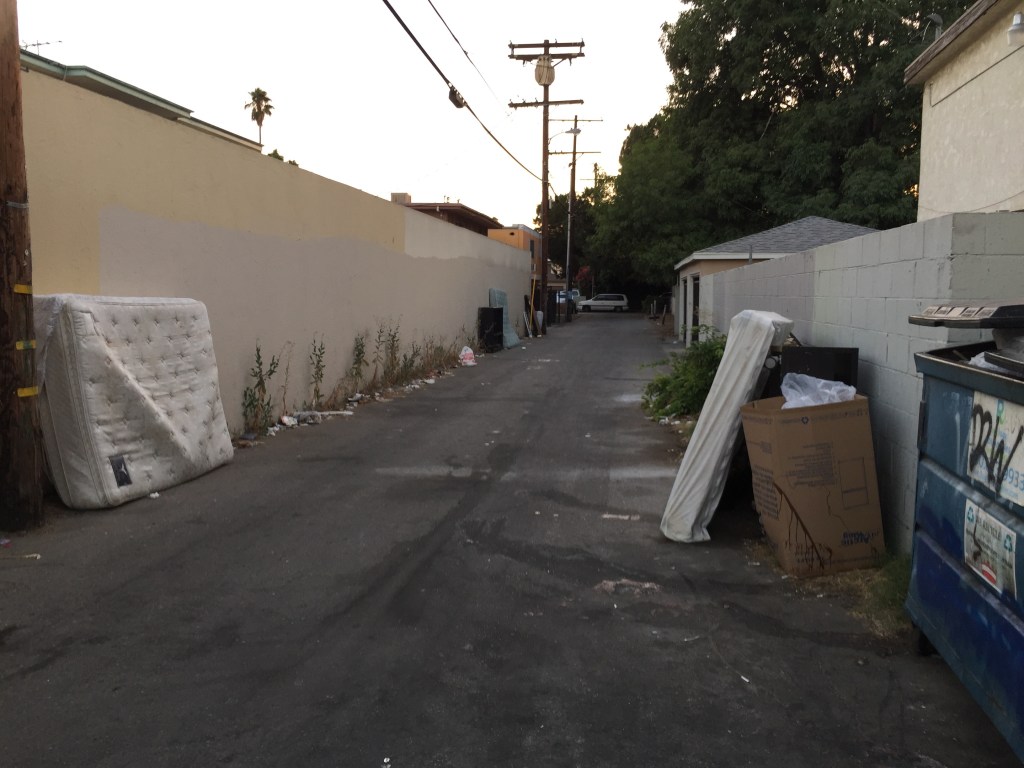
The one on top is three bedrooms with astroturf patio and rents for $7,000 a month next to a graffiti splotched alley.
The exploitation of land to build exploitative housing that hardly houses anyone is one of the ills of Los Angeles. For there are enormous plots of parking lots and open land, especially near the Orange Line, where walkable, civilized and attractive housing can be built.
After spending time in Switzerland last year, I came back thinking of how well things are built there. Not only are they solid, but the housing is meant to enhance the community. Sometimes it’s starkly modern, other times it’s traditional, but it always makes the environment better.
Bremgarten, CH.Merenschwand ZurichLucerne
Why in this city, which invented Hollywood, are the visual arts of architecture and design so lacking in public view? Why do we live amongst so much ugliness?
LA Fitness, Sepulveda Bl.
Is there perhaps something in the past we can look to as we rebuild Los Angeles for the future? Perhaps we need Elon Musk to siphon off $5 billion dollars from somewhere and employ an AI architect to make LA lovely again.
In only five years, it is quite (un)likely that Van Nuys Boulevard will be completely transformed into a walkable, safe, vibrant and urban corridor with a light rail system running down the center.
This essay is about VNB between Sherman Way and Oxnard, basically the original part of pre WW2 downtown Van Nuys.
Currently a littered wasteland of vacant stores, homelessness and speeding cars, desirable for nobody other than crows and rats, the eight lane wide “Heart of the San Fernando Valley” is also the seat of local government where officials, and those transacting official business, appear in court, apply for building permits, and attend meetings of the Van Nuys Neighborhood Council where they can yell and scream and stuff their faces with donuts and Subway sandwiches.
It’s been going downhill since the 1970s, but its condition has steadily gone from bad to worse in the pandemic years.
Despite enormous areas of underused open space, populated by unused parking lots, Van Nuys could be the center of a revitalization of urban life in the San Fernando Valley.
Since nobody in power has any vision for its future, I went to Google AI to see what might be possible.
As the photos above show, buildings that come up to the street and do not shrink from engagement with street life promise a more healthy atmosphere of prosperity and safety. A light rail, patrolled by law enforcement, should help move people in and out of the new Van Nuys neighborhood.
Ambitious and expensive new bridges will be built along the Metro G Line Bus Route in a six year project to improve public transportation in the San Fernando Valley. About 12,000 riders in black clothes ride the buses every day.
Costs are estimated at nearly $400 million dollars, or the equivalent of four new houses in Bel Air.
At Van Nuys Blvd and at Vesper Av. the bridges will leap over the boulevards with overhead spans. Upon completion (2031) riders will board atop elevated platforms and travel on buses or light rail which will not be impeded or stopped at intersections by vehicular traffic.
Expect a lot of delays and ripped up streets in the next half decade as Los Angeles prepares to build a system that will bring us up to the level of 1975 urban transport.
In all the days since the disastrous fires destroyed vibrant and sparkling communities of people and their houses and businesses in Altadena and Pacific Palisades, flat and socially unpopular Van Nuys, miles from any combustible forests, sat silent, its empty parking lots and vacant stores along Van Nuys Boulevard mute and abandoned, its daytime as empty and lifeless as its nighttime.
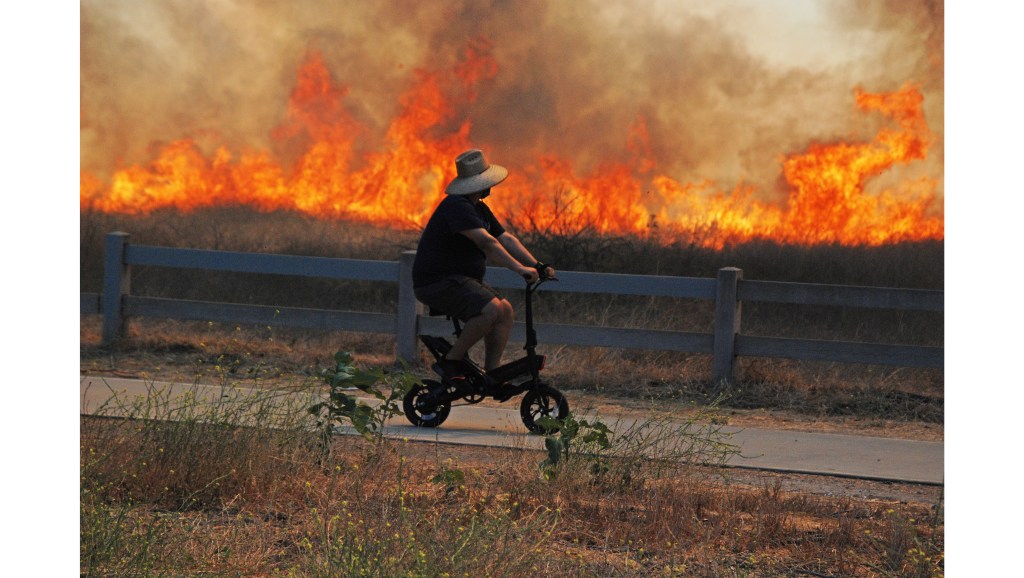
You live here and just like people anywhere yearn for the same normal things that civilized places provide: safety, cleanliness, affordability, and lawfulness. But all you get are sirens, speeding cars, helicopters at 2am, Woodley Park set ablaze monthly.
After nearly 25 years here I see nothing but decline in the environment around Van Nuys.
3/5/18 Bessemer at Cedros.Van Nuys, CA3/5/18 Bessemer at Cedros.Old Post Office
The same neglected mini-mall that I complained about in 2009 is still the same trash strewn dump it always was. Its owner used to live in Bel Air. He complained about my criticism when all I asked him to do was hire a $10 an hour worker to sweep the sidewalk weekly and install a security light on the side of the building so people didn’t sleep and urinate and tag the walls.
The stores that line Van Nuys Boulevard from Vanowen to the Oxnard are largely empty, many are built with gigantic parking lots behind them that are also empty, parking for thousands of cars that once shopped here, but those shoppers have left or died.
The Valley Municipal Building is where CD 6 Councilwoman Imelda Padilla reigns over the neglect and the ugliness. She replaced Nury Martinez who had to resign in disgrace after she was recorded by covert means saying ethnically insulting things about other Angelenos. Martinez came after Cardenas who went to Congress where he now serves.
Cardenas, Martinez, Padilla. It sounds like a nursery rhyme with its melodic Spanish surnames. It might well be a soundtrack set to an ever- present social disaster of Van Nuys with its hundreds of homeless sleeping in the plaza, along the Orange Line, or in the parking lot of the CVS on Erwin Street.
How is it that the so-called heart of the San Fernando Valley, the place that once bustled with prosperity and good infrastructure, including light rail and neatly tended homes and businesses, has been allowed to die for so many decades?
Victory Bl. east of Sepulveda, Van Nuys, CA 5/10/18
Is it callous to also point out that Van Nuys is less prone to fire than other areas that have boomed in recent decades? Would Van Nuys Boulevard, lined with 13-story tall Park Avenue apartment houses be a higher fire risk than thousands of wooden McMansions shoved up canyons in Bel Air, Brentwood, Malibu and the Palisades?
And when Van Nuys gets light rail, might it be possible to imagine a walkable, pleasant, less expensive part of Los Angeles where the vaunted word diversity can be used equitably as all types of inclusion would occur with young, old, well-off, not so well-off, living in nice apartments with patrolled and orderly parks and streets?
Perhaps some of the displaced people would live in well-maintained buildings if such a thing existed in Van Nuys.
With so much focus on rebuilding Los Angeles a good place to start an experiment in civilization would be Van Nuys. It’s the only corpse that has been screaming for rescue for decades.
Recently, a multi-family property, one lot west of Kester Street, came up for sale. And I saw it on Redfin.
14914 Sylvan Street was built by Mr. Leroy Dondelinger in 1954 and has a smart, Mid-20th Century modern look with solid brick, deep eaves and an angled roofline. There are multiple units on the property, making it suitable for owner rental income.
The asking price is $1.3 million.
Who would have built such a stylishly architectural building in this now forlorn neighborhood?
The bold design intrigued me.
I took a trip on Google to find out more.
Van Nuys Circa 1945
70 years ago, this part of Van Nuys, west of Kester, which had been covered in orange and walnut groves before WWII, was in the midst of a furious building boom. The old, walkable town, centered around the Valley Municipal Building, was no more. In the middle 1950s, the streets were widened. Victory Blvd became six lanes wide, old pepper trees were ripped to chips, and Van Nuys Boulevard was expanded to its current width and the streetcar tracks yanked out.
70 years of toxicity, speeding, accidents, death, aggression and mayhem is our inheritance.
LAPL: Widening of Victory Bl. at Columbus Ave. 1955.
We all live in 2024 now and have various explanations for the decades long, dystopian fall of Van Nuys. 14914 Sylvan is in one of the less expensive parts of the San Fernando Valley, and in this area, residents go about their lives behind iron gates, accompanied by big barking dogs, chopping helicopters and avoiding those wandering, lost people who have no home to call their own.
The 1937 San Fernando Valley Directory listed DWP lineman Leroy Dondelinger (b.4/15/1902, Colfax, NE/d.10/27/85 Santa Barbara, CA) and his wife of 12 years, Mary Ellen (nee Fridell; 1902-1980) living at 14545 Vanowen St.
The US declared war on December 8, 1941. Leroy would have been middle-aged, a father of two girls, and probably did not enlist for active duty.
The 1945-46 Van Nuys City Directory had Leroy Dondelinger at 14211 Friar St and mom Lovina Dondelinger (1876-1951) at 14217. But the 1950 US Census listed Leroy, wife Mary Ellen, and daughters Pauline and Joann at 14545 Vanowen.
In 1954, Mr. and Mrs. Leroy Dondelinger built a two-family $21,000 house at 14914 Sylvan St. for their family. Building permit says, “possible future triplex.” Practicality and financial astuteness won out for the power line technician and his progeny.
He seems to have done fine with his new house, and in 1957, 55-year-old Leroy built a $4,200 addition to 14914 Sylvan which included a back lot kitchen, living room and bedroom.
I searched newspaper archives for Dondelinger references, and by wacko coincidence, the fancy home of my neighbors at 14937 Hamlin was the subject of a 1948 Van Nuys newspaper story about “Impressive Fly-Up Ceremonies” conducted by Brownie Girl Scout Troops at the home of Lucile F. Days. Mrs. Mary Ellen Dondelinger was the leader of Troop 716.
60 parents and friends attended the twilight ceremony.
This home on Hamlin is still lovely, on spacious grounds. I’ve eaten Thanksgiving there a few times and walked through the landscaped estate with its fruit trees and swimming pool.
It once typified the aspirational possibilities of what could be achieved in American life if you were born of the right stock and knew the right people and applied yourself accordingly and carefully and diligently to work, family, education, and morality.
We are all lost now, damned and defined by something we cannot control, our identities.
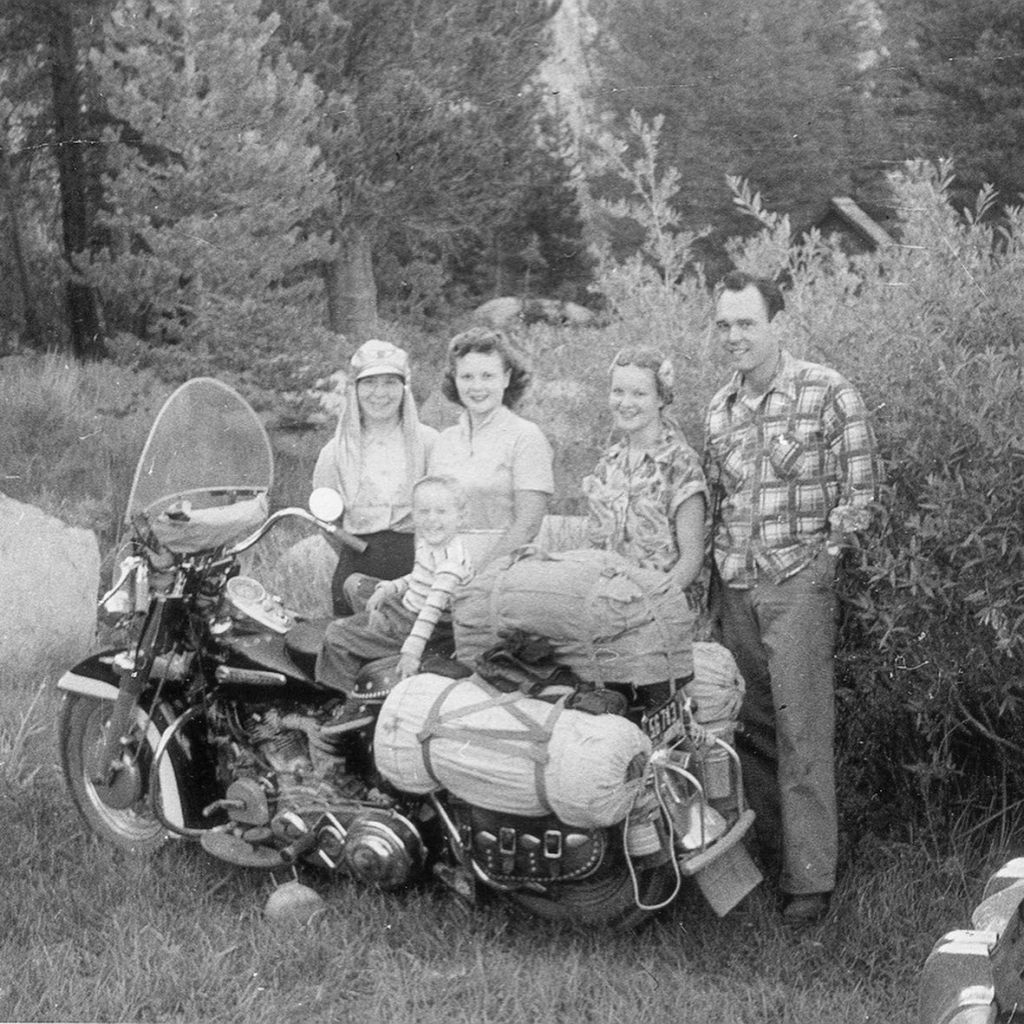
The Dondelingers were motorcycle riders and owned the brand new Hydra-Glide Harley Davidsons. On August 15, 1955, Mary Ellen and LeRoy Dondelinger and daughters, Pauline Ellen (1936-93), and Joann (b.1938) set out on a California vacation aboard their Hydra-Glides.
In the April 1956 issue of The Enthusiast, Mary Ellen Dondelinger shared details of her and her husband’s 1,480 mile California road trip.
Leaving from Van Nuys, they packed their Hydra-Glide with a pup tent, air mattresses, sleeping bag, stove, white gas, dishes, food and clothing. She wrote about visiting their children and grandchildren, camping sites, scenic roads, and some of “the different expressions with which we were regarded by other tourists as we rode down the highway. Some looked at us in amazement, some in disbelief and occasionally in envy.”
Postwar Harley Davidson introduced the telescoping hydraulic shock absorbers to smooth long-distance rides. Industrial designer Brooks Stevens reconfigured the suspension, front fenders and headlight to achieve a look of grace, power and elegance for a mode of transport which many associated with low lifers, rebels and angry young men.
The Dondelingers, a wholesome looking family from Van Nuys, CA. submitted their road trip to The Enthusiast and gave Harley-Davidson a different image for their products, one that may have countered that which leather jacketed Marlon Brando projected in his hit bike flick, “The Wild One” (1953).
Harley-Davidsons became ever fancier in 1956 with the introduction of luggage racks, saddlebags, windshield and a tandem seat which increased sales and expanded the consumers to include traveling families like the Dondelingers.
Four years after their epic road trip, a wedding was held at 14914 Sylvan for Mr. and Mrs. Robert Maurice Fleming (Pauline Ellen Dondelinger).
Bride and groom honeymooned in the new state of Hawaii.
The bride was a graduate of Van Nuys High School and her husband was in school at USC majoring in biochemistry.
There are certainly other stories of the Dondelinger Family since 1959. I featured one small tale.
This is just a glimpse of a family, a house, another time in America, and a Van Nuys whose people and customs seem as different as a foreign country.
You must be logged in to post a comment.