Advertising For Church and Everlasting Life


A friend told me he had gone for drinks in Glassell Park at a bar in a restored building, a renovated Spanish traditional like they once had all over Los Angeles.

I was curious if I could find out anything about the history of 3501 Eagle Rock Blvd. in the Los Angeles Times. I went online to the archives of the paper at the library and found out nothing.

I wasn’t really trying very hard. 

Instead, I got distracted by 1930s church advertising, display ads for places like Temple Baptist Church, April 15, 1933, “Was God Blowing Soap Bubbles When He Created a Sea!” 

There were Christian Scientists, Theosophists, Episcopalians, Presbyterians, Catholics, Congregationalists, Lutherans, and Swami Yogananda who would give a free lecture on “How to Analyze People at Sight.”

The variety, the selections, the choices were endless, a feast for the soul and the imagination. Out there, beyond you and the mirror and your mind, was a divine world of love and community.

Day Memorial Church said Jesus Christ, son of God, God the son, was not crucified on Friday, according to the scripture.  That church was Independent- Fundamental-Baptist Doctrines. Dashes and precepts.

First Methodist Episcopal advertised itself as “The Church with the Revolving Cross” on December 5, 1931. On that day you could also go to the First Unitarian Church on West Eighth Street, just east of Vermont to hear a lecture by Dr. John R. Lechner about Communism in America and “The Dilemma of the Liberal.”

July 30, 1932 advertised Dr. G.A. Briegleb from St. Paul’s Presbyterian. “Another Mountain Peak From Acts,” KFVD radio, Fridays at 10pm.

Electric signs, radio broadcasts, neon lit dreams and full color visions; everlasting life, the answers to life, the origin of life, the meaning of life; the answers to why we are here and where we are going and how we can get there.

It was all over Los Angeles, all you had to do was go and get it. 

“You’ll Fell a Little Bigger and Better!” proclaimed the LA Times, “When the church bells peal out Sunday morning, select your church and attend it. Don’t consider yourself a stranger, you’re not. The church owes you spiritual enlightenment and instruction. It’s your duty to receive it.”

Glorious California: Some Photographs from UCLA’s Bartlett Collection.


UCLA’s Adelbert Bartlett Collection has superb, hi-resolution images from the work of a commercial photographer who lived from 1887-1966 and worked in Southern California in the 1920s through the 1960s.

It was a time when this state was considered the pinnacle of glory, a place where aviators, sportsmen, golfers, movie stars, and athletes played and worked in brilliant sunshine under smog-free skies; swimming, water skiing, boating and hiking through deserts, mountains and parks.

As we endure cataclysmic natural disasters and allow unnatural disasters, such as homelessness, to overtake our state, we have to look back to how the Golden State operated when economic conditions were truly bleak.

We have brought ourselves, by our own powers, to a time and place of our own creation, and our California is a product of our human strengths and weaknesses, a society which can go up or down, in a natural environment which is now turning deadly as it is heated up by carbon.

Way before people understood that our planet might perish by our own hand and not God’s, California took stock of its good fortune and erected a real place out of fantasy.

How did such phenomenal architecture, science, sports and innovation happen here in the early and mid 20th Century? What can we do to restore the optimism and leadership that once made California the envy of the entire world?

Can we bring back the pristine, polished, glimmering, spotless world that once existed?

A Once Neat City.


Looking from Wall Street between 8th and 9th Streets. “Japanese and Negro District”

The California Historical Society has a fine website with old photographs of Los Angeles. The Anton Wagner Collection is especially notable for its images of our city in the 1930s.

The Great Depression was in full swing and Los Angeles was a place where people also struggled to make a living, even though photographs show new buildings, apartments, public works, farms and industries. It seems everyone was working and the city was thriving despite hard times.

One thing that stands out is the spectacularly tidy streets with swept sidewalks, clean curbs, and not one sign of shopping carts filled with garbage or mountains of trash.

This was during the most severe economic downturn in American history, yet Los Angeles functioned as a functioning city, where the presentation of tidiness, order, and cleanliness was foremost.

There were many poor, destitute people in the 1930s. But Los Angeles did not create a dystopian city where people shit in the streets, or lived along the road, or slept on bus benches, or roamed mentally ill in parking lots, or set up tents on residential streets for outdoor trash camping.

There were not two-story high trash piles that authorities promised to remove in three months time.

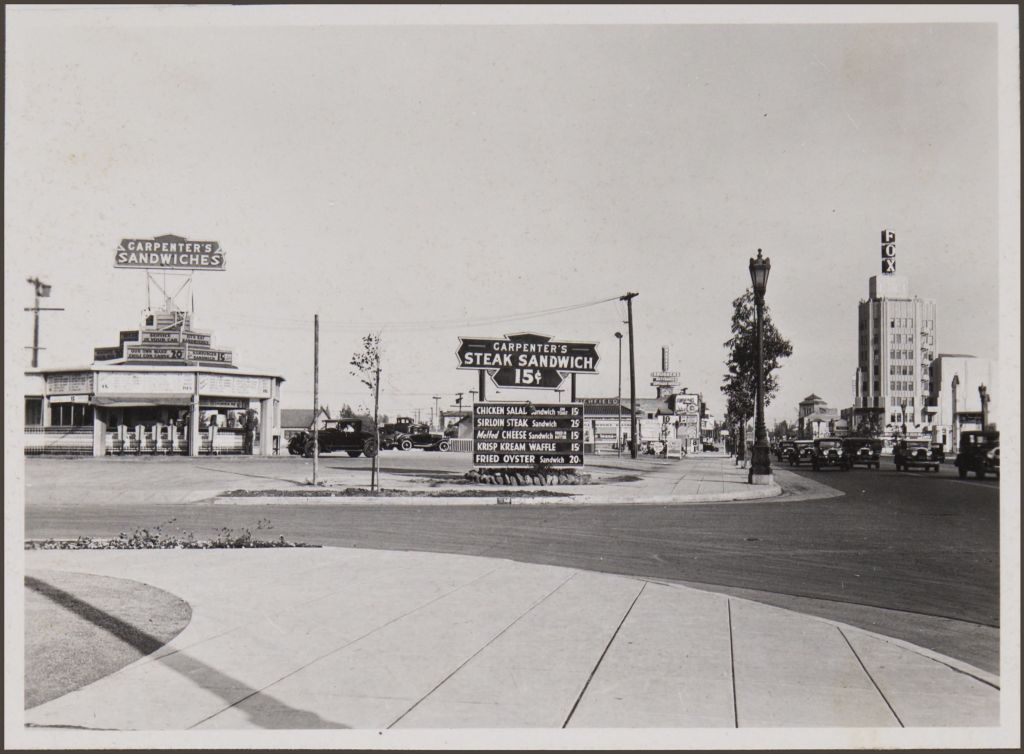
Cheap structures on Eagle Rock Boulevard, looking east from north of York Boulevard

There was a crisis and it was called the Great Depression, but government and people, here in this city, were not seized in panic and unable to respond or knocked over by circumstances.

They ran the city well, with pride, and these photographs of ordinary life in the City of Angels, 85 years ago, should fill our modern, jaded hearts with shame for what we have allowed Los Angeles to become under Mayor Garbageciti.

Griffith Observatory, 1930s


Dufay_color_shots_Edward__beans_Southern_California_sd_image_18

Dufay_color_shots_Edward__beans_Southern_California_sd_image_17Dufay_color_shots_Edward__beans_Southern_California_sd_image_2

Dufay_color_shots_Edward__beans_Southern_California_sd_image_6

Dufay_color_shots_Edward__beans_Southern_California_sd_image_4

Dufay_color_shots_Edward__beans_Southern_California_sd_image_8

Courtesy of Nathan Masters, I found these fascinating vintage images which the USC Digital Libraries recently added to their Dick Whittington Photography Collection.

They show a family or friends (Dufay?) on what seems to be a Sunday type of outing, in the mid 1930s, up to Griffith Observatory, which had opened on May 14, 1935.

In the midst of the Great Depression, or perhaps because of it, people took care to dress up in dignity and elegance.

Lankershim and Victory: 1930


Al_Monroe_station_in_North_Hollywood_Lankershim_Boulevard__Victory_Boulevard_Los_Angeles_CA_1930_image_1

83-years-ago, the San Fernando Valley was an all together different place than today.

Rural and urban, it was dotted with Spanish style gas stations, grocery stores, small houses; orange and walnut groves, neatly designed and well-kept businesses, with swept curbs and gracefully articulated architecture. Store signs were designed to fit into architecture and each letter and every proportion was sensitive to the greater architectural whole.

Photographer Dick Whittington worked this region back then, and his images are kept, for posterity, in the archives of USC.

Heartbreaking it is to see what has become of the corner of Lankershim and Victory today, a grotesque piling together of cheap plastic sprawl and indifferent commerce, junk food and junk culture. Even without looking, people know the location Lankershim and Victory is synonymous with ugly. Guns, crime, speeding, littering, illegal everything…that is what it is today.

What started out with great promise, California, is now ready for the apocalypse.

Historic Van Nuys: The Jue Joe Clan.


This slideshow requires JavaScript.

The Internet is a strange thing.

Yesterday, while Googling for “Bike and Van Nuys Blvd.” in a search for a bike store, I came upon a family blog about a Chinese immigrant, born 151 years ago, who came to California to work on the railroad and ended up owning hundreds of acres of agricultural land and running a successful asparagus farm in Van Nuys in the 1930s.

“Descendant of the 2nd emperor of the Song Dynasty (Zhao Gunagyi), Jue Joe was born and raised in a chicken coop, in 1860. He grew up dirt poor and vowed that his descendants would never suffer as he had. So at the age of 14 he sailed alone to California, working as a cabin boy, and jumped ship in San Francisco. He sailed with 16 lbs of rice and landed with 1/4 lb left. So he went to the Chinese Six Companies for help. They sent him to St. Helena and Marysville to work the vineyards. Then he found work on the Southern Pacific Railroad. In the Mojave Desert he met Otto Brant who was hoboing his way to L.A. They became friends and together hoboed to that destination. According to San Tong, Jue Joe learned business from Otto Brant and what land and water would mean to future settlers of the L.A. Basin. “ – written by Auntie Soo-Yin.

In 1913, California passed a law that forbid aliens (Non-Americans) from purchasing land in the state. The openly racist ALIEN LAND ACT was aimed at a growing and prosperous Asian population whose success threatened white hegemony in the Golden State.

But Chinese born Jue Joe was friends with the very powerful Otto Brant. The fascinating story of how Otto Brant helped his Asian friend purchase land, in spite of the restrictive law, is retold by Auntie Soo-Yin:

“Jue Joe’s friend was Otto Brant, a prominent member of a Los Angeles land syndicate. Jue Joe discussed with Brant his desire to own and farm land in the San Fernando Valley.

“The name of Otto Brant’s land syndicate was the “Los Angeles Suburban Homes Company,” formed in 1909. It had 30 members all prominent leaders of L.A. (Harrison Otis and Harry Chandler of L.A. Times newspaper, Wm. Mulholland the L.A. Water Commissioner, M.H. Sherman, Grant the founder of Santa Fe Railroad and California Bank, H.J. Whitley the sub-divider, I.N. Van Nuys, to name a few).

Together the Syndicate controlled Tract 1000. In it Brant reserved 850 acres for his Title Insurance and Trust Company and, within the acreage, platted Van Nuys, Marian (Reseda), and Owensmouth/a.k.a. Canoga Park).

You could buy a small farm 1 to 10 acres, or a large farm 100 to 600 acres. In 1920 he reserved a large parcel for Jue Joe: 300 acres of prime property from Vanowen St to Haynes, and from Hayvenhurst to Balboa Blvd. It was segregated from a large ranch owned by Mr. Van Nuys, later was part of the Anderson Ranch, then bought by Mr. Dickey who later sold to Jue Joe.

Brant ( and later Brant’s estate after his death in 1922) held the Jue Joe property as Trustee for the benefit of Corrine and Dorothy until they came of age. When they came of age the land was deeded to them pursuant to the original trust documents.”

Auntie Soo-Yin fondly remembers her time in the 1930s growing up and living on a large agricultural ranch in Van Nuys, whose boundaries today sit just west of the Van Nuys Airport along Vanowen:

“I loved our homestead. Our ranch was self-sustaining. We had our own gas pump, an auto- and repair shop, fruit trees of nectarines, oranges, pears, apricots, lemons, figs, walnuts, etc. We grew strawberries, grapes, corn, and vegetables of all kind. Behind the big red barn that faces Vanowen St. we had a large chicken coop.”

The story of one American family in the San Fernando Valley, who didn’t let little obstacles like racism and the Great Depression get in their way…….