A House Fancy Enough for a Fireman


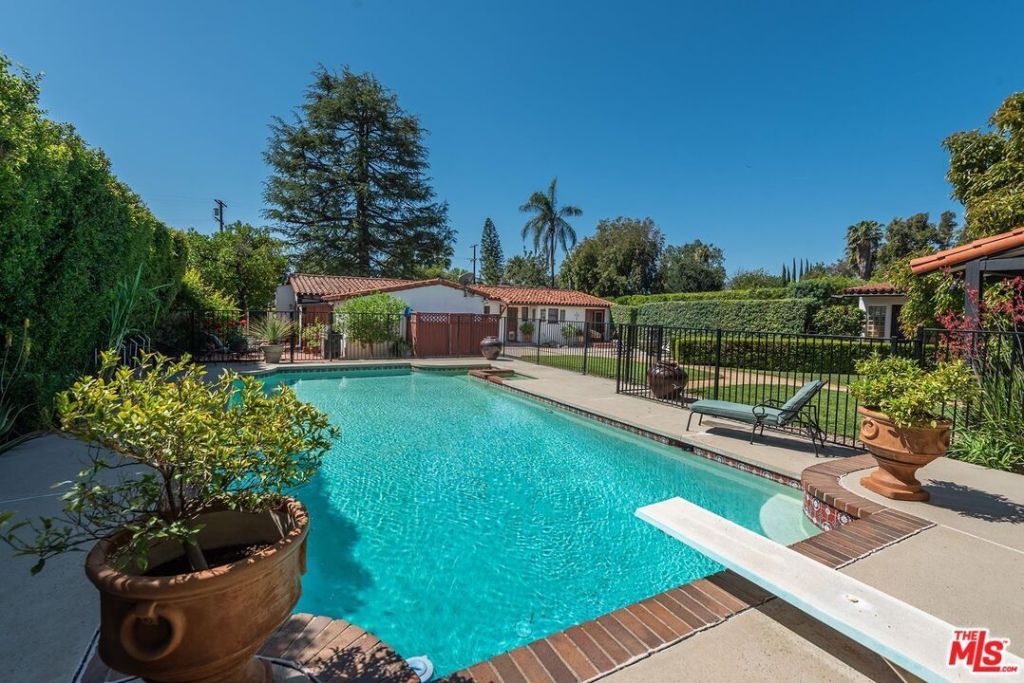
To those who don’t know it, Valerio Street in Van Nuys, especially between Van Nuys Boulevard and Kester, is lined with many exquisite, old, historic homes on large properties. Often these houses have Spanish architecture, swimming pools, and many fruit trees.

One of these, at 14721 Valerio, is on a 15,000 sf lot. The home is 3 bedrooms, two baths with a red tile roof, backyard swimming pool, and a very tranquil, luxurious garden.

Built in 1933, by one of the founders of Van Nuys, Mr. WP Whitsett, for $2,500 (two-thousand five hundred dollars) it is now on the market for $1.1 million dollars.

In the 1937 telephone directory, the homeowner is listed as James T. Von Eschen (wife is Clara.) 

The 1940 US Census says Mr. Von Eschen was born in 1903, and the couple had two sons, James, 12 and John, 11. Marvin Grimsrud, brother-in-law, 38 years old, also lived in the house.

Mr. Von Eschen was a fireman.

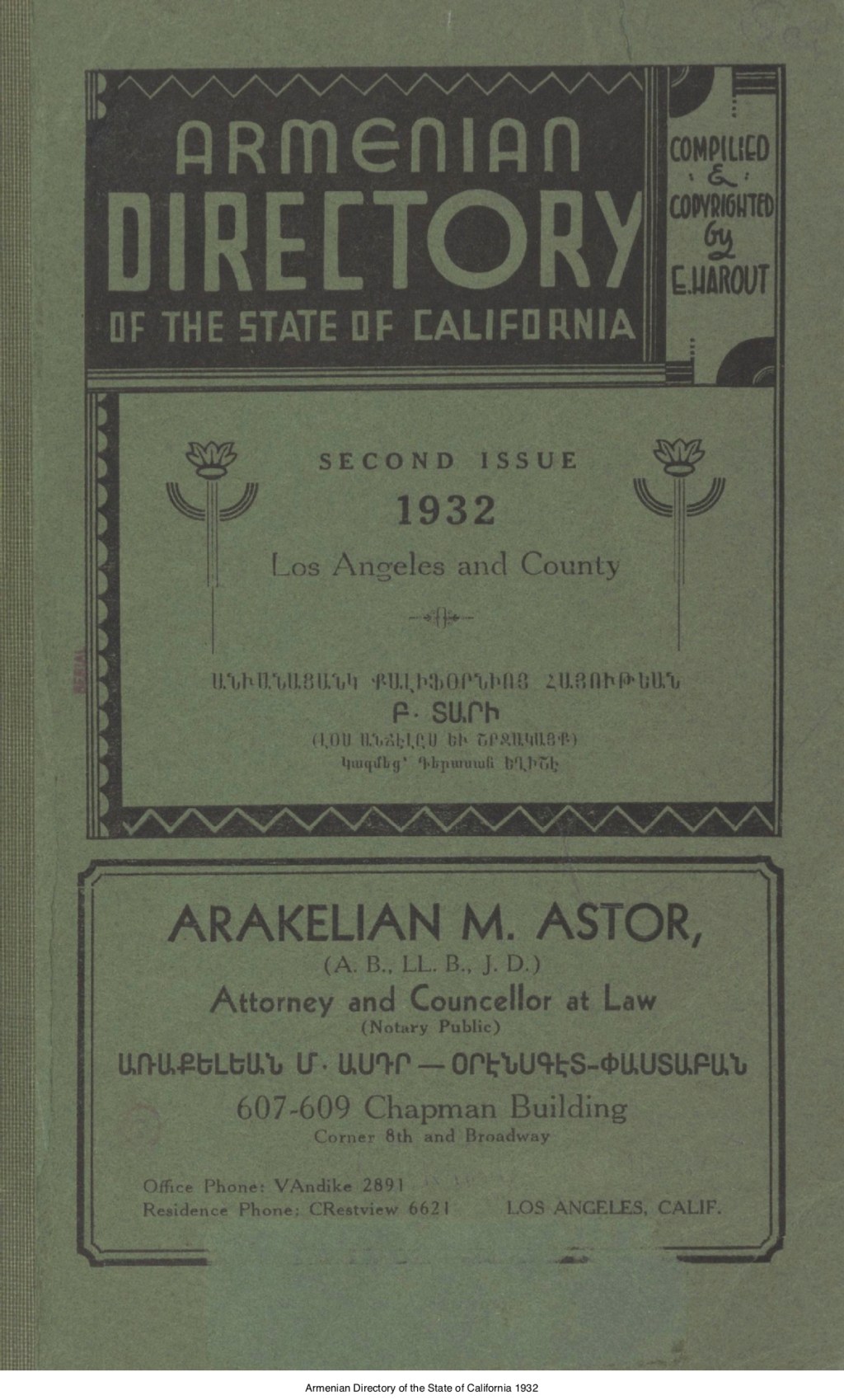
The Armenian Directory: 1932.


Within the collections of the Los Angeles Public Library there are city, business and phone directories going back to 1873.

Among the historic books can be found The Armenian Directory of The State of California, 1932, related to the Armenian community of Los Angeles, at that time, numbering a few thousands, many of whom were settled in Pasadena, and throughout the Southland.

The first wave of emigration from Armenia came after the First World War when Turks murdered millions of Armenians during the breakup of the Ottoman Empire. Most of the refugees came from Western Armenia near Turkey.

Here in Los Angeles they established an industrious, skilled, hard-working community. They built churches, founded benevolent societies, and created cultural and social institutions centered on music, food, and dance. 

Their professions in their new adopted city were many and varied and included dentists, physicians, attorneys, tailors, grocers, bakers and funeral homes.

The Standard Crate Co., Inc. built fruit boxes and gave “special attention to Japanese customers” many of whom grew citrus. Ten years later these same clients were rounded up and put into detention camps, a tragic and historical irony the Armenian advertisement could not foresee or imagine.

The Hollywood movie industry was already famous worldwide when the Antranik Dramatic Company advertised their actors. Mastery of frivolity has always been important in this city.

It seems that many Armenians did well here. 

The Altoonian Family, and their sedan, is seen below in a 1926 photograph. The 1933 directory lists an “Altoon Apartments” at 2405 S. Hoover, and several Altoonians who lived at that address.

At Joe’s Garage, 2505 E. 4thSt. the motto was “Once a customer, always a customer.”

A magnificent Art Deco ad for signs is a last breath of the 1920s with its rhythmic patterns and syncopated layout.

The Luther Eskijian family is shown in 1924, perhaps in front of their home at 1738 Bridgen Rd., Pasadena. Boys are in knickers, those short pants that children wore up into the mid 1930s.

The Constantinople Cigarette Shop at 356 South Broadway made special monogrammed cigarettes “which makes [a] splendid gift or present for your friends and relatives for their birthdays.” 

The International Grocery Co at 134 N. Main St. had such Armenian foods as aghy banir, lablebi, boulgour, chadana and fistuhk. Or cheese in brine, roasted chickpeas, crushed wheat, pine nuts and pistachios.  A one-gallon tin of olive oil was an enormous luxury item priced at $2.50 ($25.68 today).

Elegant tailoring was the province of Gregory H. Chashoudian at 4562 Beverly Blvd east of Western Avenue. His skills were endorsed by B.R. Ware, Attorney, who said Mr. Chashoudian’s suits were “entirely satisfactory” and reasonably priced.

The world was in the midst of the Great Depression. 

Yet looking through the pages of the Armenian Directory in 1932 one feels a sense of pride and admiration for these industrious people who overcame such grueling tragedies and unjust cruelties. 

They somehow made it to Los Angeles, CA and established stable and prosperous lives in a new and unfamiliar land.

History Online


15139 Hamlin.jpg

In the public record, and available online, are millions of building records, in The Department of Building and Safety, encompassing a large part of the history of the city of Los Angeles.

I discovered this great trove of fascinating information during a recent employment incarceration at a Sherman Oaks realty agency.

When we received a listing, we went online and pulled up permit records related to a particular property. This was part of my duties, along with stuffing plastic fingers and plastic spiders into hundreds of orange and black Halloween bags destined to hang on doorways south of Ventura Boulevard.


My neighbor’s home at 15139 Hamlin went on sale yesterday.

I pulled up a 1933 building permit for the property.

These records are available for anyone to view. And are not confidential, private or top-secret. They are part of the public record of building safety in our city.

15139 Hamlin was built by Fred J. Hanks who lived down the street at 15015 Hamlin (since demolished). Mr. Hanks estimated the total construction cost of the home at $2,000.

Incidentally, I plugged $2,000 into the US Inflation Calculator and found that amount to equate to $36,606.92 in 2015 dollars.

Mr. Hanks built a two-bedroom house with one bathroom and a kitchen, living room and dining room on a 50’ x 137’ lot with garage for about thirty-six thousand 2015 dollars.

The current values for housing properties in Los Angeles are truly insane. They are fed by a frenzy of speculation and collusion by appraisers, property owners, banks and realtors and seem to reflect no sane relation to either income or reality.

Van Nuys, between Kester and Sepulveda, above Victory, is stuck in a strange rut. The houses here are expensive enough (over $500,000) but are mostly unaffordable for new home buyers. But there are few that sell for over $650,000 so developers have no interest in purchasing old or dilapidated houses, pouring $100,000 into them, only to find that their $600,000 investment cannot sell for over that amount.

As a result our area has quite a number of empty houses, and others that sit on large parcels of land that could be developed for more housing. People sleep on benches, and on the street, or spend $3000 a month for renting an apartment and they all could be owning a house if only the economics of our times permitted.

Perhaps someone sensitive and aesthetic, with modern tastes and an artistic eye will purchase 15139 Hamlin. Or, as seems more likely these days, the house will be obliterated by concrete driveways, 30 cheap exterior lantern lights sitting on stucco walls or iron gates, vinyl windows and Roman columns, and five Hummers parked in front with four on the street.

People once had little money but could build cheaply and practically and pleasantly. Now they have little money, but they build as if they have millions, and the result is a vandalizing of our communities producing pimped-up houses that will again go vacant and unsold when the next downturn hits.

They knew something in that Great Depression year of 1933 we need to learn all over again.


Constructing the Valley Municipal Building, 1932


Most photographs of the Valley Municipal Building show the 1933 building after its completion, but here are some, by Dick Whittington Studio as the hole was being dug in 1932.

Construction_of_new_city_hall_Van_Nuys_Los_Angeles_CA_1932_image_1

Construction_of_new_city_hall_Van_Nuys_Los_Angeles_CA_1932_image_2

Pile_driver_Van_Nuys_City_Hall_Los_Angeles_CA_1932_image_1

Pile_driver_Van_Nuys_City_Hall_Los_Angeles_CA_1932_image_2

Statistics and specifications for the completed structure exist and have been cited many times, so I won’t do it here.

Instead, one might look at these photographs and imagine the small town of Van Nuys, self-sufficient and walkable, safe and sunny, sitting in the middle of the largely agricultural San Fernando Valley in the depths of the Great Depression.

Surrounding the t-shaped dig, is a Richfield gas station and The Erwin Hotel, criss-crossed in a vaguely Tudor style.

In contrast to today’s heavily regulated construction, the men are all in civilian clothing-no hardhats, no vast walls around the site, no safety signs. The humble trucks are pulled right up to dirt and a two strips of lumber comprise a fence surrounding the digging.

Laborers, architects, drivers, engineers, photographer; everyone was lucky to work.

With such opening modesty the end product was magnificent, distinguished and proud.
And became that symbol of Van Nuys everlasting.

Additional_views_of_Van_Nuys_city_hall_14410_Sylvan_Street_Los_Angeles_CA_1933_image_2

Additional_views_of_Van_Nuys_city_hall_14410_Sylvan_Street_Los_Angeles_CA_1933_image_7