The Criterion Channel is showcasing the actress Myrna Loy (1905-1993) in its August line-up.
One of the most popular and lauded performers of the 1930s and 40s, Ms. Loy was famous as the co-star of “The Thin Man” films with William Powell, characters who solved crimes in the well-dressed and liquored penthouses of Manhattan.
William Powell and Myrna Loy (c. 1935)
She was adept at underplaying comedy, always alluding to something funnier and sexier without drowning in it. Her personality was built upon allusion and intelligence. Along with “The King” Clark Gable, she was voted “The Queen of Hollywood” in the late 1930s.
Married and divorced four times, she never had any children.
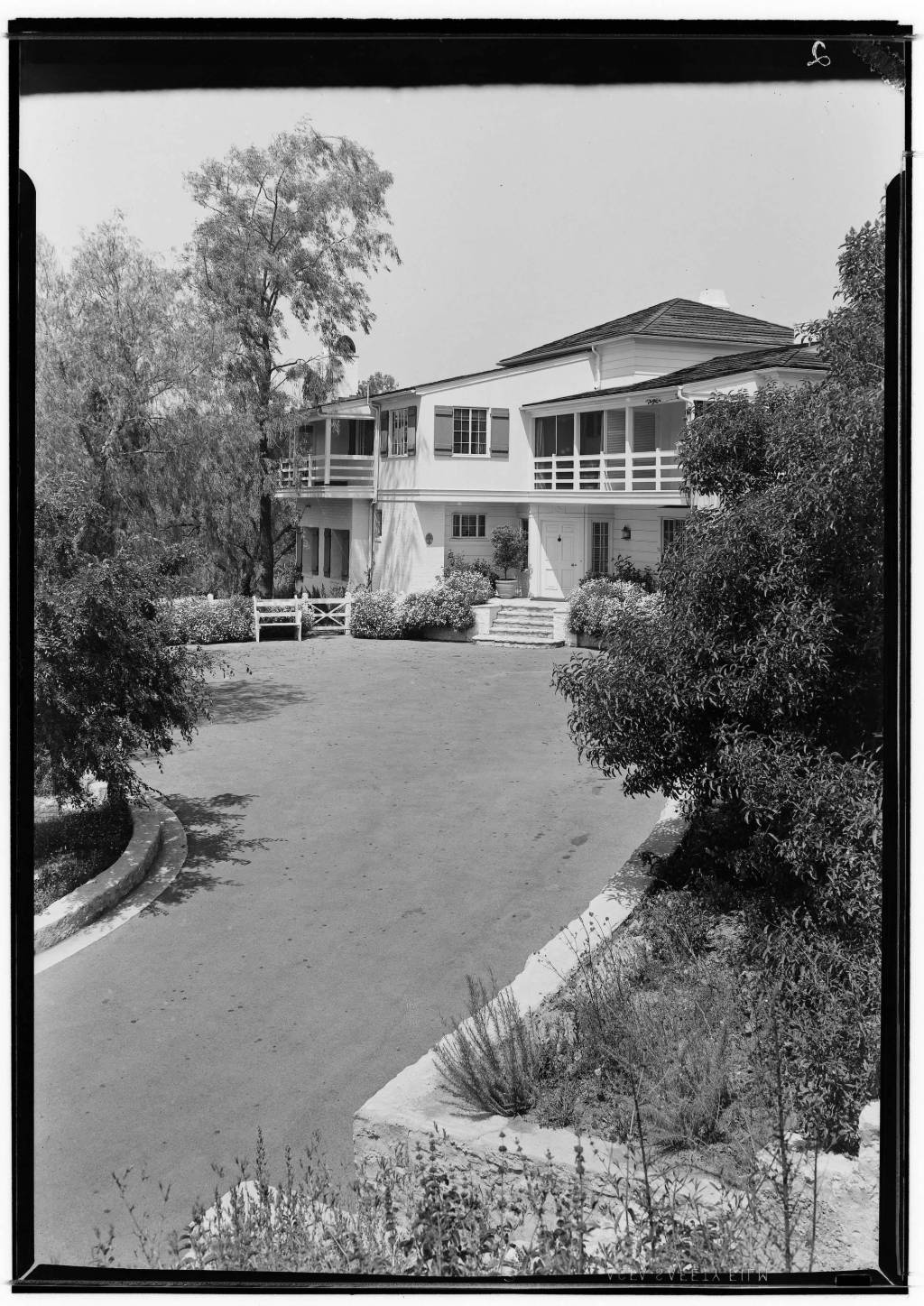
But in 1938, as these astonishing photographs (by Maynard Parker) show, she was married to Mr. Arthur Hornblow, Jr. and they lived on a spectacular estate in Beverly Hills, CA with vast lime orchards, tennis court, swimming pool and a rustic, but refined, California country estate with wood siding, shaded porches and many flowers, trees, and vistas of the undeveloped mountains.
Everything about this property sparkles with the graciousness and rarified perfection of well-tended Southern California affluence. They swam, they played tennis, they drank cocktails in the wood paneled library. They might have flown with Howard Hughes to Catalina Island or gone fishing on a boat that docked in Baja California. They danced, they played music, they acted in movies, and their lives, off set and on, were theatrical, and moved, often intoxicated, with emotion, and grace.
In these photos are two opposing qualities that complement each other: restraint and opulence. This large house is well-proportioned, charming, whimsical and cozy.
Nobody lives like this now. Nobody, even the richest, has a library of books. Nobody has servants working in the house or gardeners tending to acres of lime trees. Nobody opens their windows to ventilate their rooms. All of it, phony or real, has been torn down, and today we can only go online and drool.
Photos are from The Huntington Library.
Architectural Digest 10, no. 1, 1938, 43–49. Martha B. Darbyshire, “‘Lime Orchard’: The California Estate of Mr. and Mrs. Arthur Hornblow, Jr.,” Country Life & The Sportsman 75, March 1939, 45–47. Better Homes and Gardens, September 1940, 29.
The 1938 Book of Small Houses is a selection of the best residential work of American architects.
Published during the Great Depression, when there was a dire lack of housing, the book showcases how innovative, cost-conscious and community oriented architects built on a budget.
I selected some houses that were built in Southern California, one also in San Mateo, CA.
There are a few by Schindler, Neutra and Paul R. Williams. Many are by lesser known names.
These are 84 years old.
An astonishing amount of time has passed, nearly a century, and these houses still retain a hold on our hearts.
Constructed in a variety of styles, from modern to Georgian to Colonial Revival, they evince a time when architecture tended to understatement, modesty, and proportionality.
Unlike today, nothing is painful to look at. There are no obese styles with garish ornamentation, or massive oversized windows, three story tall entrances, round driveways with 10 vehicles parked in front.
If classical columns appear, they follow the classical proportions. Laid out in a rule book thousands of years old. And when new styles are worked out, they too have geometric logic.
Nobody trusted a fool with a pickup truck to build their castle.
Modern was not a synonym for arrogance.
Nobody winced when they saw the final 1938 product.
In 2022, millions is expended and achieves so little attractiveness.
Most of these old houses cost between $4,000-$10,000.
$6,000 in 1938 is about $115,000 today.
We are so used to ugliness all around us, so narcotized to the malformed and monstrous new palaces that pockmark Encino, Tarzana, Woodland Hills and Calabasas, that we cannot imagine that once upon a time architects and builders and homeowners aspired to build quiet, well-behaved, lovely houses to beautify a neighborhood.
And provide a restful, relaxed, joyous home for their owners.
Flooded area at Ventura Boulevard and Colfax Avenue in Studio City. 1938 (LAPL)
After March 1938 Flood: Lankershim Bl. looking north near Universal City. Photo: by Herman Schultheis
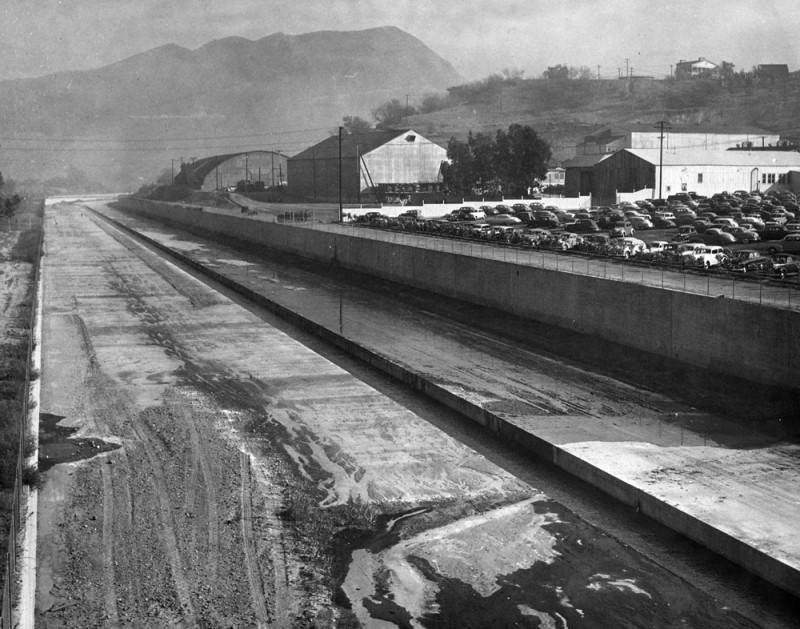
After the disastrous 1938 floods, the City of Los Angeles worked with the State of California and the Federal Government, specifically The Army Corps of Engineers, to encase the rivers of Los Angeles in a waterproof lined concrete sewer to expel waters during the rainy season.
These December 1949 photographs, archived at the LAPL in the “Valley Times Collection”, show the splendid progress of turning natural riverbeds into something distinctively man-made without natural life. The cost, at the time, was $72 million, which is perhaps $800 million today, but sounds like a bargain, since the Getty Center mountaintop gouge and railroad itself cost $1.3 billion dollars upon completion in 1997 and the widening of the 405 five years ago was a $1.6 billion dollar project that has since added one lane in each direction and shaved 10 seconds off each commuter’s journey.
And let us ponder that our latest crisis, homelessness, will be remedied by taxpayer dollars close to $5 billion. Not the Federal Government, not the State of CA, but taxpayers, you and me will shell out to well-meaning bureaucrats and post-collegiate interns, $4.6 billion to build housing — 10,000 units in 10 years — and “provide supportive services” for homeless people. When every person in need on every continent around the world, every down and out person from every state, city and town in the US, Canada and Mexico, arrives in Los Angeles, we will see how well this plan goes down. It once was against the law to dump garbage in parks, to set up tent cities on sidewalks, to sleep on benches, under bridges, but now this is a behavior eliciting “compassion” because that’s how you are directed and asked to speak of it. You must not condemn what your own eyes tell you is wrong. Let it grow, let it expand, then create new programs to fight it, until it becomes unstoppable.
A city that once built hundreds of miles concrete rivers to stop flooding, cannot erect temporary shelters and police the filth and disorder and rampant grossness of the ever growing homeless situation. 1949 was a different time, for Angelenos were not intimidated and cowered into attacking threats that endangered the growth, health and well-being of this city.
Lankershim and Cahuenga
Riverside and Whitsett
Laurel Canyon Bl. near Ventura.
The concreting of the LA River in the San Fernando Valley allowed the development of housing right up to the edge of the old slopes. No longer would houses and apartments face potential destruction from heavy rains and overflowing waters. Soon the freeways would come through, another onslaught of concrete that helped transform the San Fernando Valley from a place of horses and orange groves to one of parking lots and 10-lane local boulevards.
Today, in many parts of the LA River, most notably in Frogtown and along some sections of Studio City, there are naturalizing effects going on, and residents are biking, hiking, and even boating where it is permitted in the once fetid waters of the river.
The other day, I drove past the gray ranch with white casement windows at 4336 Teesdale, a house I briefly lived in for 4 months when I arrived in Studio City in May 1994. There was a for sale sign in front, so I stopped my car, got out and started to take photos for posterity.
A middle-aged Israeli, parked nearby, emerged from his SUV to ask me why I was taking photos of “his house.” I told him I had lived there many years ago. “I am on the neighborhood watch,” he said.
I explained that I knew the previous occupant and had lived here myself. I asked him how much the house sold for, but he would not say. He said he was a broker, but “I don’t like to call myself a broker. I’m more of a preservationist.”
He told me the house, most likely, would be torn down.
He seemed satisfied with my benign answers and he drove away.
Redfin, I saw later, listed it for $1,034,500.
In 1994, a college friend, “B”, was renting it for $1,200 a month. There were two bedrooms and one bathroom, 1168 square feet, built in 1938 for $3,200. I paid “B” $100 a week when I earned $500 a week as a PA.
“B” went away for the summer to work on “Woodstock ‘94” a twenty-fifth anniversary program of the rock festival. I stayed in the house and got a job at Greystone in Valley Village where the hazy air obscured the view of the mountains and everyone went across the street to get lunch at Gelson’s salad bar.
When “B” returned we fought over something silly and we never spoke again. And I moved out.
Everyone sees their life and their times in their own way. And we interpret our communities with stereotypes we overlay on them. And Studio City has stayed in my head as a certain place, regardless of fact or reason. It still exists in my imagination in that way I first encountered it that summer in 1994.
In the 1990s, there was a family type who lived in Studio City, not at 4336 Teesdale, but in many other homes. I often met them on runs when I worked at Greystone.
The mom was always named Linda. She was single and raising two teenagers in a two-bedroom ranch that looked like 4336.
She was 43-years-old, with a perpetual tan, curly dark blonde hair, living in a tiny house with many VHS cassettes, tons of books, two cats (Cat and Kitty), a bedroom with burgundy sheets, a leopard print comforter, brown velvet pillows and a chenille throw. Her fireplace mantle was stacked with scented vanilla candles and ornate gold-framed photos of her two kids who were always named Zoe and Adam.
There were three closets in the home, each 23 inches wide, and the front hall was stuffed with everything nobody would ever need in Southern California: waterproof boots, winter coats, sweaters in dry cleaner bags, hats, gloves, mittens, a file cabinet and an Electrolux Steel Framed Canister Vacuum.
Linda was always a writer/producer and had worked on documentaries about Nostradamus, the Titanic and “The World’s Most Amazing Dogs.” Her new boyfriend was always a bearded therapist named Robert or Steven and he had a dry, calm, objective, scientific and analytical view of everything from genocide to dieting to menopause. He was always rational and grown-up, in contrast to the immature first husband. He never lost his temper unless someone disagreed with him.
He ended most arguments with this winning argument: “Chomsky said it. I believe it. That settles it!”
He knew wine and he knew women. And he had classifications and opinions on both which he pontificated upon with his index finger waving in the wind.
Linda drank highly oaked Kendall-Jackson Chardonnay and treated herself to Wolfgang Puck’s pizzas topped with smoked salmon and caviar. After coming home, stuffed and intoxicated, she plopped down into her overstuffed sofa which took up almost her entire 10 x 12 foot living room.
She was divorced, always from David, who always moved to the beach, and they had joint custody of the kids whom he picked up on Friday nights, two times a month, in his Jetta Convertible. David was always an editor. He had once worked with Scorcese, but had a falling out. He was said to be bitter, but he still earned $5,000 a week working for NBC or Universal and had a 25-year-old girlfriend, who was always tall and always named Jennifer.
The broken up families of Studio City, twenty years ago, were always white, and they were always from different white backgrounds: Jewish and Irish, Jewish and Italian, Jewish and Atheist. They were always self-professed liberals and had always grown up in completely segregated, wealthy neighborhoods and were uniformly horrified at the downfall of their former hero Orenthal James Simpson.
They always came from back east, and had attended Ivy League schools, some earning MBAs, always with the intention of using their top-level education to write or produce Hollywood sitcoms.
Someone’s parents had always lent them $23,000 for a down payment on a $239,000 house off of Moorpark near Whitsett. “Your father killed himself saving this money for you so you would have it for this very reason.”
The parents were always difficult, but always present, in daily phone calls. When the phone rang at 6am, the parents back east never knew it was three hours earlier in California. Every August they mailed a check for $3,000 to pay for Adam and Zoe’s yearly tuition at Harvard-Westlake.
Long gone, are the struggles of 1994, those days of worry when you wondered how you would pay your $657 a month mortgage. The women who stayed put in those houses are now gray or white haired though most are still outwardly blonde. They are all passive millionaires who live in million dollar homes.
So many have sold their little quaint houses with the rope swing tied on the tree in the front yard. The picket fence, the one car garage, the kitchen with two electrical outlets and no dishwasher, the pink bathtub with plastic non-slip flowers, the glassed in back porch, the one bathroom shared by four people: all wiped off the map in Studio City.
In 2017, the new house is always white, always “Cape Cod”, always 5,000 or more square feet, always “amazing” (is there any other word?) with five bedrooms, five bathrooms, 15-foot high ceilings, with high security systems and cameras affixed around the exterior to catch squirrels, possums, robbers and send alerts day and night. The 89 windows are never opened and the air conditioning is always on. There are 100 overhead lights in the combined living/dining/den/kitchen/wine bar/library/pool/patio.
The walls are always white and there are no books, not a single one, anywhere, except if they are on the coffee table, and then they are photography books, and they sit in front of the 86″ Class (85.6″ Diag.) 4K Ultra HD LED LCD TV: $6,999.
(Text continues after egregious photos)
There are always two SUVs parked in the driveway, usually a Mercedes and a Lexus. They have Bluetooth and Wi-fi but every woman who drives one uses her handheld phone to talk while accelerating through red lights driving Sophia and Aiden to school safely.
Nobody cooks in the kitchens with the 50-foot long counters and the 10 Burner, $16,000 Viking Range. They just get takeout from Chipotle.
Inside these vacuous homes, nobody reads and nobody converses. They just look at their phones. Everybody has a spine like a banana and red, callused, sore thumbs.
The old Studio City, cramped life creatively lived, is fast under demolition and in its place something alien, gargantuan, empty, expensive and all-white fills in the empty lots on every quaint street like a new set of false, horse-tooth-sized dentures rammed into a 4-year-old girl’s mouth.
The bulldozers, I expect, will come soon for 4336 Teesdale. The 80-year-old house will be a pile of wood by lunchtime. And then a new lot will get dug, the new foundation poured, and stacks of lumber, men and tools will put up a new spectacular that looks like every other new spectacular in Studio City.
And upon completion, the realtors will smile, the banks will lend, the in-laws will underwrite, and some young family will be in debt for $2,500,000 for the next 30 years, if they are lucky.
“Wow, what a cool picture! That little shop on the corner is my grandfather Frank Preimesberger’s Van Nuys Printing shop. He started the business in 1942 after moving to Van Nuys from Pierz, Minn. The business was passed to my uncle Lee Preimesberger in the 1960s, and he ran it until his death in 1993. Grandpa and Grandma lived on the corner of Hazeltine and Emelita for 40 years, and they both died in 1982.
You must be logged in to post a comment.