The Folks Who Moved in Next Door.


For about five years, an encampment of vagrants, with cars and trucks full of bikes, shopping carts, electronics, blankets, and various junk, spread their filthy circus along the corner of the Vanowen and Kester.

There were men and women in parked cars, and drugs, and women in the back seats of the vehicles. The sidewalk was taken over by them. They had complete autonomy and seemingly the blessing of the city to live outside.

Our senior lead officer, whose name I don’t care to name, cleared them away. He appears monthly on a Facebook chat room to brag about the latest clearance. “Happy to say they are gone,” he will say on Zoom.

But the camp of tramps always comes back.

They next set up their junk show on Lemay, in a quiet residential area, where they lived along the parking lot that borders the Casa Loma College.

Day and night they sat out on lawn chairs or slept on mattresses behind trees. One man danced with his dick out for an 8-year-old girl who rode her bike past. Complaints flooded LA311. Ms. Nury Martinez, Latin-X Councilwoman, got letters, emails, phone calls. LAPD Van Nuys was called numerous times. Yet the trash camp endured.

Outdoor urination, pot smoking, liquor, prostitution, dumping, disorder, noise, none of it mattered. It stayed in place, just like the homeless circus that has played on for 3,000 days and nights at the NW corner of Gault and Sepulveda. 

After six months, their crap was cleared. 

Two weeks later the tarps and the shopping carts went up along Lemay near Norwich. That took dozens of calls to remove. Then it was gone.

Then they came back to Saloma and LeMay. That lasted a few months.

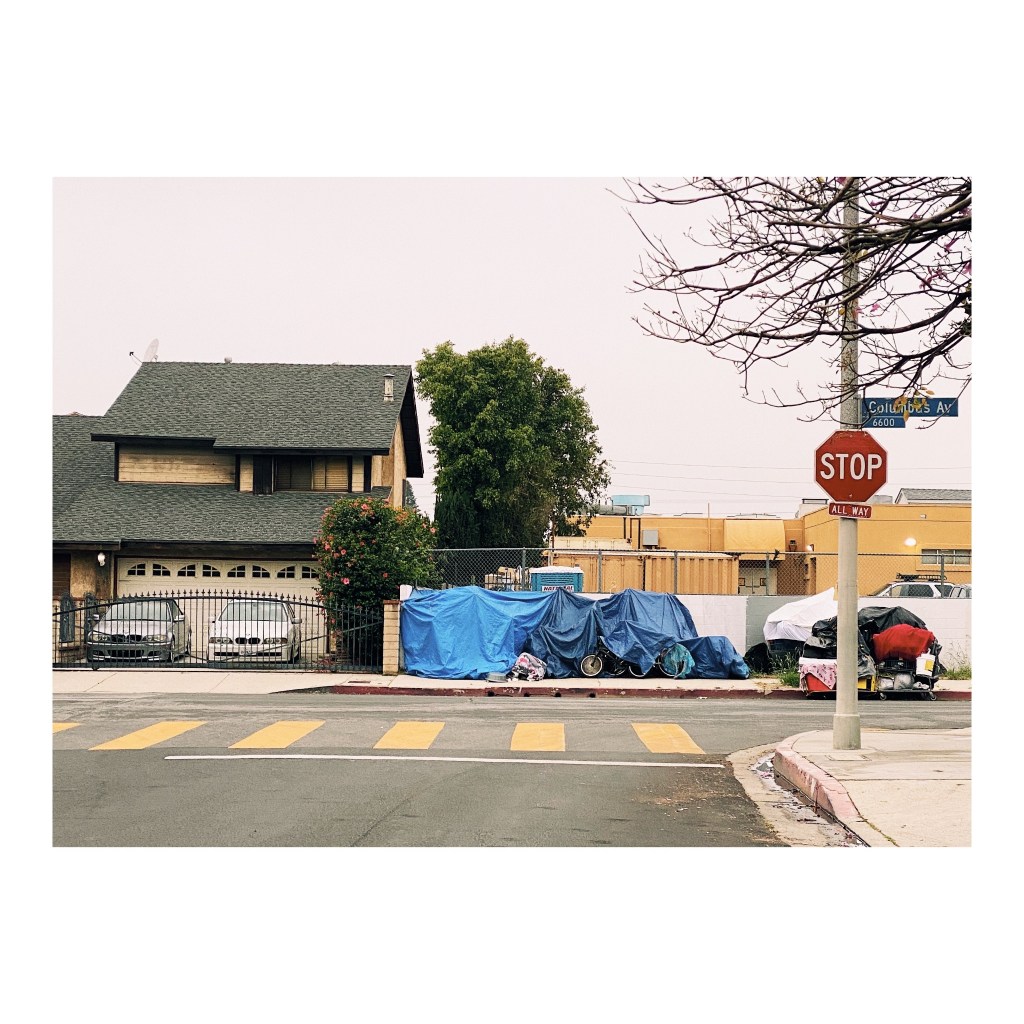
Now they have reappeared along Columbus Avenue across from the grammar school. While it’s doubtful anyone is actually learning grammar in that one-starred rated school, what’s certain is that the garbage camp is illegally set up in full view. 

When people wonder what drives Angelenos mad, it is this: there is no control on the disorder and criminality of this city and state. 

San Francisco, true jewel of the west, has gone to hell.

Los Angeles, costume jewel of the west, has followed suit.

And when mayoral candidates go on podcasts and talk ad nauseum about their humane and expensive solutions for the poor people who are homeless, you want to scream!

Why should the suffering of private persons, their addictions and mental illness, be allowed such a prominent and destructive place in the lives of all law-abiding citizens in the State of California?

“One of my proposals is to create a $1 billion revolving private equity fund with which to build permanent supportive housing. That’s housing that’s been costing $600,000-800,000 a unit. That can be cut to a third of that cost using a private equity model that has worked on the streets of Los Angeles,” says Mayoral Candidate Mike Feuer.

Is anyone knocked-up on drugs and alcohol going to sober up in a new, unsupervised housing unit?  

Here’s an idea: use the billions in homeless funds to send $100 Visa gift cards to legally housed residents, home owners and renters, who report trash camping in their neighborhoods. Top off the yearly payments to those who report the vagrants at $2,000. Thousands of Angelenos, short on money for gas and groceries, would be impelled to report vagrancy and clean up dumps that have destroyed our city.

Do the people burning down parks and sleeping under tarps on bus benches care to move into a new studio apartment? 

Trash camping?

Don’t permit it. Don’t allow it. Don’t normalize it.

Burning parks, setting fires along freeways, camping out on public sidewalks and streets. This is the state of California, the most technologically advanced region on the planet.

So much money, so much talk, so little results.

The Nervous Hour


Later in the year, if we are feeling better, or if we are alive, we may look back on March 11, 2020 as one of a number of dark days in a time of never-ending calamities.

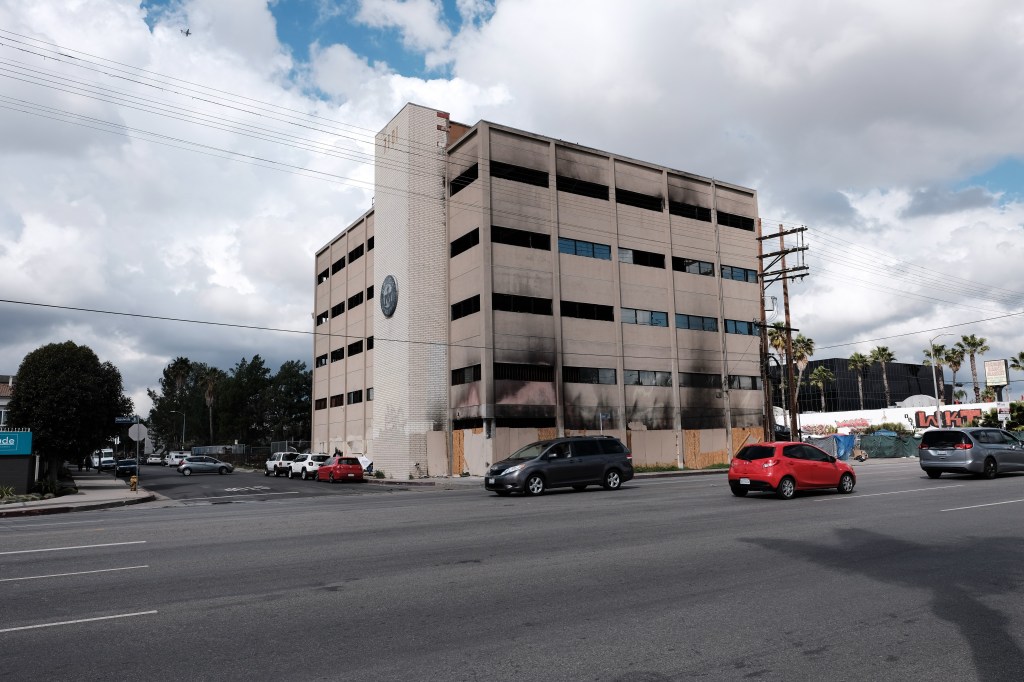
Today, as the Coronavirus was declared a pandemic, and the stock market crashed yet again, and the slow-motion, fast spreading virus appeared aimed for me and my nation, I walked past this gruesome, burned-out building at 7101 Sepulveda Blvd. It caught fire on November 24, 2019.

A 5-story office building that caught fire months ago, and is structurally unsound and unsafe, is the setting for a community of homeless owners. Where is LADBS? Where is Nury? Where is God?

I didn’t photograph the community of perhaps 40 or 50 men and women who make their homes just north of 7101. They are, of course, there illegally, but why the hell not?  I dared not disturb their encampment, a satellite skid row in a community, Van Nuys, that until this century, was tacky, but spotless. 

In 1967, at 7101 Sepulveda Bl., the building, the parking lot and a motel court, was photographed by Ed Ruscha, our famed artist, for a book he compiled called “Thirty-Four Parking Lots in Los Angeles.”

The photograph is in the collection of the Tate and National Galleries of Scotland. And the LACMA.

Like his other works, “Twenty-Six Gas Stations” and “Every Building on the Sunset Strip,” Mr. Ruscha used documentary photography unbeautifully to state unequivocally what we honestly are in our built forms. 

Ah, the Sixties, when we laughed at the bad designs of roadside architecture, parking lot covered suburbia, and those husbands and wives who only wanted to live in a $30,000 ranch house and barbecue steaks.   We thought anyone over 30 ridiculous, an old prejudice recently renewed.

The children of the 1960s and 70s are among the ones living in the tents with the rats and the needles and the trash. 

We have fallen further than anyone could have imagined in 1967. We have only to look baldly at the evidence in front of our own eyes. We don’t need Twitter to tell us things are rotten in the states of reality and mind.