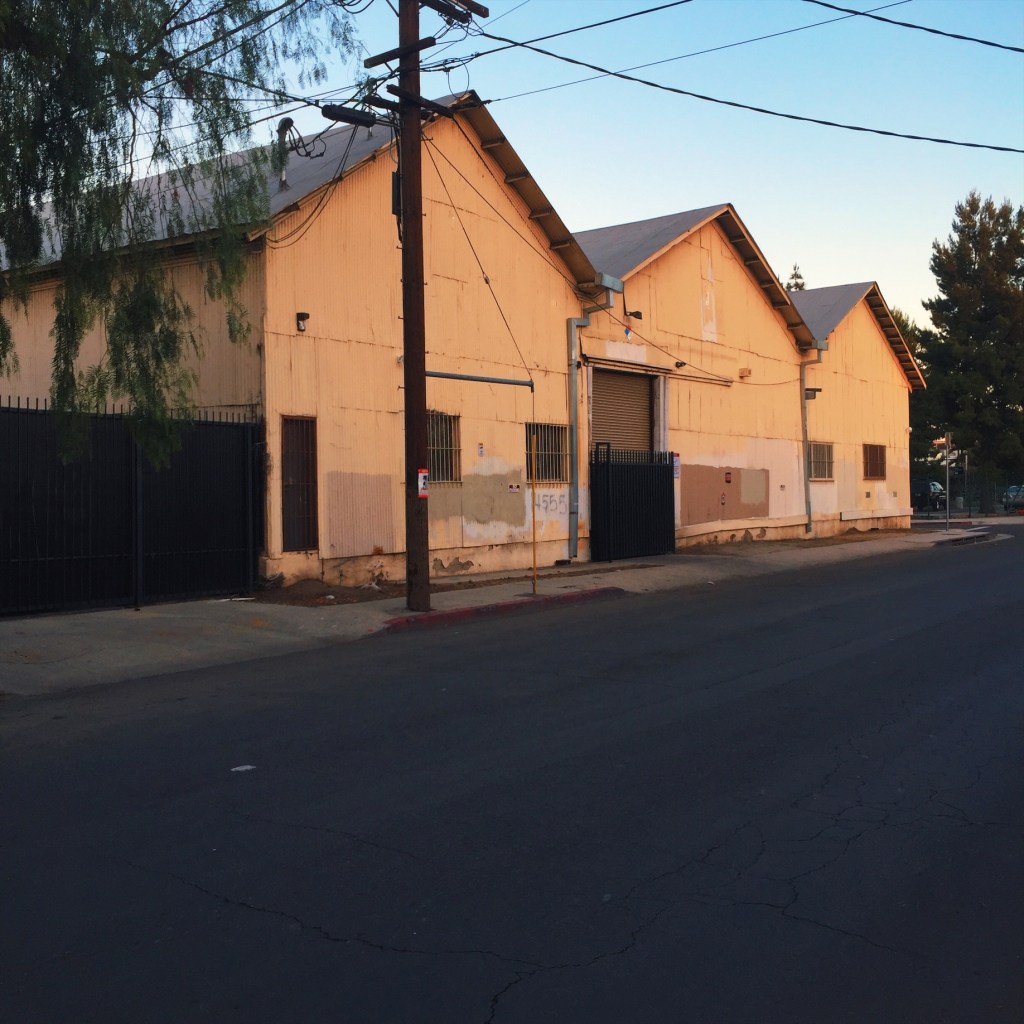
Valley Feed and Fuel


14551 Bessemer St. (Photo by Andrew B. Hurvitz)
Map 14551 Bessemer

On the NE corner of Bessemer and Vesper, here in Van Nuys, there is a steel walled storage warehouse with three pitched roofs.

Unmarked with any signs, it seems to have been there many years, and is characteristic of structures that once stood alongside rail lines to receive and to send out produce, grains, and manufactured products to faraway markets.

I dug up information from the city and found that “14551 Bessemer St.” was built in 1922, at a cost of $4,000, for the Fernando Feed and Fuel Co. It stood alongside the freight lines and was serviced by a dedicated Southern Pacific rail spur that went right into the property.

6/22/1922: 14551 Bessemer St. Van Nuys, CA Dept of Buildings Application

By 1925, chicken ranches were a big business in the San Fernando Valley, with an estimated 1,000,000 laying hens in the valley producing some 12 million eggs at a gross return of $5 million dollars. (In 2019 dollars, about $72 million.)

A 1925 LA Times article said that the Fernando Feed and Fuel Company started in 1916 as a feed store, but grew, in nine years, to 1,500 customers, large and small. Several other facilities for warehouse storage were located in Owensmouth and Van Nuys with a crew of 45 men and 15 trucks delivering feed and other orders to customers.

Chicken ranches, on one, two or five acres were a type of housing development that sprung up all around Southern California. They allowed families to feed themselves and also make a living selling chickens and eggs. At that time, other orchards grew oranges, walnuts, lemons, avocados, asparagus, and strawberries. 

A 1916 LA Times article praised “rose lined Sherman Way” (later renamed VNB) and the white feathered leghorns that dotted recently established (1911) Van Nuys.

“White Feathered Leghorn” Chicken. (source unknown)

Scientific work to bolster the agriculture industry and  promote poultry farming was often shown. 

In 1920, a four-day poultry institute was given at Van Nuys High School, by Prof. Dougherty, head of the poultry division, college of agriculture at U of CA, under the auspices of the LA County Farm Bureau and the Van Nuys Poultry Association.  A vaccination to fight chicken-pox was demonstrated there. 

Entrepreneurs and peripatetic innovators flocked to Van Nuys to raise chickens in advanced ways.

At a five-acre ranch on Woodman Avenue, in 1925, a recently transplanted Englishman, JCF Knapp, who had run plantations in Sumatra and India, had finally realized his lifelong dream to become a poultry farmer in Van Nuys. His operation had the capacity for 4000 chicks, and Mr. Knapp confidently asserted that he had not only a successful business model but a new kind of assembly line efficiency [for producing Grade A chickens on the scale of Model A’s.]

Also in 1925, WW Todd Realty Co. reported that a new set of chicken farms, totaling five acres, were to be built on Ranchito Av. near Tulare St. in Van Nuys. Some 100,000 laying Leghorn hens were expected to arrive in the valley within six months. 

[Ranchito Av., for the geographically ignorant, runs parallel to Woodman and Hazeltine, halfway between both. I found no modern maps with a Tulare St. however]

A 1920s aerial photograph of downtown Van Nuys shows the Fernando Feed and Fuel storage warehouse and the combination of commercial buildings along “Sherman Way” (renamed in 1926 Van Nuys Bl.) and orchards that were planted right inside the middle of town. VNHS is in the upper center/right of the photo. (below)

Van Nuys Feed and Fuel 1925, view NW

The chicken farms of the 1920s, which boosters never stopped boosting, gradually died out when the Great Depression hit after 1930 and sank agricultural prices.  By the late 1930s, suburban development came to the San Fernando Valley, and during the war (1941-45), industrial and defense plants, soldiers, military hospitals and the urgencies of war supplanted the rural way of life raising chickens. 

After 1945, the San Fernando Valley was the fastest growing place in the world, and every acre of land was transformed by housing developments, shopping centers, and car centered designs. 

The chicken farm, with its odors and mosquitos was now a menace, and housewives in Reseda were scared to let their children play outside.

Lost in the stories about the chicken farms is an old America that valued challenges and thought itself capable of surmounting them.  Poor, barely educated and hard-working people came here and somehow transformed Los Angeles into an advanced city that also grew its own food and sold off the surplus to an amazed and grateful nation.

Van Nuys, once a proud and admired center of advanced agricultural innovations, committed civic suicide. It destroyed its downtown by ripping up diagonal parking, widening the road to freeway widths, removing the streetcar, tearing down old buildings and replacing them with empty plazas and zombie moonscapes of trash and concrete. It embarked upon decades of laying down asphalt and laying out the red carpet for criminals, malcontents and derelicts.

Porn, marijuana, prostitution, bail bonds and slumlords were the largest industries by year 2000. Hopelessness replaced optimism and dystopia seized this district like an incurable disease. 

And politicians were thought worthy, not for their works, but only if their last names ended in the letters S or Z.

At least we have the Internet to thank for a glimmer of what it once was.

Yes We Can Grow It Here in Los Angeles


From the website of Ron Finley:

“FASHION INNOVATOR. MANIC COLLECTOR. RENEGADE GARDENER. VISIONARY. COMMUNITY ACTIVIST.

Raised in South Central Los Angeles, Ron showed an early passion and talent for fashion, and started his innovative clothing company, The DROPDEAD Collexion, in his family garage. The DROPDEAD Collexion featured Ron’s unique design vision expressed through top quality workmanship and materials. The line was a top seller with high-end retailers such as Nordstrom, Neiman Marcus and Saks Fifth Avenue. Ron Finley’s design ingenuity attracted the attention of many celebrities, and he was the go-to designer for several NBA and Hollywood stars, including basketball All-Star Robert Horry. The DROPDEAD Collexion set the standard for the fashion forward.

Ron Finley started collecting Black entertainment memorabilia, both for its preservation and also for a connection to his own history, and now owns one of the premiere collections of this genre. The current exhibition of posters from Ron’s collection, Ron Finley’s Travels Through Blackness: International Movie Poster Design 1920’s to 1970’s, depicts the progression of Black experience in the movie industry. It is an exciting show and generating much interest in the work!

When Ron found that it was impossible to buy healthy produce in his neighborhood he started growing his own! This turned into a passion for the art of gardening and the study of permaculture. As one of the founders of LAGREENGROUNDS.ORG, Ron Finley leads the fight to transform neighborhoods currently identified as “Food Deserts” into “Food Forests.” LAGREENGROUNDS installs gardens in homes throughout South Central Los Angeles free of charge, bringing healthy fruits and vegetables to families in need.”

Historic Van Nuys: The Jue Joe Clan.


This slideshow requires JavaScript.

The Internet is a strange thing.

Yesterday, while Googling for “Bike and Van Nuys Blvd.” in a search for a bike store, I came upon a family blog about a Chinese immigrant, born 151 years ago, who came to California to work on the railroad and ended up owning hundreds of acres of agricultural land and running a successful asparagus farm in Van Nuys in the 1930s.

“Descendant of the 2nd emperor of the Song Dynasty (Zhao Gunagyi), Jue Joe was born and raised in a chicken coop, in 1860. He grew up dirt poor and vowed that his descendants would never suffer as he had. So at the age of 14 he sailed alone to California, working as a cabin boy, and jumped ship in San Francisco. He sailed with 16 lbs of rice and landed with 1/4 lb left. So he went to the Chinese Six Companies for help. They sent him to St. Helena and Marysville to work the vineyards. Then he found work on the Southern Pacific Railroad. In the Mojave Desert he met Otto Brant who was hoboing his way to L.A. They became friends and together hoboed to that destination. According to San Tong, Jue Joe learned business from Otto Brant and what land and water would mean to future settlers of the L.A. Basin. “ – written by Auntie Soo-Yin.

In 1913, California passed a law that forbid aliens (Non-Americans) from purchasing land in the state. The openly racist ALIEN LAND ACT was aimed at a growing and prosperous Asian population whose success threatened white hegemony in the Golden State.

But Chinese born Jue Joe was friends with the very powerful Otto Brant. The fascinating story of how Otto Brant helped his Asian friend purchase land, in spite of the restrictive law, is retold by Auntie Soo-Yin:

“Jue Joe’s friend was Otto Brant, a prominent member of a Los Angeles land syndicate. Jue Joe discussed with Brant his desire to own and farm land in the San Fernando Valley.

“The name of Otto Brant’s land syndicate was the “Los Angeles Suburban Homes Company,” formed in 1909. It had 30 members all prominent leaders of L.A. (Harrison Otis and Harry Chandler of L.A. Times newspaper, Wm. Mulholland the L.A. Water Commissioner, M.H. Sherman, Grant the founder of Santa Fe Railroad and California Bank, H.J. Whitley the sub-divider, I.N. Van Nuys, to name a few).

Together the Syndicate controlled Tract 1000. In it Brant reserved 850 acres for his Title Insurance and Trust Company and, within the acreage, platted Van Nuys, Marian (Reseda), and Owensmouth/a.k.a. Canoga Park).

You could buy a small farm 1 to 10 acres, or a large farm 100 to 600 acres. In 1920 he reserved a large parcel for Jue Joe: 300 acres of prime property from Vanowen St to Haynes, and from Hayvenhurst to Balboa Blvd. It was segregated from a large ranch owned by Mr. Van Nuys, later was part of the Anderson Ranch, then bought by Mr. Dickey who later sold to Jue Joe.

Brant ( and later Brant’s estate after his death in 1922) held the Jue Joe property as Trustee for the benefit of Corrine and Dorothy until they came of age. When they came of age the land was deeded to them pursuant to the original trust documents.”

Auntie Soo-Yin fondly remembers her time in the 1930s growing up and living on a large agricultural ranch in Van Nuys, whose boundaries today sit just west of the Van Nuys Airport along Vanowen:

“I loved our homestead. Our ranch was self-sustaining. We had our own gas pump, an auto- and repair shop, fruit trees of nectarines, oranges, pears, apricots, lemons, figs, walnuts, etc. We grew strawberries, grapes, corn, and vegetables of all kind. Behind the big red barn that faces Vanowen St. we had a large chicken coop.”

The story of one American family in the San Fernando Valley, who didn’t let little obstacles like racism and the Great Depression get in their way…….

IMAGERY – The Celery Merchants of Venice – Hidden Los Angeles


Celery fields in Venice, CA, 1927, which was once known as “The Celery Capital of America”.

IMAGERY – The Celery Merchants of Venice – Hidden Los Angeles.

Urban Farming: Kansas City, MO.


An urban farm in Kansas City, MO.

DSC_0019 | Flickr – Photo Sharing!.