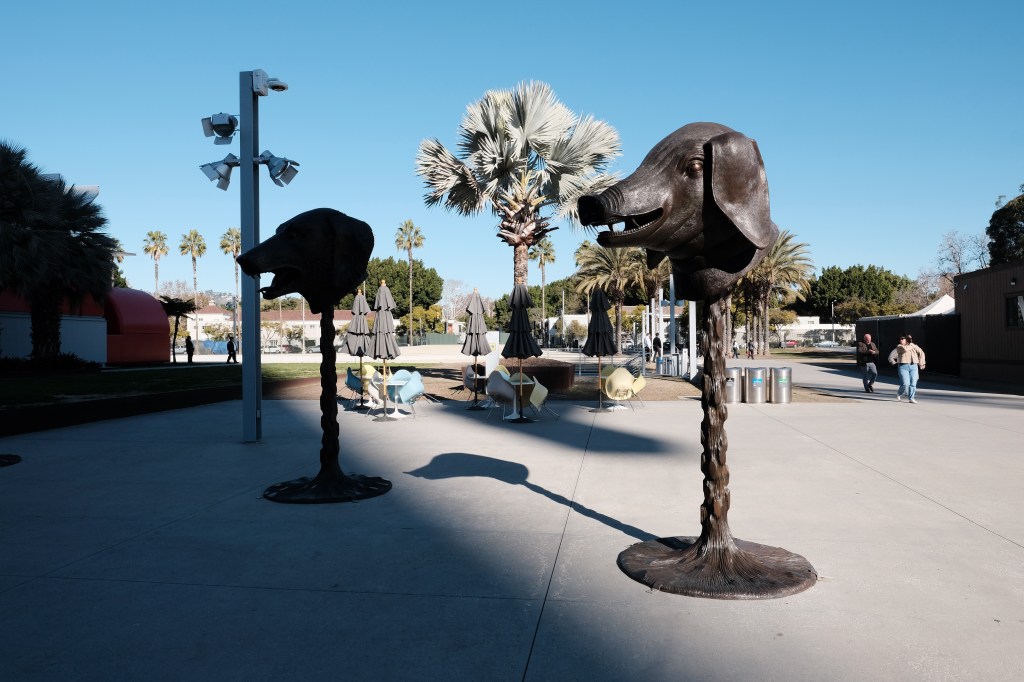
Before the rains came, we went to visit the La Brea Tar Pits and the outdoor grounds adjacent to the Los Angeles County Museum of Art and the new Academy of Motion Pictures.
Despite having lived in Los Angeles, close to 30 years, I don’t remember ever walking around the La Brea Tar Pits.
It was Christmas Eve and there was parking along 6th Street just east of Fairfax, past many homeless tents. We pulled into a free spot, got out of the car and walked into the park.
The first thing we encountered was a man under the giant rock screaming his head off while two amused security guards watched him from a distance.


We walked on, into a sculpture garden of enormous steel animal heads on steel posts arranged in decorative circles around a concrete patio. (The Zodiac Project by Ai Weiwei, his first major public sculpture.) It felt like a religious installation but the gods were animals, toylike and comical. Their creator is currently in prison in China. We are free to laugh at his genius and liberated to be ignorant of its meaning.

Further we went along the red columned walkway that connects various art galleries and the new Academy of Motion Pictures built inside the old May Company Department Store where Bette Davis played a washed-up actress working as a sales clerk in “The Star” (1952).
There were nice looking families dressed in nicer clothes, out for a holiday walk or visit to the museums or motion picture halls. You could believe right there that LA was a normal city with civilized citizens taking part in the arts like people do in any other city outside of the United States, forgetting the woman on life support shot in her car, December 17th, on the 101 in Tarzana, a kind of gruesome violence that is our everyday normality, and nothing special to speak of, only one human life.
The crazy screaming man walked past us still screaming, trailed by two security guards, and there were so many security guards in every part of the property, inside museums, at the entrances, around the park, and you knew they were there to provide security in an insecure city where mad people wander and sleep in tents and on bus benches in the tens of thousands. And drivers fire guns at other drivers.
We saw many smiling, delighted Indonesian tourists taking pictures next to the decorative lampposts on Wilshire near Ogden. Their bus waited with open door as the happy group posed in the sunshine. What did they think of this city and this nation, so much abundance, so much squalor?


The future of Wilshire was all around us: the demolished museum buildings and the new construction for the concrete exhibition rooms that will catapult over Wilshire and connect via an indoor sky bridge filled with rooms of paintings.
The new subway is pummeling along below, and there will soon be underground trains taking people from east to west and west to east just like every other modern city around the world where people take public transport to get around. But here it was a novelty, opposed for years by the most powerful and influential leaders in politics and business, but somehow, now, in the 2020s, we are getting a subway along the most important boulevard in Los Angeles.
Priorities of this city. So meaningful and so confounding. What we hold dear, what we think matters.
Traffic, car chases, murders, helicopters, homeless.
We walked west and saw the ugly but beloved, closed down coffee shop on the corner of Wilshire and Fairfax where Senator Bernie Sanders had a campaign office in 2016. His name and murals still decorate the building.


Into the Academy of Motion Picture Museum we went, past more friendly, young security guards, (aspiring screenwriters?) guiding us to a gift shop where they sell “The Godfather” memorabilia and nice sweatshirts, t-shirts, film posters and music albums.
The Renzo Piano designed lobby is perfectly proportioned modernism with crisp polished concrete floors and exposed steel ceilings, pipes and vents. There are also many precisely hung blood red signs to bring life to all the gray steel and tan concrete.
It’s all very well done, very architectural and quite elegant. In Copenhagen or Stockholm this would probably be a subway station.
There are some very nice restrooms and we went down to use them, past many masked security guards who ensure that urinating visitors come, like us, from the proper stratum of society. (I have a BA from Boston University.)
After peeing and handwashing we went outside in the La Brea Tar Pits Park walking past fenced in oil pools with signs explaining the stories of animals who walked here 10,000 or 20,000 years ago and were caught unwittingly in the tar for eternity.
Almost all the old LACMA buildings from the 1960s, 70s, and 80s have been torn down to make way for the latest incarnation of faddishness, but they somehow allowed one of the ugliest to escape death: the Pavilion for Japanese Art, a monstrously grotesque, green rocked assemblage of artificiality, concrete ramps and gigantic shoji screens; asymmetric, tangled up, psychotic and tortured, mumbling to itself, whose only real quality is being outdated.


The George C. Page Museum at the La Brea Tar Pits was our last stop. “A fiberglass frieze depicting Pleistocene mammals runs around the top of the building, held up by a black aluminum web called the “space frame,” writes the LA Conservancy.
It is also a 1977, Charlie’s Angels era building sunk into the ground and rising up with a sculpted mural along the horizontal façade, kind of monumentally casual and pop art significant in the mode of Hall and Oates in concert or Kristy McNichol skateboarding.
1977, 1957, 1937, 2001, 1985, 2022, 2032, 2055, 2077, 15,000BC.
What are these years and what do they matter? And what are the plans for Los Angeles and what do they matter?
Tear down, erect, tear down, erect, tear down, erect. Make big plans, wait a few decades. Discard.
Spend millions, spend billions, spend it lavishly, tell a story about a story and what have you got for a city?
The dead animals in the tar, the homeless on the streets, and the fenced in realm of enlightenment.
This is our civic space: a tar pit, an old department store, and a policed park. Maybe one day it will evince as much humanity as it aspires to, but for now, the answer to what Los Angeles will become is buried with the fossils.
You must be logged in to post a comment.