Matt Jalbert on North Hollywood and the Toxic Arrangements of Streets


North Hollywood.

Matt Jalbert writes:

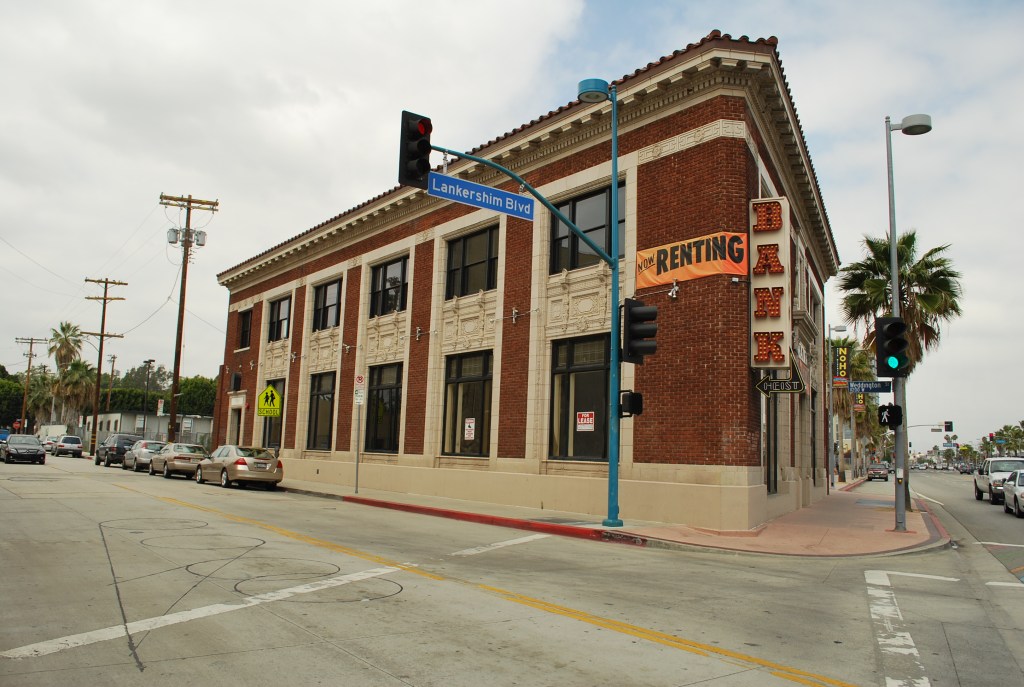
“I recently spent a short time in “NoHo,” aka North Hollywood (around Lankershim and Magnolia) where I was reminded of how utterly hopeless the sprawling project of Los Angeles is. There, in a “neighborhood” marketed to a new round of real estate suckers as an “arts district,” my overriding sense was of endless pavement, aggressive drivers, frightened and forlorn pedestrians, mostly lousy food choices, and a huge oversupply of commercial space. The same holds true for much of the San Fernando Valley.

Whatever promises were made to the American middle class by the developers of such living arrangements have been proven to be outright frauds. The L.A. pattern of car-centric living, especially in the post-WWII San Fernando Valley, is a cancer on society, evident on most of the citizenry, even some of those who profit from this arrangement.

North Hollywood in 2010 is yet another example of the failure of automobile-suburbs to result in healthy communities. Unfortunately, a few pretty buildings do not save this area, like the rest of the San Fernando Valley, from the toxic arrangements of streets designed for one mode only: vast flows of automobiles. That these areas are only a few generations old, yet are well advanced in their decay and social dysfunction, is all the proof any of us should need to recognize that the great experiment has failed and it’s time to make other arrangements now.

My sense is that people are starting to wake up to the lie they’ve been fed through the mass media — the lie that their car would set them free. (Stimulated by endless AM radio advertisements for leased Mercedes that would somehow make driving more bearable?)

Drivers are frustrated and angry, because no matter how rich they are, no matter how fat their asses grow, no matter how black and shiny their car is, no matter how witty the texts they write while negotiating the racecourse that is Lankershim Boulevard — they are imprisoned in a mobile prison cell, living an attenuated existence where every action they take is bludgeoned on both ends by a soul-killing automobile trip.

Better to rip the whole place down and rebuild it in a smaller, denser space. Keep a few of those fine old buildings, but otherwise, start from scratch, because what’s left on the ground for us all at this moment is simply not worth keeping.

God help Los Angeles. 26 years into my California experience and I’m finally understanding just how truly awful that place has been handled by the hands of man — in the service of automobiles. “

Matt Logue’s “Empty LA”


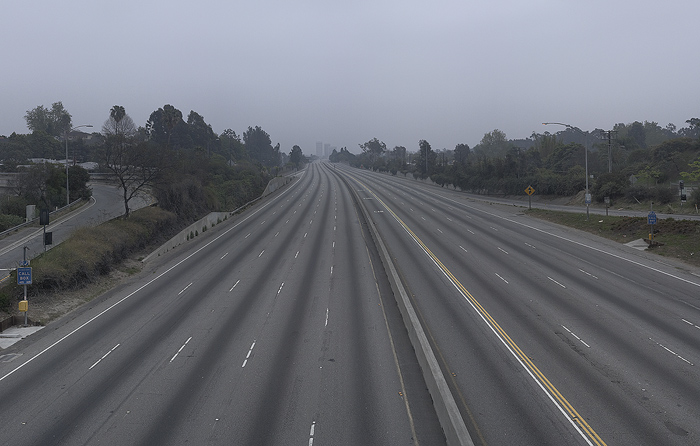
Photographer Matt Logue’s created images of the wide streets of Los Angeles absent automobiles. His photographs are now published in a book, Empty LA.

I often have wondered what it would be like to live in this city without fighting the daily war of driving.

Like David Yoon’s Narrow Streets, Logue’s digitally manipulated fantasies of Los Angeles bring up the sad reality about how ugly, depopulated, empty and inhuman the main arteries and roads are.

The architectural pathologies of Los Angeles…… the new modern grotesque monstrosities, the factory high schools, the high rise prisons, the Caltrans black glass behemoth downtown………… they will not go away even if the car does.

You can subtract the cars, but the roads are still four times as wide as they should be.

You can narrow the streets, but the buildings that line the road are ugly, blank, indifferent and cold.

It is not enough to reduce and diminish the automobile.  We must do this:

  • Los Angeles needs to rip up the enormous asphalt parking lots.
  • Urban agricultural gardens should replace the big box shopping center monstrosities.
  • Schools should set aside some land for residential, high-density walkable brownstones and cottages on LAUSD land.
  • The enormous roads must be downsized by center tree planting, jogging and biking paths.
  • Unsafe driving must be vigorously prosecuted and the fines for texting while driving, speeding, running red lights, and aggressive driving should be quadrupled.
  • A 50 cent tax should be instituted on every gallon of gasoline to finance region wide train, bus and light rail service.

Let photographers photograph Los Angeles in 2060 without having to resort to digital manipulations.

’64 Coupe DeVille


3404439441_b592a5340b_o

’64 Coupe DeVille, originally uploaded by here in van nuys.

Epitaph for the 20th Century.


General Motors Century Cruise, originally uploaded by Zane Merva.

As big and powerful and immortal as GM once was, it could not survive in a nation that had no policy for reducing its dependence on oil.

Think about it. For 30 years, GM has been struggling. And that is just about the amount of time that the US has been involved in an ongoing “Energy Crisis”. When the price of oil goes up, people drive less or think about buying smaller cars. When the price goes down, the drivers go back to larger cars and trucks. What company could possibly produce vehicles to withstand this constant instability of fossil fuels? Would you expect McDonalds to stay profitable if beef went from $10 a pound to $300 in one year?

Give GM some credit. They have revamped and improved their autos so that they are just as good as anything Tokyo produces. Quality is not the issue, the national lack of an energy strategy is. It influences everything from terrorism to Iraq, from sprawl to global warming.

The car makers have missed one point in these years, however. They would have been better, all along, if they had been forced to produce energy efficient cars, and cars that did not emit pollutants.

Instead, we’ve spent the last 30 years in a fantasy where we can consume all the deadly oil we want, and then wonder why our planet and our industries and our way of life is standing under the executioner’s rope.

Los Angeles Traffic: 1947


1947: Traffic in Los Angeles/ Olive and 6th/ Credit: Life Magazine

In 1947, Life Magazine published a photograph of Los Angeles trafffic, near Olive and 6th, downtown.