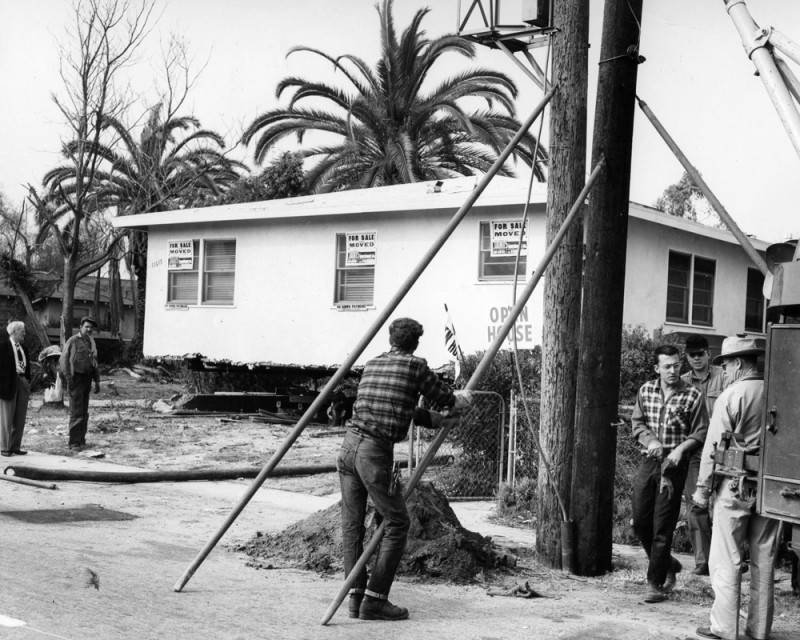
In the 1950s and early 60s, the expansion of the Ventura and Hollywood Freeways was accomplished by massive bulldozing of parks and houses.
May 11, 1961 reads “The view from the tip of North Hollywood Federal Savings and Loan Association building currently shows a westward view of unfinished freeway ramps and and [sic] cleared ground. Construction is expected to be completed on this last remaining gap in the Ventura Freeway, connecting the Golden Gate [sic] Freeway and the Valley extension of Hollywood Freeway, by late 1962. The project will provide a second freeway route into Los Angeles for Valley motorists without their having to use the usually congested Hollywood Freeway. Officials expect Hollywood Freeway traffic will be cut 15 per cent by the addition.”“Photo shows the $3,300,000 next link in the Hollywood Freeway that is now under construction. Link will cross over Vineland Avenue at Acama St., about half a mile north of Ventura Boulevard. Motorists who use Vineland Avenue will be glad when this section is finished, for the underpass will be six lanes wide instead of the present two lanes. The Hollywood Freeway bridge already is completed and the cement forms are being removed. Beyond this, at Moorpark, a cloverleaf will be built. Photo dated: December 14, 1956.”February 17, 1956 reads, “Telephone company workers in foreground take out pole to facilitate removal of apartment house building from 11017 Acama St., North Hollywood, as work progresses on structures which will carry extension of Hollywood Freeway across Los Angeles river at Lankershim boulevard and across Vineland avenue above Ventura boulevard. Structures must be built before work begins on freeway itself.”August 10, 1960 reads, “Movers star in ‘The Apartment’ – There’s a 12-family vacant lot at the corner of Magnolia and Westpark in North Hollywood after building owner Ben Joseph of Studio City House Sales Co. took his 12-unit apartment house up the street to Burbank boulevard. Building moved because of planned freeway extension.”November 7, 1957 reads, “Nearing completion – Looking southeast toward Cahuenga Pass and Hollywood Freeway, this view shows nearly completed bridge over Vineland avenue on North Hollywood extension of freeway, which will be opened to traffic near end of month. Vineland Avenue and Moorpark Street will both be widened to accept heavy flow of vehicles when section is opened. Freeway will eventually extend 6.8 miles across Valley and connect with Golden State Freeway. All photographs in this series were taken from helicopter piloted by Bob Gilbreath of Southwest Helicopters Inc.”
North Hollywood, never rich in parkland, suffered the loss of some 20 acres of parkland to accommodate the construction of the 170 which today slices through and forms a new border between more affluent “Valley Village” and less wealthy North Hollywood.
It was cheaper to take parks than pay private property owners to seize land for the highways. Yet there were also many thousands of buildings moved or destroyed when California embarked on its mad program to make us completely dependent on motor vehicles.
September 9, 1961 reads “Community and city officials dedicate the last of the municipal parking lots to be constructed in the North Hollywood business area. Participating in the ceremonies at the Magnolia boulevard lot, west of Lankershim boulevard, are (from left) Everett M. McIntire, North Hollywood Chamber of Commerce president; Verna Felton, honorary mayor of the community; Ted Rathbun, parking chairman, and Everett Burkhalter, First District councilman.”Pictured are several vehicles preparing a 20-acre parcel of North Hollywood Park for construction of the Hollywood Freeway extension. The park strip, approximately 250-ft. wide, is located on the west side of the park between Chandler and Magnolia Blvds. The $3 million segment will extend from the new Ventura Freeway to Magnolia Blvd., and will include several bridge structures. The eight-lane freeway will ultimately join the Golden State Freeway north of Roscoe Blvd. in the vicinity of Laurel Canyon Blvd. Photograph dated September 13, 1961. “Lou Kerekes, 5004 Bakeman, North Hollywood, on his daily walk with his dog, Cheeko at North Hollywood Park. On this day, they stop to contemplate a portion of the 20-acre parcel of North Hollywood Park, which is being used in construction of the Hollywood freeway extension. The park strip, approximately 250-ft. wide, is located on the west side of the park between Chandler and Magnolia Blvds. The $3 million segment will extend from the new Ventura Freeway to Magnolia Blvd., and will include several bridge structures. The eight-lane freeway will ultimately join the Golden State Freeway north of Roscoe Blvd. in the vicinity of Laurel Canyon Blvd. Photograph dated September 13, 1961.”February 17, 1956 reads, “Salesman S. E. Stafford, from Janis Investment Co., ponders sale of buildings being moved within next two weeks to make room for Valley extension of Hollywood Freeway. Agreement for construction of freeway is to be submitted to Los Angeles City Council within six weeks.”
Today we live in a reality that we think is normal but was paved and paid for by our elected ancestors. Car chases, global oil with wars and climate change, air pollution, shopping centers that took away orange groves, every five-minute traffic reports, the self-defeating obsession with oil prices, the decline of walking and the promotion of obesity are all linked in some way to the freeway system.
Our fervor to ride our cars to the Starbucks and drop our kids off at school, empowers Saudi Arabia, Russia, Iran.
Our question for every apartment building and every house built in California: where will they park? Nothing architectural or aesthetic, nothing about the urgency of housing, only one thing on everyone’s minds:
Where will they park? Where will they park? Where will they park? Where will they park?
If by some miracle there was a proposal to build Rockefeller Center in the middle of a parking lot in Van Nuys behind rows of empty storefronts, there would still be only one question: where will they park?
We would rather live in environmental degradation than rethink our freeway and road addictions.
But in the 1950s every destructive program was considered an improvement.
You must be logged in to post a comment.