Where Have All the People Gone?


It has been some two and a half years since the pandemic began, and somehow it is sort of (not) over. In that time, since March 2020, America has been in a slow-motion meltdown, proceeding quickly, an epoch unlike any other with riots, lockdowns, and a lunatic who would not and will not accept that he is no longer President.


There was always Santa Monica for me. 

Since I came here in 1994, that always cooler place near the ocean was a destination for dining, drinking, shopping, biking, and hiking. It was where you took out-of-town guests, where you went to show them, half truthfully, that LA was just as walkable, vibrant, urbane and enjoyable as New York.

I went down there yesterday to cool off and what remains on Third Street is deserted. Gone are the crowds, and gone are the stores: J Crew, Banana Republic, Bloomingdales, Barneys, Barnes and Noble, Old Navy, and Levi’s.

The sun still shines brilliantly. The buildings, for the most part, are well-kept. But the life and the crowds are absent. Benches, outdoor dining, storefronts, are lifeless. There are “for lease” signs everywhere. 

In some ways it feels as if the clock has spun backwards before gentrification, when Third Street was awaiting revitalization, when JC Penney was the big store. 

We walked, expecting to come to that fancy outdoor mall with the wine bar on the floor and Bloomingdale’s, the blowout salon, Jonathan Adler, Starbucks and CB2, but all of it was gone, shuttered, closed down, papered over windows and nothing. All the jobs, all the merchandise, all the interactions between people and goods, work and profit, and millions in tax revenues for the City of Santa Monica, wiped out.

This is August! This the height of tourist season! This is when thousands of families come to Santa Monica to partake and enjoy everything this city has to offer! And hardly anybody was there on a Saturday morning! Except for the Farmer’s Market.

The low point for me was May 31, 2020 when mayhem and looting destroyed many businesses, the murder of George Floyd acting as irrational justification for mass robbery, fires and stealing. I remember the BMWs and Audi’s pulling up to Vans, the broken glass, the fat, young, tattooed trash in black leggings, with boxes of sneakers getting into their cars and driving off. I saw the mobs work their way up the street and hit everything they could get their hands on. 

And now Santa Monica is a quieter and dying version of its pre-pandemic, pre-George Floyd self. Will it come back? Detroit, Newark, The South Side of Chicago, Watts, 1965, 1967, 1968…are they somehow the ancestors of Santa Monica’s fate? Or does Santa Monica belong with Beverly Hills, often assaulted, but easily available to afford plastic surgery, police protection, and investment capital?

Will Santa Monica slowly fade off the way so much of Los Angeles has, all the places that once held joy and nice stores and nice memories: Miracle Mile, Westwood, Bullocks, 7th Street, Van Nuys Boulevard, the May Company?

Los Angeles is fickle, people dispose of anything inconvenient or unpleasant if it does not offer amusement or distraction. A destination without anything to offer is DOA.

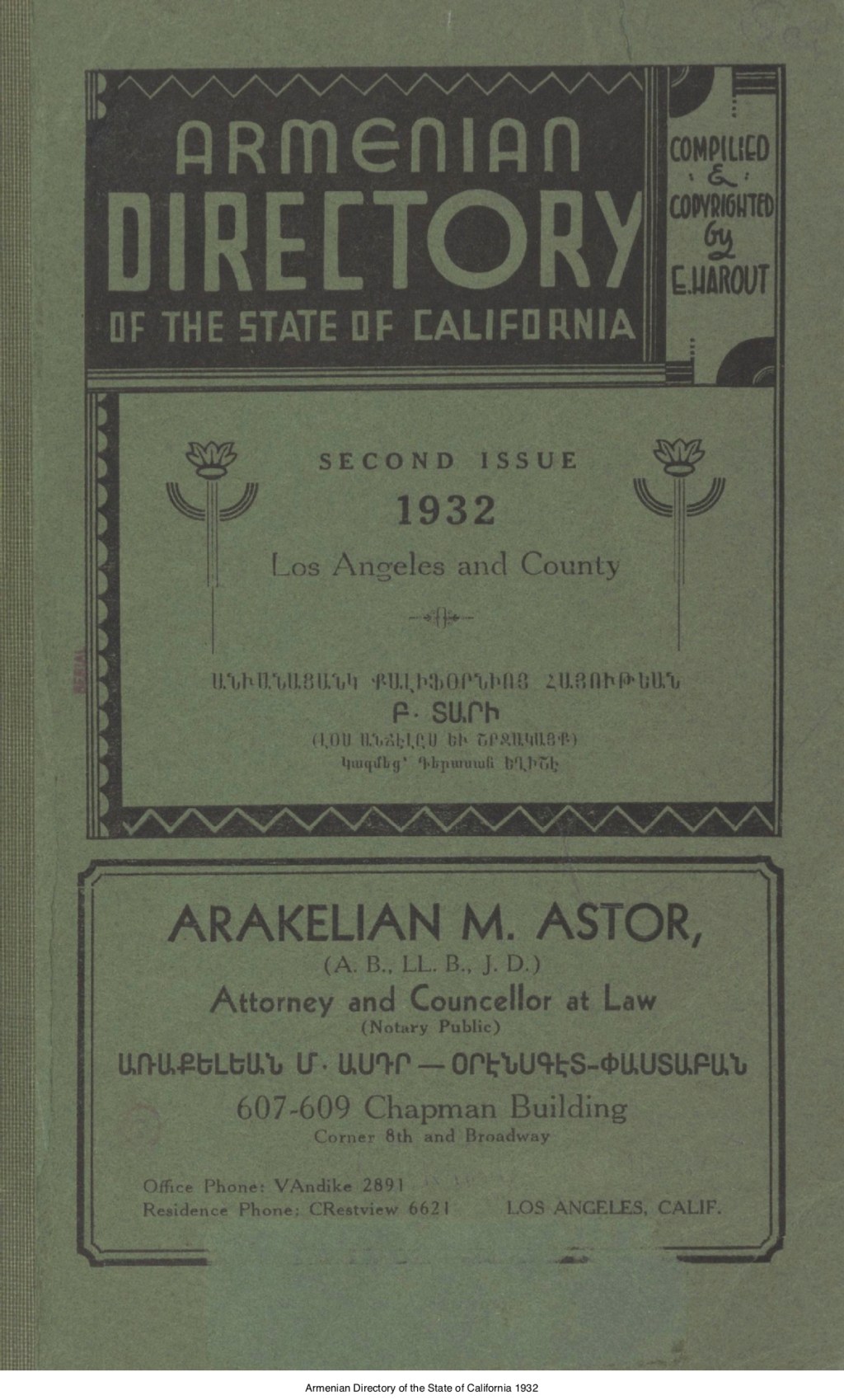
The Armenian Directory: 1932.


Within the collections of the Los Angeles Public Library there are city, business and phone directories going back to 1873.

Among the historic books can be found The Armenian Directory of The State of California, 1932, related to the Armenian community of Los Angeles, at that time, numbering a few thousands, many of whom were settled in Pasadena, and throughout the Southland.

The first wave of emigration from Armenia came after the First World War when Turks murdered millions of Armenians during the breakup of the Ottoman Empire. Most of the refugees came from Western Armenia near Turkey.

Here in Los Angeles they established an industrious, skilled, hard-working community. They built churches, founded benevolent societies, and created cultural and social institutions centered on music, food, and dance. 

Their professions in their new adopted city were many and varied and included dentists, physicians, attorneys, tailors, grocers, bakers and funeral homes.

The Standard Crate Co., Inc. built fruit boxes and gave “special attention to Japanese customers” many of whom grew citrus. Ten years later these same clients were rounded up and put into detention camps, a tragic and historical irony the Armenian advertisement could not foresee or imagine.

The Hollywood movie industry was already famous worldwide when the Antranik Dramatic Company advertised their actors. Mastery of frivolity has always been important in this city.

It seems that many Armenians did well here. 

The Altoonian Family, and their sedan, is seen below in a 1926 photograph. The 1933 directory lists an “Altoon Apartments” at 2405 S. Hoover, and several Altoonians who lived at that address.

At Joe’s Garage, 2505 E. 4thSt. the motto was “Once a customer, always a customer.”

A magnificent Art Deco ad for signs is a last breath of the 1920s with its rhythmic patterns and syncopated layout.

The Luther Eskijian family is shown in 1924, perhaps in front of their home at 1738 Bridgen Rd., Pasadena. Boys are in knickers, those short pants that children wore up into the mid 1930s.

The Constantinople Cigarette Shop at 356 South Broadway made special monogrammed cigarettes “which makes [a] splendid gift or present for your friends and relatives for their birthdays.” 

The International Grocery Co at 134 N. Main St. had such Armenian foods as aghy banir, lablebi, boulgour, chadana and fistuhk. Or cheese in brine, roasted chickpeas, crushed wheat, pine nuts and pistachios.  A one-gallon tin of olive oil was an enormous luxury item priced at $2.50 ($25.68 today).

Elegant tailoring was the province of Gregory H. Chashoudian at 4562 Beverly Blvd east of Western Avenue. His skills were endorsed by B.R. Ware, Attorney, who said Mr. Chashoudian’s suits were “entirely satisfactory” and reasonably priced.

The world was in the midst of the Great Depression. 

Yet looking through the pages of the Armenian Directory in 1932 one feels a sense of pride and admiration for these industrious people who overcame such grueling tragedies and unjust cruelties. 

They somehow made it to Los Angeles, CA and established stable and prosperous lives in a new and unfamiliar land.

Densmore and Stagg, N. of Saticoy.


Drive west on Saticoy St., past the 405 and turn right/north, onto Densmore Avenue. 

You are still, according to Google Maps, in Van Nuys. (all apologies to Lake Balboa, which seems to have some fourteen boundariesaround its neighborhood.)

On Densmore, near Stagg, you’ll find, as I did, a neat, monotonous, hard-working district of small companies; mostly hidden behind bricks and barred windows.

Creative Age Productions at 7628 Densmore is there. They publish beauty magazines. Nailpro, Eyelash and Dayspa are some of their best-known publications. These titles are often competing with mirrors for customer attention.

They are neighbors with: Superior Shipping Supplies, New Rule Productions, Regency Fire Protection; and Kedem Properties, 7752 Densmore, which sounds like a Kosher wine but is actually a commercial property company. 

Black Sheep Enterprises, at 15745 Stagg, manufactures theatrical and stage drapery, a specialty one cannot buy off the shelves of Target.

The Katsu-Ya Group at 15819 Stagg owns nine sushi restaurants around the Southland. They are incongruously housed in a white and brown brick Mexican style building with arched designs.

Katsu-Ya Headquarters at 15819 Stagg St.

And the American Rubber and Supply Co. at 15849 Stagg St. has been in business since 1947 and is a supplier of industrial rubber products. Your car mat, your yoga mat, and your kitchen mat, next to the kitchen sink, might have all come from here.

New Rule FX at 7751 Densmore makes special effects props and supplies for movies, TV and theater. If you need piles of fake US currency, realistic cheeseburgers in rubber, or a room full of exploding balsa wood furniture , then this is the place to shop.  Their free-floating, fantastical, imaginative fantasies are constructed behind a dismal, prisonlike façade of white cinderblocks and steel bars.

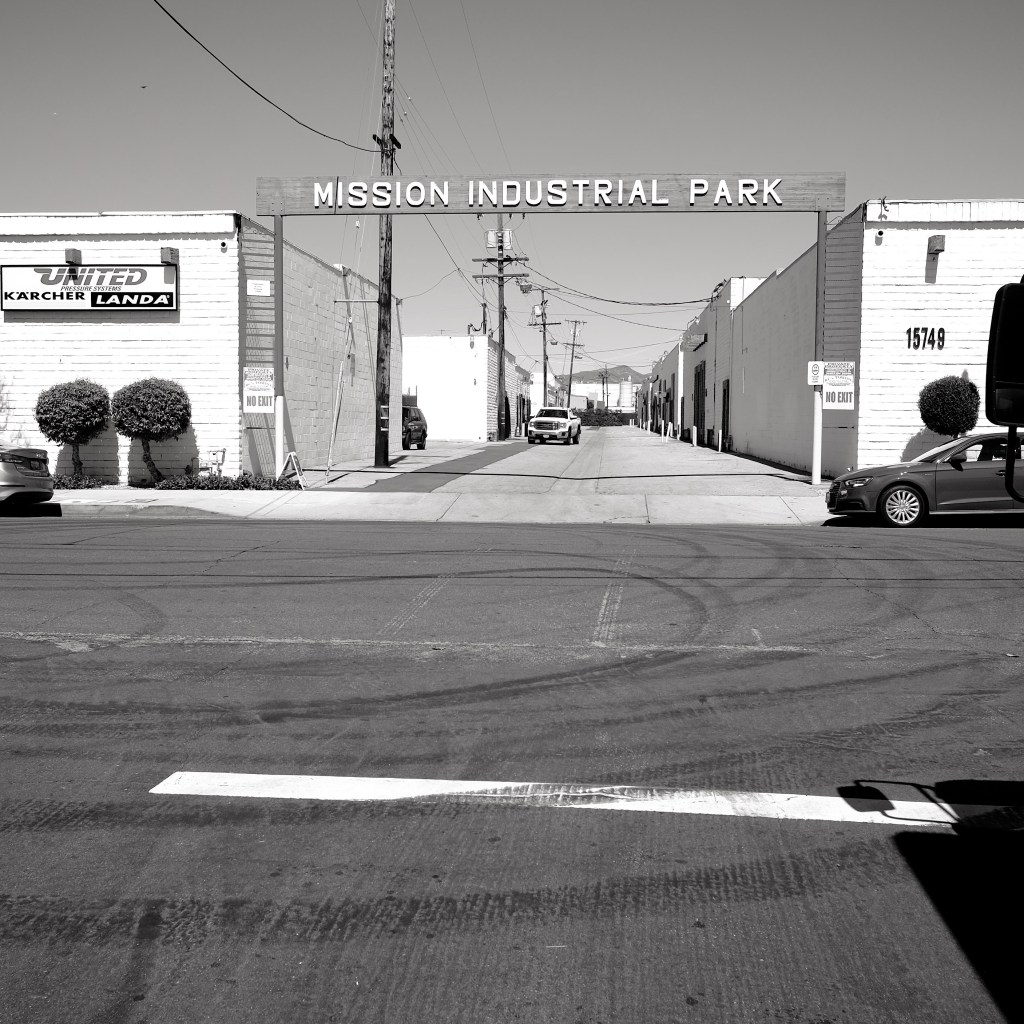
Where Stagg St. bisects Densmore Ave is Mission Industrial Park, announced by a two-posted, two-fisted, old Western kind of sign with raised letters on a wide wooden board hung 20’ high over the street.  It welcomes you to a white-walled alley of various buildings presumably under one owner who felt compelled to establish an identity for her vastly unremarkable assemblage.

Mission Industrial Park.

We went all around here, on public sidewalks, a few days ago, to shoot some photos for a mens’ fashion brand called Magill Los Angeles.  

James and Carter were the models.

Along Densmore Av. Carter (L) and James.

James was 19 and had long blonde hair and said he was born in South Los Angeles but had moved with his father to North Dakota. He was now living in New York City and visiting Hollywood to strike up a modeling career. He had the dazed and confused 70s aura from juvenile and stoned Reseda. He works at McDonalds now but may well be famous in 2029.

Carter, actor, came from North Carolina and was well-read, articulate and sensitive to both words and pollen.

James

The day was sunny, the wind was blowing, the boys were happy and we went to eat tacos later at Tacos Hell Yeah which they said was their best ever meal in LA.

Tacos Hell Yeah
7607 White Oak Ave, Reseda, CA 91335

____________________________________________________________

Those industrial compounds, like the Stagg/Densmore District, are the hidden places in the San Fernando Valley that nobody knows about. 

Tidy, productive, industrious, they are the old lifeblood of Los Angeles, where your late Uncle Bernie, with the cigar in his mouth and the bad gallbladder, set up shop after the war and bought a three bedroom, rock-roofed ranch up on Zelzah Avenue with a delightful kidney-shaped pool.

He had little patience for tears, or men who didn’t know the difference between a wrench or a pliers, having served up ice cream at Montgomery Ward until he enlisted in ’42 and saw action at Guadalcanal. He was never bored, because he was always busy, and you vowed you would never become Uncle Bernie but you’ve done quite worse, haven’t you? He had work and a family, and a company, and a paid for house and you made fun of it, but now life laughs at you.

Aside from the work that goes on inside these shops, there is nothing to do in this area for someone in search of stimulation. Densmore and Stagg and parts around here are boring, without street life. Yet men and women in these enterprises are engaged in work, absorbed in inventions, and creating products that are, in many respects, quite interesting.

Along Stagg St.

Magill: Target/N. Van Nuys
(Not near the Densmore/Stagg/ Mission Industrial District)
James on the Raymer St. Bridge, Van Nuys, CA.

Stop, Thief!


Yesterday, around Noon, I went to meet my brother for lunch near his office at LaBrea and Wilshire.

I was early. We weren’t meeting until 1pm so I took a walk along the south side of Wilshire heading west, passing Detroit, Cloverdale and S. Cochran.

On the north side of Wilshire, I saw a middle-aged Asian woman in a green apron chasing a red-haired, plaid shirted male east towards Detroit. She was screaming, “Stop him! Stop him!” He kept looking back and outran her, eventually boarding a bus parked at Wilshire and LaBrea.

I ran too, crossing the street, breathlessly getting on the bus and telling the driver, “You have a man who just robbed a store on your bus. He is in back. I am calling LAPD!”

The driver waited. I called LAPD and reported a “hold-up” of a store on Wilshire and that the suspect was aboard a Metro bus. The police operator made me repeat the description of the suspect several times (“red hair, plaid shirt, middle-aged, white”).

I stood next to the bus, on the sidewalk and waited. The bus and its passengers, including the suspect, waited.

Then after about ten minutes, cops arrived.

Two police cars, including one unmarked, pulled behind the bus, shoved the rear engine cover up and crouched down, drawing their guns. Another car of cops went in front of the bus, and the police told us to all get out of the way.

I ran to the corner with others, and we watched, behind building at LaBrea, as the cops worked.

Then the driver got off and pointed at me, and a cop, his silver gun drawn, rushed at me and told me to put my hands up, to face the wall, to get down on the ground. His partner also ran at me, and I yelled, “I’m the one who called the police!” My hands up in the air, guns aimed at me, I was suddenly endangered and suspected of something. I don’t know what.

I was told to hand over my wallet and ID. And then I was allowed to put my hands down. The officer asked if my current address was the same as the one on my driver’s license.

“Yes, sir. Yes, sir. Yes, sir…”

The suspect was removed from the bus, laid down on the sidewalk, handcuffed, and the other passengers got off and ran to another bus, parked down the street.

My brother came out of his office in the Samsung Tower, crossed the street, and asked me what happened.

Sweat poured down my face. We walked over to a restaurant for lunch. I ordered an iced tea, sat down at a table, wiped my face with a napkin and told him the true crime story.

Later, after lunch, I walked down Wilshire to find the lady who had been chasing the robber. I found her inside a little Korean convenience store. The cops had already visited her. Speaking not much English, she thanked me for my apprehension of the suspect, an action that might have ended my own life.

She gave me a cold iced tea.

Oh, and she said the thief had stolen three packs of cigarettes.

Lido Pizza and Other Businesses….


CSC_5928

Christmas 1948: Van Nuys


196049_10200186606895823_1743355000_n

481540_10200186560574665_198265382_n

228316_10151253674844463_1895827878_n

These 1948 clippings were just sent to me by Phil DePauk, who grew up here in the 1940s and 50s and now lives in Virginia. The photo of Van Nuys Boulevard at Christmas, however, is from an unknown source but is also dated 1948.

Mr. DePauk has a large collection of photographs and memorabilia, some of which is related to his family’s former business, photography.

Before regional shopping centers, Van Nuys was a regional shopping center, centered on a street, Van Nuys Boulevard. There was a streetcar running up and down, diagonal parking, and many thriving businesses.

And there was a Van Nuys Christmas parade attended by many.