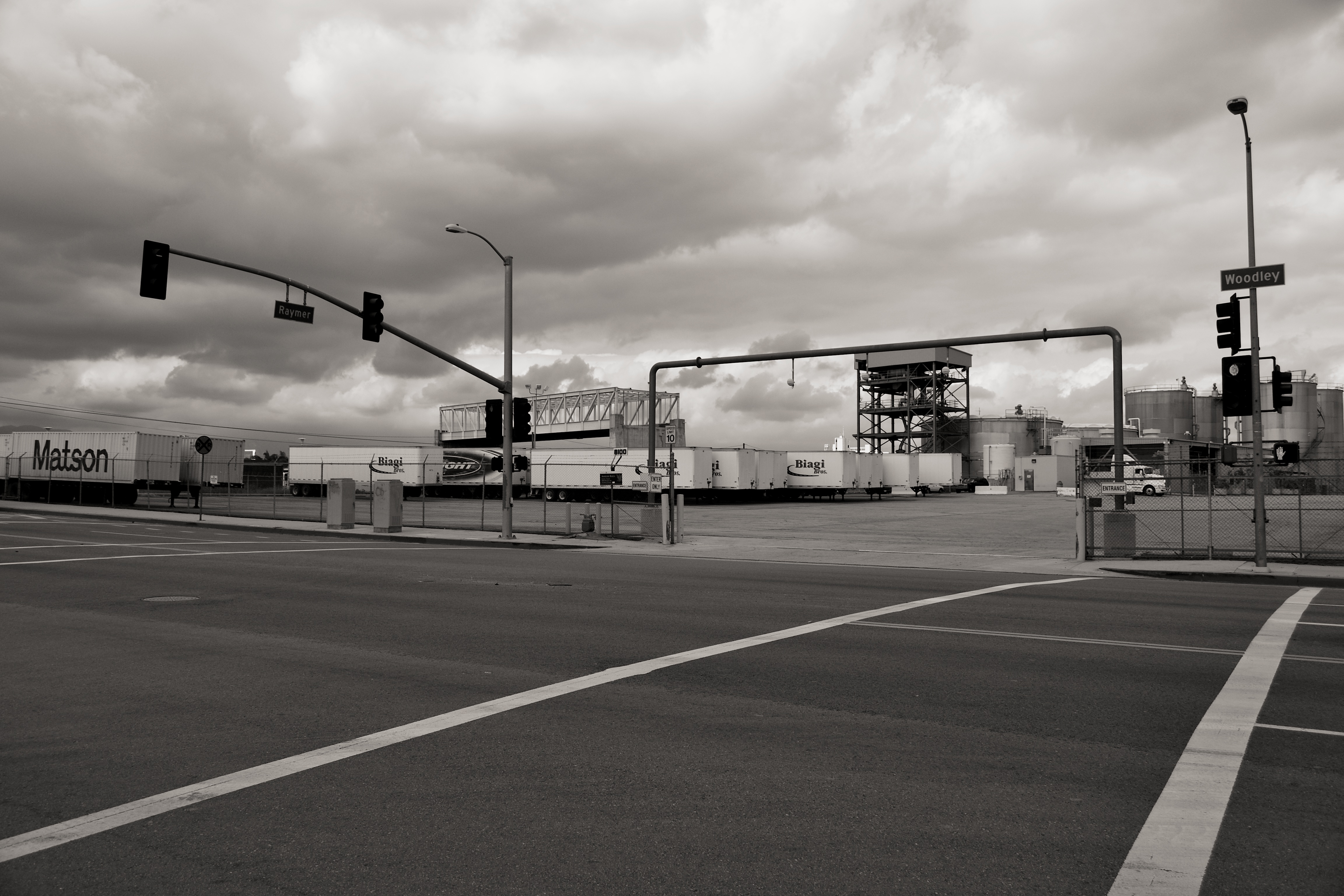
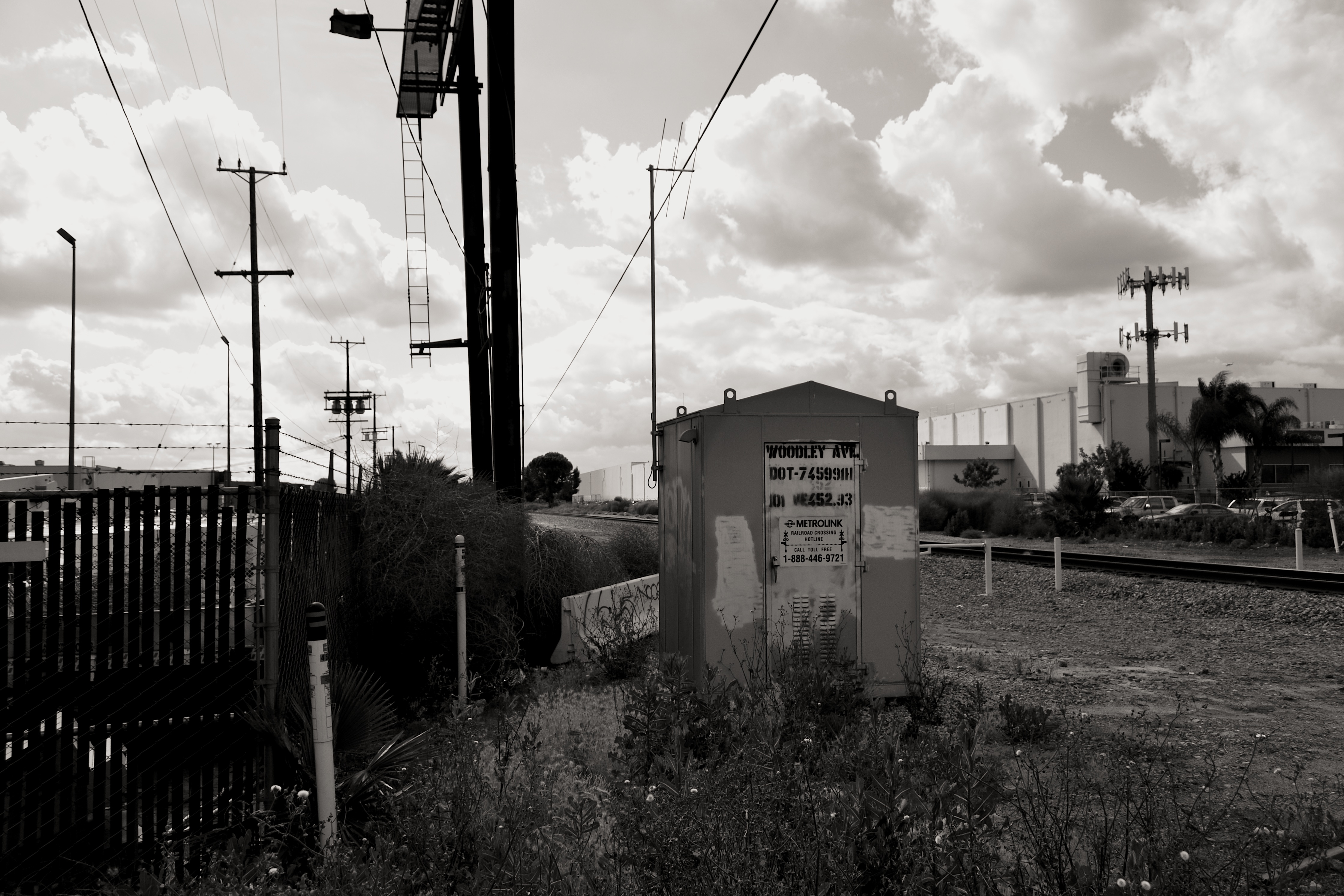
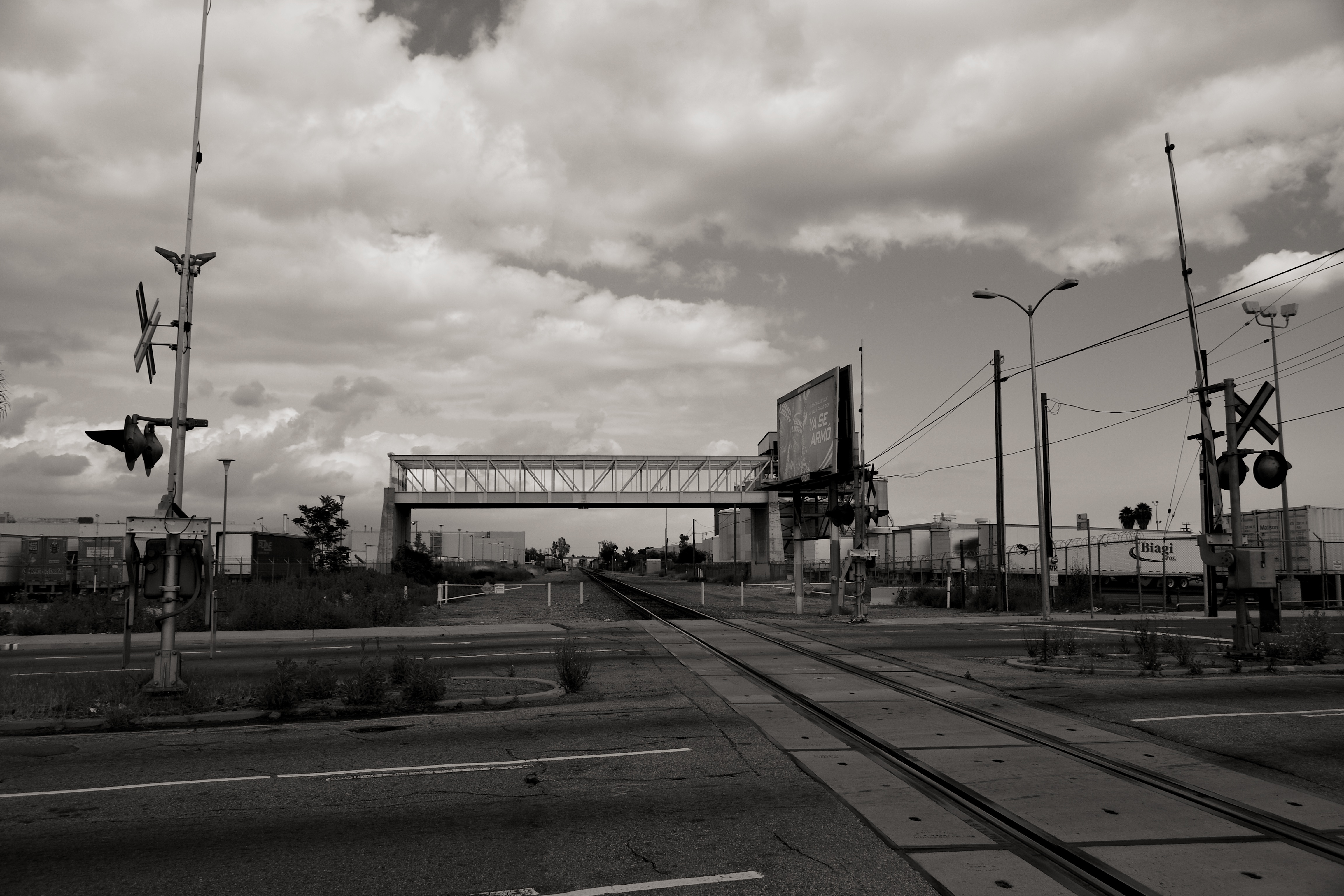
Woodley Avenue Near Roscoe.


Woodley Near Roscoe, Van Nuys, CA b
Woodley Near Roscoe, View South, Van Nuys, CA
Woodley Near Roscoe View East, Van Nuys, CA.

West of the 405, the vista opens up.

The skies are big and the mountains vast.

This is the land of beer and jets, trucks and steel; gasoline, fire and the burning sun.

This is the Van Nuys Airport, the Flyaway, the Anheuser-Busch Plant, many warehouses, and an enormous sod farm.

Here men and women are working, a necessary condition.

And the horizon of the San Fernando Valley, the blue skies and the straight wide streets, the planes taking off, the delivery trucks speeding across Van Nuys, and a commuter train blowing its horn; this is work and we are in need of work and we live and work; and hope that work returns to our nation as it did in times past.

Historic Van Nuys: The Jue Joe Clan.


This slideshow requires JavaScript.

The Internet is a strange thing.

Yesterday, while Googling for “Bike and Van Nuys Blvd.” in a search for a bike store, I came upon a family blog about a Chinese immigrant, born 151 years ago, who came to California to work on the railroad and ended up owning hundreds of acres of agricultural land and running a successful asparagus farm in Van Nuys in the 1930s.

“Descendant of the 2nd emperor of the Song Dynasty (Zhao Gunagyi), Jue Joe was born and raised in a chicken coop, in 1860. He grew up dirt poor and vowed that his descendants would never suffer as he had. So at the age of 14 he sailed alone to California, working as a cabin boy, and jumped ship in San Francisco. He sailed with 16 lbs of rice and landed with 1/4 lb left. So he went to the Chinese Six Companies for help. They sent him to St. Helena and Marysville to work the vineyards. Then he found work on the Southern Pacific Railroad. In the Mojave Desert he met Otto Brant who was hoboing his way to L.A. They became friends and together hoboed to that destination. According to San Tong, Jue Joe learned business from Otto Brant and what land and water would mean to future settlers of the L.A. Basin. “ – written by Auntie Soo-Yin.

In 1913, California passed a law that forbid aliens (Non-Americans) from purchasing land in the state. The openly racist ALIEN LAND ACT was aimed at a growing and prosperous Asian population whose success threatened white hegemony in the Golden State.

But Chinese born Jue Joe was friends with the very powerful Otto Brant. The fascinating story of how Otto Brant helped his Asian friend purchase land, in spite of the restrictive law, is retold by Auntie Soo-Yin:

“Jue Joe’s friend was Otto Brant, a prominent member of a Los Angeles land syndicate. Jue Joe discussed with Brant his desire to own and farm land in the San Fernando Valley.

“The name of Otto Brant’s land syndicate was the “Los Angeles Suburban Homes Company,” formed in 1909. It had 30 members all prominent leaders of L.A. (Harrison Otis and Harry Chandler of L.A. Times newspaper, Wm. Mulholland the L.A. Water Commissioner, M.H. Sherman, Grant the founder of Santa Fe Railroad and California Bank, H.J. Whitley the sub-divider, I.N. Van Nuys, to name a few).

Together the Syndicate controlled Tract 1000. In it Brant reserved 850 acres for his Title Insurance and Trust Company and, within the acreage, platted Van Nuys, Marian (Reseda), and Owensmouth/a.k.a. Canoga Park).

You could buy a small farm 1 to 10 acres, or a large farm 100 to 600 acres. In 1920 he reserved a large parcel for Jue Joe: 300 acres of prime property from Vanowen St to Haynes, and from Hayvenhurst to Balboa Blvd. It was segregated from a large ranch owned by Mr. Van Nuys, later was part of the Anderson Ranch, then bought by Mr. Dickey who later sold to Jue Joe.

Brant ( and later Brant’s estate after his death in 1922) held the Jue Joe property as Trustee for the benefit of Corrine and Dorothy until they came of age. When they came of age the land was deeded to them pursuant to the original trust documents.”

Auntie Soo-Yin fondly remembers her time in the 1930s growing up and living on a large agricultural ranch in Van Nuys, whose boundaries today sit just west of the Van Nuys Airport along Vanowen:

“I loved our homestead. Our ranch was self-sustaining. We had our own gas pump, an auto- and repair shop, fruit trees of nectarines, oranges, pears, apricots, lemons, figs, walnuts, etc. We grew strawberries, grapes, corn, and vegetables of all kind. Behind the big red barn that faces Vanowen St. we had a large chicken coop.”

The story of one American family in the San Fernando Valley, who didn’t let little obstacles like racism and the Great Depression get in their way…….

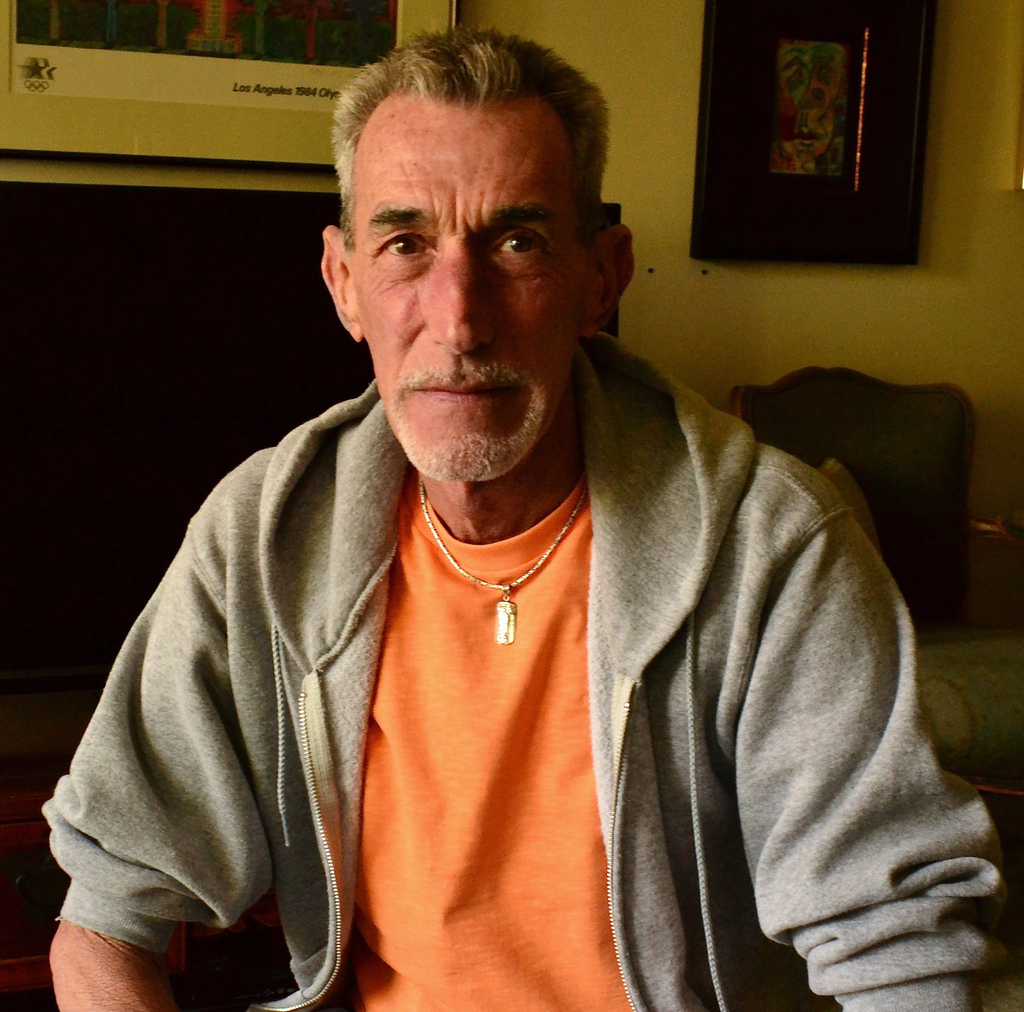
The Optimist


The Optimist

If you were to bullet point Mike Hewson’s biography, the list would sound sad:

• Grew up gay in the 1950s
• Drafted into Vietnam as a medic
• Returned to Los Angeles and worked in a hospital
• Cared for his mother during her 4-year ordeal and death from cancer
• Watched his good friends, all young men, die from AIDS.

But it was Abraham Lincoln who said, “People are about as happy as they make up their minds to be.” He might have been speaking about Mike, who was born on July 18, 1945, and moved to 16724 Morrison St. in Encino five years later.

He had an ideal childhood, with a stay-at-home mother and a father who worked as printing company salesman, and a younger sister, Deawn.

In those days, Encino was like a small town, with block parties and vast ranches and newly built houses. The 101 and 405 didn’t come through the Valley until the early 1960s.

He went to Encino Elementary and Birmingham High School. His family lineage, including many veterans of many wars, stretched back some 200 years.

He attended Valley and Pierce Colleges for two years and then studied to become an Operating Room Technician.

In 1967, he went into the Navy and later joined the Marines and went off to Vietnam for 27 Months. His nickname was “Flash”.

In his field hospital, 30 miles outside of Dan Nang, near China Beach, he assisted in neurological operations on wounded soldiers. Blood, suffering, the horrors of war, death and truncated and destroyed young men: all of these violent and horrific human tragedies marched before his young eyes.

He got down in the trenches and did anything he needed to do to help his fellow Marines. He was “Doc” but he was GI Joe too, never allowing his higher position to interfere in lending a helping hand.

He told me that everyone knew he was gay, but that he never heard one hateful remark. He believed that a lot of homosexuality went on in the armed forces, but that it was not an issue because survival and fighting mattered most.

Only politicians make an issue of it.

When he came back to the San Fernando Valley, in 1971, he was overjoyed to be back in the USA. He was still only 26 years old, and he went to work at Encino Hospital and lived as a single gay man in the Brady Bunch era.

Active in the Metropolitan Community Church, he also hung out with a group of friends who all died from AIDS. He and another buddy survived the lethal scourge of the 1980s.

Unlike many people who remember so fondly the San Fernando Valley and talk badly about its present condition, he finds that some things have gotten better. He misses the horse farms and orange groves, but he loves all the trees and greenery that has come up in the last 60 years. He remembers the view of the mountains that was so clear in the early 1950s, and now those views are returning as cars burn cleaner.

His last job was at Barnes and Noble in Encino, and he does regret the loss of the store, which was closed by greedy billionaire owner Rick Caruso and will be replaced with another CVS.

Mike is retiring to Puerto Vallarta. And at age 65, he will take his optimism down to Mexico, which is also a place where people have hard lives but smile frequently.

Stand on the Freeway.


In Egypt, it seemed, at first, that the thousands who finally decided that they have had enough, were brought to their senses and onto their feet by Facebook and Twitter.

Oppressed, humiliated, tortured, spied on, forgotten; the ordinary Egyptian has no future to look forward to, no better life ahead, and only a vague sense that his individual life matters.

Over there, in the Middle East, Americans can see that a very small slice of the elite own everything, and that the vast majority of people cannot earn enough to even buy bread.

And, as Abraham Lincoln said, “You can fool some of the people some of the time, all of the people some of the time, but not all of the people all of the time.”

We Americans have been living in fiction here too. For thirty or more years, it has been normal for every single industrialized section of the nation to close down. Abandoned, emptied, unused: these are the very engines of the economy that are no more.

So we took flight into frivolity: speculating in houses, throwing money into stocks, dancing on credit card debt. We celebrated our “post-industrial” lifestyle. Bad art and self-indulgent decadence occupied factories that once produced good machines and solid income.

And we imagined that the world was somehow being remade under a new virtual lodestar, hung in the Silicon Valley sky, guiding the world’s peoples into a smart, technical, open, free and intelligent self-rule and entrepreneurial cornucopia.

While Apple may introduce a new product every six months, human behavior only changes every million years. These are the eternal conditions of this planet: power, exploitation, greed, oppression, hunger, violence, war.

So the people of Egypt are marching and screaming, tearing down their government and demanding some justice.

And so the American people are robbed by private corporations and must live in a crumbling land where good jobs have gone away and only texting and the internet suffice as community.

If only six hundred people in Los Angeles protested for single-payer, public option health insurance, by standing on the 405 Freeway under the Wilshire Avenue Bridge, the news media would take notice, the government would react and conditions in real life might change.

I ask you:

Which country is poorer: Egypt or America?

The answer:

The country with the most citizens willing to fight for a new and better day is the richer one.

Let the word go forth to a new generation:

Ask not what your government will do for you, but what you are willing to do for your country.

We must stand on the freeway. And it is not too late to act.

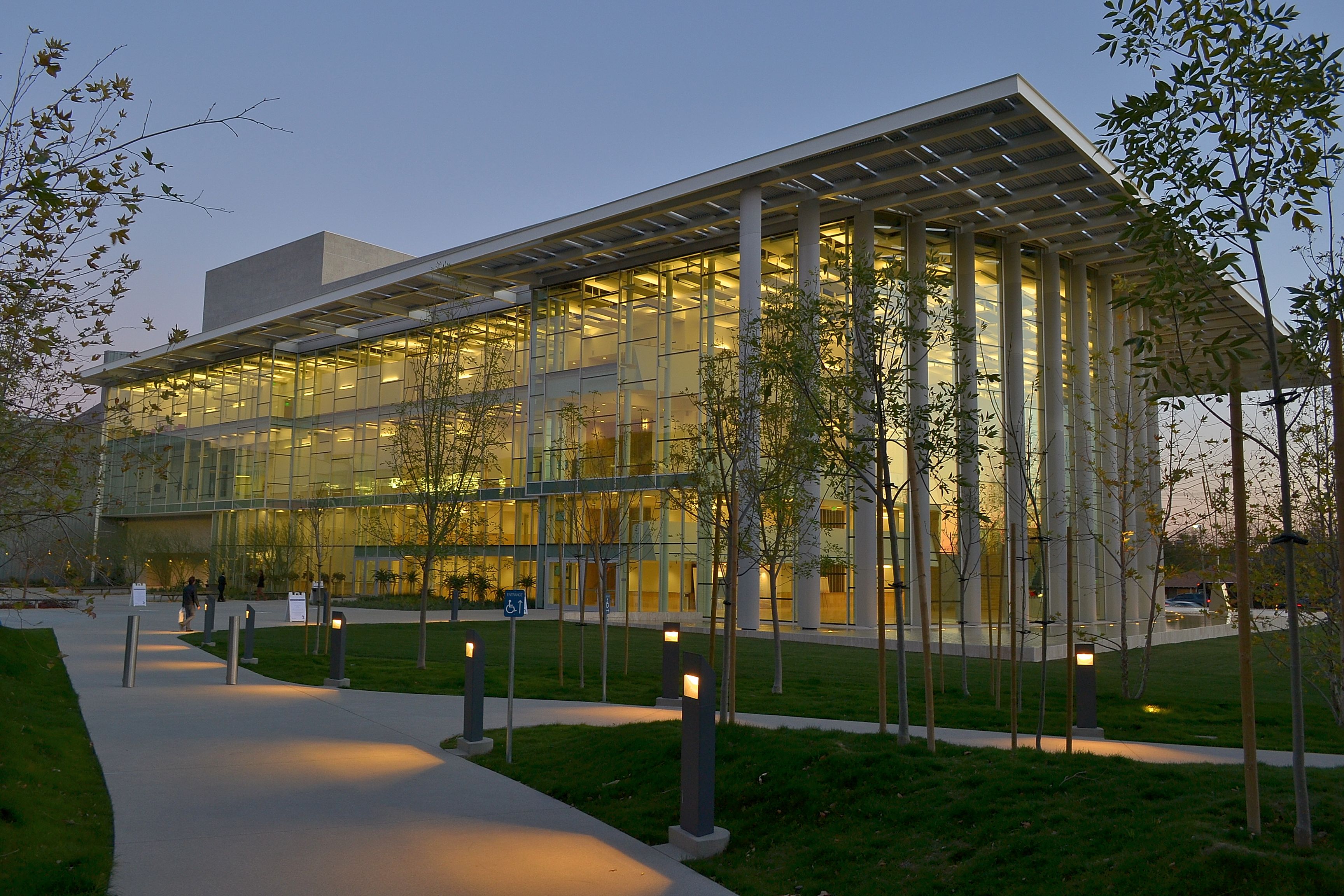
Valley Performing Arts Center at CSUN.


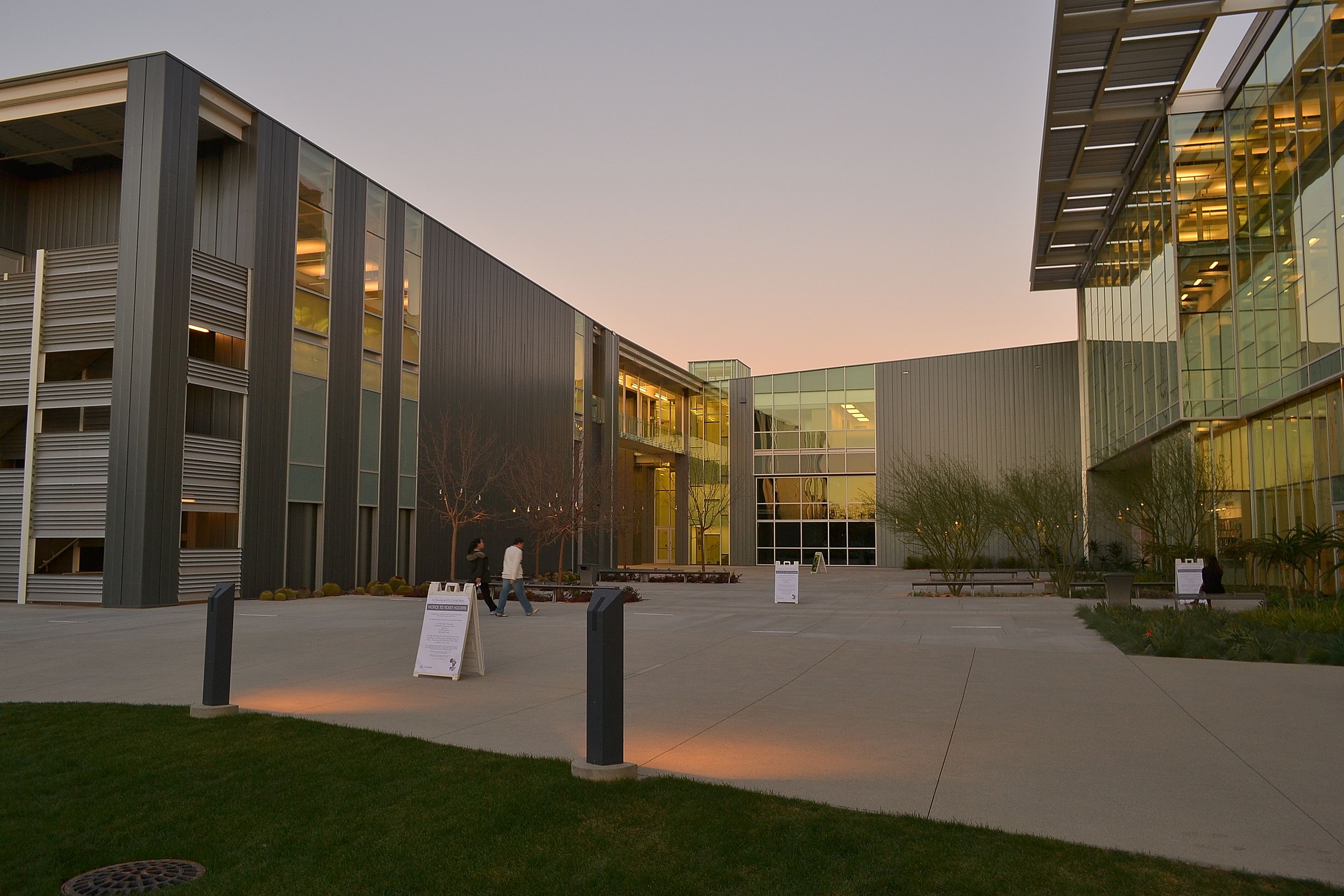
Elegant and technological, environmental and innovative, the new Valley Performing Arts Center at CSUN is a $125 Million Dollar concert hall that also provides space for an adjoining lecture hall and student radio station.

Designed by Kara Hill, a Minneapolis architect practicing with HGA Architects and Engineers, the theatre is a glassy and rhythmically lively sweep of undulating ceiling panels indirectly lit by energy efficient illumination. Subtle, understated and soft, VPAC brings a cool Scandinavian sensibility to hot Southern California.

173 new trees shade and protect 30,000 square feet of glass covering the 1,700 seat, multi-purpose performance hall. The landscape architect is Stephen Billings of the Santa Monica firm Pamela Burton & Co whose water saving innovations will save money and provide another place to hide from the monstrous sun that will soon bake the San Fernando Valley as Spring approaches.

The only disappointment upon leaving the rarified grounds of the VPAC, is driving back into the sprawling grossness of Northridge with its brown air and miles of asphalt, traffic, and speeding drivers.

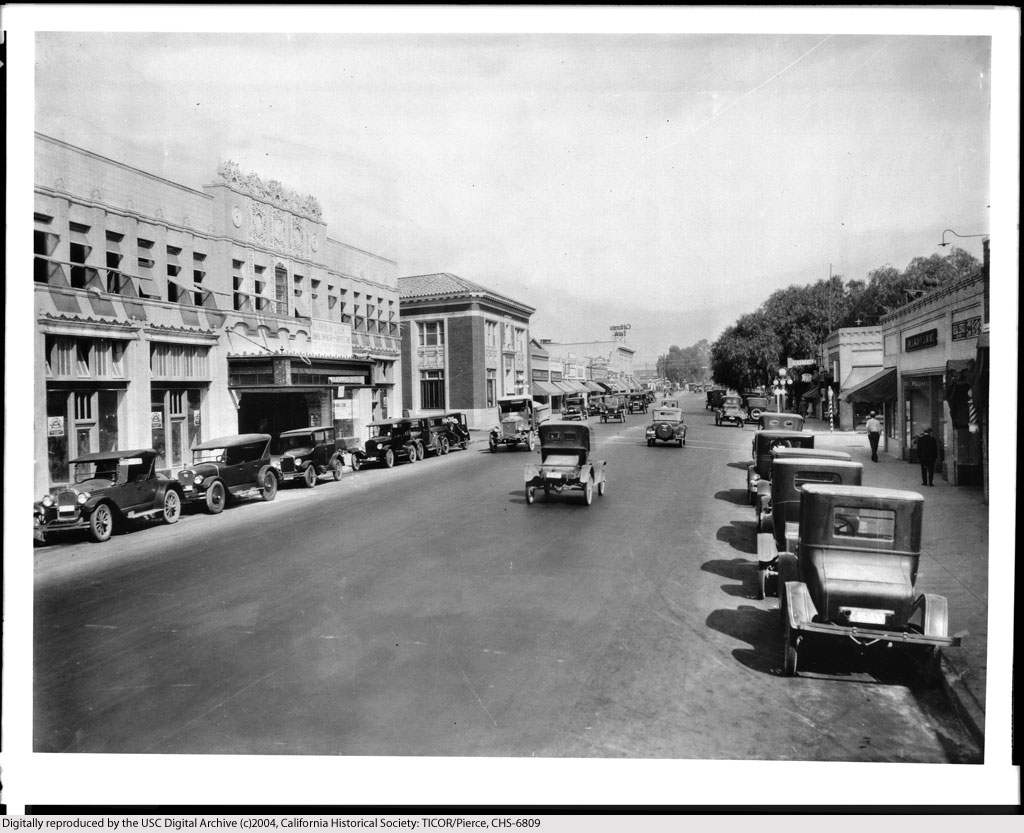
Lankershim Blvd. North Hollywood, 1926


Lankershim Blvd. North Hollywood, 1926

From the USC Digital Archives Collection.