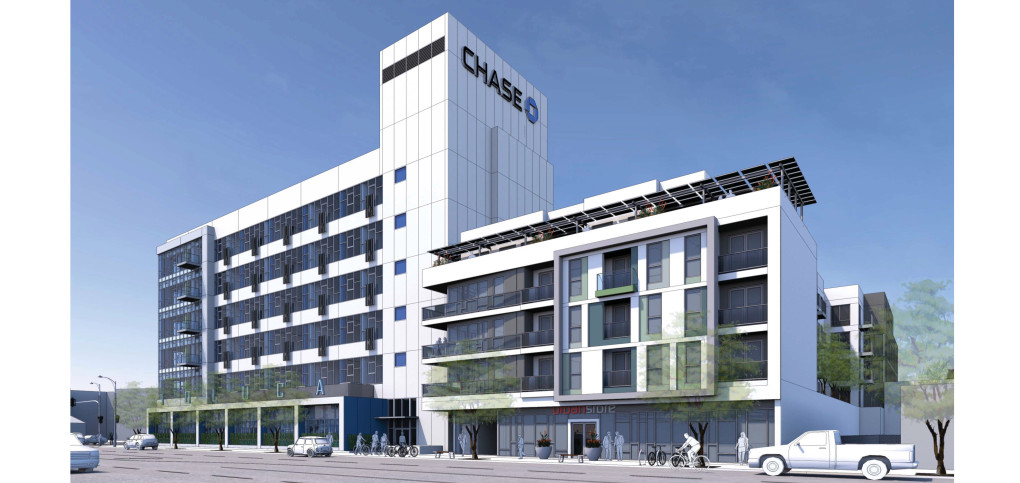
New Housing at Old Bank.


Last week, the LA Planning Commission approved 179 townhomes and 8 low-income apartments built partially out of the old North Hollywood Savings and Loan (later Chase) Bank at 4445 Lankershim Bl. at Riverside Dr. according a recent story in the Daily News.

The 1961 building will be readapted for residential use, and include over 5,000 SF of ground floor commercial space along with 263 car spots and 237 bike spaces. The architect is Winston Chang, principal of Next.

For years I have driven past this building as I traveled on the 134 or along Riverside Drive. 

Curious about its history, I dug up some old LA Times articles.

Roscoe W. Blanchard, Sr. (1882-1977) owner of the Blanchard Lumber Company, founded the North Hollywood Savings and Loan in 1923 when the San Fernando Valley was in its earliest boom days. 

Here is his 1977 obituary:

After WWII (1945), the boom in residential building made the bank prosperous, and in 1960, with over $40 million in assets, they announced a new $2 million dollar, six-story tall skyscraper with 73,810 SF of space. Earthquake resistant and fireproof, it was also the tallest structure in the San Fernando Valley. 

In a 1963 ad, the bank stated they would pay depositors 4.80% interest, a tidy amount for the time. In 1969, they promised 5% interest for new deposits.  Those were the days when a person could save money by opening a savings and loan account, and count on a guaranteed level of annual growth.

But the go-go 1960s ended with a decline in the Los Angeles realty boom. And the days of a secure savings and loan specializing in residential housing loans was numbered.

A Feb 9, 1969 LA Times article entitled, “Realty Boom is Fading as Prices Stay Stable” lamented high interest rates of 7-8%, and the inability of many families to afford the average $25,000-$35,000 SFV home, with more than 2/3 of SFV families earning less than $10,000 a year.

Overbuilding in 1965-66 had resulted in rental vacancies of 22% and almost 2,000 new homes unsold. One-third of the new, un-bought homes in Los Angeles were in the San Fernando Valley.

In 1969, both rents and residential prices fell as supplies increased, a widely accepted fact of economics which seems to have been forgotten by modern Angelenos who believe that building more housing is only for “greedy developers.” 

But back when the developers were allowed to develop, this was the result:

1970: In Woodland Hills, the average rent was $172, the highest in the Valley. 

Encino had the most expensive homes, averaging $50,000 in value.[1]

Today we have this:

According to CoStar, the price of an average apartment in the Woodland Hills sub-market—which includes Warner Center—stood at $2,200 per month. 

In 2018, Redfin said the average Encino home was $980,000.

In 1979, Proposition 13 froze property tax rates at the original level a home was sold at, not currently assessed at. Lucky owners of homes bought in 1974 for $40,000, which became $300,000 properties in 1980 (or $3,000,000 in 2019) were still taxed at 1974’s $40,000 purchase price. 

The tax rebellion was partially a white reaction against the increase in illegal migration and resentment in paying taxes for darker complexioned students. Today, most people who can, drive their children out of “bad” school districts to “good” ones thus exacerbating our air pollution and traffic problems. 

People who once rode the bus now take Uber or Lyft, thus exacerbating our air pollution and traffic problems.

We don’t build enough housing. Our housing is in short supply because many of the occupants here don’t legally have a right to be here. But that is stating what should not be said.

Part of our hypocrisy is being liberal and being racist and wanting good education for our children. And none of these traits can co-exist in modern Los Angeles without being hypocritcal. This is not an indictment, just merely a statement of fact from speaking to white parents who live on my street in Van Nuys and drive their kids out of the area to attend school.

The great shortage of homes in Los Angeles began its 40-year ascent and has now culminated in the lovely sight of human beings, unable to afford shelter, sleeping under bridges and along sidewalks. 

Mental illness is blamed for some of this but I wonder how mentally healthy I would be after eating out of garbage cans and sleeping in an alley for a year.

That some of the fortunate inheritors of parental properties, and low property taxes, are also some of the biggest opponents of new residential construction, especially in wealthy sections of Los Angeles, is a cruel irony. 

In the 1980s, the Savings and Loan crisis, brought on by government policies that bankrupted local S&Ls, resulted in the consolidation of many small banks into the large regional ones such as Chase or Bank of America.

In 1976, North Hollywood Savings and Loan was incorporated and merged into San Diego’s Central Federal Savings and Loan Association. 

So in the next few years, a building that once housed a savings and loan which played an instrumental role in lending money to young families buying homes in the San Fernando Valley, will become itself a home for some 179 families, (and 8 units or 4% of the total units will be low income).

Los Angeles, here in Van Nuys, and here in North Hollywood, and all around the city, will move along and build expensively and sluggishly until its leaders accept that it must become denser, higher, and less car dependent. An enormous push for more affordable and multi-modal transport accessible housing is paramount for our survival as a viable metropolis. 

Because we don’t build enough housing, we cannot afford to live in areas we might want to, which leads to more segregation and more bitterness and more helplessness in a city where homelessness is never far off and being housed is conundrum of insanity and indebtedness.

That we need to build more was something Roscoe W. Blanchard, Sr. would have understood with his expertise and success in building materials and financing homes 100 years ago.

We are trapped between the reality of our city and our dreams of its potential. We know what it is. We see this place with our own eyes.

But we really don’t want to accept its degraded condition, or the responsibility for how grotesque, unequal, cruel, barbaric and sadistic it often is. To look at the ugliness in this city we would have to accept that ugliness in ourselves. And why we make illogical and self-destructive choices and choose prerogatives that hasten the decline of Los Angeles.


[1]Valley Population Near Million; Growth Slows

–LA Times, April 29, 1971

Bank of America at Haynes and Van Nuys Blvd.


gri_2004_r_10_b904_f14_004
Ph: Julius Shulman

gri_2004_r_10_b904_f14_001
Ph: Julius Shulman

Many are familiar with the large, architecturally impressive Bank of America at Haynes and Van Nuys Blvd. It was designed by Paul Revere Williams, a prominent architect who was also an African-American Angeleno. The bank was built in 1967 and features murals inside and out by artist Millard Sheets. In 1968, famed photographer Julius Shulman photographed the bank. It was a high point for civic architecture in Van Nuys, and perhaps the last time this area felt proud of its main street.

OLYMPUS DIGITAL CAMERA

Prior to the 1967 bank, there was a more humble, late Art Deco, Bank of America at this same location, 6551 Van Nuys Bl.

In this black and white photograph, one sees the crisp, scrubbed-down, finely cared for building. Around it was a thriving street with well-dressed, law abiding citizens, and perhaps the occasional criminal whose activities were the exception not the rule.

00133214


DKV-uMvUQAAoTRM.jpg-large
Chase Bank, Sepulveda at Victory.

Today, human beings in Van Nuys sleep, eat, and defecate alongside bank buildings. Their disgraceful conditions scarcely cause anyone to notice. Or care.

In 2017, we are so busy congratulating ourselves on our “tolerance”that we forget that things that were once intolerable, illegal and immoral were considered so for many good reasons. In our gross barbarity, in our willful blindness to the suffering of neighbors, we are co-defendents in a new type of indecent nation, one that tests our moral fiber and will present itself to history for judgment.

Human beings do not belong on the street. They should be housed safely, affordably, with sanitation and security. Call this conservative, call this liberal, call this anything you want.


A Sharp Discordance.


d732dfc940c1bf441606f771482ac23c ciros-entrance-sunset-blvd-1940 melody-room-1956 the-source-sunset-blvd-strip-then trocadero

In the past few years, group lead mourning on social media for a lost Sunset Strip has taken hold among some sad eyed nostalgists. In their online rooms they pine for 1997, 1977, 1957 or 1937 and wish it were just like that today.

Gone are Tower Records, Elton John’s Le Dome Restaurant, Spago, The Playboy Club; Gazzari’s, which introduced the world to The Doors and Van Halen; Villa Nova Restaurant where Joe DiMaggio and Marilyn Monroe had a first date; Ciro’s, a 1940s nightclub; and Café Trocadero. Passed on are the cars, the clothes, the songs, and the youth of those who frequented whatever was young and hot at the time.

We are so far in the future but our minds are so far in the past.

Perhaps the saddest thing to contemplate is the loss of the old Garden of Allah that stood on two acres at the corner of Crescent Heights and Sunset and comprised a pool and landscaped cottages set amidst trees and flowers. It was constructed in 1913 and played host to a variety of notables, most famously F. Scott Fitzgerald. It was razed in 1960.

garden-of-allah-villas-011 ada92154fc584a2c5c28c3cdc3ecc04f

Standing in its place is a schlocky shopping mall and a bank with a folded zigzag roof. That structure, originally called Lytton Savings and Loan, and now housing a Chase Bank, is the center of a fight over preservation and architect Frank Gehry, who wants to demolish the building to erect one of his crushed-in-hand, aluminum foil wonders.

Lytton Savings and Loan (1960); now Chase Bank.

Proposed Frank Gehry design. (LA TIMES)

If Sunset Strip had no celebrities, if it were just a place, it would be one of the ugliest and least appealing urban sites in the world. Pockmarked by billboards, drenched in liquor and demeaned by fame, the Strip, from Crescent Heights to La Cienega looks like Las Vegas’s forgotten cousin.

New buildings are going up that channel the worst of Las Vegas anti-urbanism with blank sheets of walls, endless rows of dark windows, and morose hues of black and gray punctuated by large rectangles where future digital signs will obliterate the night and frazzle the eye.

img_3794 img_3793 img_3791 img_3789

There is no gayety (in the old sense of the word), no frivolity, no fantasy in any of the new, sharp-angled structures that so aggressively bulk up the street like steroid filled bouncers in a club. They have inhuman, robotic, cold-blooded designs, fueled by architecture that will impress teenage Shanghai, Moscow, and Seoul.

And, sadly, there is no presence of personality or character of Los Angeles in the new buildings. They are aliens dropped onto the street, and their presence is foreboding and corporate.

In daylight, photographed in black and white, their vapidity is most evident.

img_3788

Old Los Angeles was in love with alabaster white buildings that glistened in the sun and reflected purity, cleanliness and España. Before 1940, this metropolis built to provide sanctuary from the sun, to humanize the city, and to give guidance and signposts to the newly arrived seeking meaning in a vast and disorienting environment.

New Los Angeles has no markers of civic virtue. It is an entertainment chessboard devised on an app and sent out to to billions of people to make billions of dollars.


The Sun Came Up Slowly Above Sepulveda.


15200 Victory Blvd. 2 15200 Victory Blvd.Under dark, glassy, reflective, translucent, stormy, gray, inky blue clouds Van Nuys awoke today.

The hot sun and its aggression were held back. And the light came up slowly. The workers sat in their cars along Victory waiting for the red light to turn green.

Humidity, and the hint of rain, the blessed promise of water, hung in the air.

The Barn (in back)

DSCF1242

Bulldozers carried pieces of broken-up pavement in the Wendy’s parking lot as mechanical jackhammers tore into old asphalt. Construction workers attacked the building, skillfully peeling and nailing glossy, modern effects.

West down Erwin, old cars and overgrown bushes flank houses where age and decay cannot hide. The past and its four-wheeled rusty remainders sit on driveways.

Erwin Near Langdon  Victory, where quiet houses sit next to six lanes of traffic.

6300 Langdon Ave DSCF1252

Back on the corner of Sepulveda and Victory, right where the police shot a man to death after he broke their window with a beer bottle, the empty parking lots and bank buildings are mute, without feeling, marooned in a landscape of cheap indifference.

15249 Victory Blvd. Chase Bank DSCF1261

There is no civic center, no park, no church, no place to sit. The frenzy of cars and donut shops, office supplies and Jiffy Lube, this is one of the many centers of Van Nuys. But the center cannot hold. The consensus of American life is scattered here, as it is all over the land. Somewhere in the shadows, thousands of homeless are waking up in alleys, in their cars, behind buildings. The normality of life seems normal but things are awry.

When the traffic eases, people will speed past here, and some will run across the intersection to board buses, and the day and its distractions will obliterate the early morning calm.