Purse Snatchers and Parking Lots. (Chinatown Part 2)


On the day we walked here, a few hours after we left, a 68-year-old woman, fighting a purse snatcher, was stabbed 8 times but survived. Her attacker was tackled by others and kept down until police arrived and arrested him.

One can sense the presence of danger here even though it may not be knifing you in the chest. You wouldn’t just rationally wander here at midnight. Maybe if you were drunk. 

North Spring Street is neglected. There are burned out buildings, empty storefronts, and lots waiting for life to return. New High Street between Alpine and Ord is made of one-story buildings and 50% asphalt parking lots. 

What a struggle to run a business in Los Angeles, especially a restaurant. How have any survived the pandemic, taxation, crime, inflation, food costs, employee wages? It’s a wonder anything is functioning.

My architectural imagination wonders why many streets in this district, adjacent to downtown, are so depleted of apartments above stores, why there are still one-story buildings and acres of parking lots all around. 

Along Alameda Street, there are gas stations, and a concrete building from the late 1960s housing The Los Angeles County Fleet Services. Against the brutal and blank façade are shrubs, a mid-century idea of environmental eyeliner. 

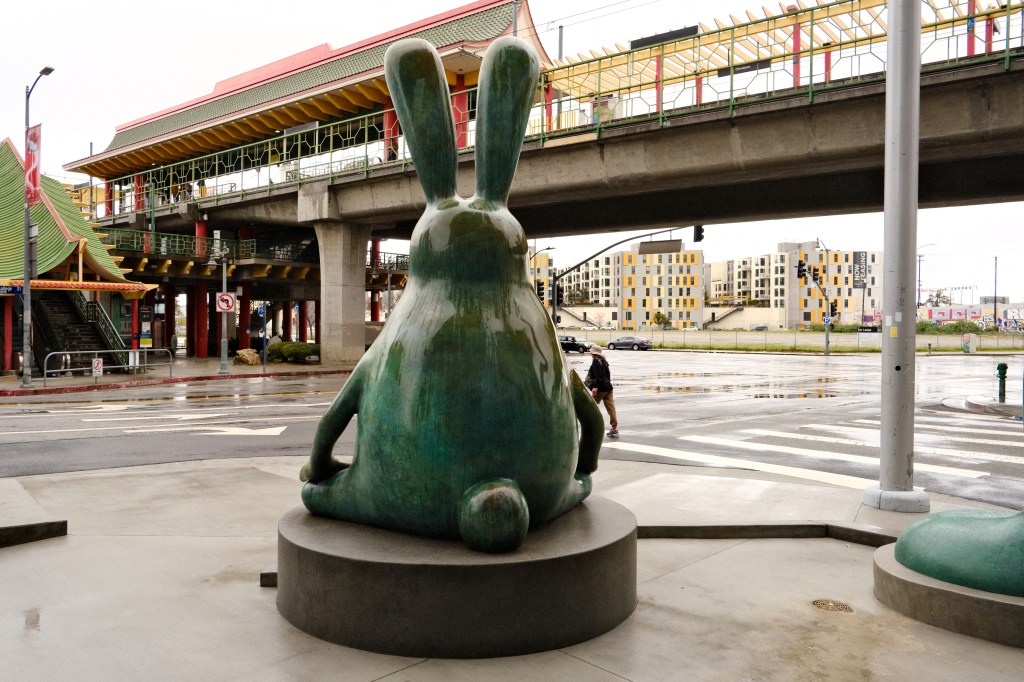
The light rail station is good looking with bright colors of red, green and yellow and decorative chinoiserie. There is a whimsical, large bunny statue on a pedestal standing guard across from the train.

There are handsome new buildings nearby but I hadn’t taken any photos of them. I will, perhaps, return here and photograph them someday. 

Chinatown in the Rain. Part I.


Chinatown is particularly poignant in the rain. 

The old and tired streets are washed in puddles. Pagodas, lanterns and the color red are reflected in asphalt. 

Everywhere there are old signs, some neon and some plastic, reminding us of families and times from long ago. 

There are old people with canes, umbrellas and face masks out shopping for hot soup and vegetables.

And packs of visitors waiting in line for take-out dim sum.

There are many empty parking lots selling parking spaces for $5 a day.

A big sign advertises Grandview Gardens, Cantonese Food next to a grass filled lot that might have once contained a restaurant. A history of this place is found online. It closed in 1991. 

Thirty-three years ago.

Grandview Gardens: an old sign like a cemetery headstone. Should it not be another restaurant or apartment or apartments over a restaurant? 

Don’t we have a critical, crying need for housing?

Everything moves so fast in Los Angeles. We come here young and eager and wake up neither.

But everything vital and necessary for the humane needs of humanity is tied up in litigation, neglect, bureaucracy, politics and abuse. For years and decades things decline but politicians are always promising the end of homelessness, the end of pedestrians dying in crosswalks, the end of hate, the dawn of tolerance, a new city of walkable, clean, affordable and safe neighborhoods. But I don’t have the funds to move to Vienna, Austria and neither do ten million other Angelenos.

Yet we drive fast, passing thousands sleeping in tents on garbage filled streets and tell ourselves that everything is normal. Another day of murder, another day of car crashes on the news, another walk through a community that has some thriving businesses and many others dying or dead. Have a smoke, get high, meditate. What else can you do?

In the civic imagination, Chinatown is one of Los Angeles’s happier places. Nobody thinks ill of it, they long to come this neighborhood, hobbling along in D- condition, months out of a pandemic that still haunts it. 

City Hall is a ten minute walk away.