Those Fantastic Clouds


In Southern California, we are so used to living under full sun with no clouds, that the presence of an impending storm is a revelation. The illumination inside our house changes, and there are real shadows hitting the walls and the sofa again just as there are in other real cities around the globe.

Introspection and thoughtfulness, a pause in the frantic, occluded light, the end of the year.

It takes days for the rain to come. We know it’s coming, the way we knew the virus was coming in February 2020, like a slow-motion freight train. But precipitation, no matter how meager, is a benevolent threat we can get excited about.

Yesterday we were still in the midst of a refreshing cycle of weather: cold nights, cool days, sun and partial sun, rain and no rain.

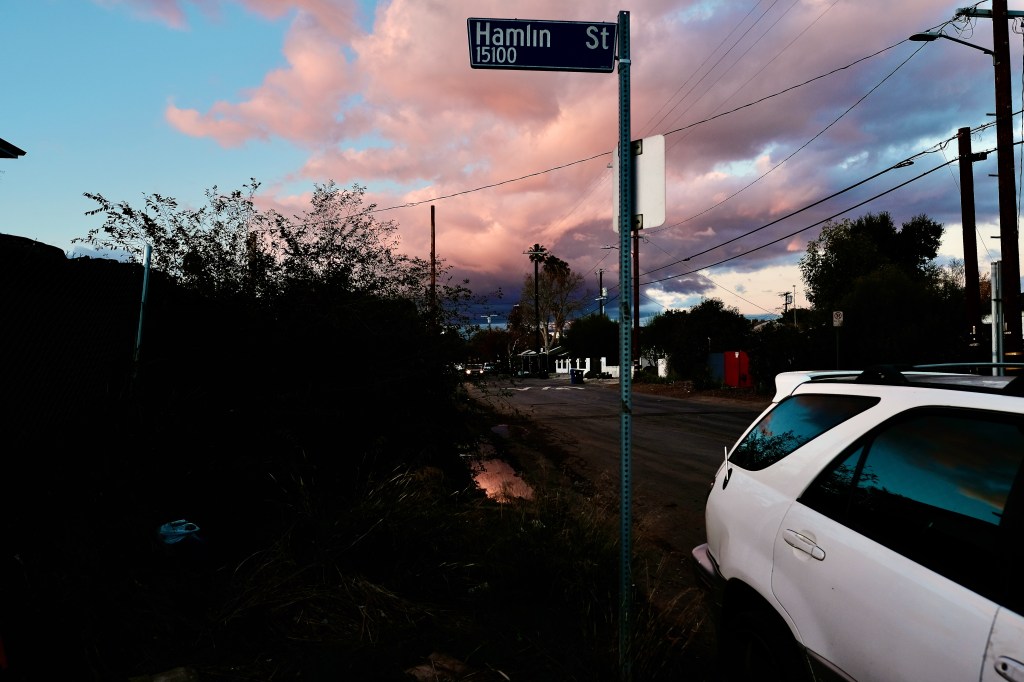
Around 4 pm I looked outside and saw a stunning sight of a gold leafed tree against a blue, pink, and gray sky. It would only last a few minutes so I grabbed my XE3 camera and ran out.

It was a strange hour. There was a menacing helicopter chopping up the sky, and reckless, going back home drivers speeding down Columbus and Hamlin in monster trucks. 

Death was just beyond my driveway so I wandered out cautiously.

Somewhere along crudely unpaved Columbus, where there are no sewers or curbs, I could see the vast sweep of the northern sky and those fantastic clouds miles away.

Culver City Awakened.


After a long hiatus, we ventured Sunday morning down to Culver City to walk around the new buildings and the architectural oddities.

Once a stronghold of flat, inland dullness, a largely white town peppered in a monotony of starter ranches and stucco apartments, barber shops, taco stands, model trains, gun stores, and typewriter repair shops, Culver City has undergone a two-decade long makeover into a town of light rail, bike and bus lanes, restaurants, lofts, luxury restaurants, furniture, art displays and wine bars.

29 is the median age for work, and 69 is the median age for owning a house. And everyone else of any age is welcome as long as you wear yoga pants and carry a small dog.

In the last two years, all the formerly open parking lots near the Expo Line have been filled in with large, modern architecture: residential and commercial.

The Helms Bakery area used to be the only area that imitated urbanity, but today we walked through it, and there were few pedestrians. But all the old furniture stores were open, and Father’s Office was getting ready for service. An electric bike was parked outside of the Kohler Store, a man and a woman conversed next to a fountain, and through my camera’s viewfinder 1930s Hollywood was alighted in 2022.

Washington Bl. is now a multi-use roadway with specific lanes for cars, buses, bikes and pedestrians, an oddity of our region that takes some mental and focal readjustment.

A thin, blond woman in mask carried a shopping bag and waited for the light to change near Shanti Hot Yoga (“We’re open again! 7 Days of Yoga for $7”).

On the corner of Washington and National, adjacent to the elevated rail, there were new buildings, each one different but not too different: modernism with steel, glass, angles, some wood and some plants, and strong, assertive street walls.

On National Blvd with its spotless sidewalks and young trees, we walked, tranquilized and medicated, by train sounds and light breezes. A paved bike path coexisted with a train that hummed down the tracks high up on a concrete overpass. 

Sunshine was rampant and inescapable.

We were the only pedestrians. 

I had that disembodied sensation one only finds in Los Angeles: isolation and excitement, boredom and anticipation, urban exploration in a landscape of sunshine and emptiness. 

At “Nike Corp – Extention Lab”, 3520 Schaefer St. steel girders and compressed lumber presented an incomplete cathedral of construction. The wood was blond and warm. The materials seemed ready to be pounced on by that shoe brand’s rubber sneakers.

We walked south one block to Hayden Avenue, to a junction of ugly brilliance: Samataur by Eric Owen Moss, the architect whose offices and deconstructed designs decorate the entire street.  

Before the pandemic I would have hated this discordant scene, but now I rejoiced, for the chained off tower and the accompanying office blocks survived intact: startling, grotesque; yet unique in their ambitious awfulness: empty parking lots, cinderblock walls, dark glass windows. 

And a sign called “Clutter.” Without any.

These are the workhouses for young, multi-cultural creatives of dazzling imaginations whose languages are only taught at MIT or art colleges. I’m sure these well-compensated bees have worked on my brain many times as I play video games or buy a bottle of gin with the most gorgeous and award-winning fonts, or scroll through Netflix. They are all 29, tall, and play frisbee on the roof and bring their dogs to walk and I really do hate them all. 

They work for companies where Tyler, Dylan, Ashley and Rebecca, must list their preferred pronouns after their names and every company has a mission statement that begins with “we believe every human being has the right to…”

On the west side of Hayden, 3535 is another Eric Owen Moss, a multi-story stucco structure from 1997 with protruding supports that fly out of the building, angled walls angled for entertainment. Everything is decorative irony, not form follows function, but form for forms sake. Tenants are graphic design and media companies. This is a perfect setting for sons-of-bitches startups, Tesla influencers, wellness lubricants, Armani jackets and collectible sneakers.

At 3585 was Sidlee. This conglomeration was perhaps the most interesting of all the oddities along Hayden Avenue. 

The company, which describes itself in the most inscrutable and amorphous ways[1] has seemingly vacated this arrangement of forms and textures scattered along a parking lot like a museum of sculptures. 

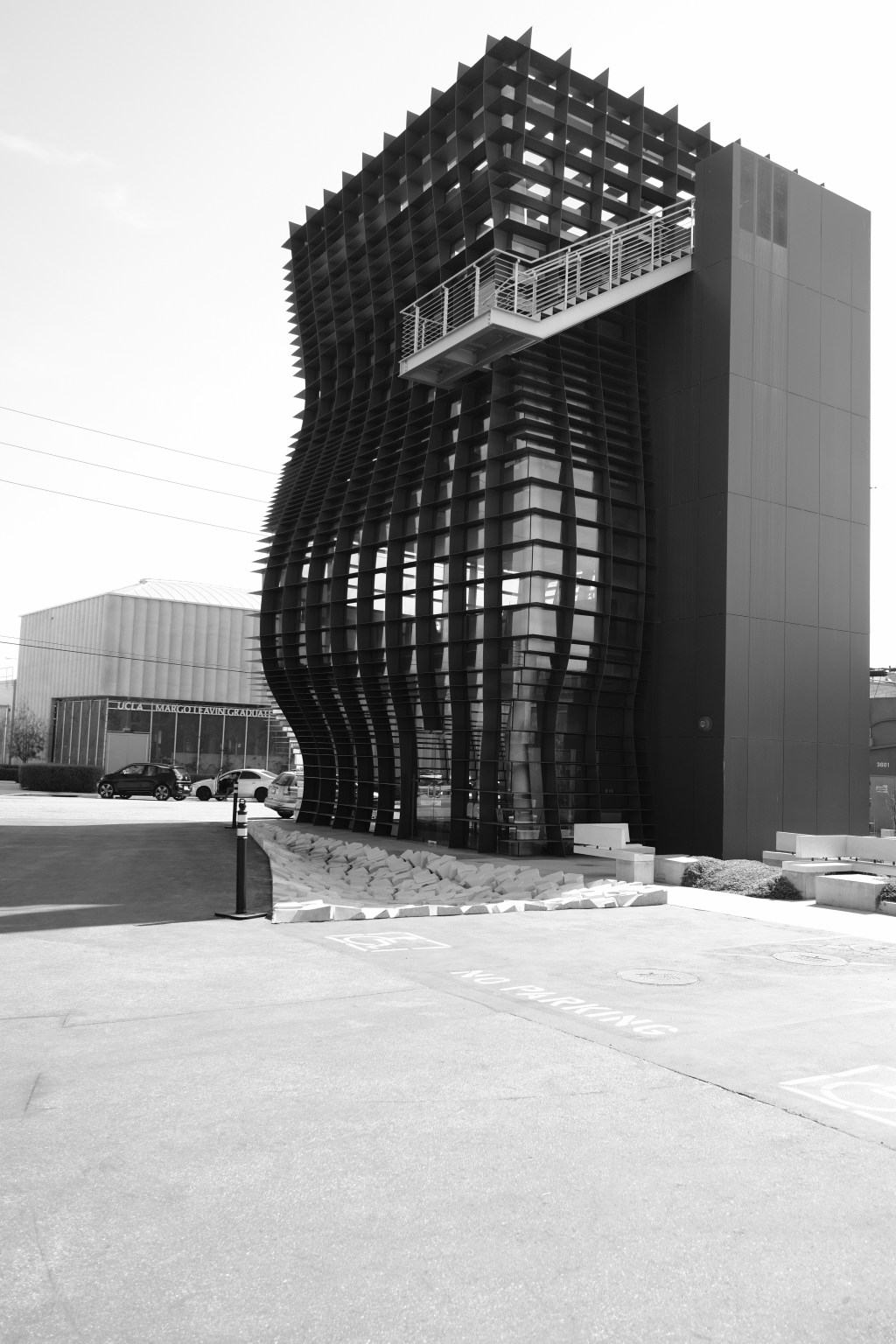
Vespertine, (dinner for two: $650) a luxury restaurant of museum like dishes, was the tenant of a tall glass building encased in protruding, undulating sheets of horizontal and vertical steel. It was built next to a river of concrete rocks like a dry stream; nearby, a four-story tall steel tower sculpture supported rows of steel cactuses in steel pots suspended 40 feet in the air; a concrete park was furnished with cushy concrete seats and shaded by shaved down cats tails. 

If the ghosts of director Michelangelo Antonioni, and actors Monica Vitti, and her still living co-star Alain Delon came to film a sequel to “L’Ecclisse” (1962) this would be their location.

Another strange fact of 2022 was the absence of security guards. I could walk up to any building and take photos. This was impossible from exactly September 22, 2001 to March 20, 2020, when Fear of Arab Terror was replaced by Fear of Invisible Virus

There were signs everywhere for masks and Black Lives Matter, and everywhere I looked I knew I was living in the here and now of 2022, poised somewhere between the past and the present, never quite certain of reality, but walking in it every step of the way.

END


[1] “Deep-rooted in the United States since 2012, Sid Lee Los Angeles has become a thought-leading hot shop for the country’s most iconic brands. With an extensive network reaching all the way to New York, our L.A. team delivers work that matters for a global clientele. This multi-faceted team at the epicenter of content and innovation offers fully integrated solutions supported by the weight of Sid Lee’s global collective.”

Vanilla or Chocolate?


Today we went to get our first oral Covid-19 test at a free clinic set up near Van Nuys High School along Kittridge St.

When we drove up the street, a little before 9am, there was already a parking lot in the high school set up with masked attendants, and tented booths marked #1, #2, and #3. There was an ENTER sign to drive up. A woman held up two fingers and we drove up to the second tent.

Another woman asked us our first question, “Chocolate or vanilla milk?”

It was strange because we had been instructed to not eat or drink 20 minutes prior to the test. “We are here for Covid tests,” we said.

“No, no. This is for free meals for students and their families,” she said.

That cracked us up. We left that area and drove around the block looking for parking.

There was another large line of people behind St. Elisabeth’s Church. Could that be the Covid testing site? No, no. This was a food bank pantry and they were distributing groceries.

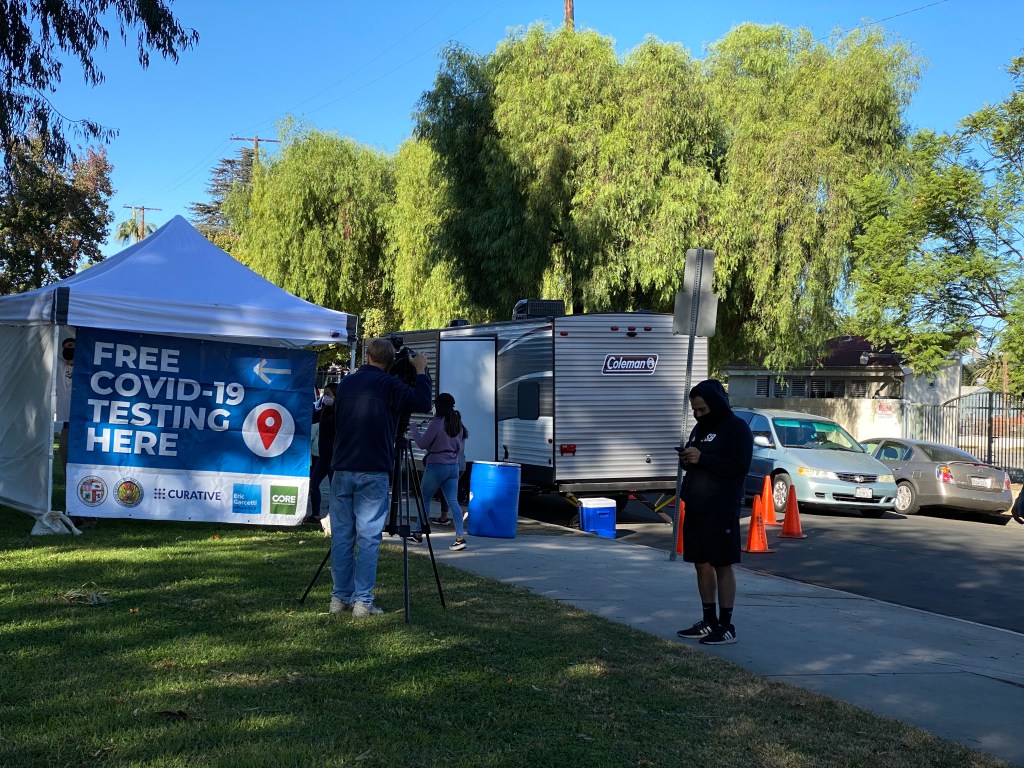
We went up to Vanowen, and then back down and we parked along Kittridge and saw a CBS-TV van filming another line of people outside of a tent. Was this the Covid-19 test line?

No, no. This was free flu shots given by USC.

Then we saw the Covid tent, and the sign, and the RV parked along the sidewalk where you went and signed in.

After we signed in, another line. Six feet apart waiting.

A tent. We were ushered in, one at a time. A masked fire department man, standing six or more feet away, instructed how to cough into your elbow, how to unzip the plastic Ziploc, how to take out the long plastic wrapped swab, how to swish it around your mouth, under your tongue, on the roof of your mouth, and then insert it into a chemical container and break off the swab so it would fit into the tube. You then disposed of the litter, dropped your sealed plastic bag into another container, fixed your mask back onto your face to cover your mouth and nose, and then you walked over to the area where they were giving free flu shots.

Before you could get your anti-flu injection, you had to scan a QR code, which created a webpage which you had to fill out, with your hands, and your poor eyesight, and your mask; fill out the form which asked you to scan your insurance card, asked for your mother’s first name, asked for your email, your home address, your allergies, your date of birth, your telephone number.

The assistants were nice, helpful. Their boss was too, after she had been interviewed by CBS news. Then you were done with the fill in the information on your smartphone and you sat down in a tent, and took off your sweater, your sweatshirt, all the layers you wore on this blustery day, and then you got your flu shot.

But the best part of the day was laughing about driving into the wrong area and being asked before anything else if you wanted vanilla or chocolate.

Sunday Errands


Yesterday, Sunday, there were no evident calamities around us. Tragedy took a day off. The air was clear from fire smoke, some blue showed in the sky, and we went for an air-cooled drive around our San Fernando Valley behind tinted windows and masked faces.

We passed Woodley Park, once a bird sanctuary, now just a burned-out bunch of fields with blackened pieces of wood and broken fences, shopping carts of trash and an air of war, desolation and defeat. 

There was the farm stand at Tapia Brothers and we stopped to buy tomatoes, Anaheim peppers, carrots and peaches, standing six feet away from other masked shoppers. Pulling out of the dusty lot there were two choices: drive somewhere else or go home. We chose the former.

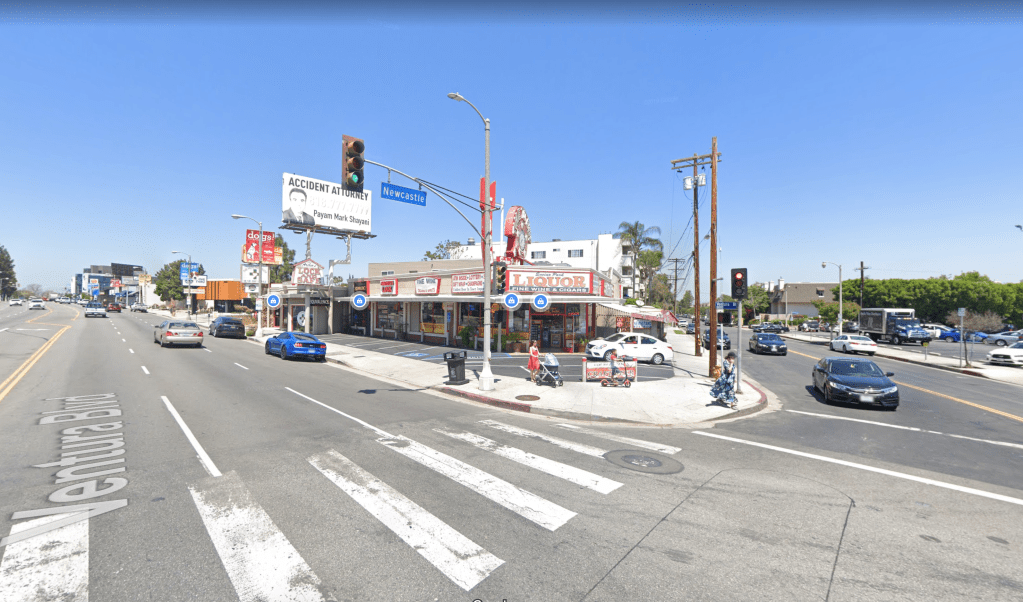
We went for a drive west along Ventura Boulevard through Encino and Tarzana, past those billboarded and plastic signed points of shlock and tackiness beloved by many, demoralizing in a good year, demoralizing in a bad one.

At Newcastle, groups of Jews in masks, yarmulkes, and tallit, walked with prayer books, dressed in their Rosh Hashana suits and dresses. A mentally ill Black man, without a shirt, danced obliviously in front of the liquor store as the faithful passed by him pushing baby carriages, on their walk home.

Further west, a homeless woman emerged from a tent parked along a concrete channel behind the prow shaped Encino/Tarzana library, temporarily closed. A blue sign hung along the fence on Ventura, “NO DUMPING: This Drains to Ocean.”

We drove all the way to Shoup Avenue in Woodland Hills, a district of Los Angeles where people once moved to get away from everything bad in the city. Under the 101, dozens of men and women were set up in a trash camp, living under tarps, in tents, the public sidewalk their front lawn.

At Woodland Hills Park, where Uncle Paul, Aunt Frances, Cousins Barry, Helene, Julie, Jason, Delaney and Courtney, spent many days of the past half century in the world of juvenile baseball and softball, homeless RVs parked. I wonder what flowered apron and blue rubber gloved Aunt Frances, who died in 2012, would say. She kept a spotless house, even telling me she would not eat dark raisins because they reminded her of little bugs. 

“Oh, Andy you’re so funny,” she would often say.

We turned down Erwin Street just to look at the corner ranch Aunt Frances and Uncle Paul bought for $63,000 in 1973. Uncle Paul is 99, a widower, still living there. The stucco is faded pink, there are bars on the windows, and Zillow estimates the house could fetch close to a million. Property taxes are about $800 a year, eternally fixed at the purchase price, a good deal for the retired soldier who fought at Iwo Jima and Leyte Island.

We didn’t go in but I thought of the inside I first saw in July 1974.

The Barcalounger, the brown carpet, the brown paneling, the yellow wallpaper, the cottage cheese ceilings, the dining room with the glass shelved cabinets full of Lladros and ceramic poodles and carved children with fishing poles, a room nobody ate in; the other dark rooms with the Roman shades or pleated drapes always pulled down against the sun, the bathrooms with wall-to-wall carpeting and mylar wallpaper, the rooms full of family photographs, the 1,762 square feet of living space without one book; the air-conditioning that ran year round, and the garage housing the Buick LeSabre, full of power tools and Leslie Pool Equipment, the refrigerator packed with Costco frozen foods, bottles of cold water and diet sodas, the TV always on for baseball and Fox News, these are the moments one cannot easily forget.

Then we turned around and drove east along Victory Blvd. passing the empty weed infested parking lot at temporarily closed Pierce College. We drove down Winnetka to get to the 101 and again passed another encampment under the freeway, more men and women living outdoors without housing in Los Angeles. 

When I go out these days, leave my house for a drive, I am in another nation, not my own, a scarred and withered place of broken people, angry and exhausted, in a city unclean and unjust. And ominously, seemingly, frightfully just about ready for a violent revolution. 

Only Yesterday


In 1931, two years into the Great Depression, Frederick Lewis Allen published his history of the 1920s, “Only Yesterday” covering the period from the end of WWI until the market crash, in October 1929, that plunged the world into poverty. The American economy would not revive until war and destruction obliterated Europe and engulfed Asia, and after the suffering and the debacle of that period, enlightened leaders vowed to never allow world war again.

So, here we are, now.

We seem, again, to be living in the most exciting of times, a moment of collapse when people are without money, in fear of their health, and watching the world outside collapse. Families and friends are unwittingly jammed up inside, fearful of intimacy, terrified of shopping, petrified about their money, unable to sleep at night, and looking for some savior vaccine to end this nightmare.

An incurable contagion devastates the lungs, drowns us, and we die alone. Please, somebody, do something.

We look up high to the presidential podium for answers. 

But we hear the cries from the asylum.

Every aspect of normal human life is now that moment in the horror movie when The Lone Girl goes downstairs into the dark basement after she hears a noise. 

7.5 billion are now The Lone Girl.

We are home with children or aged parents, or quite alone, with nobody. We are sitting at computers, trying to work or forget; obsessed over disabled relatives in group homes; monitoring children playing in the yard when the wind is blowing.

We can’t go to the gym, to the mall, to the coffee bar, to the park. We do push-ups if we can, and we lay on the couch all day until we try and sleep but we can’t. 

We are on guard receiving a package at the door, opening a letter, putting hands on a steering wheel, touching a doorknob, wiping down a mobile phone, cleaning a countertop, eating a banana with unwashed hands. We dare not open a window to let in a virus or forget to sanitize a salt shaker. 

A text message, “Call Me”, is alarming.

Everything is terror.

We are told, now, too late, to wear masks when we leave the house. Before they were of no use, now they are essential.  We are told to use hand sanitizer, but what if someone behind us, at the grocery store, unmasked, sneezes or coughs? 

In the midst of this darkness, I learned, strangely and horrifically, that one of my friends from MacLeod Ale, Drew Morlett, 37, had been stabbed to death last Sunday, by a woman, during a fistfight with a man, at a party given by a nurse (Drew’s girlfriend?) who unwittingly invited the murderer over to her apartment on Kester Street.

To attend a party during a pandemic is foolish, but just being foolish is not reason enough to justify murder. In poetic justice, all the fools at the party would catch the virus, their punishment for violating what we all know we must not do.

Though I knew Drew for five or six years, I hardly knew him at all. 

We had met at MacLeod Ale, and then we’d hang out, always by coincidence, never by intention. 

From what I knew, he lived walking distance from MacLeod, with his family, near Hazeltine and Oxnard. He had a raspy voice, with a sound almost frail and hoarse, so I nicknamed him “The Raspy.” He was a townie, like many at MacLeod, adults raised in Van Nuys who never leave Van Nuys. MacLeod was his parish.

On Saturday, June 27, 2015, The Raspy and I went to Venice, this time by intention, to take photographs and drink beer at Whole Foods, beer served by bartender Drew Murphy, an amateur expert on beer, who used to casually serve us oysters, shrimp tacos and other good foods that somehow never ended up on the tab.

That bar at Whole Foods on Lincoln had become a place I went to often, especially in the year 2014 when my mother was laid up in bed in Marina Del Rey, dying of lung cancer, and I’d go down and see her, and then stop off at Whole Foods and self-medicate, and drive home slowly in the night air, always careful to let the beer burn off before I drove, sometimes going up Beverly Glen, the long way, windows open, as Jo Stafford or Frank Sinatra played, and the profusely growing night jasmine floated in. 

The Raspy worked in computers, or fixing computers, or something like that, I never knew. He was gentle, and short, and thin, and a twin, with a twin brother. He had olive skin and wore olive t-shirts. I felt like I could have been his best friend, but we never talked about anything, really.

Others at MacLeod, people who drank nightly, or played darts, knew him better. I was not one who played darts or drank nightly, and last year I only spent some $800 dollars at MacLeod, for all of 2019, and I would guess Drew spent considerably more, though I don’t know, and to speculate is to lie, so I can’t say. 

One time I saw Drew Morlett and he said he was laid off and looking for work. Another time he said he was living with his girlfriend on Kester. One late night he called me and invited me out, and it was after 11pm and I didn’t go. He was known at other bars, other dart places, and in other drinking establishments, and it seemed he was out and about and all around the city, going out and about and all around the city. 

Until he died last weekend.

Now he is dead, dead in the way Van Nuys kills you: in obscurity, senselessly, ridiculously. That weekend, two days before he was stabbed, another man, a homeless man, Dante Tremain Anderson, 35, was killed the same way, by knife, not far away, on Burbank Boulevard in the Sepulveda Basin.

Before I learned about the identity of the second victim, Drew Morlett, I knew about the first and second murders. And in my mind, they were indistinguishable. Just anonymous and tragic and forgotten. 

Now one of the dead I had really known, and hugged, and laughed, and drank with. He had siblings, parents, friends, and they all mourn his death. I cannot feel the grief his family carries, and they have my deepest condolences.


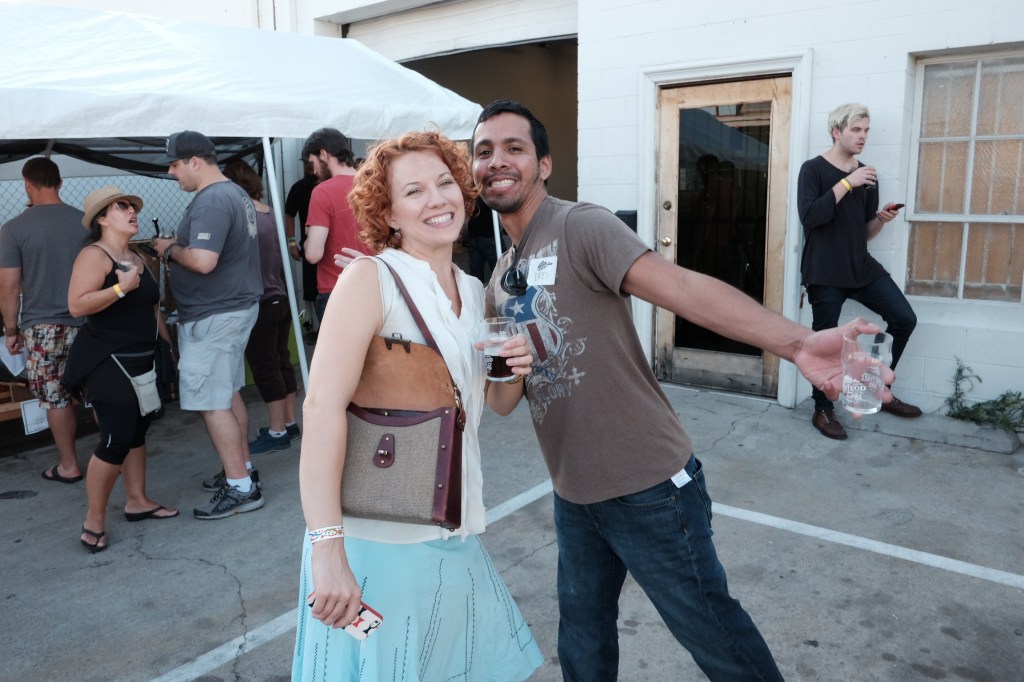
On June 21, 2015, a year after MacLeod Ale opened, that brewery held a big party. 

Drew Morlett was there, and so were hundreds of other people. They lined up to buy tickets, to sample brews from guest taps, to listen to lectures by brewers discussing brewing, to meet other enthusiasts and lovers of craft beer.

I took many photographs that day, and now they look remarkably dated. 

It is not only that we are presently, legally restricted from gathering, but that we are older. We are now incarcerated by grave and ominous fears and worries, and to drink beer in a crowd and listen to music and get drunk, that is our fondest hope for what we might do again. 

We hope, not only to be well, but to live, to be in this world, not banished from it, and to return to happiness and blithe ridiculousness, and even carelessness and stupidity. We should not have to die for our love of each other, we should not have to die because we partied, or touched our face, or went to a movie, or shopped for food, or cared for a sick person in hospital. Somewhere there is a profound lesson in all this, but I can’t quite fathom it. 

I have to go wash my hands now.