The Pandemic Changed Everything.


Since the pandemic began every single one of my relationships were tested. Some failed, some succeeded, some ended.

Sitting at home, mostly in the room with my computer, I scrolled catastrophic headlines.

Outside the world got quieter as people stopped working.

There was one month, April 2020, where it seemed that there was no longer any traffic noise from the freeway, and no planes flew in the sky, and nobody went past my house, except for the few, the lone, the masked.

In the backyard garden, hummingbirds, bees, and butterflies flew around purple flowered plants, oblivious to Covid-19. The wind blew, the air was clean, the sky sparkled, it was the glorious, refreshing epoch of days without cars.

My partner started working from home. We ordered groceries from Instacart. Then, a few months into the pandemic, he went out in N95 mask to buy groceries. And spent three hours washing them down.


An old friend from Chicago, who I stopped speaking to a few years earlier, contacted me on Facebook. “I miss you. And with this pandemic going on, I want to reconnect,” she said.

We talked on the phone. She told me about her catastrophic illness, a brain infection that almost killed her, her hospitalization, her loss of balance, partial eyesight, and the emotional pain of applying to the State of Illinois for disability funds.

Back and forth we texted. Until the texts were too numerous, hurling into the middle of my day, as I was sitting in my house, writing or reading. Did I have to answer them? Did I need to say I liked her choice of basement décor? Did I have to text back when she sent a photo of a pie her daughter made?  Did I have to thumbs up for that Benjamin Moore paint chip?

Somehow, I no longer wanted to be involved with her. Was it the pandemic? Was it the emotions she provoked? I don’t know. I just wanted to be left alone.

And she tried to keep it going, bringing nostalgia into it, reminiscing about old friends, telling me she loved to watch re-runs of Bewitched. The more she reached out the less I wanted to engage. Was it the pandemic? Me?


Aunt Millie was not allowed to leave her room at Lincolnwood (IL) Place. The 96-year-old had to stay inside her assisted living apartment for a year.  We would talk every few weeks. The conversation and facts repeated.

“Are you writing Andy?” she asked.

“Yes. I’m finishing my novel, Exiles Under the Bridge, about two families in 1980s Pasadena,” I answered.

“You’re writing a novel? I didn’t know that. You’re a very talented writer. You should keep writing,” she said.

We would talk again in two weeks. I would tell her I was writing a novel. She would tell me how talented I was. And she would tell me she could not leave her room.  

“Millie! Stay in your room! That’s what they yell at me,” she said.


The months dragged on. The months flew past.

George Floyd was killed, the rioters sacked the cities, the protestors protested masks, business closures, or police violence; others ran red lights, shot guns, launched fireworks, got into fights in grocery stores, yelled about the most corrupt election ever, invaded the Capital as the electoral college was being certified.

The American Flag was weaponized, partitioned, and privatized, held like a spear to fight for liberty in battles against imaginary enemies .

Our world of beautiful wickedness is melting, melting, melting.


I did chin-ups, got to five. I got my bike fixed and pedaled west into the sun. I wrote short stories, finished my novel, sent out my novel, got 130 rejections.

The parks went up in flames, the homeless set fires along the freeways, the windows of the shops were boarded up, the hospitals were full of sick and dying people, and nobody was allowed to swim in the ocean.

The former president pleaded for rage and misunderstanding.

At five o’clock, every single day, Mayor Eric Garcetti spoke; clean shaven, untouched by fervency, updating us on his city’s response to the pandemic.

Some weeks businesses were essential and they were open. Other weeks businesses were non-essential and they were closed. Some wore masks and some did not, some stayed apart and some got together, certainly all were uncertain, guided by magic and intuition.

And I bought a mixer to make smoothies with bananas, ice, blueberries, milk and protein powder.

My best friend invited me to a Christmas party when nobody was vaccinated. I declined. He didn’t believe Covid was that big. In the beginning of the pandemic, he urged people to cough on each other to get us up to herd immunity.

I used to drink beer at the local brewery a few times a month. Now I don’t go. Have I stopped liking beer? Have I stopped liking people? I don’t know. I stay at home and mix up a Negroni or pour a glass of whisky over ice, in the kitchen, alone.

We got our vaccines in January, courtesy of the connected relative who works with a health clinic in South Los Angeles.

We went down there, lining up, in another very poor neighborhood, next to the homeless in their RVs. We stood in line, awaiting vaccinations, as other Hollywood friends and acquaintances of the relative arrived in their Teslas and Mercedes: the thin women with blond hair and $300 sweat pants, the ass hole boomer executives with their 25-year-old girlfriends.

We were the first to get our shots. Hollywood was vaccinated. “The Bachelor” could go back into production.

On February 1st I was fully vaccinated. Only one percent were at that time. I felt guilty. Had I stepped in line before the truly needy?

Now vaccines are available for everyone, but some choose not to avail themselves.

Like my friend Bajoda in New York.

A schoolteacher, a scoliotic, a smoker; 56-years-old, a vaccine skeptic. With a chain-smoking boyfriend who believes that Covid is no worse than a head cold. She was scared. She heard the vaccine could damage your liver.

I yelled at her. Stupid, ignorant, self-destructive, risking your life! She texted the next day and said her daughter made an appointment for her to get vaccinated.

We made up. I told her I only yelled because I care. She texted me a red valentine. If my cruelty and ugly words induced her to get the vaccine maybe it was worth it.

I texted her to find out how the second shot went. I texted again. But she didn’t answer. And I left a message but no answer. And I texted again but no response.

Since the pandemic began every single one of my relationships were tested. Some failed, some succeeded, some ended.


Sometime in early September, Uncle Paul, veteran of Leyte Island and Iwo Jima; widow, father, grandfather, great-grandfather; will celebrate his 100th Birthday. And his son Barry is already planning a backyard blowout in Woodland Hills. Many of the guests will be over 65, 75, 85, or 95.

They are expecting at least 100 or 150 guests. Who wouldn’t want to honor him? Who wouldn’t go to celebrate his birthday? Who would fear the Delta variant in a packed house of old people?


Since the pandemic began, two babies were born in our family: Edwina’s Zoe in Diamond Bar, Jacinda’s Julia in Singapore. Penny is grandmother to both. She lives in Malaysia and cannot enter next-door Singapore. Penny has never met her two new granddaughters.

But later this month, vaccinated Penny and Jacinda, and baby Julia will fly from Singapore to Los Angeles to meet the Americans.

And the joy of seeing them reunited is tempered by the fear of the unknown. How do we overcome it? How will we move on when we suspect and fear closeness to the ones we love the most?

The Pandemic Changed Everything.

You March That Way, You’ll Live This Way


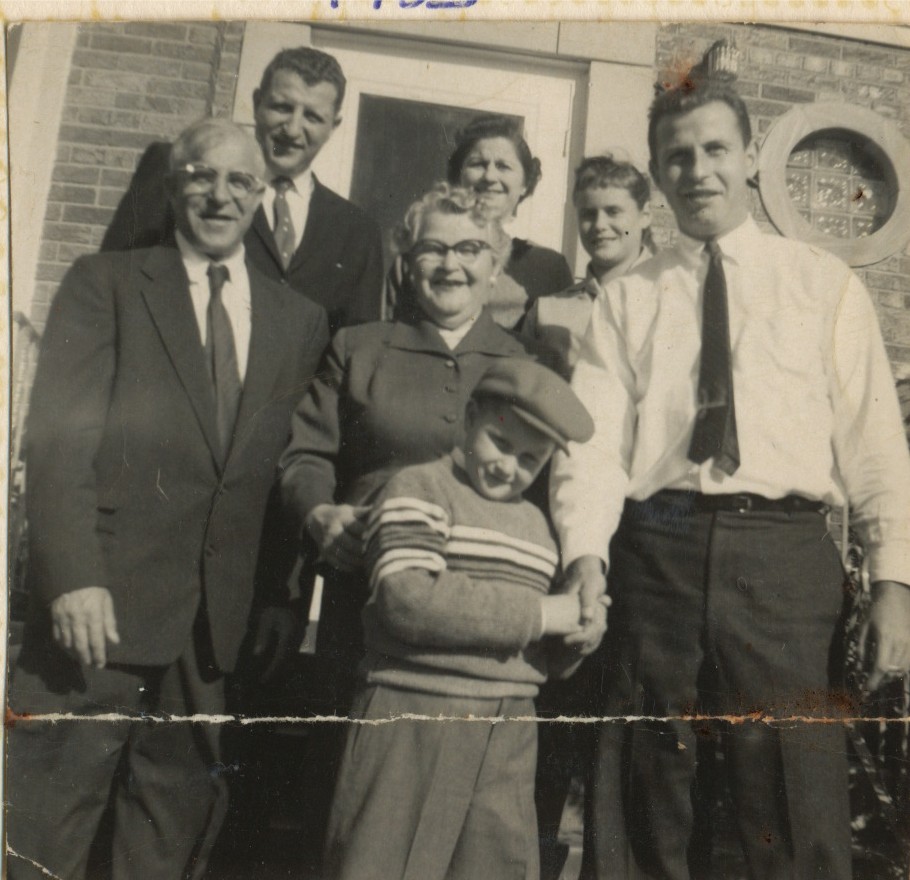
1955.

Once upon a time, my father’s family lived on the South Side of Chicago.

Grandpa Harry and Grandma Fanny had their little house on 88th and Clyde, a squat brick home built in 1950 with a back porch and a spotless kitchen. 

Uncle Paul, Aunt Frances and Barry lived on Luella, not far from Grandpa Harry.

And Uncle Harold and Aunt Evie lived with their children, Adrienne, Michael and Bruce in expansive, grand old apartments overlooking Lake Michigan along the South Shore.

Harold and Paul had both been soldiers during WWII, married young, and came back home. Harold was an engineer, so he started a heating/air-conditioning company that installed systems in many buildings in Chicago. Paul (1921-), veteran of Iwo Jima and the Battle of Leyte, worked as a plumber and electrician. He is still alive at 99 and lives in Woodland Hills, CA.

In 1968, after the assassination of Martin Luther King Jr., there were nationwide riots. And the stores on the south side were burned down and looted. And my grandfather’s new 1968 Chevy Impala, parked on the street, had its antenna broken off by a vandal. That’s when everyone sold their houses and moved up north to Rogers Park and Lincolnwood, North Lake Shore Drive, Deerfield and Highland Park. 

Because they were safe there. 

There were federal investigations by the Kerner Commission, whose findings were released in 1968, to get to the root causes of rioting from 1967, the year before. And they found, (surprisingly!), that segregation, poverty, discrimination, poor jobs and broken families contributed to unhappy lives. 

_______________________________________________________________________-

After every insurrection, after every march, after every episode of mass looting, there comes a vow to move forward and make certain that this time, this time for sure, these events will not happen again.

So the streets in major cities were renamed Martin Luther King Jr., and on television Norman Lear created “The Jeffersons” and “Good Times.” And Hollywood and the media proclaimed that justice would reign over all the land.  See the diversity!

And then there is a reaction, a call for law and order, new laws for harsher sentencing, new reforms for welfare, and progressive ideas to rebuild the cities (Brooklyn, Venice, South End Boston) by making everything safe for tech and shopping and historic renovations, and guess who will be removed again? 

Giuliani is the king. Love what he’s done! This city is the best it’s ever been. We’ve been through 9/11 and now we are never going to be down and out again!

_____________________________________________________________________

Who gets shot and who goes to fight the wars and who dies in the streets and who dies on the battlefields and whose population is dying today of Covid-19 and why is it always the same answer?

Why is it still terrifying to drive through the west side of Chicago before you reach Oak Park and tour Frank Lloyd Wright’s houses? Who lives there and who kills there and who suffers there? It’s always the same answer.

Let the looting and fires and protests begin! America don’t you see what’s going on! 

You are violent by custom, and this is another type of violence. How dare they smash shop windows and steal what isn’t theirs!

___________________________________

Note:

Estimated U.S. military spending is $934 billion. It covers the period October 1, 2020, through September 30, 2021. Military spending is the second-largest item in the federal budget after Social SecuritySource.

That works out to about $2,838 per person in the US. Or about $236 a month for every man, woman and child in the country.

We aren’t even at war. But you could argue we are always at war.

__________________________________

People of pinker pigmentations are again woken up and made to face the suffering of some of their fellow, darker citizens. And every year the same old story is retold, just with new clothes, new celebrities, new movies, and now, a new hashtag, #oscarsowhite or #blacklivesmatter. 

And a silent majority, one whose all-white room I sometime inhabit, deplores criminality, violence, and looting; and I’m locked in there in that all-white room; I can’t get out, because I like the all-white décor that tells me that some people are violent and barbaric and have the wrong values. I feel better about myself, in that all-white room, knowing I’m law abiding and that should be end of the discussion. I’m suffocating in there, I can’t breathe, but I am relaxed in my self-assurance and high self-esteem.

Because if you get in trouble you are a troublemaker. 

_________________________________________________________________

Where I came from is some of who I am.

I grew up in 1970s Lincolnwood, IL and there were no black people other than domestics who worked in people’s homes. 

In 2017, Lincolnwood was racially composed of 57% whites, 30% Asian, and 6.2% Latino or other.  I didn’t see a mention of African-Americans.

There was once a way to run away from troubled places, and seek refuge in a safer neighborhood, but I think we have run out of hiding spots.

They have come to Beverly Hills and Buckhead and Santa Monica, and they is us. 

In 1992, I worked in the Polo Ralph Lauren mansion on 72nd and Madison in New York. There was no social media, no Twitter or What’s App, only rumor.

So as Los Angeles burned, New York City trembled, and rumors of mobs attacking Herald Square and other locations were falsely spread. There was not mass violence or destruction in New York City, that year, and it remained largely in Los Angeles, mostly, infamously, in South LA and Koreatown.

The Polo Store had wooden doors with glass windows, and the security guards pulled the cloth window shades down. They turned the lights off, and we all went home around 3pm on Friday, May 1, 1992. I walked through Central Park in my linen suit and back to my little apartment on West 96th St. to sit in the air-conditioning and wait out the troubles. 

Until this past week I thought we lived in a new time of toleration and nobody was that angry and the times I saw horrendous videos of police brutality seemed the exception and not the rule. And I lived, because I am allowed to do so, in a bubble of wishful thinking and fantasy, in a country that mistreats others but not me.

I thought Barack Obama was the pinnacle of we shall overcome. 

And I was wrong. Dead wrong. 

I was naïve. 

Me? 

Naïve? 

No. 

Just white.

I’m protected from the injustices perpetuated by a system designed to give me a boost up, a feeling of betterment, because others are down there, and can’t be as good as me, no matter how spectacular they are, by virtue of their inherited DNA.

That’s really the truth. Because you might have an MBA, or be the CEO of a company, and if you go running as black you might be shot dead. So why bother to be the best if your country already decides you are the worst? That is the quandary of racism, it rips down the individual to a category, incarcerating her within a foul story of failure. 

It takes a remarkable concentration of effort for the protagonist to overcome her role as the demon in a bad fairy tale.

Like an Obama or Oprah or any father or mother of color in North America.

______________________________________________________________

We are at a point that is not only about the murder of the man by copper knee in Minneapolis. 

There is the small matter of our chief executive, a corrupt ignoramus, who came to power, by questioning the birth certificate of our black president.

We are sick, we are unemployed, we are uninsured, we are scared. 

We were kept home, kept in fear, brought out in mask, and indoctrinated to wash hands. We stayed home and got our groceries delivered, and got a check from the government, and some people got sick, some died, and the nation looked in vain for a leader who could not lead, a savior who could not save, and today we are waking up in the wreckage of our homeland.

A virus still stalks the Earth and lives in our saliva.

When Los Angeles was at its richest and most prosperous, three months ago, there were 100,000 homeless. And that was permitted, by the leaders, the citizens, and the public. 

When Los Angeles was at its most diverse, the whitest among us drove our children to school districts that were majority white, and our morning and afternoon traffic was largely made up of children riding to and from whiter schools with their parents. 

And that was toxic and unjust, racist and unfair, blatantly racist. When you think about it.  Public schools where no children walk to school. Public schools, not of neighborhoods, but of magnets propelled to collect like particles to adhere with.

And what have we done to change education, health inequalities, housing shortages, racism itself? Because it all circles back to race when you ask people where they want to live or go to school.

We have an invisible problem right before our very eyes. 

Our feet stand on blood-soaked soil. But we don’t see under our white sneakers.

We are striving to succeed, we want our children to succeed, but what is personal success if our nation is a failure?

So many marched, that way this week, holding up signs: impassioned, motivated, angered.

It was a religious fervor of moralism sweeping the country. 

But nothing has changed, really. Stores are burned and looted, cops get down on their knees, mayors and governors call for a new dawn of tolerance and kindness.

The new plate glass windows go up, the tags scrubbed off the buildings, and surely Oprah will find a new heartwarming book to promote by a young black author.

Instagram will black out, and hash tag, and celebrities will proclaim they stand with the oppressed and the hated, and vow that a new day is here.

And new laws will get passed. And everyone will listen to great podcasts about race and police. And eventually the marchers will not march. They will go home, or get jobs, or go back to school, and the national hibernation will end, and the fast, furious ambitious race to get more for me will resume. 

The next time someone dies unjustly, Our God, Lord Smartphone, will record it. 

But Lord Smartphone cannot right a wrong. Only we can.

We marched that way, but we’ll live this way.