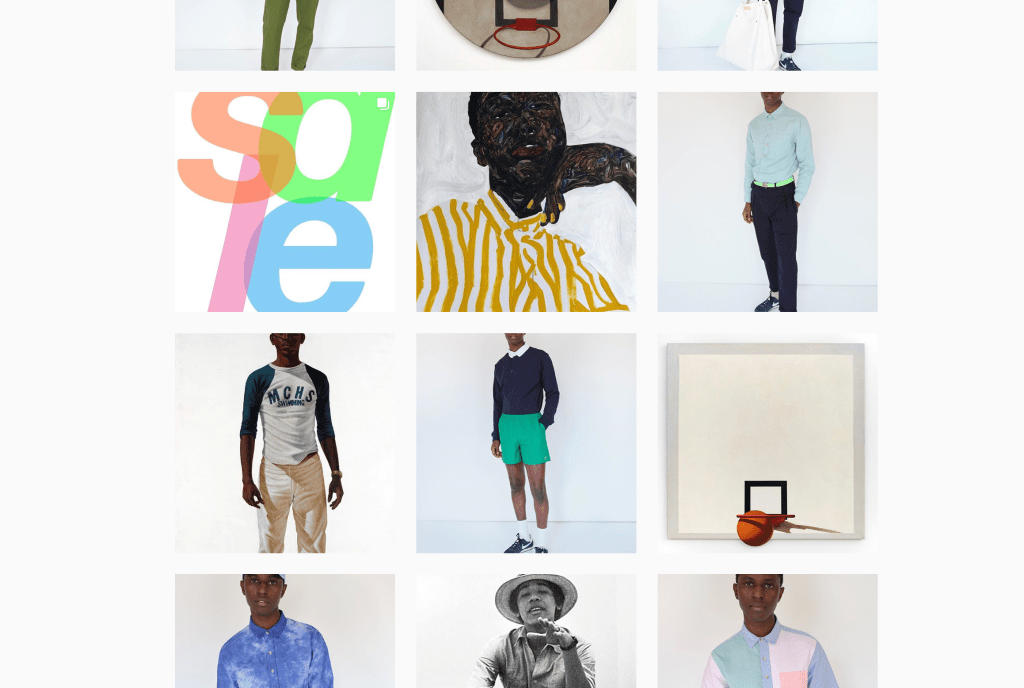
Fashion Entanglement


Last year, in early 2019, before all hell swept over the Earth, I was working as a photographer.

Seeking to refresh my portfolio, I contacted a model on Instagram who was a striking looking Black male. He had close to 20,000 followers. He agreed to a “trade for print” (TFP) which is just a term for a barter arrangement where a model and photographer work for free in a mutually beneficial arrangement.

I thought about how I might shoot this person, and I found a start-up clothing company that was just gearing up. The designer founder, a middle-aged white, who had 20 years of experience in fashion, had just moved from New York. He made rugby shirts, well-tailored trousers and other prep clothes that were locally manufactured in downtown Los Angeles to high quality standards.

I contacted the designer and drove down to his perfectly decorated art deco apartment in Hancock Park where he had selected and neatly folded jackets, pants, and shirts to photograph. Again, the arrangement was just to “tag” his products on Instagram and he would get credit and some free advertising and I would have loaner clothes for my model.

The model came over to my house. I shot him in the clothes as he stood in my backyard, and in a chair in my living room. And then he left. And all was fine. The Black guy with the green eyes in the colorful shirts looked wonderful. (I have erased his face to protect his identity.)

I felt some compassion for the model, who was, of course, also pursuing acting. I gave him a couple of leads of directors or producers I knew and said he should follow them online. He sent me texts of thanks. And that was the end.

Then the designer saw the gratis, no charge, promo photos. 

And for whatever reason, he hated, despised, and was completely revolted by the good-looking young Black male. He gave no reasons, but it seemed that he preferred a “preppy, All-American” (WASPY) male.  He was aghast at the free photographs and not at all appreciative of the pro-bono work. He told me he wished that I never put this Black man in his clothes.

A day later the model contacted me and asked why the designer had (unknown to me) blocked him on Instagram. I had no answer. My heart broke because I could not understand why. I could only guess racial animosity. But could not prove it. Why the hostility directed against this dark-skinned man? He had done nothing wrong other than wear the designer’s clothes!

I had, in my initiative, promoted a new clothing line, and an upcoming model, and all I had were some very fine photos. It had cost me nothing, except for the gasoline driving 30 miles roundtrip to Hancock Park.

Then a few months ago, about a year after the shoot, the model, whom I hadn’t communicated with, sent me a DM on Instagram. It read something like this: 

“You do not have the right to TFP my name to promote your friend’s clothing company! You are OLD! Why don’t you go fuck your Chinese boyfriend!”

I didn’t answer. The attack was completely unprovoked. It did not matter to the model that he got free, edited, professional photographs that he could use to promote himself. And that my “friend” was not a friend at all, just a brand I found on Instagram. I guessed that the pandemic had made him just a bit more crazy as it had all of us.

Today, out of curiosity, I went to see whatever happened to that promising start-up company that made the very colorful rugby shirts and high-quality khakis. 

I couldn’t see it. The clothing company designer had blocked me on Instagram. 

I’m recounting this story because I had the best of intentions all around in producing this small shoot. Everyone was treated fairly, courteously, respectfully. Nobody was mistreated in any way.

I found an alternative way to look at the website of the designer’s IG page. He has one Black model in every single photo. And dozens of boxes of “Black Lives Matter” and all sort of salutes to racial justice and racial equality. 

Of course, it’s past May 25, 2020. George Floyd is dead. Black Lives Matter. Everyone must show social media empathy for the cause. The company that sells the $200 khakis makes sure that its’ images are on the appropriate side of compassion.

I see the kind posts this year. I remember the mean actions of last year.

Today, in fashion, we salute Black Lives.

What about next year?

Where Have You Gone?


Vernon Merritt III/Time Life Pictures/Getty Images

Where have you gone
The girl who passed by
Where have you gone?
I think of you all the time

She walked along the road,
50 years ago

I was a boy,
inside a shop,
looking out a window,
at her.

It was spring
I think
The sun was still faint
I remember
The breeze brought a chill
But not for you
Life was about to begin
For me

Where have you gone
The girl that I knew?
Where have you gone?
The seasons and dreams?

Her hair was blonde
and blew in the wind
She was young
And free
And alive
And unreal

She was a vision
I still hold
An ideal
Kept fresh
In my heart

Her legs were long,
her skirt was short,
she went past me and smiled,
I ran outside

But she was gone
only the scent of roses remained
the scent she wore
it soon went away

So where have you gone?
The girl who passed by
You were to me
the essence of free
you were the girl
I wanted to see
you were the one,
Where have you gone?

Tell me please.
If you know.
Where have you gone?

-Andrew B. Hurvitz


Poème en français
Où es tu allé
La fille qui est passée
Où es tu allé?
je pense à toi tout le temps


Elle a marché le long de la route,
il y a 50 ans

J'étais un garçon,
à l'intérieur d'un magasin,
regardant par la fenêtre,
chez elle.

C'était le printemps
je pense
Le soleil était encore faible
Je me souviens
La brise a apporté un froid
Mais pas pour toi
La vie allait commencer
Pour moi

Où es tu allé
La fille que je connaissais?
Où es tu allé?
Les saisons et les rêves?

Ses cheveux étaient blonds
et soufflé dans le vent
Elle était jeune
Et libre
Et vivant
Et irréel

Elle était une vision
Je tiens toujours
Un idéal
Conservé frais
Dans mon coeur

Ses jambes étaient longues,
sa jupe était courte,
elle est passée devant moi et a souri,
J'ai couru dehors

Mais elle était partie
seul le parfum des roses est resté
l'odeur qu'elle portait
il est bientôt parti

Alors où es-tu parti?
La fille qui est passée
Tu étais pour moi
l'essence de libre
tu étais la fille
je voulais voir
Vous étiez le seul,
Où es tu allé?

Dis-moi s'il te plaît.
Si tu sais.
Où es tu allé?


¿Dónde has ido?

Dónde has ido
La chica que pasó por
¿Dónde has ido?
pienso en ti todo el tiempo

Ella caminó a lo largo del camino,
Hace 50 años

Yo era un chico,
dentro de una tienda,
mirando por una ventana,
a ella.

Era primavera
creo
El sol todavía estaba débil
recuerdo
La brisa trajo un escalofrío
Pero no para ti
La vida estaba por comenzar
Para mi

Dónde has ido
La chica que yo conocía?
¿Dónde has ido?
Las estaciones y los sueños?

Su cabello era rubio
y sopló en el viento
Ella era joven
Y gratis
Y vivo
E irreal

Ella era una visión
Todavía sostengo
Un ideal
Mantenido fresco
En mi corazón

Sus piernas eran largas,
su falda era corta,
ella pasó junto a mí y sonrió,
Corrí afuera

Pero ella se había ido
solo el aroma de rosas permaneció
el aroma que ella usaba
pronto se fue

Entonces, ¿dónde has ido?
La chica que pasó por
Tú eras para mí
la esencia de la libertad
tú eras la niña
quería ver
Tú eras el único
¿Dónde has ido?

Dime por favor.
Si usted sabe.
¿Dónde has ido?

Live in the Moment.


Through the virtual sheet of postage stamps on my smartphone, I learned of an event, with music and men’s fashion, held last night at Rogue Collective at 305 S. Hewitt St. in the Arts District.

Due to the constraints of my domestic relationship, I drove down alone around 5pm, the most beautiful part of the day in late winter.

I sped down the 2, crawled on Glendale, accelerated on Sunset, turned onto Alameda and found a parking spot on E. 2nd St., now built fine with dark brick  loftettes where children under 30 live in $3,000 rooms and rent zip cars.

It was a cold night, a gorgeous night, and I had dressed up in wool plaid pants, a black turtleneck, a new wool zip cardigan sweater, and a gray wool beanie from 1995, along with suede lace up boots. I mention all this because I thought about how I would look at an event where every gesture and style would end up on the virtual sheet of postage stamps.

As I walked alone down S. Garey St. and E. 3rd St., past people eating ice cream in the cold, past the bright artworks and candlelit tables where people dined, it was like 30 years ago in New York City’s Soho.


Inside the Rogue Collective, site of the Gooch Collective, I saw the people from the virtual postage stamps.

I knew many. Nobody knew me.

@ethanmwong in beret


Credit: @ethanmwong

@ethanmwong was there, a stylish photographer who favors retro clothing from the early 1940s and reminded me of those Margaret Bourke White images of evacuated Japanese-Americans from the West Coast who wore high-waisted khakis, fedoras, cinched leather bomber jackets and double breasted suits on their way to prison camps.

I told him about “Out of the Past” (1947) and how his jacket reminded me of one worn by the sheriff.  He didn’t know the movie, but he looked as if he came from that time.


Rogelio 2 15 18 4
@goochybaby

The host: limber, loose, effusive @goochybaby a tall, thin, bearded and handsome man who looks good in flood length trousers and anything else. He recently moved from San Francisco to Studio City.

The star performer was @goochybaby brother @joshuaraygooch another natty dresser, seemingly talented, who plays guitar and has great riffs and swinging, blunt cut hair. I wondered if the Gooch Brothers were related to writer Brad Gooch.

There was the guy who makes the fancy shoes  @2120handcrafted. He lives in Lincoln Heights and some of his shoes are upholstered with cow-hair. He recently wrote about his ventures on Facebook:

“The last few months have been amazing for 2120. Garret and I [me]. [We] have been selling at both the Rose Bowl Flea Market and Melrose Trading Post where we have connected with some amazing new customers. It’s simply just us enjoying our Sunday speaking to people about our shoes. Thank you all so much for the support and as always, feel free to join us today at Melrose.”

@bradleyjcalder

Tall, blond, long-haired photographer @bradleyjcalder was there in bell-bottoms and I asked him to try on a strangely gorgeous salmon colored jacket from @clutchgolf. I wondered if he was related to artist Alexander Calder.

In the virtual postage stamp rollout of friends, people who knew one another, people whom I just met, everyone was a friend, all had been inducted into a club where creatives supported creatives and all ventures were destined for success.

There was a link online, a chain of love, holding everyone together, every hashtag and heart was a gesture of affection and support.

To paraphrase Pharoah: “So it was posted. So it will be done.”

The cow-hair shoe man told me that the long-haired photographer, “an expert studio shooter” would be creating visuals for a new 2120 catalog. @goochybaby told me @ethanmwong was amazing and @ethanmwong told me we had to grab coffee.

I don’t think anybody that attended the event last night bought anything, such as the $200 shirts, $250 trousers or $80 candles or the exquisite, unconstructed salmon colored sportcoat. Or perhaps they did. I’m making assumptions…

One of the characteristics of young artsy life is that everything is a promotion, but nobody gets paid, so nobody can afford anything, but the virtual postage stamp rollout convinces the world you are dazzlingly successful.

In the end, I left, shaking hands, not hugging, retaining the vestiges of my generation where you only hugged people you knew and loved, mostly in private.

I walked back, alone, and passed an outdoor, black and white sign at Inko Nito restaurant which read:

Live in the moment. Savor the moment.

Stories From Our Landscape.


Deborah Geffner
Deborah Geffner


bcflyer

This writer and three others will have their short stories read aloud at the Annenberg  Community Beach House on Tuesday, August 16, 2016 at 6:30pm.

My story, “The Bright Shop”, concerns a  European refugee who designs a new life in 1960s Los Angeles only to see it crumble on the edge of the Pacific Ocean. Actor Deborah Geffner will perform it.

Tickets are free but require reservations.