Antidote for a Self-Destructive Time


One of the first places I remember visiting, when I moved here in 1994, was Will Rogers State Historic Park.

I went on a hike with my television production company friends, up in the hills there, and there was a young woman named Justine who had a crush on me, and I liked her, but not that way, and we all met there. 

There was the owner of our doc shop, a well-to-do, tall, green-eyed lady named Lois who drove a dark green Range Rover. She was cheerful and lived nearby, and presented herself with the relaxed ease of a native Californian who grew up well-connected and well-protected. And she loved Will Rogers.

It was a time of iceberg salads with little pieces of ham and croutons, and Gelson’s Market, and unauthentic Italian restaurants where they served meatball sandwiches and cheddar cheese pizzas and diet sodas. That was some of what we might eat after we had hiked Will Rogers.

The decades passed and occasionally I would visit Will Rogers.


But it only seemed like a sanctuary from tumult, tragedy and protest after 2020 when the world closed in, and the things I took for granted, like movies, restaurants and visiting friends, were now forbidden. 

We returned to Will Rogers in 2020, masked then unmasked, and went there to breathe in the cool foggy air, to walk up the paths and look out over the gorgeous homes nestled into the womb of the Pacific.

In back of us, to the east, a nation went mad. A lunacy descended from the highest to the lowest rungs of life. And each minute brought something unthinkably un-American into our lives, a passion for self-destruction, hate, crudeness, stupidity and conspiracies that knew no bounds. An earthquake of ignorance shook America and everything was ripped down, from statues to statesmen, from medicine to the media. And we ate the poison and we threw up.

We still are lying helpless on the ground, with metaphorical and real guns pointed at our heads, all in the name of nihilism.


We drove here to get away from protests that threw shopping baskets off of bridges, held up signs of hate, pitched tents on campuses, marched on freeways, and ignited parks in flames and set underpasses on fire. 

Every day there was something to feed despair. The helicopters and the sirens, and the nightmares of what else might go wrong. On screen, in my head, sometimes imaginary, sometimes not.


And then there was Will Rogers State Historic Park, nothing bad could ever happen there, not among the eucalyptus and the oaks, the horses in the paddocks, the rustic stone house with the wood shake roof and the twin chimneys with bougainvillea trailing up the sides and the rocking chairs on the front porch.

But that bad also came burning to the Rogers home.


Yesterday, more than a year after the fire that destroyed 10,000 houses, we were again at Will Rogers.

The house, the stables and the history burned down, but something wondrous remains, nature and the renewal of life and hope.

There was a lot of clearing and cleaning up that went on here. Perhaps in a ridiculous way, it compares to Berlin in 1946, with neat paths next to empty lots where glorious old buildings once stood.

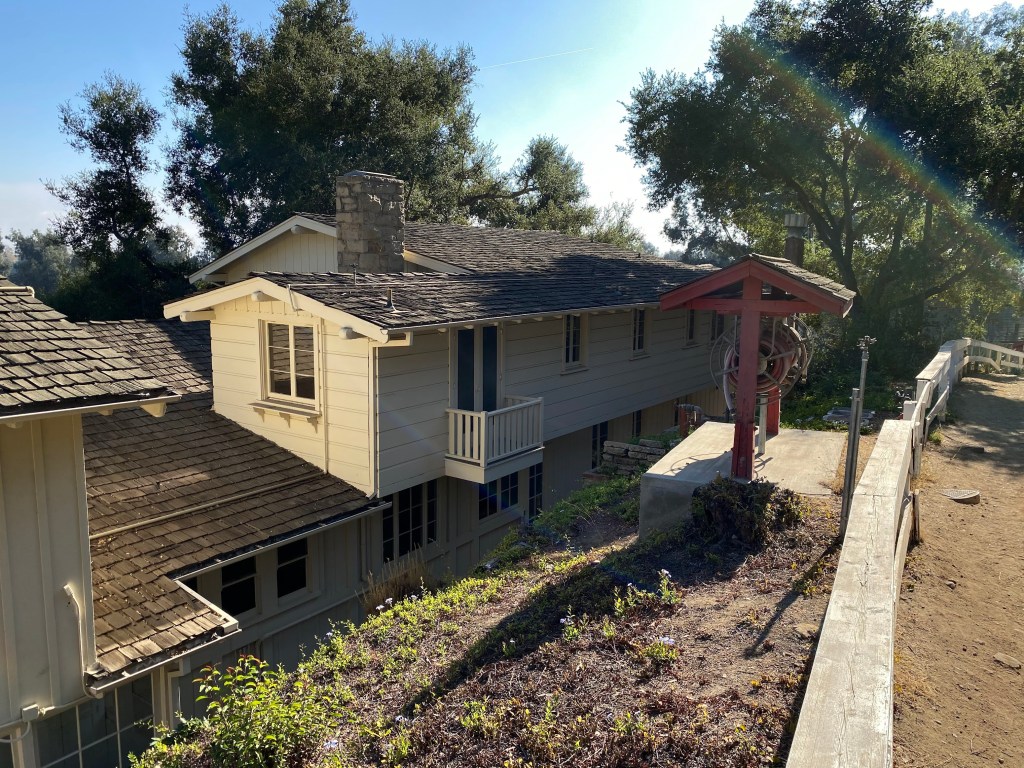
The workers’ house, a modest ranch with Western fencing, survived. Above the little place a bulldozer sat on a hill, occupying a god-like position over the property. 

There were other visitors yesterday, and if wholesomeness is a real condition, it exhibited itself with smiles, and people saying “good-morning” and behaving as if they had gratitude for something free and magnificent; the Western sky, the Santa Monica Mountains, the liberty to spend a quiet Sunday climbing up a hill to look out to shoreline.

Coming here was a needed antidote for a self-destructive time, a release from digital enslavement, a happier reality.

Rebuilding for Sustainable Reasons


The fire ravaged hills of Pacific Palisades and Altadena not only cry out for rebuilding. But cry to rebuild in a better way.

Especially in Pacific Palisades, the only way back (as imagined by those in power) is to rebuild the gargantuan single family home. How these can be afforded, let alone insured, is the new mystery of 2025, for very few will want to spend the next decade constructing McMansions that may burn down in the next fire.

Insurers are fleeing California, as the pool of “safe” properties dwindles, and the rates they can charge are understandably limited. A low cost insurance would not even replace a burned down tool shed.

And then there are the philosophical and political battles raging from those who only want luxury housing to those who believe it is a moral imperative to provide a percentage of “affordable” housing to Angelenos.

Somewhere in the middle is the moderate case to be made for developments that mix commercial and residential in the same walkable community. For here, there may be defensible lines for firefighters to use to battle the next conflagration. Up in the hills, next to the wild lands, is where the greatest danger lies.

The safer alternative is a denser community of pleasant surroundings with apartments and homes near stores, and walkable streets with cafes, restaurants, hardware, shoe repair and bookstores. Yes, we have to make room for Lululemon, Alo and skin clinics, but they should not occupy the entirety of every single commercial space.

There should be a plan for rebuilding in an architecturally coherent way, one that actually puts living residential spaces above the stores along the sidewalk, rather than fake windows as one sees in The Grove and Disneyland.

And if a plan is selected, it should be in styles that evoke what made old California beautiful.

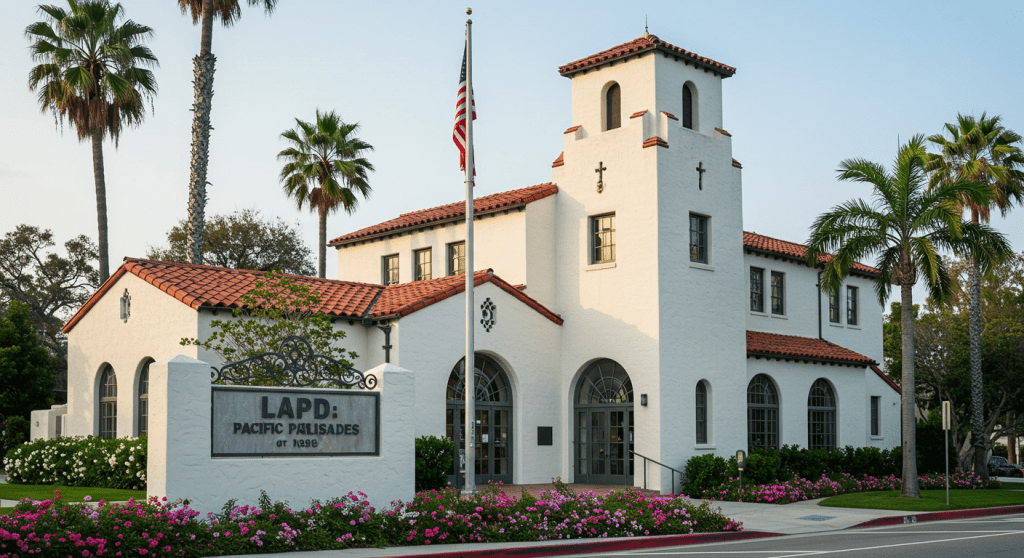
What follows are imagined architectural designs for rebuilt fire zones in Pacific Palisades and Altadena.

The Social Disaster


In all the days since the disastrous fires destroyed vibrant and sparkling communities of people and their houses and businesses in Altadena and Pacific Palisades, flat and socially unpopular Van Nuys, miles from any combustible forests, sat silent, its empty parking lots and vacant stores along Van Nuys Boulevard mute and abandoned, its daytime as empty and lifeless as its nighttime. 

You live here and just like people anywhere yearn for the same normal things that civilized places provide: safety, cleanliness, affordability, and lawfulness. But all you get are sirens, speeding cars, helicopters at 2am, Woodley Park set ablaze monthly.

After nearly 25 years here I see nothing but decline in the environment around Van Nuys. 

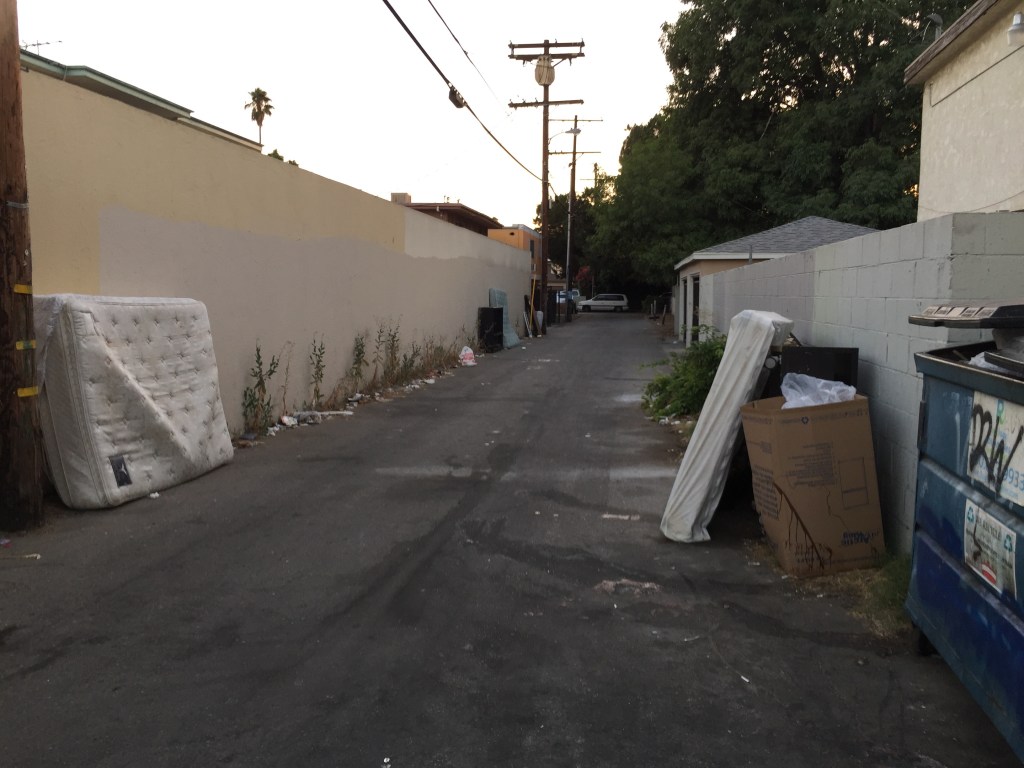
The same neglected mini-mall that I complained about in 2009 is still the same trash strewn dump it always was. Its owner used to live in Bel Air. He complained about my criticism when all I asked him to do was hire a $10 an hour worker to sweep the sidewalk weekly and install a security light on the side of the building so people didn’t sleep and urinate and tag the walls. 

The stores that line Van Nuys Boulevard from Vanowen to the Oxnard are largely empty, many are built with gigantic parking lots behind them that are also empty, parking for thousands of cars that once shopped here, but those shoppers have left or died.

The Valley Municipal Building is where CD 6 Councilwoman Imelda Padilla reigns over the neglect and the ugliness. She replaced Nury Martinez who had to resign in disgrace after she was recorded by covert means saying ethnically insulting things about other Angelenos. Martinez came after Cardenas who went to Congress where he now serves.

Cardenas, Martinez, Padilla. It sounds like a nursery rhyme with its melodic Spanish surnames. It might well be a soundtrack set to an ever- present social disaster of Van Nuys with its hundreds of homeless sleeping in the plaza, along the Orange Line, or in the parking lot of the CVS on Erwin Street. 

How is it that the so-called heart of the San Fernando Valley, the place that once bustled with prosperity and good infrastructure, including light rail and neatly tended homes and businesses, has been allowed to die for so many decades? 

Victory Bl. east of Sepulveda, Van Nuys, CA 5/10/18

Is it callous to also point out that Van Nuys is less prone to fire than other areas that have boomed in recent decades? Would Van Nuys Boulevard, lined with 13-story tall Park Avenue apartment houses be a higher fire risk than thousands of wooden McMansions shoved up canyons in Bel Air, Brentwood, Malibu and the Palisades?

And when Van Nuys gets light rail, might it be possible to imagine a walkable, pleasant, less expensive part of Los Angeles where the vaunted word diversity can be used equitably as all types of inclusion would occur with young, old, well-off, not so well-off, living in nice apartments with patrolled and orderly parks and streets? 

Perhaps some of the displaced people would live in well-maintained buildings if such a thing existed in Van Nuys. 

With so much focus on rebuilding Los Angeles a good place to start an experiment in civilization would be Van Nuys. It’s the only corpse that has been screaming for rescue for decades.

Woodley Park, R.I.P.


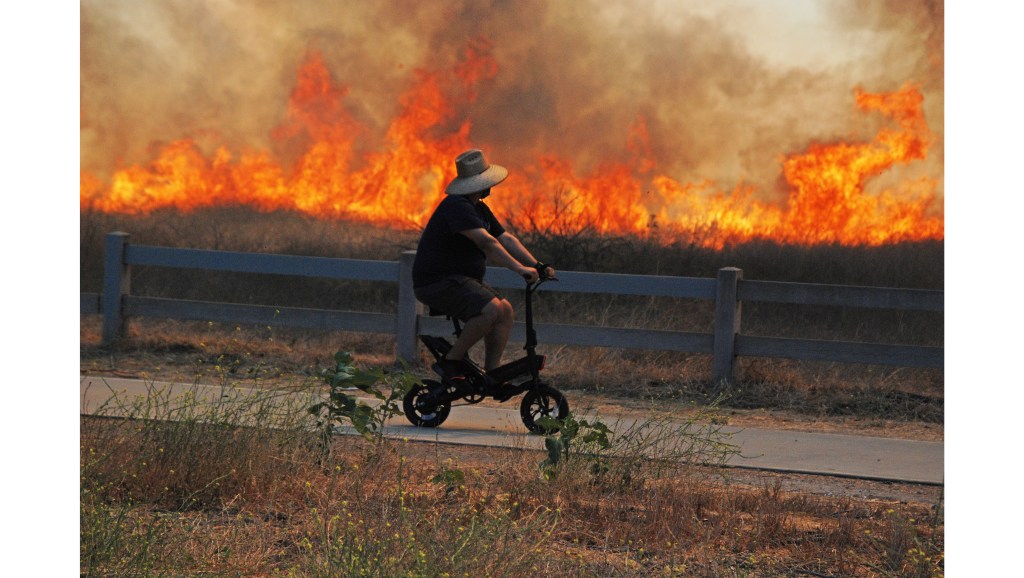
A man rides his mini bike down a bike path at Lake Balboa in the Sepulveda Basin as a wall of flames approaches Saturday, July 18, 2020. The fire put up a huge cloud of smoke and burned for well over an hour near a model airplane park and along Woodley Avenue. The blaze charred about 4 acres of brush before over 60 firefighters managed to contain it. No structures were damaged and no injuries were reported. (Photo by Mike Meadows, contributing photographer)

One of the ameliorating joys of moving to Van Nuys in 2000 was escaping, on bike, to Woodley Park, that formerly glorious area of bird sanctuaries, bike paths, grasslands, ponds, and the Japanese Garden.

Through the years I was so happy to ride through it, to feel the wind and the sun and openness of the park, a place to photograph, and wander and exercise in.

Since the reign of Mayor Eric Garcetti (Garbageciti) began in 2013, the park has become a homeless encampment, with hundreds trashing it with shopping carts, drugs, needles, garbage and worst of all, starting fires. 

It seems that every other month there is a massive blaze in Woodley Park, illegal cookouts or arson or just exploding propane tanks, and now the park is an ashen graveyard of nature, just black fields where tall grasses once thrived.

Why is it “humane” to allow vagrancy, disorder, disrespect and abuse of our parks, our streets and our environment?  We thought we had seen the worse of this city and nation in 2020, but if you want to feel even more gloom, take a saunter over to Woodley Park and witness for yourself the broken fences, the depleted environment, and the still evident trash camps of tents, shopping carts, stolen bikes and litter along Burbank Boulevard.

And ask yourself what competent and worthy leader would permit his city to become so degraded that even a simple park is too embarrassing to look at?