Before the Luck Ran Out.


The first job I had in Los Angeles was working at Barley Corn Entertainment, a small documentary production company in Valley Village.

It was the summer of 1994. OJ had just not killed his ex-wife and the young waiter who was returning her sunglasses. I was living in Studio City for $400 a month, and the new job as a PA paid $450 a week.

The woman who hired me, Lisa, was in her mid 30s, married to one of the owners, Sean. She was green eyed, tall, broad shouldered and drove a dark green Range Rover from her home in Pacific Palisades.

She brought along a little white Pomeranian dog to the office every day, a novelty to me, being from the Middle West and the East Coast where dogs were large and stayed at home.

Lisa was a line producer, a job she mastered in daily calm, always even tempered, even when she got cross. She commanded runs and released funds, met with producers, writers, editors, and researchers, and still had time to walk across the street to Gelsons for a cup of coffee and a large spinach salad. Her day ended at 5 or 6, and she would go down to the parking garage and drive an hour back to her enchanted life on Enchanted Way in Pacific Palisades.

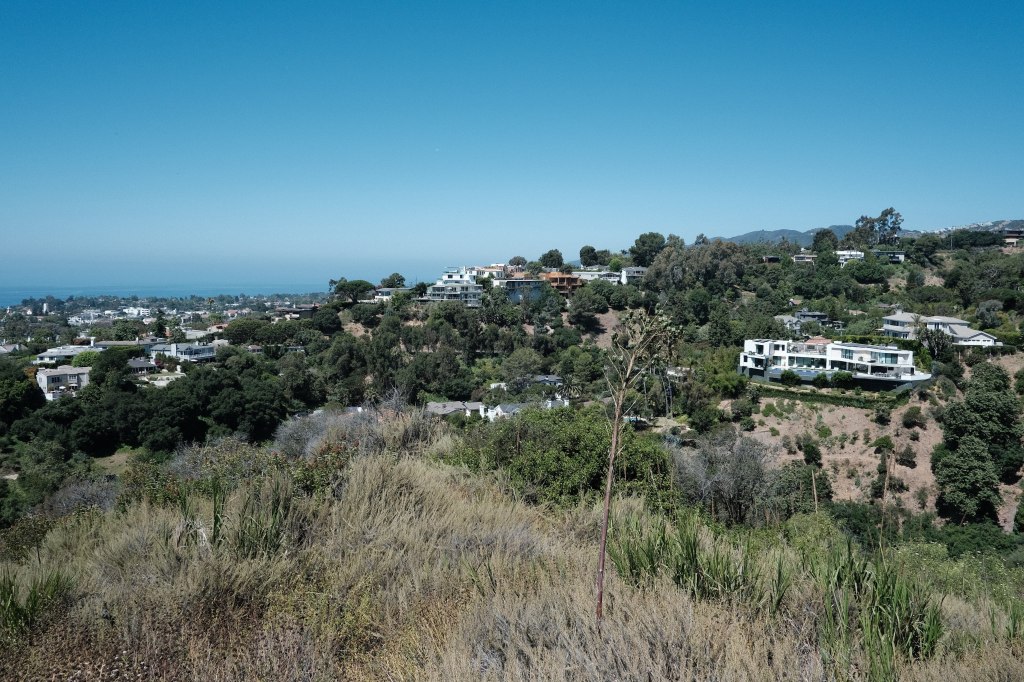
There was a Christmas party at their home in 1994. I arrived at the 1960s ranch house, built on a terraced lot, like every other house, little plots of splendor overlooking the Pacific, lots along a hilly street stacked and placed like many dinner plates on the arms of a hash house waitress. 

We were all young and in awe at the $600,000 home with sliding glass windows that opened to a small patio that overlooked the mist and the ocean. 

I drank a lot, and Lisa forbade me to drive home.

I went to bed on the white sectional in the living room, and awoke under a baby blue cashmere throw with a headache. Lisa made coffee, and then Sean invited me to leave “when it was convenient.”

Lisa and Sean, Sean and Lisa, Pacific Palisades. Range Rovers, small dogs, lovely houses that always sat in the temperature range of 58-68 degrees. 


My co-worker, Julie, was the daughter of two negligent Marin County hippies and had gone to live with her maiden aunt in Santa Monica during high school. She adored Lisa and Sean and hoped that one day she too would live in Pacific Palisades, perhaps leveraging her BA from UCLA and weekly production check to buy a house on Enchanted Way.

A few years later Julie met Aaron, a wealthy man who lived on Lachman Lane in the Palisades. She moved into his house, and they made plans to marry. I went to their house, sat by the pool, and talked with Julie about a reality show idea we never produced.

Aaron wanted Julie to sign a prenuptial agreement before marriage. Julie asked her friends what they thought, and the consensus was “he doesn’t really love you.” They broke up and Aaron married someone else, a compliant wife who signed an agreement, and they may have lived happily ever after.

Julie met a hard drinking Missouri man on a production shoot in Wisconsin, married him, had a baby girl, moved to Kansas City, got divorced after a year, and spent the next 15 years in Missouri pining for the lifestyle she lost. She and her teen daughter moved back to the aunt’s condo in Santa Monica last year.


Kevin, circa 1995, was a producer at Barley Corn, a year older than me, married to Cori, and they lived in a house in Pacific Palisades. 

He looked like a young Dick Nixon, was kind of a dick swinger at times, bragging about his $400,000 house bought with the wife’s parental endowment. 

I hadn’t seen him in 28 years, but there was a reunion of Barley Corn folks last summer. I asked him about his house, his $400,000 house. 

“It ain’t $400,000 anymore! We sold it and bought a much larger place near the village in Pacific Palisades!”


In the 1990s I also took a comedy writing class at the home of Bill Idelson on Brooktree Lane in Rustic Canyon.

It was a mid 1950s wood house in a redwood grove next to a creek. It was designed by Mario Corbett and photographed by Julius Shulman. (his photo below).

Idelson, an actor, also had a successful career penning sitcoms, and he had a formula, much of which I forgot, except for his drawing of a man and a moon. “How he gets to the moon is your story!” he said.

We would sit on the patio next to the creek, and with the sounds of water and nature, get instructed.

Idelson had a grown son, a handsome, athletic blond guy who said he would ride the creek during rains in his raft straight down to the ocean.

That was Pacific Palisades: the successful sitcom, the gorgeous house, the beautiful surroundings, the happy-go-lucky son who rode the rain water for fun.


Pacific Palisades does things to people who live there and people who don’t.

For those of us who only live there vicariously, it is sprinkled with celebrities, hiking trails, valet parking, croissants, gourmet coffees and cheeses, blond boys in collared shirts, hot yoga, scented candles, soccer matches, Will Rogers, polo ponies, Eucalyptus trees, gardeners and caterers, brand new big white houses with black windows and electric steel gates, and smooth faced women in sunglasses driving large SUVs 60 miles an hour down Sunset on their way to Lululemon. There is never smog, heat, homelessness or obesity. The maids commute two hours to clean 10,000 square foot houses that are empty because their owners live in New York City. 

It was, until a few days ago, something you venerated and worshipped, like Harvard University (before October 7, 2023), Berkshire Hathaway, or inheriting ten acres of land atop Mulholland. If only you had that Ivy League degree, or ten $677,000 Berkshire Hathaway shares, or lived on El Medio Avenue so you could walk to the Temescal Canyon Trailhead. You might someday hit it big, marry that blonde girl, date the personal trainer stepson of that HBO celebrity with a lot of fame and money, sell that show, invent that software sold for millions to Meta, or become a partner of that law firm in Century City, if only you had one of these or that you could be the happiest person on Earth and live in Pacific Palisades.


Since I moved to LA in 1994, there was always a sense to me that people migrated to places rather than improve the ones they lived in. They sometimes did this by changing names, from North Hollywood to Valley Village, or Valley Glen; or converting West Van Nuys into Lake Balboa.

To this day, Los Angeles, for miles and miles, is neglected, filthy, violent. It has no nice parks, hardly any real neighborhoods to walk around. It costs a fortune to live here, to rent or buy is oppressive. People sleep in tents, or on bus benches, they rob stores, and start fires because they are so lost and miserable. 

Seemingly not so in Pacific Palisades. Charming, safe, family friendly, delightful. Nothing catastrophic or out of control. The powers that be lived here and kept it well-tuned and well-functioning. Until January 7, 2025.

Once in a generation weather. Except it happens around the globe every week in different horror scenes. One month it’s Lahaina, the next month it’s Greece, Spain, Western Canada.

But Pacific Palisades? Our Pacific Palisades? Where we go for hikes, where my nephew goes to school, where my gentle, wine sipping bosses lived, where I brought my parents to Rustic Canyon so they could see “the real California?”

We kid ourselves thinking our good luck is our own doing, that we may escape losing our health or our home. We really do live by the whims of fate.

There is one migration that seems innocent, but it is, in a sense malignant, many people of means seeking to escape the bad air hellhole of greater Los Angeles, and it leads to Sunset at PCH where there is no more land, paradise promised at the end of the continent.

Now it is temporarily destroyed. 

Thank God for those who have survived. Life matters most.

We have seen these fierce wind driven fires and their atomic destruction. 

How one small spark can end one era and perhaps usher in another one that may be more humane and sustainable. 

Journey to Intelligentsia


I hate the place but I agreed to meet a friend who lives in Silver Lake down at the expensive, pretentious coffee house where there are many nice dogs and many mean people.

It was a random Tuesday in Los Angeles. The 101 was packed with cars and trucks. But when I drove down Hollywood to Sunset, I passed less than five people walking on the streets.

They were repairing the electrical wires on Sunset, on the year 1888 wooden poles, so I turned up Hyperion and found parking across the street from a man sleeping on the sidewalk in front of the two-million-dollar wooden bungalow.

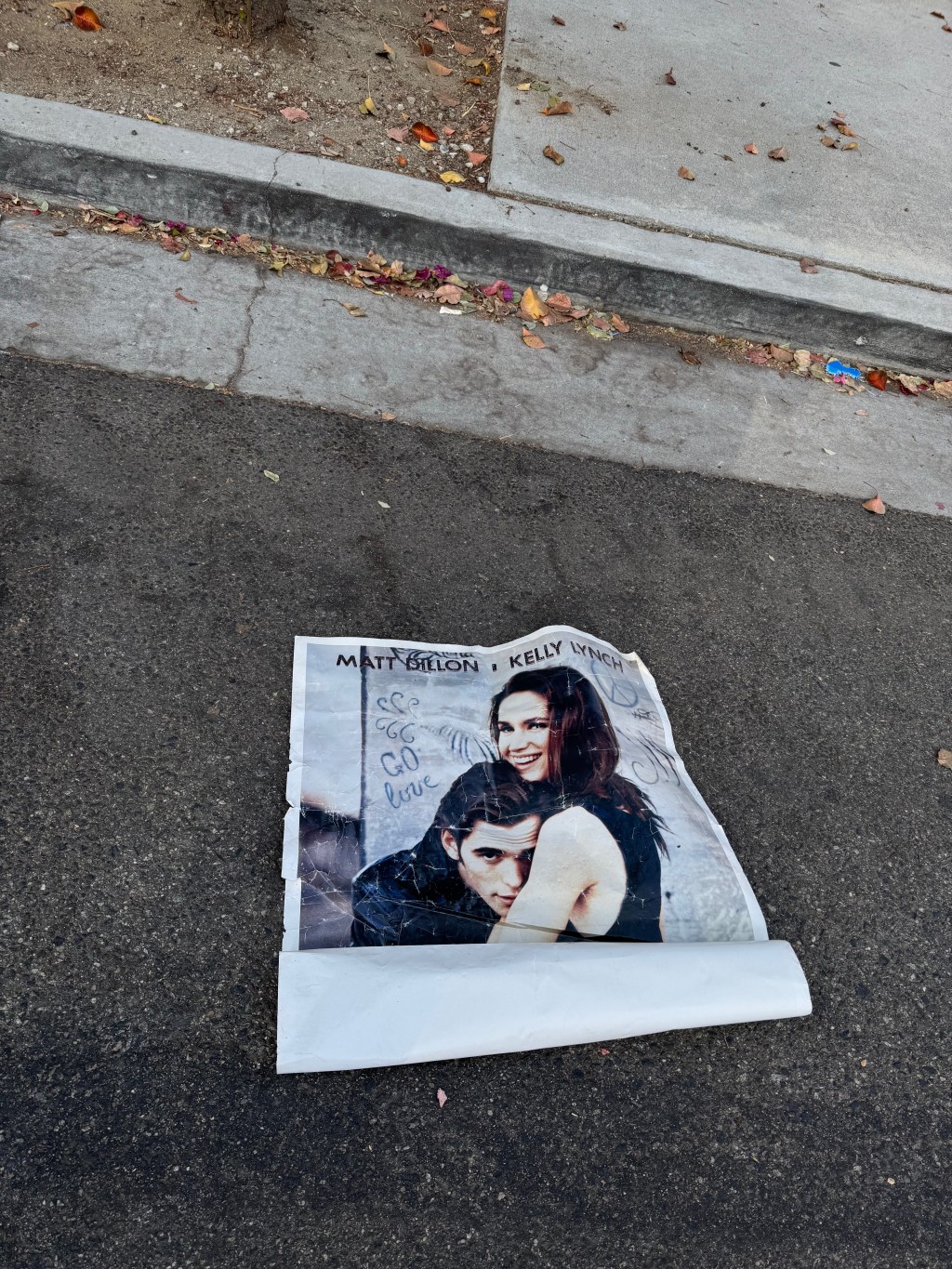
A discarded, half rolled out movie poster from the Matt Dillion/Kelly Lynch picture, “Drugstore Cowboy” (1989) was thrown on the street. An unemployed, 60-year-old gaffer on that film probably threw it out before moving back to Naperville.

I had to pee badly so I made a mad dash to Intelligentsia and found that the bathrooms were allegedly out of service. Quick thinking and I ran down to the other coffee place, La Colombe, which has better coffee, nicer servers and a clean, open restroom. I bought a croissant which was pretty good and walked back down to Intelligentsia to meet my friend.

There were angry political posters taped to every pole I passed:  

We need and demand a whole new way to live, a fundamentally different system.

LA’s Best Restaurants Are Feeding You a Lie.

And there was even a quotation from Black Conservative Thomas Sowell:

“The fact that so many politicians are such shameless liars is not only a reflection on them, it is also a reflection on us.”

      Perhaps the progressive person who posted Sowell’s quote didn’t know that Sowell is an ardent opponent of racial quotas.

      Two artfully outfitted Japanese guys were taking photos of the coffee shop exterior to document their visit to this legendary place. I felt excited for them being so excited.

      I found a seat outside across from a large black French Poodle and his bearded owner in a baseball cap imprinted with the flag of a foreign country.

      A small, middle-aged man emerged carrying an espresso cup balanced on a saucer, carrying a pastry, holding a dog leash attached to a large, gray Weimaraner.

      “Do you mind dogs?” he asked as he sat down and attempted to fit his large animal between the petite table and the flat wood bench.

      I was still waiting for my friend as more dogs arrived. It was an excellent seat for dog watching, looking at their fur colors, admiring their leashes, listening to their barking. The whole patio was dogs, tied up to the table legs, emptied of their owners who were inside ordering drinks.

      Finally, my friend arrived. He is about 50, a short Filipino graphic designer who carried Age of Revolutions: Progress and Backlash from 1600 to the Present by Fareed Zakaria. 

      He told me he had a crazy dream about losing expensive camera equipment. It inspired me to tell him about a camera store in St. Moritz I had recently seen that kept hundreds of thousands of dollars of electronics in their store window overnight without fear of theft.

      We got our coffees and new seats and sat on the outdoor patio where no loud humans could be heard, only the occasional bark from one of 12 dogs.

      Suddenly, a foul faced young woman holding a saucer of water for her rust bulldog threw the water bowl liquid on the patio inches from where we were sitting. She might have walked to the numerous plant containers and politely dumped her dog water there, but since this was Los Angeles, not Switzerland, consideration for others was highly unlikely. 

      We talked more about travel, politics, international affairs, apartments, real estate, and everything that might have involved Donald Trump, but his name was never mentioned. My friend asked if I wanted to walk down Sunset, perhaps to a park, to sit and talk, so we left Intelligentsia, the dog motel with coffee drinks.

      “Are you still hungry?” he asked. I assumed he was going to buy me a sandwich.

      We walked into Bravo Toast, a place with gourmet toasts. He ordered one with thin slices of bananas and a power drink. He paid for his sandwich and drink and got a number.

      “Hey, should I order something Ross?” I asked.

      “Oh, I’m sorry Andrew. Go ahead,” he said.

      But since this was Los Angeles, not Switzerland, consideration for others was highly unlikely.

      I got one with ricotta cheese for $12.50, plus $1.50 tip, my treat, for me.

      We were conversing, quietly, enjoying our food and ruminating about life, ideas, dreams.

      Then the noise began. 

      Two skinny, female presenting things somewhere north of 20 with many piercings and 18-inch waists sat down nearby. As they screamed and laughed not even the fire engines with sirens speeding down Sunset could be heard. I briefly considered asking them to talk softer, but since this was Los Angeles, not Switzerland, consideration for others was highly unlikely.

      We left Bravo Toast and said good-bye on Sunset.      

“Next time I’ll come up to Van Nuys and you can show me around,” Ross said. 

In Singapore.


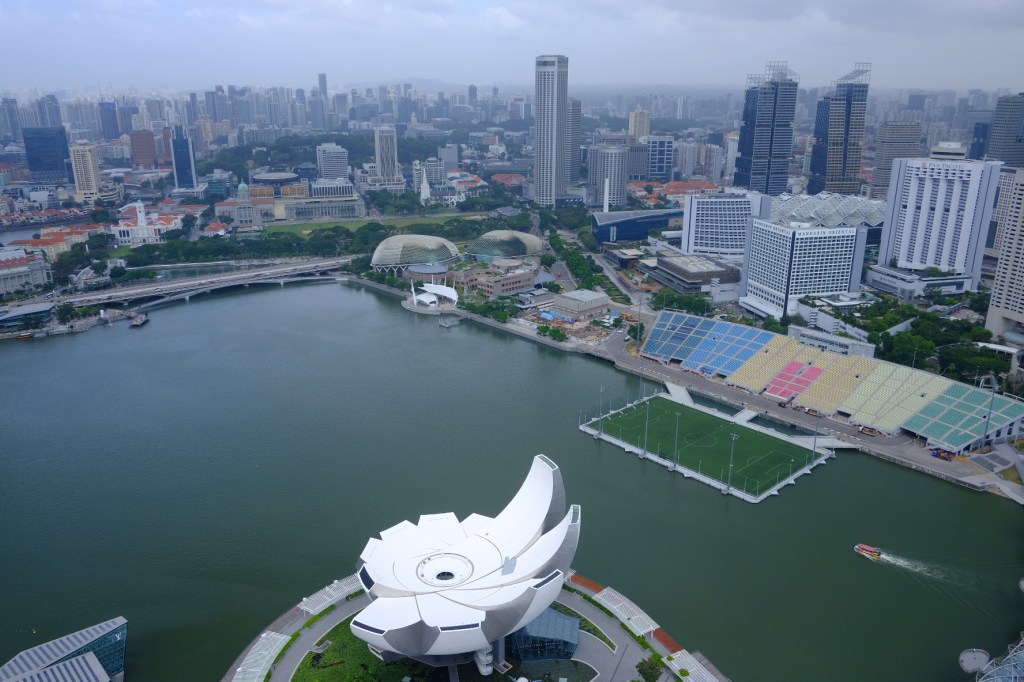
In Singapore, which I just visited for four days, I do not remember seeing any decorative streetlights, but I might have been looking, instead, at spotless plazas, copiously planted parks with enormous trees and bright flowers; or perhaps I was riding the air-conditioned MRT, easily navigating between scrupulously clean stations, labeled in easy-to-read signs, navigable by newcomers and citizens alike.

One day we walked up to the MacRitchie Reservoir where students, in the water, directed by coaches, were practicing and exercising rowing. They worked hard and still smiled. At the clubhouse I saw posted rules and regulations and fines for violating the laws of the recreation area, and still, all around me, everyone was peaceful and happy. Why shouldn’t they be? They were surrounded by order, nature, and safety.

I was unaware, until I returned to Los Angeles, that our city was removing fines for overdue library materials.

In Singapore, next to transit, are great food halls, called “Hawker Centres” which gather, under one roof, superb eating establishments: affordable, delicious and regulated by government inspectors.  We ate at two:  Tiong Bahru and Old Airport Food Centre.

The hawker centres date back to the 1960s, when the new government of Singapore, in order to insure cleanliness, hygiene and food safety, put all the street food into these mass eating halls.

In 2019, Los Angeles made it LEGAL to sell food on the street, so the lady who just finished cleaning her cat’s litter box and will shortly make your guacamole, can also sell it from her blanket next to MacArthur Park and not get arrested. 

Often when people talk about Singapore, people who don’t live there, they bring up draconian laws that sound utterly terrifying. Death for drug dealers, chewing gum is illegal, and a recently enacted “fake news” law that might curb free speech.

Singaporeans I spoke to didn’t think about these laws, or believe they hampered their freedoms. Perhaps they were too happy enjoying the liberties of crime free streets, or sidewalks without homeless encampments.  They probably were also feeling good while availing themselves in superb health care or government subsidized housing.

Incidentally, Singapore has public housing. Rules are that the residents must be legal citizens or permanent residents. 82% of the housing in Singapore is government run. So here we have a refutation of the tired conservative/liberal ideology that poisons American minds. There is such a thing as desirable government housing. And there is such a condition as limiting the use of these buildings to those who are lawfully in the country.

Singapore is rated number one or number two in education for its schooling. An 8-year-old boy, a son of a friend, helped me program my mobile phone so I could get internet coverage all over the city.  Just one example of intelligence at a very young age that comes to mind. 

What else can be said to praise laws, rules, order, safety, and yes, penalties, punishments and respect for social order?  Can our nation, and our city, emulate Singapore? Or should we look to Mississippi, El Salvador and New Delhi for our future plans in transit, education, housing, health care and sanitation?

On the day we came back to Van Nuys, two men were shot and wounded nearby.  Four were killed here in 2019 according to the LA Times.  

“According to UN data, Singapore has the second lowest murder rate in the world (Data excludes tiny Palau and Monaco.) Only 16 people were murdered in 2011 in a country with a population of 5.1 million.”-BBC News  In 2017, 11 people were killed in Singapore.

Am I freer in Los Angeles or do I live inside a city prison of another kind?

Friends in Low Places.


One of the first lessons new arrivals to Hollywood learn is that you make friends with people who can do something for you.

It’s a secret that is out in the open, one that many imagine they alone own.

I was as guilty of it as anyone else when I moved here in 1994 and thought a 15 year friendship with a television producer would lead to work and connections. Instead it just ended in bad words and we never spoke again.

Poisonous as it is, the tendency to believe that high connections produce happiness and fulfillment leads people into dead ends. And the idea that every single new friend should have some mechanical use is part of the reason people here have so many friends, and hardly any good friend.


This was one of the weeks I was back at work turning people I hardly knew into friends. Because I have written a webseries. And I want people to work on it. And I’m pitching it around and thinking that I’m getting somewhere by speaking personally to those whose skills or interests might correlate to mine.


You own a studio and you build sets?

You went to film school and you’ve shot video?

You are funny and you act?
You’ve never acted and you want to?

You’re a producer because you call yourself one?


I’m going to be your next friend.


149881_10150094001276343_7961205_n

This is the time of year when the weather turns colder and leaves turn golden and I think of those times I would cook Thanksgiving dinner with my mother and father in Woodcliff Lake, New Jersey, and she would rip out the entire food section of the New York Times and we would try and create something artistic like Creole Oyster Wild Rice Stuffing that would later be eaten and despised by my father and brother.

And when my parents were here in California, on a holiday visit, or living here,  we would all gather at a relative’s house. And my mother and I would drink many glasses of wine and eat several helpings of turkey and stuffing, potatoes and pie, and wander around, not talking to anyone, but just enjoying a stuffed stupor, while outside Christmas lights twinkled and cold winds blew. And life was bracing and lovely and numbingly satisfying.

Those occasions were times I had to testify to my mother on plans and ideas and money-making schemes I had dreamed up. “I think I might work on a new documentary in January Mom. Nobody is hiring in December. The whole city is dead.” Some of those Thanksgivings, especially in the 1980s and 90s, involved a blonde woman named Carmel on my arm, and a message handed out by matriarchal authority that I was only welcomed home as a heterosexual.

Everything is gone now, the house, my youth, my Ralph Lauren tweed jackets and wool pants, my mother and father. My brother and his family escape to luxury in San Francisco and eat burritos and sushi in the Mission District while I stay back and think about which friends or family are really true and who are not.

Thanksgiving (like Halloween, Christmas, Hanukah, Easter and the Fourth of July) is not thought of too highly by my Malaysian born partner, but he is willing to eat everything provided it is drenched in maple syrup.

This year we were invited to several places but we will cook at home. It sounds cozy and dull. But I should be thankful I think.

Some friends from out-of-town, people whom I know from years back, may visit Los Angeles and I will see their photos on Facebook but they will never call. They will be busy, they will be showing off their children, their production photos, their visits to Disneyland. And I will still call them my friends.

One poetic and articulate friend is now an executive producer rebranded as an authentic Southern voice and storyteller. He was one of the quality people I met when I moved here. If I live here 20 more years I will probably encounter others of great self-importance.

Living in Hollywood for twenty years I still have idea how to quantify or recognize authenticity.


Meeting the #YummyDog Man


IMG_0898

IMG_0888

IMG_0895

For a few weeks now, Yummy Dogs, a Van Nuys purveyor of New York style Sabrett Hot Dogs, has been haunting me with their tweats, imploring me to stop by and see owner Rick and his food cart on his stopovers in Lake Balboa and Calabasas.

Today I met owner Rick Feldman (b. 12/12/74), an affable and sweet man in a baseball cap who was born in Southern California, but spent time in my old neck of the woods, Skokie, IL. His white sneakers unintentionally gave away his Chicago origins.

He previously worked as a landscape contractor but brain surgery forced him to relook and reevaluate his life, and he decided to sell hot dogs, a fun and less stressful job, he claimed, than overseeing construction. He lives in Lake Balboa. And is married to a woman, an arrangement once widespread.

On this partially sunny day, he was in the back parking lot of a dark glass office building along Sherman Way, not far from the Van Nuys Airport. Streams of deskbound young Latinas in black tops and black bottoms, taking their only exercise of the day from office seat to car seat, poured out of the building, followed by those men in name tags, blue shirts, and goatees who populate this part of the San Fernando Valley office world. Many stopped by to try the various incarnations of carne doggeria: the Spicy Dog, the Jumbo Spicy Dog, the Veggie Dog.

Rick, pulling the steamy dogs out and into waiting buns, chatted and served and directed the customers towards his international array of condiments: powdered cumin, dry and yellow mustard, Sriracha, Tabasco, and pepperoncini. He talked up his self-roasted coffee, brewed and served a la cart.

In his new venture, under the bright umbrella, he seemed happy, happier than most anyone without a hot dog cart.

Food Pantry List.


HOW TO HELP

Call food pantries for hours and other information on how to donate.

Lutheran Social Services: 6425 Tyrone Ave., Van Nuys; 818-901-9480; http://www.lsssc.org

Valley Interfaith Food Pantry: 11076 Norris Ave., Pacoima; 818-718-6460; http://www.vic-la.org

Meet Each Need with Dignity: 10641 N. San Fernando Road, Pacoima; 818-897-2443; http://www.mendpoverty.org

FISH of West Valley: 20440 Lassen St., Chatsworth. 818-882-3474.

SOVA: 16439 Vanowen St., Van Nuys. 818-988-7682; http://www.jfsla.org.

North Hollywood Interfaith Food Pantry: 4930 Colfax Ave.; 818-980-1657.

Guadalupe Community Center: 21600 Hart St., Canoga Park; 818-340-2050.

Our Redeemer Lutheran Church: 8520 Winnetka Ave., Winnetka; 818-341-3460.

West Valley Food Pantry: Prince of Peace Church, 5700 Rudnick Ave., Woodland Hills; 818-346-5554.

First Methodist Church of Reseda: 18120 Saticoy St., Reseda; 818-344-7135; http://www.fumcreseda.org.

Rescate at Canoga Park Community Church: 22103 Vanowen St.; 818-884-7587; http://www.rescatefamilycenter.org.