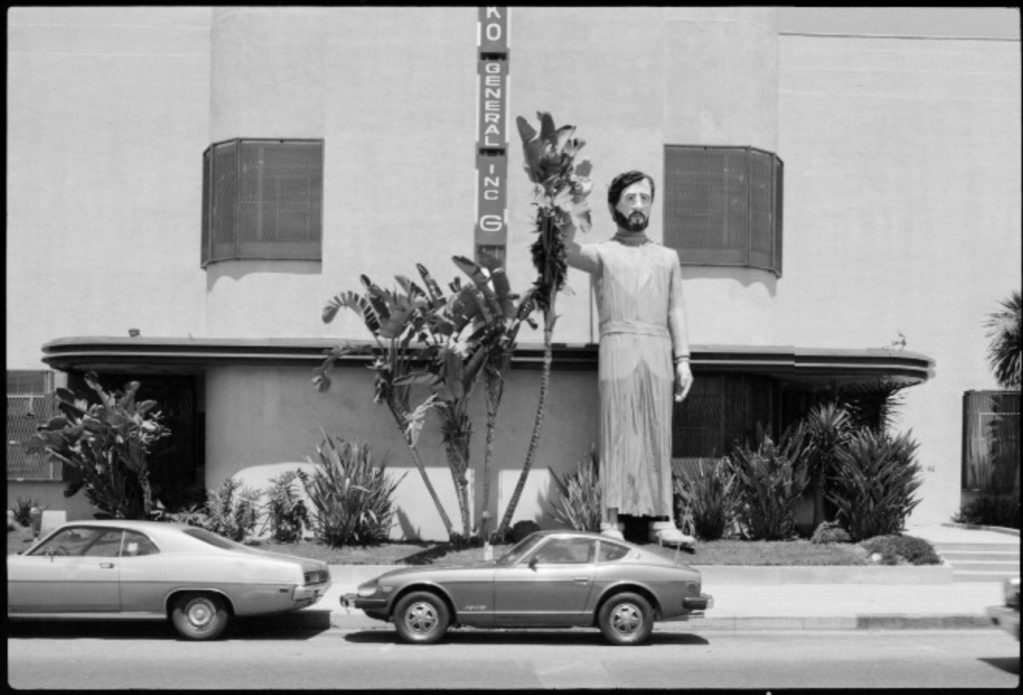
1975 Los Angeles by Ed Ruscha


The Getty has 45,856 digitized photographs of Los Angeles by Edward Ruscha.

I went to look at just a part of it, May 1975 (3,724 images). 

There are black and white photographs of entire stretches of streets in our city, for example every structure along Melrose Avenue for miles.

Many who possess far greater insights than I will concoct profundities about these pictures, connecting them to politics or music or the decline of the West.

They will project onto the photos whatever template of modern ideology they wish. 

But I think these photos just are. They are the exact thing they show. And that is what makes them brilliant. For they are the essence of Los Angeles, a homely and free place of ambition and anomie.

There is 3910 Melrose Avenue with a circa 1964 Pontiac parked in front of a 1920s Spanish Style house with arched windows, topiary and a cement walled lawn.

At 7168 Melrose there is a commercial building, with a 1960s decorative screen covering over a 1920s red tiled roof and stucco façade.

Most of the photographs juxtapose car and architecture. That is the recipe. It makes us long for youth, ache for what has passed, and imagine what it might be like to drive a ’74 Camaro down spotless Melrose, listening to a Doobie Brothers 8-Track, and stopping off to pick up a bag of gourmet Brazilian nuts at Iliffili.

Sex was open and advertised in 1975. Cock of the Walk had live sexy males in private rooms. It was next door to Madam’s Cat House with sexy girls in private rooms. If you messed up your clothes you could slip in quickly next door and change into a new pair of old jeans at Hollywood Used Clothing

Bundi’s at 8525 Melrose had stylish looking clothes. Just outside, a bus bench advertises the Jewish funeral services of Malinow Silverman.

Along 8650 Melrose, a 1969 Cadillac convertible, and a 1964 Chevy Impala coupe, are parked on the curb in front of several young, hip stores offering haircutting, needlework, a rock gallery, and Ruthe Lee Richman’s Art in Flowers.

A few doors down, Irving’s Coffee Shop served Pepsi-Cola. What kind of menu did they have ? Imagine your dining choices in 1975 Los Angeles, a 90% white city prior to the mass immigration and cuisines of Vietnamese, Filipino, Burmese, Persian, Haitian, Korean, Guatemalan, Honduran, Brazilian, Malaysian, and Sri Lankan peoples.

Imagine a city where so much was tolerated but where nobody lived under bridges or slept alongside freeways, and bus benches were used by bus riders.

Having trouble sleeping? Stop by International Water Beds. Writing letters to friends? Pick up some custom letterhead at Melrose Stationers. Is your cane chair falling apart? Frank Lew at 706 N. Orange Grove will repair it.

There are a lot of photos to look at. Like everything else these days we compare it to 2020. Even 2019 seems more like 1975 in the take-for-granted-liberties we had before the pandemic. 

And now we close with these lyrics:

Freedom’s just another word for nothin’ left to lose

Nothin’, don’t mean nothin’ hon’ if it ain’t free, no no

And, feelin’ good was easy, Lord, when he sang the blues

You know, feelin’ good was good enough for me

Good enough for me and my Bobby McGee[1]


[1] Kris Kristofferson-songwriter

Janis Joplin-singer

Shulmanism


The world needs another book on the late photographer Julius Shulman (1910-2009) like it needs another Katherine Heigl movie, but there I was, last night, driving to Woodbury University, to attend a book signing for the new Rizzoli photography book, “Julius Shulman and the Birth of a Modern Metropolis” by Sam Lubell, Douglas Woods, Judy McKee (Shulman’s daughter) and illustrated, of course, with Mr. Shulman’s voluminous and gorgeous architectural images.

In an auditorium, a large screen was set up in front of the audience. At a long table sat Craig Krull, whose gallery sells Shulman’s infinitely reproducible photographs for thousands a piece; a woman from the Getty Research Institute/ Julius Shulman Archive; Judy McKee, Julius Shulman’s only child and the executor of his estate; authors Sam Lubell and Douglas Woods; and architecture critic and author Alan Hess.

Shulman’s photography was the clearest and finest representation of the California dream after WWII. Through his lens, the world saw a state of endless innovation and mass-market modernism where mobility and technology might remake the lives of millions under the glowing sunshine.

Architects Neutra, Eames, Koenig, Lautner and Beckett hired Shulman to promulgate, promote and propagandize modern building and modern design. Through the 1950s and 60s, every freeway, every parking lot, every shopping center replacing every bulldozed orange grove was an opening to a grand and glorious future. The lone skyscraper in a sea of parked cars was held up as a model of how life should look. And Shulman was the master who made the desert of Los Angeles bloom.

The skyscraping of Bunker Hill, the lifeless streets of Century City, triple-decker freeways– they all were shot at the end of the day: shadows, textures and gleaming surface.

Mr. Krull called Mr. Shulman “the most optimistic man I’ve ever met.” Like Ronald Reagan or Arnold Schwarzenegger, Shulman loved the Golden State and kept his company with the most successful and accomplished men of his time.

The speakers last night, acolytes and worshippers, reinforced each other. The academic praised the archivist who saluted the authors who thanked the gallery who paid homage to the photographer.

Like Scientology, that other great religion of this region, Shulmanism demands fealty and loyalty to its founder and his work. To ask why Los Angeles has never lived up to its photographic glory is to risk blasphemy. To ask why Shulman, who lived for almost a century, did not turn his very observant eye, onto the less attractive parts of LA, is to insult the very vision and mythology he produced.

Mr. Krull also said that Mr. Shulman never thought his photographs were worth so much until the checks came in. Photography is reproducible… but oil painting, sculpture and the Hope Diamond are not. No doubt, Mr. Shulman knew that each of his negatives could turn out 3 million photographic prints. But art collectors and art sellers must be smarter than the rest of us. And Shulman’s work is the gift that keeps on giving. Publishers, filmmakers, galleries are going to go on licensing Shulman for as long as they do Warhol, Presley and Monroe.

Projected onto Shulman is the very ideal that modernism was moral. Once upon a time, myth-makers imagine, architecture was about making the world a better place. By omitting broken down and shabby Los Angeles, and posing happy children, well-dressed wives and various home furnishing accents, Shulman decorated and embellished his structural subjects. With biblical fervor and pixelated proof, these photos demonstrate to believers that paradise did indeed exist in post-war Los Angeles County.

At the end of the presentation, one of the authors spoke about his favorite photograph in the book: a 1930s image of a thriving and ornate corner of downtown Los Angeles with streetcars and pedestrians.

Fire Near the Getty Center.


Brush Fire in the Sepulveda Pass

A burning brush fire, in the Sepulveda Pass, near the Getty Center, began today around 1pm.

Photo was taken in Westwood by Andy Hurvitz

View From the Getty.


Getty Garden
Getty Garden