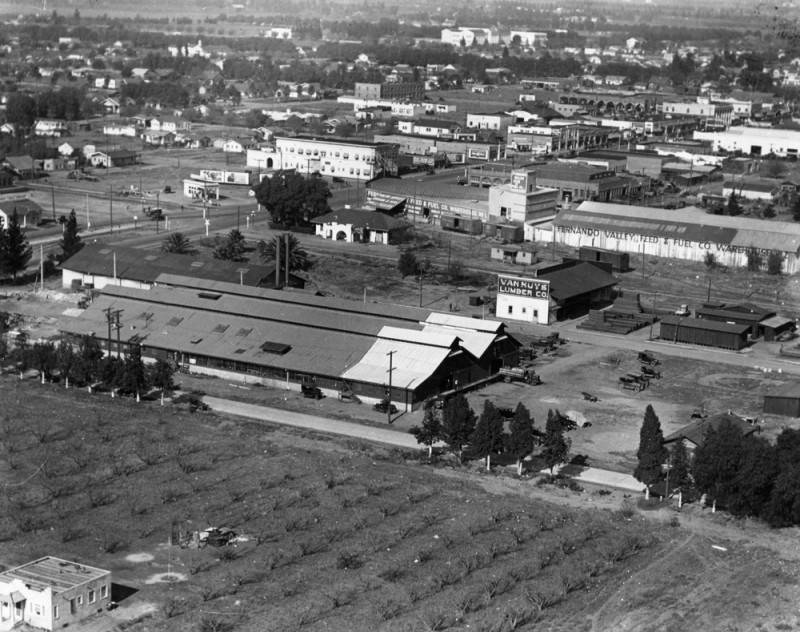
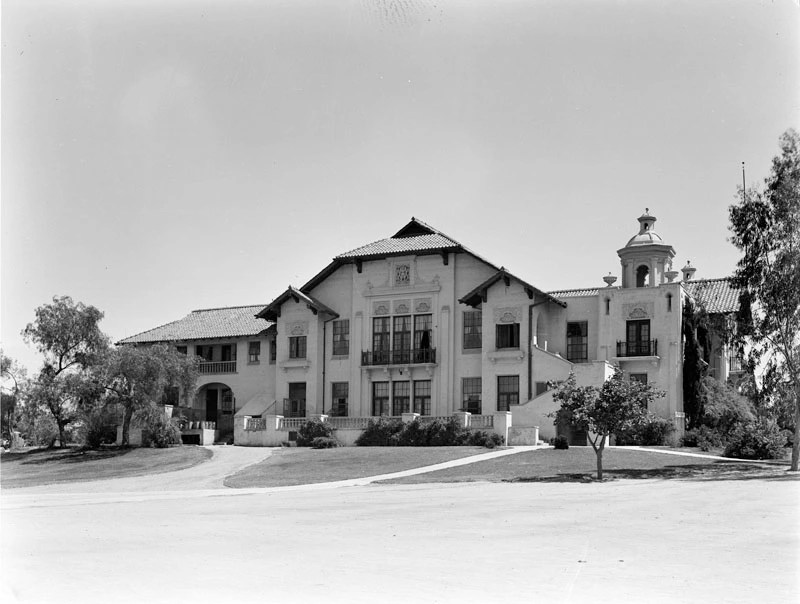
Automobiles travel in both directions on Sepulveda Boulevard where it crosses Saticoy Street in Van Nuys; direction shown is unknown. A billboard advertises Signal Gas, pumped next door at the service station (left).
Six decades or more along Sepulveda Bl in Van Nuys, life was very different than today.
People conducted all their daily activities, from work to shopping, in automobiles. They were frustrated by traffic, and there were many accidents. This started early in the morning, before sunrise, and continued long after dark, in a slow, honking, and impatient parade of tens of thousands of trucks, cars and buses.
Photograph caption dated January 5, 1961 reads, “This modern supermarket at the corner of Sepulveda and Victory boulevards in Van Nuys is the latest addition to the expanding Dale’s Market chain which now operates 10 stores in the Valley.” (LAPL)
The buildings along Sepulveda were a motley, junky collection of fast food, auto repair, filling stations, car washes, cheap motels, hardware, liquor and supermarket businesses dropped down between billboards and wooden power poles.
There was nowhere that was pleasant, in the sense of a community, with proper landscaping, trees, amenities, or aesthetic zoning regulating signs or advertising.
There was no trace of grace, of history, of the old Spanish missions, the orange and walnut groves, the spectacular trees, flowers, and natural beauty that characterized California. Everything was garish, commercial, toxic, selling everything that polluted and sickened human beings in a circus of raucous, blind, aggressive hucksterism.
Photograph caption dated March 9, 1959 reads, “Hub Furniture Stores newest location on Sepulveda and Nordhoff in Van Nuys marks the 14th Hub Store in the greater Los Angeles area. March 14 is the opening day.”Photograph caption dated March 3, 1961 reads, “Sherman Way and Sepulveda.” This intersection tied with Century and Airport boulevards for fifth worst intersection, each with 20 accidents in 1959.;
Even with many new, lovely ranch homes, built after the war, on the residential blocks nearby, the general appearance of Sepulveda was ratty, unappealing, low class and frightening.
Mr. and Mrs. Audie Murphy and son, 6233 Orion Ave. Van Nuys, CA, 1953
Holdups at liquor stores, kidnappings, harassment of women by men driving past, littering, dumping, intoxicated drivers; in every respect related to civilized life, mid-20thCentury Sepulveda Bl. was so very different than today.
The only thing that remains the same is the presence of openly gay events, something that was even advertised on a sign in 1954.
Photograph caption dated October 20, 1954 reads “‘Gay Ninety Days’ at Builders Emporium, Van Nuys, is opened by Victor M. Carter, at driver’s seat of early-day Cadillac, firm’s president. Featuring month-long event is ‘good old fashioned prices,’ bearded salesmen, and 5,000 derbies to be given customers. In picture, left to right, are Jay Delia, Mel Goodman, Carter, Margaret Porth, Marthie Ferderer, Helen Ireland, George Blum and Lou Johnson.”
Within the collections of the Los Angeles Public Library there are city, business and phone directories going back to 1873.
Among the historic books can be found The Armenian Directory of The State of California, 1932, related to the Armenian community of Los Angeles, at that time, numbering a few thousands, many of whom were settled in Pasadena, and throughout the Southland.
The first wave of emigration from Armenia came after the First World War when Turks murdered millions of Armenians during the breakup of the Ottoman Empire. Most of the refugees came from Western Armenia near Turkey.
Here in Los Angeles they established an industrious, skilled, hard-working community. They built churches, founded benevolent societies, and created cultural and social institutions centered on music, food, and dance.
Their professions in their new adopted city were many and varied and included dentists, physicians, attorneys, tailors, grocers, bakers and funeral homes.
The Standard Crate Co., Inc. built fruit boxes and gave “special attention to Japanese customers” many of whom grew citrus. Ten years later these same clients were rounded up and put into detention camps, a tragic and historical irony the Armenian advertisement could not foresee or imagine.
The Hollywood movie industry was already famous worldwide when the Antranik Dramatic Company advertised their actors. Mastery of frivolity has always been important in this city.
It seems that many Armenians did well here.
The Altoonian Family, and their sedan, is seen below in a 1926 photograph. The 1933 directory lists an “Altoon Apartments” at 2405 S. Hoover, and several Altoonians who lived at that address.
At Joe’s Garage, 2505 E. 4thSt. the motto was “Once a customer, always a customer.”
A magnificent Art Deco ad for signs is a last breath of the 1920s with its rhythmic patterns and syncopated layout.
The Luther Eskijian family is shown in 1924, perhaps in front of their home at 1738 Bridgen Rd., Pasadena. Boys are in knickers, those short pants that children wore up into the mid 1930s.
The Constantinople Cigarette Shop at 356 South Broadway made special monogrammed cigarettes “which makes [a] splendid gift or present for your friends and relatives for their birthdays.”
The International Grocery Co at 134 N. Main St. had such Armenian foods as aghy banir, lablebi, boulgour, chadana and fistuhk. Or cheese in brine, roasted chickpeas, crushed wheat, pine nuts and pistachios. A one-gallon tin of olive oil was an enormous luxury item priced at $2.50 ($25.68 today).
Elegant tailoring was the province of Gregory H. Chashoudian at 4562 Beverly Blvd east of Western Avenue. His skills were endorsed by B.R. Ware, Attorney, who said Mr. Chashoudian’s suits were “entirely satisfactory” and reasonably priced.
The world was in the midst of the Great Depression.
Yet looking through the pages of the Armenian Directory in 1932 one feels a sense of pride and admiration for these industrious people who overcame such grueling tragedies and unjust cruelties.
They somehow made it to Los Angeles, CA and established stable and prosperous lives in a new and unfamiliar land.
Last week, the LA Planning Commission approved 179 townhomes and 8 low-income apartments built partially out of the old North Hollywood Savings and Loan (later Chase) Bank at 4445 Lankershim Bl. at Riverside Dr. according a recent story in the Daily News.
The 1961 building will be readapted for residential use, and include over 5,000 SF of ground floor commercial space along with 263 car spots and 237 bike spaces. The architect is Winston Chang, principal of Next.
For years I have driven past this building as I traveled on the 134 or along Riverside Drive.
Curious about its history, I dug up some old LA Times articles.
Roscoe W. Blanchard, Sr. (1882-1977) owner of the Blanchard Lumber Company, founded the North Hollywood Savings and Loan in 1923 when the San Fernando Valley was in its earliest boom days.
Here is his 1977 obituary:
After WWII (1945), the boom in residential building made the bank prosperous, and in 1960, with over $40 million in assets, they announced a new $2 million dollar, six-story tall skyscraper with 73,810 SF of space. Earthquake resistant and fireproof, it was also the tallest structure in the San Fernando Valley.
In a 1963 ad, the bank stated they would pay depositors 4.80% interest, a tidy amount for the time. In 1969, they promised 5% interest for new deposits. Those were the days when a person could save money by opening a savings and loan account, and count on a guaranteed level of annual growth.
But the go-go 1960s ended with a decline in the Los Angeles realty boom. And the days of a secure savings and loan specializing in residential housing loans was numbered.
A Feb 9, 1969 LA Times article entitled, “Realty Boom is Fading as Prices Stay Stable” lamented high interest rates of 7-8%, and the inability of many families to afford the average $25,000-$35,000 SFV home, with more than 2/3 of SFV families earning less than $10,000 a year.
Overbuilding in 1965-66 had resulted in rental vacancies of 22% and almost 2,000 new homes unsold. One-third of the new, un-bought homes in Los Angeles were in the San Fernando Valley.
In 1969, both rents and residential prices fell as supplies increased, a widely accepted fact of economics which seems to have been forgotten by modern Angelenos who believe that building more housing is only for “greedy developers.”
But back when the developers were allowed to develop, this was the result:
1970: In Woodland Hills, the average rent was $172, the highest in the Valley.
Encino had the most expensive homes, averaging $50,000 in value.[1]
Today we have this:
According to CoStar, the price of an average apartment in the Woodland Hills sub-market—which includes Warner Center—stood at $2,200 per month.
In 2018, Redfin said the average Encino home was $980,000.
In 1979, Proposition 13 froze property tax rates at the original level a home was sold at, not currently assessed at. Lucky owners of homes bought in 1974 for $40,000, which became $300,000 properties in 1980 (or $3,000,000 in 2019) were still taxed at 1974’s $40,000 purchase price.
The tax rebellion was partially a white reaction against the increase in illegal migration and resentment in paying taxes for darker complexioned students. Today, most people who can, drive their children out of “bad” school districts to “good” ones thus exacerbating our air pollution and traffic problems.
People who once rode the bus now take Uber or Lyft, thus exacerbating our air pollution and traffic problems.
We don’t build enough housing. Our housing is in short supply because many of the occupants here don’t legally have a right to be here. But that is stating what should not be said.
Part of our hypocrisy is being liberal and being racist and wanting good education for our children. And none of these traits can co-exist in modern Los Angeles without being hypocritcal. This is not an indictment, just merely a statement of fact from speaking to white parents who live on my street in Van Nuys and drive their kids out of the area to attend school.
The great shortage of homes in Los Angeles began its 40-year ascent and has now culminated in the lovely sight of human beings, unable to afford shelter, sleeping under bridges and along sidewalks.
Mental illness is blamed for some of this but I wonder how mentally healthy I would be after eating out of garbage cans and sleeping in an alley for a year.
That some of the fortunate inheritors of parental properties, and low property taxes, are also some of the biggest opponents of new residential construction, especially in wealthy sections of Los Angeles, is a cruel irony.
In the 1980s, the Savings and Loan crisis, brought on by government policies that bankrupted local S&Ls, resulted in the consolidation of many small banks into the large regional ones such as Chase or Bank of America.
In 1976, North Hollywood Savings and Loan was incorporated and merged into San Diego’s Central Federal Savings and Loan Association.
So in the next few years, a building that once housed a savings and loan which played an instrumental role in lending money to young families buying homes in the San Fernando Valley, will become itself a home for some 179 families, (and 8 units or 4% of the total units will be low income).
Los Angeles, here in Van Nuys, and here in North Hollywood, and all around the city, will move along and build expensively and sluggishly until its leaders accept that it must become denser, higher, and less car dependent. An enormous push for more affordable and multi-modal transport accessible housing is paramount for our survival as a viable metropolis.
Because we don’t build enough housing, we cannot afford to live in areas we might want to, which leads to more segregation and more bitterness and more helplessness in a city where homelessness is never far off and being housed is conundrum of insanity and indebtedness.
That we need to build more was something Roscoe W. Blanchard, Sr. would have understood with his expertise and success in building materials and financing homes 100 years ago.
We are trapped between the reality of our city and our dreams of its potential. We know what it is. We see this place with our own eyes.
But we really don’t want to accept its degraded condition, or the responsibility for how grotesque, unequal, cruel, barbaric and sadistic it often is. To look at the ugliness in this city we would have to accept that ugliness in ourselves. And why we make illogical and self-destructive choices and choose prerogatives that hasten the decline of Los Angeles.
These are a selection of violent news stories from just a few months in 1956, mostly related to people in Van Nuys, but also in Canoga Park and Burbank.
It is common to look back at the 1950s, especially in Los Angeles, as a less violent and less chaotic era. Old-time residents of the San Fernando Valley remember it as a verdant, peaceful, fun, and safe place.
But there was actually a 62% increase in crime in the SFV from 1954-55.[1]
More Police Asked for West Part of Valley
True one could buy a house for $14,000. But the average US household income in 1956 was $5,000 a year or about $96 (before tax) dollars a week. And nobody drove their children to school in Los Angeles. The kids walked or biked. Affordable houses and children on foot: two extinct attributes of life in Southern California.
Then, as now, the horrors of sudden death were attributable to two beloved things profuse in our city: cars and guns.
1/9/56: Burbank motorcycle officer, William Catlin, 44, said he owes his life to citizens who helped him subdue youth he said threatened to kill him during questioning. Reginald Lemon, 18 was booked on suspicion of assault with intent to commit murder.
5/14/56: Three persons were shot to death, a fourth critically wounded, at 19859 Saticoy St., Canoga Park. Regis Johnston, 35 went berserk and killed his wife Jean, 30 and Bessie Mungall, 35 and wounded Bessie’s husband John, 40. Regis Johnston then took his own life by shotgun.
6/18/56: Rudolph Liberace, 24, of Van Nuys, brother of pianist Lee Liberace, is shown in jail after his arrest as a burglary suspect.
9/30/56: Protecting the mid 1950s’ 600,000 residents of the San Fernando Valley (2018: 1.75 million) were 418 LAPD officers who were crammed into the 1933 Van Nuys City Hall which was designed to only house 45 cops. The new regional police buildings that were later built around the San Fernando Valley in the late 1950s and early 1960s helped alleviate the primitive conditions of the old headquarters.
10/18/56: In the midst of a strike by laborers at Hydro-Aire, Inc. in Burbank, a striker’s wife in Van Nuys, Mrs. Patricia Laszlo, 21, of 9920 Saticoy St. was cooking dinner when a masked, leather jacketed thug entered the house and beat her and knocked her out. He struck her in the abdomen and threatened to burn her fingers on a stove if her husband, James Laszlo, 22, a machinist, did not return to work. The International Association of Machinists, Lodge 727 is the union picketing the plant at 3000 Winona St. Burbank.
10/23/56: Twenty-one juveniles were arrested for vandalism including Robert E. Farmer, 18 of 15001 Paddock St., Van Nuys who was apprehended by custodians as he and a friend attempted to crack a safe in the student store at San Fernando High School, 11133 O’Melveny St. Both were booked on suspicion of burglary.
11/23/56: A 31-year old mother of a 10-year-old boy took a 22-caliber rifle, shot her son to death and then killed herself. Julia McIrvin of 7240 Woodman Ave., Van Nuys, died in the Valley Emergency Hospital along with her son. Twice divorced, she suffered from mental issues.
11/30/56: A Youth Dies, 4 Hurt in 3-Car Smashup on Sepulveda. The youth was a native of Germany, Karl Schmidl, 21, who was driving southbound in his lightweight, imported car when he plowed into a northbound car with four people driven by Leonard W. Kraska, 30, of 14259 Vanowen St. Van Nuys; James Robert Parker, 48 of 9261 Wakefield Ave, Van Nuys; and Earl Schapps, 53, of 8850 Tyrone Ave. Van Nuys.
[1]10/4/1956 LA Times: “More Police Asked For West Part of Valley”
“Next week, the South Los Angeles Area Planning Commission will consider an appeal of Buckingham Crossing, a proposed small lot subdivision near the Expo Line.
The proposed development from Charles Yzaguirre, which would replace a single-family home at 4011 Exposition Boulevard, calls for the construction of four small lot homes. The houses would each stand four stories in height, featuring three bedrooms, two-car garages, and roof decks.
Los Angeles-based architecture firm Formation Association is designing the project, which is portrayed as a collection of boxy low-rise structures in conceptual renderings.
The appeal, which was filed by residents of a neighboring home, argues that the project does not comply with the City of Los Angeles’ Small Lot Subdivision guidelines, and have bolstered their case with a petition signed by nearby residents, as well as a letter of opposition signed by City Council President Herb Wesson, who represents the neighborhood.
However, a staff response notes that the project was filed with the Planning Department before the new regulations were adopted, and are thus not subject to them. The staff report also rejects claims that the four proposed homes would increase traffic congestion and create a “‘wind tunnel’ spreading toxins” through the passing of Expo Line trains.”-Urbanize LA
As this blog has shown, many times, we live in a city of homelessness for those who cannot afford a home, or are too sick to attend to the normalcy of paying rent.
At the same time, the dire need for housing continues to be opposed by vast segments of the city who will take any proposed multi-family dwelling, even one as small as four stories, and attach some fear-mongering lawsuit against it.
The condition of Los Angeles in 2018 is comedic in its insanity, with ostriches of all sorts screaming about “overdevelopment” inside the second largest city in the United States, a spread out sprawl of parking lots and shopping centers where residents complain about lack of space, lack of parking, and too much traffic. Yet lack the political and moral will to remedy an ongoing tragedy.
These same NIMBYs oppose even the tiniest increase in density, along light rail lines and public transport, refusing to allow the city to progress economically and logistically, and also, quite cruelly and callously, perpetuating the expensiveness of all housing, by limiting its supply.
One-hundred years ago, Los Angeles was a much more modern and progressive city than today, a place where tall apartments were welcomed, possibly because they looked aristocratic, well-proportioned, and they brought economic growth and well regarded architecture to a growing city starved for development. They wore their best European tailoring, even if they were overdressed, because they had pride and self-worth and a city which respected those qualities.
By contrast, many of today’s multi-family dwellings are self-effacing, timid, obsequious, broken up into many little pieces to ward off attackers, erased of any individuality or identity. So even when the architects surrender to the bullies, that cannot mollify the attackers. The NIMBY mob wants the city to stay exactly as it is, even if that means that 100,000 people sleep on the sidewalk every single night.
Imagine the screaming in Encino or Palms or West Adams if anybody proposed the old styles seen below next to any existing single family homes. (source: LAPL)
Chateau Elysee
Ravenswood and El Royale, Hancock Park, Los Angeles.
Urbanize LA is a website showing new development around our city. I get updates from them and see what architecture is going up and what it looks like.
In residential multi-family buildings, modernism is triumphant.
Today, every building is uniquely ahistorical, without any reference to past classical styles, which, in a way is good. Los Angeles, especially in the San Fernando Valley, suffered from 20 years of Neo-Mediterranean buildings, a style that still afflicts much of residential, single-family Beverly Hills.
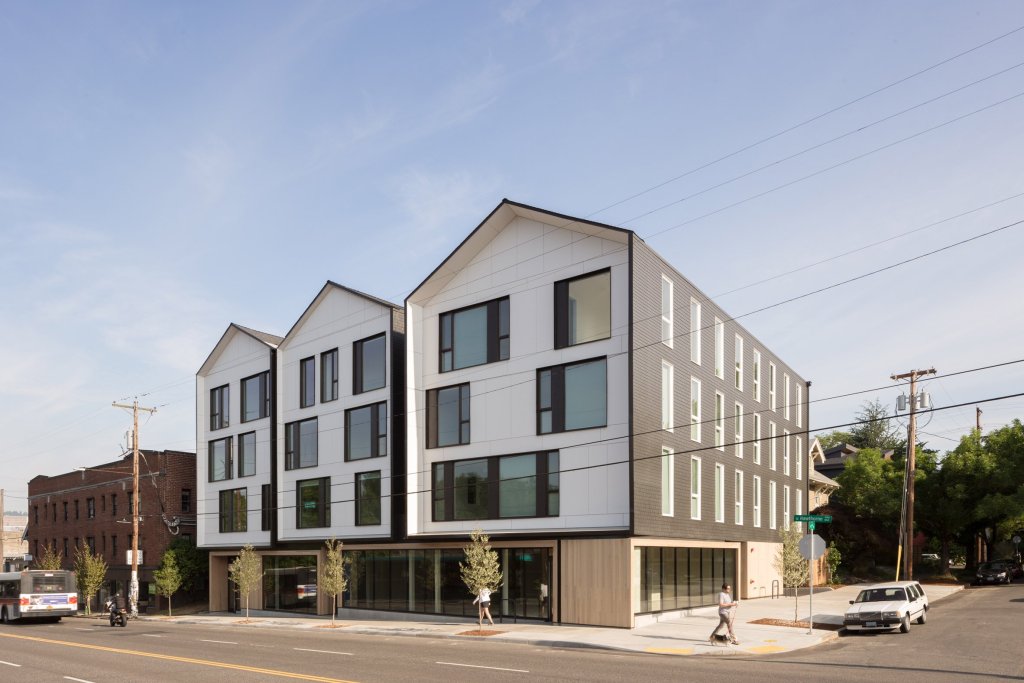
But the modern styles going up are nervous, jittery, full of multi-colored sections of various colors, so that many buildings do not exude calm or confidence but insecurity. Sections of four, five, or eight story apartments are broken up into light/dark/red/green/white/blue/wood/yellow/purple….. sometimes on one building.
I’m not sure how to psychoanalyse the stylistic quirks of mediocre apartment architecture. I think some of it is due to trying to sell buildings to neighborhoods which are hostile to them. By dividing up larger buildings into many colors, the effect is to reduce the apparent total size.
An apartment building with 40 windows on a wall 160 ft. long in one color appears large. 40 windows in 8/20-foot long sections with 8 different colors seems smaller.
Compare these two examples below. The new Expo Line is 7-stories, while the older one is 5-stories.
Sycamore apartments, northwest corner of North Sycamore Avenue and Beverly Boulevard
An Ugly Example at a Prominent Corner
One of the ugliest of the newer buildings is the retail/apartment built on the SE corner of Wilshire/Labrea which is not only multi-colored but cheap looking as well. LA Curbed called it “possibly LA’s most hated” in 2013. “The building’s facade is a jumble of balconies and discordant frontal planes with the northern and eastern faces designed differently, united by a central tower that seems to lack any elegance or even much design,” wrote Julie Grist of Larchmont Buzz. “It’s a shame the design team couldn’t at least try to borrow some of the sleek lines from other streamline or deco architecture still standing along Wilshire Boulevard.”
Tragically, it occupies an important corner of Los Angeles but has an H&M quality where a fine building belongs.
LA architects and builders built one color apartments from roughly the 1920s through the 1960s with no degradation to the aesthetic fabric of the city. How was that possible?
Southwest corner of Pico Boulevard and Union Avenue
Sycamore apartments, northwest corner of North Sycamore Avenue and Beverly Boulevard
You must be logged in to post a comment.