The Streets Were Spotless


On Sunday I went to Burbank to take photos of a 25-year-old actor. 

We met at Chili John’s, a “World Famous” landmark, now out-of-business, a spot of streamline slickness with a neon sign, all of its recent Covid signs still intact. Somewhere I had read that preservationists were fighting developers on this site but could not pull up any stories to verify.

It was Burbank so there were no people around, just an empty parking lot, spotless, without litter, tagging or anything vandalized. The rains had washed the skies. In the distance, past Glendale, sharp and clear, stood the eternal San Gabriel Mountains. 

I got there before he did, and I walked along Burbank Boulevard where the cherry trees bloomed, and one specialty liquor store was open for contactless delivery. Through the window, I saw a $24 bottle of Riesling and moved on.

On Sundays, in Burbank, there are always old, spotless cars driving around. I saw a VW Beetle turn right. 

After that notable vehicle sighting, the actor from Springfield, MO appeared. 

He had just taken a Zoom acting class. He had long pandemic locks and beard and was quite chippy and happy with himself as he ran his hand through his hair and made goofy expressions with his face. He took out a guitar, which he doesn’t play, and he soulfully strummed it for our shoot. 

He had a backpack, a wool driving cap, zip up boots, tight pants, overcoat, trim denim shirt. We shot some photos of him along the long white wall where its red painted parking in rear. He talked about his end days Christian friends from Missouri and trimming his chest hair and how he comes from the same town as Brad Pitt.

He said he was happy in Hollywood, happy to meet cool people, happy for people who were signing him up and taking him to Peru for work. I think.

He told me he had access to a super high resolution Blackmagic Production 4k Camera, and if I wanted to use it on some other day I could. 

He left his stuff in the back, behind the store, and we walked up front to the sidewalk. I had no fear any of it would be stolen. But he went back to retrieve it and then rejoined me on the sidewalk where I directed him to slump down into the doorway and look down the street as if he were a tired, exhausted traveler.

We had free reign, with nobody nearby.

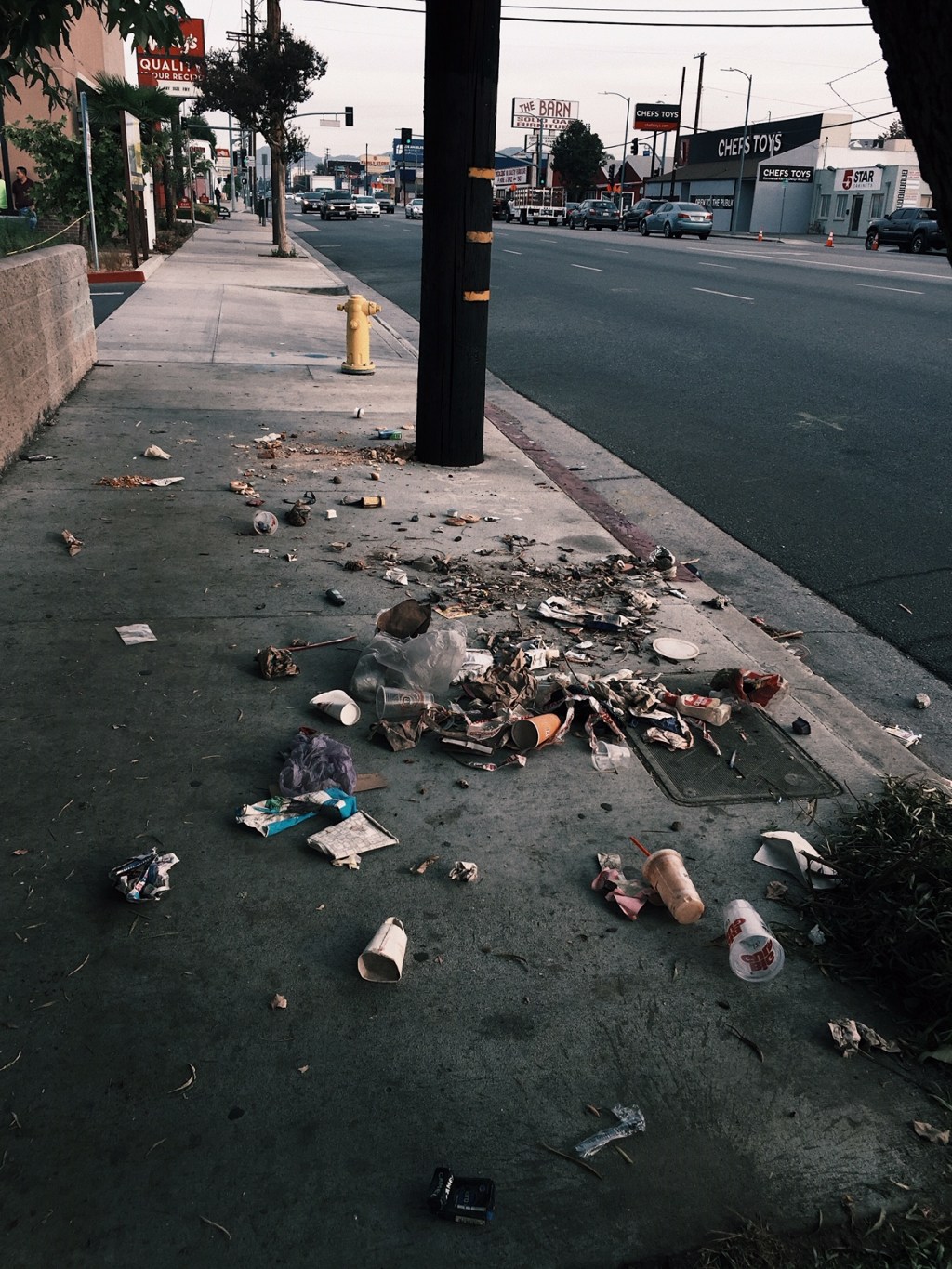
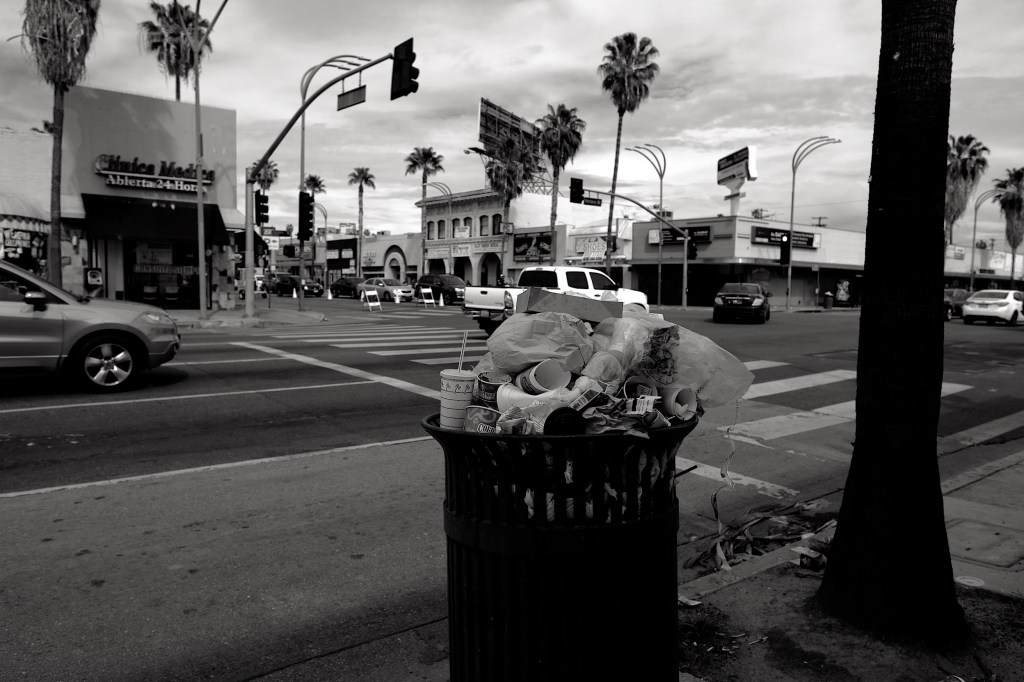
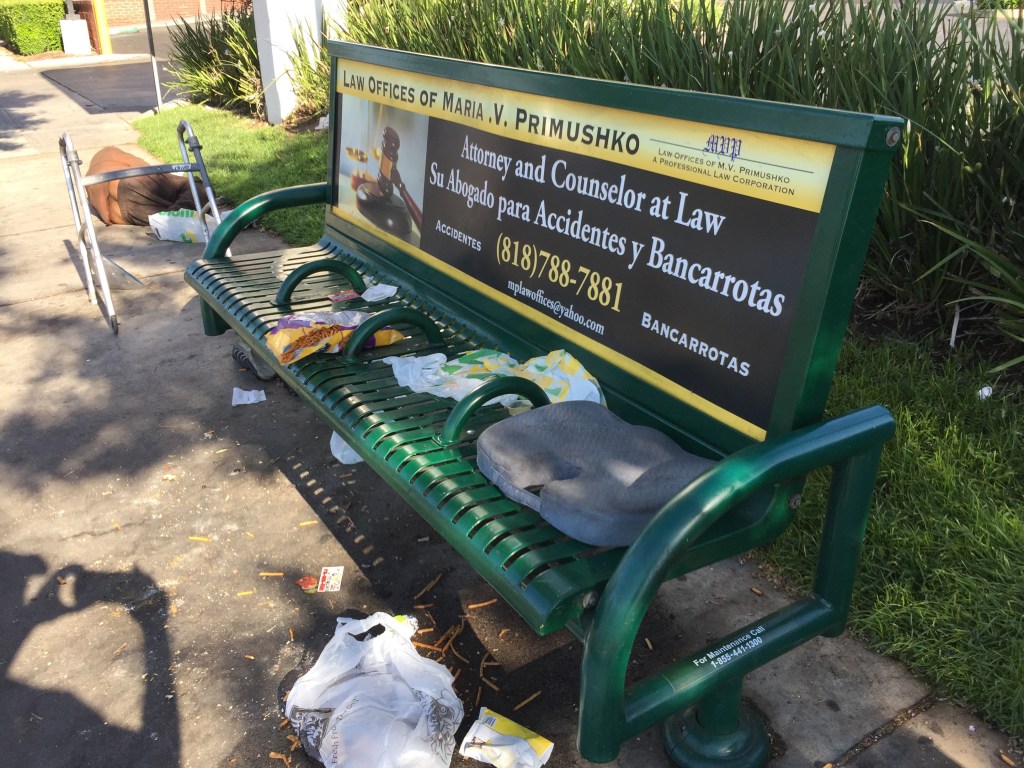
There was also no trash, no litter, no fast-food wrappers, no condoms, no homeless, no shopping carts; just an empty place all around, with store windows and shuttered businesses. After two hours, one masked pedestrian walked by.

That Sunday, Burbank was the Los Angeles that once existed, the hygienic wonderland of donuts and burgers and whimsical cars, chlorinated swimming pools, empty sidewalks and freshly washed streets.  It was dead but it was a delight, and somewhere nearby I imagined a crew-cut kid with blonde hair and plaid shirt riding his Schwinn.

When I was done, I drove through North Hollywood and crossed back into chaos, filth and disorder, past an invisible wall between dreams and reality, past and present, Los Angeles and Burbank. 

Letter From a Homeless Man


From the LA Times article, “Garcetti’s A Bridge Home Homeless Problem Has Mixed Results.”

A formerly homeless addict refutes all the tolerant and feel-good ideas that are bandied about by Garcetti and other enablers. Here is what WEHO LIBERAL said in a letter to the LAT:

“I’m someone who once was homeless multiple times, but always stayed in shelters no matter what. NEVER, ever camp outside! It’s a dead end and that behavior is only for people with serious behavioral problems, alcoholism, drug addiction and mental illness. If you lose your housing? You do NOT camp outside. Period.

I’ve posted multiple times about homelessness on LAT over the years. The last time I did, Nita Lilyveld (not sure if I spelled her name right) wrote about 2 young homeless people in their early twenties that I reached out to offering support and even to take them to dinner. After 2 or 3 texts between one of them where they kept saying they’d follow up with me, they flaked. No more texts. They didn’t follow up or stay in touch.

I am done with this nonsense. And I say that as a liberal Democrat who supported all of these shelters being built. Enough is enough. My mother was mentally ill her entire life and constantly refused treatment.  Even when I was struggling with my own addiction, I ALWAYS made sure I had shelter.

I live in Hollywood.  You see these people every day.  I see them sitting or lying around their campsites when I leave for work. I come home from work and they’re still there, doing nothing but eating, urinating, defecating, some listening to the radio or watching TV on their phones. But they are always there and they make zero effort to change their lives or better their situation.

They ask me for cigarettes, they ask me for money. Their laziness and refusal to change infuriates me. I was homeless, multiple times. I’m sick and tired of LAT columnists like Steve Lopez and Nita Lilyveld pleading to help people who simply do not want to help themselves–or in the case of Lopez, only interested in finding a charity case that they can champion in press and on TV for his own ego.  No, I do not care to hear about how hard Nathanial Ayers’ life is when he refuses to take his medication that would help save his life and better his living situation. My own mother refused treatment for years so I have zero sympathy for people like him who literally are victims of their own refusal to simply do what could get them housed and improve their lives.

Look, being homeless and living in either a shelter or housing provided by local government was no picnic and no fun. I was miserable. My addiction was my responsibility and I deal with it and take responsibility for it. But Lopez, Lilyveld and others like them have their own faults and shortcomings, too.  It’s morally right to have compassion for others, absolutely.  But people who refuse to help themselves even when others try to help them and move Heaven & Earth to do it are not worthy or deserving of compassion.  They are not money pits; they are emotional black holes who will drain the time, energy and resource of everyone around them because they refuse to do what they need to do.

I’m living paycheck-to-paycheck. Yes, I’ve been lucky and yes, I have white male privilege. But as an incest survivor and an HIV+ positive drug addict in recovery, I no longer buy what Lopez, Lilyveld, LAHSA and others like them keep preaching. It is infuriating and it’s becoming obscene. I tried to help 2 homeless young people less than half my age last year after reading about them here.  For God sakes, I offered to feed them more than once. They kept making excuses and then just stopped reaching out to me.

I am done with supporting this policy and their behavior. We all need help sometimes. God knows I spent years exhausting people and it took me a long time to get my act together. But sooner or later, you have to reach deep down inside yourself, confront your problems and change your behavior as much as possible to save your own life.

I am not perfect and all of my problems are not solved. But as someone who sees homeless people every day who sit around all day doing nothing, my compassion for all but a select few is pretty much drained and gone.”

An RV For the Person with Many Homes Around the World.


Today, on our morning walk, around 6:30am, we passed an old RV that had pulled up near Kittridge. A tall, gaunt, middle-aged man came out with a cigarette and a big can of Colt 45. He walked up Noble, beer and smoke in hand. And, like so many of us these days, seemed headed to nowhere in particular.

Facebook must have known I had that RV and that lost man on my mind.

For, inexplicably, on my feed today, a glossy spread advertised a $190,000 Bowlus Road Chief RV, an exact replica of the 1930s with 2020 features. They start at $190K and go up in price from there.

26 feet long, six and a half wide, 3,200 pounds, the aluminum skinned, aircraft riveted trailer sleeps four.  The all-wood interior features anodized galley, five silent gravity ceiling vents, LED Lighting, luxury commercial grade flooring, hotel bathroom with privacy doors, Italian Marine shower head, vanity, and toilet with a hygienic, “easy emptying cassette system.” There is also a stainless steel bathroom sink, teak shower seating and flooring, and yours and mine large wardrobes with hanging bars.

You can park, off-grid, in any desert and still enjoy a powerful, lithium iron, phosphate power system that runs for seven days. Even the A/C blows for up to four hours a day without current. Control it all on your smart phone. If it gets cold at night, don’t worry, the floors are heated and there is continuous hot water.

A “Wyoming” décor option features “natural brown seating that is incredibly soft with an unrivaled comfort. It pairs perfectly with luxury bedding in flax and oyster. The awning has stripes of flax and beige.”  It would suit one of Ralph Lauren’s mistresses.

Hand crafted in Oxnard, California, the tale of this exquisite trailer goes back 90 years to designer, engineer and aircraft builder Hawley Bowlus who built the famed “Spirit of St. Louis” airplane which Charles Lindbergh flew to Europe in 1927, the first time a man crossed the ocean by plane.

Mr. Bowlus built some 80 Road Chiefs in the 1930s before ending his project in 1937 and returning to aircraft production. Many are still in operation today and fetch a premium.

The new CEO of Bowlus Road Chief is Ms. Geneva Long who conceived of this while in Wharton Business School. She and her company have quite a few accolades: 

• The first female-founded RV company

• The first [RV] with heated floors and life-work solutions that include the first charging stations/router/wifi amplifier for personal technology

• The first direct to consumer model in the RV market with sales generated online

• An ultra-luxury market for travel trailers

• The first lithium-powered travel trailer with sophisticated power management systems

• The first truly sustainable RV

The Bowlus Road Chief is a glorious toy for any person wealthy enough to afford one for their unique and privileged leisure. 

Imagine Gwyenth Kate Paltrow in Pioneertown, CA alighting from hers after lovemaking, the scent of This Smells Like My Orgasm candle wafting out into the desert as she rubs a soothing and aromatic nutritive Tammy Fender Bulgarian Lavender Body Oil ($65) over her moistened, tanned, bony arms and hands.

RVs: An Ethical Question

My question, as always: why can’t all the innovation, design, capital, industry, and technology be applied to housing those who are desperately in need of a place to live? Are we blind and deaf to the tens of thousands camped out in tents along our streets? Do we not smell the fires that burn every single day in these drug and alcohol saturated encampments? 

Why can’t Mr. Garcetti employ Ms. Long or someone from her team to build ten RV cities with lower cost versions of this? Perhaps the City of Los Angeles could have ten factories around the city to employ workers turning these out for our current housing emergency and put up ten villages around the city to house homeless. Am I insane for proposing this?

In 2016, voters passed Proposition HHH which allocated $1.2 billion to build homeless housing.

LAist wrote:

“The city estimated in 2016 that it would cost between $350,000 to $414,000 to build a unit of supportive housing (in other words, one apartment), depending on the number of bedrooms. Now, more than three years after that estimate, the median cost per unit of housing in the Prop HHH pipeline is $531,373, according to the audit.” In 2019, three years after passage, not ONE UNIT HAD BEEN BUILT.

Imagine if during WWII we were attacked in 1941 and never built one aircraft until 1944? We would be saluting Hitler today.

You could have two, nearly three luxury Bowlus Road Chiefs for the price of one unit of supportive housing.

Something is terribly wrong in our city. And his name is Eric Garcetti.

So, let us appreciate the qualities and accomplishments of the Bowlus Road Chief. And let us not forget this jewel box of an RV will travel past the freezing, the hungry and the forgotten, a misbegotten luxury which could be a template for saving many, but instead is a frivolity for the very few.

Sunday Errands


Yesterday, Sunday, there were no evident calamities around us. Tragedy took a day off. The air was clear from fire smoke, some blue showed in the sky, and we went for an air-cooled drive around our San Fernando Valley behind tinted windows and masked faces.

We passed Woodley Park, once a bird sanctuary, now just a burned-out bunch of fields with blackened pieces of wood and broken fences, shopping carts of trash and an air of war, desolation and defeat. 

There was the farm stand at Tapia Brothers and we stopped to buy tomatoes, Anaheim peppers, carrots and peaches, standing six feet away from other masked shoppers. Pulling out of the dusty lot there were two choices: drive somewhere else or go home. We chose the former.

We went for a drive west along Ventura Boulevard through Encino and Tarzana, past those billboarded and plastic signed points of shlock and tackiness beloved by many, demoralizing in a good year, demoralizing in a bad one.

At Newcastle, groups of Jews in masks, yarmulkes, and tallit, walked with prayer books, dressed in their Rosh Hashana suits and dresses. A mentally ill Black man, without a shirt, danced obliviously in front of the liquor store as the faithful passed by him pushing baby carriages, on their walk home.

Further west, a homeless woman emerged from a tent parked along a concrete channel behind the prow shaped Encino/Tarzana library, temporarily closed. A blue sign hung along the fence on Ventura, “NO DUMPING: This Drains to Ocean.”

We drove all the way to Shoup Avenue in Woodland Hills, a district of Los Angeles where people once moved to get away from everything bad in the city. Under the 101, dozens of men and women were set up in a trash camp, living under tarps, in tents, the public sidewalk their front lawn.

At Woodland Hills Park, where Uncle Paul, Aunt Frances, Cousins Barry, Helene, Julie, Jason, Delaney and Courtney, spent many days of the past half century in the world of juvenile baseball and softball, homeless RVs parked. I wonder what flowered apron and blue rubber gloved Aunt Frances, who died in 2012, would say. She kept a spotless house, even telling me she would not eat dark raisins because they reminded her of little bugs. 

“Oh, Andy you’re so funny,” she would often say.

We turned down Erwin Street just to look at the corner ranch Aunt Frances and Uncle Paul bought for $63,000 in 1973. Uncle Paul is 99, a widower, still living there. The stucco is faded pink, there are bars on the windows, and Zillow estimates the house could fetch close to a million. Property taxes are about $800 a year, eternally fixed at the purchase price, a good deal for the retired soldier who fought at Iwo Jima and Leyte Island.

We didn’t go in but I thought of the inside I first saw in July 1974.

The Barcalounger, the brown carpet, the brown paneling, the yellow wallpaper, the cottage cheese ceilings, the dining room with the glass shelved cabinets full of Lladros and ceramic poodles and carved children with fishing poles, a room nobody ate in; the other dark rooms with the Roman shades or pleated drapes always pulled down against the sun, the bathrooms with wall-to-wall carpeting and mylar wallpaper, the rooms full of family photographs, the 1,762 square feet of living space without one book; the air-conditioning that ran year round, and the garage housing the Buick LeSabre, full of power tools and Leslie Pool Equipment, the refrigerator packed with Costco frozen foods, bottles of cold water and diet sodas, the TV always on for baseball and Fox News, these are the moments one cannot easily forget.

Then we turned around and drove east along Victory Blvd. passing the empty weed infested parking lot at temporarily closed Pierce College. We drove down Winnetka to get to the 101 and again passed another encampment under the freeway, more men and women living outdoors without housing in Los Angeles. 

When I go out these days, leave my house for a drive, I am in another nation, not my own, a scarred and withered place of broken people, angry and exhausted, in a city unclean and unjust. And ominously, seemingly, frightfully just about ready for a violent revolution. 

Woodley Park, R.I.P.


A man rides his mini bike down a bike path at Lake Balboa in the Sepulveda Basin as a wall of flames approaches Saturday, July 18, 2020. The fire put up a huge cloud of smoke and burned for well over an hour near a model airplane park and along Woodley Avenue. The blaze charred about 4 acres of brush before over 60 firefighters managed to contain it. No structures were damaged and no injuries were reported. (Photo by Mike Meadows, contributing photographer)

One of the ameliorating joys of moving to Van Nuys in 2000 was escaping, on bike, to Woodley Park, that formerly glorious area of bird sanctuaries, bike paths, grasslands, ponds, and the Japanese Garden.

Through the years I was so happy to ride through it, to feel the wind and the sun and openness of the park, a place to photograph, and wander and exercise in.

Since the reign of Mayor Eric Garcetti (Garbageciti) began in 2013, the park has become a homeless encampment, with hundreds trashing it with shopping carts, drugs, needles, garbage and worst of all, starting fires. 

It seems that every other month there is a massive blaze in Woodley Park, illegal cookouts or arson or just exploding propane tanks, and now the park is an ashen graveyard of nature, just black fields where tall grasses once thrived.

Why is it “humane” to allow vagrancy, disorder, disrespect and abuse of our parks, our streets and our environment?  We thought we had seen the worse of this city and nation in 2020, but if you want to feel even more gloom, take a saunter over to Woodley Park and witness for yourself the broken fences, the depleted environment, and the still evident trash camps of tents, shopping carts, stolen bikes and litter along Burbank Boulevard.

And ask yourself what competent and worthy leader would permit his city to become so degraded that even a simple park is too embarrassing to look at?

Why You Taking Picture?


A housing and planning blog I read, Granola Shotgun, recently had a post about how the author is hassled for taking photos in public for such elements as parking lots, buildings, encampments or anything structural connected to a human.

In the past 15 years, since I started this blog, I have had similar experiences of being confronted when diligently just recording any exterior anywhere because it captured my imagination.

As recently as March 2020, on the last night I went out to drink at MacLeod Ale, I left the brewery. I was with a friend, who also had a camera. The sun was setting. The light was golden and glorious. I had my Fuji XE3. While walking on Calvert towards Cedros, I started photographing many things that the light was hitting, including the exterior of an auto body shop. 

Several tough, menacing looking men were conversing across from the shop. One yelled at me, “Hey! Why you taking picture?” he said.

I had a few beers so I answered, “Because I want to. I’m not on private property and the sun looks beautiful on that building.”

“What building? What sun? What you talking about?” he answered.

We walked over to Bessemer St. through the trash of a block long homeless encampment, (which I wouldn’t dare shoot) which once would have been illegal and immoral, but is now normal. People living, shitting, drinking, sleeping on the street. By the tens of thousands. OK in Garbageciti.

On Bessemer, as we got into the car, a tinted window Mercedes SUV drove by slowly, eyeing us, letting us know we were under his surveillance. Nothing happened, but we drove away chilled at the implicit threat. 

I write and photograph about the urban condition of my neighborhood. I do it with the intent of telling the truth, not to promote my product or sell a political dogma. A billboard on Kester at the golden hour is just a billboard.

In 2006, I was photographing the exterior of the historic Valley Municipal Building on a Monday morning. An older woman came out, not a security guard, just an older woman, and she screamed, “What are you doing! Why are you shooting this building!” She had a car, and she drove up to me as I walked along Sylvan St. asking again what I was doing. 

 “There are people who want to harm this country!” she said through her window.

Like her. Opponents of constitutionally protected free speech.

Photography is politicized now, like everything else. A public photo in Los Angeles is assumed to be:

  1. ICE finding undocumented people.
  2. TMZ trailing a celebrity.
  3. Location scouting for a porn.
  4. A developer intent on building something.
  5. A Karen uncovering a violation.

Will a photograph ever just be a photograph again? Could Robert Doisneau or Henri-Cartier Bresson shoot children on the street today? Or would they be confronted by parents or teachers or strangers asking what the hell they were doing?

How did it come to be that a joyful, celebratory, observant act, public photography, become so reviled and feared? We live in a time when every person has a camera on their phone, so anyone can really take a photo anywhere at any time, yet the deliberate, artistic, considered flaneur, strolling through the city after a few glasses of wine, can be confronted if he carries a traditional camera and aims it at strangers.

Then there is the aspect of shame. We have no public shame anymore. People dress, eat and behave in ways that would largely be considered shameful by 1945 or 1970 standards.  So shame is employed as a tool by the weak, sometimes used against others who are weak, but often to gather like minded bullies together to defeat free-thinkers.

These examples of 21st C. public dress and obscene signs would have probably been against law or custom 60 years ago. Just as today it would be unthinkable for grown man with a camera going up to a children crossing the street and photographing them, as Henri Cartier Bresson did in Paris 80 years ago.

The public no longer knows what is properly public and what is not.

When private people prohibit public photography, they often think they are exercising the rule of law. Security guards fall into this category. Yet they stand on weak ground. No building, other than a military installation, has the right to not be photographed.

And we live in time of political intention. Every act is political. One can identify with a political party by wearing or not wearing a virus guarding mask, or drinking soda with a plastic straw, living in a gated McMansion, expressing sympathy for the police, or wearing a red baseball cap. All can get you harmed or doxxed.

At the 2017 Woman’s Rights March, I went out with several older neighbors and of course I had my camera. It was a historic moment. And I photographed a crowd near Universal City. Which provoked a young guy, masked in bandana, to walk up and demand to know why I was photographing.

There is nothing illegal about photographing people in publicOr buildings. Even outside a schoolyard, even families picnicking in the park, even photographing a parking lot in a poor area of Van Nuys. These are all legal and protected by law.

But no law protects against widespread public fear of freedom of speech. When enough mobs band together to ban something you can be sure it will be. Photography by photographer is on the list of once free rights that face censoring, cancelling and expulsion.