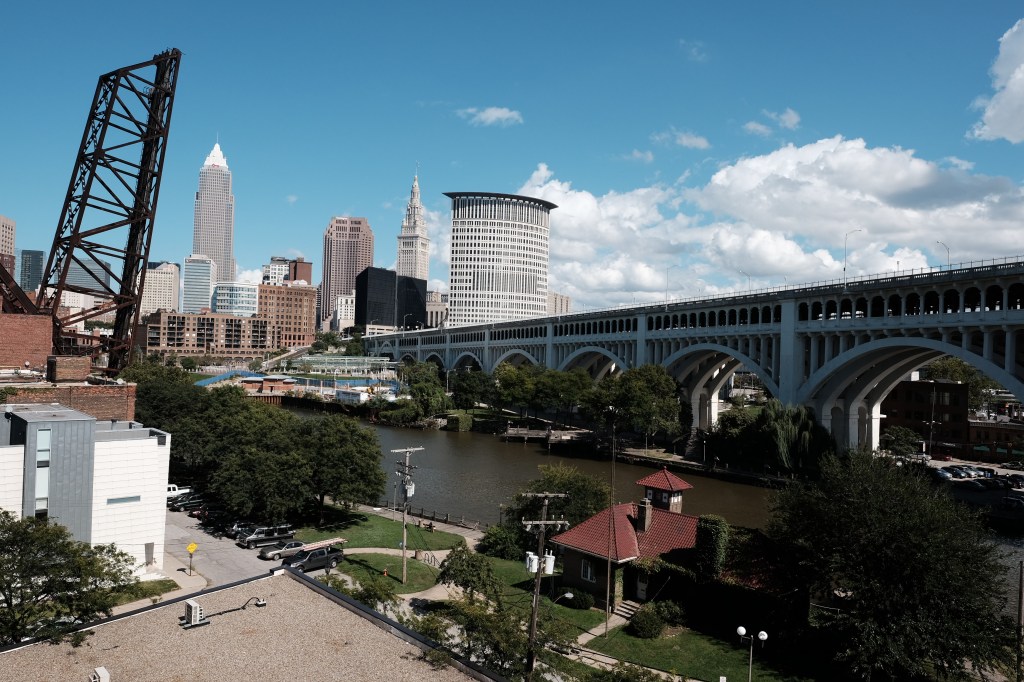
A Clean, Well-Cared For City.


Bridges and Parks and Skyline: Cleveland, OH.

I recently spent a few days in Cleveland, OH on an exploratory trip, visiting a city I’ve never been to before to see how I liked it.

Cleveland has had a long, slow, drain of population, and it is now about 270,000. Less than the size of Glendale (200,000) and Pasadena (142,000) put together.

I stayed in Cleveland Heights, outside of the city, in an AIRBNB run by two guys who bought a half acre estate for $146,000 four years ago, and make some extra income hospitably renting out rooms in their home.

For me, I relished the time away from Los Angeles in an environment of lush greenery, green lawns, deer, and clean streets.

Overlook Rd. Cleveland Heights, OH.
$599,000 asking price for home in Cleveland Heights, OH.
Lee Rd. Cleveland Heights, OH.
Sign in window on Lee Rd. Cleveland Heights, OH.
Homes in the Mayfield Heights section of Cleveland Heights.
Mayfield Heights section of Cleveland Heights.

Cleveland Heights is also a historic city, full of blocks of homes from the 1880s to the 1940s, a rich, well-maintained, lovingly cared for collection of architecture, punctuated by churches, parkways, and museums. Case Western University and Cleveland Clinic are just outside its borders, to the south is Shaker Heights, an elegant town developed in the 1920s, laid out with nature preserves, winding streets, gracious mansions and a languid Midwestern grace.

There are many homes for sale in Cleveland Heights and you can buy one for as little as $79,000 with most in the $140,000-$250,000 range. If you are starved for a Hancock Park type mansion there is one I liked for $599,000.

Many miles of interior Cleveland are empty. They were abandoned, bulldozed and cleared away. And what’s left are vast green spaces where the grasses and woods are reclaiming the land.

Even in the poorest neighborhoods, I did not see garbage dumps, shopping carts full of trash, littered streets, graffiti, or dumped furniture.

Lakewood Park, Lakewood, OH.
Lakewood, OH.
Wedding in Lakewood.

In Lakewood, OH, just west of Cleveland, a little town on Lake Erie has rows of neat bungalows, leading up to a gorgeous park on the lake where a wedding (between a man and a woman) was taking place in the sunshine overlooking a bluff. I walked around the park, full of bicyclists, walkers, joggers, tennis players and people sitting on benches socializing. Nobody was intoxicated, high, homeless, destructive, or neglectful. And if someone were, I have no doubt they would be arrested.

Lakewood is also “gay friendly” with rainbow flags, anti-Trump posters, tolerance banners, welcoming immigrant signs. I saw liberalism all over Cleveland, but it did not need to co-exist with uncared for mentally ill camping out on bus benches, mountains of debris, urinating and defecating and injecting.

You can hate Trump and still have a clean park system.

Anti-Trump demonstration in Market Square, Cleveland, OH.
Tremont section of Cleveland.
Ohio City, Cleveland, OH.

You can champion diversity and still enjoy people who say hello to you on the street and sweep their sidewalks every single morning.

In Cleveland, they still prohibit using the sidewalks and parks to sell old underwear and moldy shoes and sweat stained t-shirts and rancid socks on blankets. Nobody calls it discrimination to adhere to a standard of sanitation and order completely absent in cities such as Calcutta and the MacArthur Park district of Los Angeles.

I went to the Rock and Roll Hall of Fame. I ate cannoli in Little Italy. I visited the historic West Side Market with its food sellers and ethnic hawker stands. I went to Ohio City, a restored section of Cleveland with brick houses, and Victorian mansions, loft buildings and yoga studios.

I didn’t step over feces, walk down alleys that smelled like toilets, stare at intoxicated men on the ground. And nobody asked me for money.

How cruel to enjoy such freedoms away from the rot of Mayor Garbageciti’s Los Angeles.

West Side Market, Cleveland, OH.
“The Black Pig” pub and restaurant in Ohio City.
Ohio City, Cleveland, OH.

6/22/69- Fire on the Cuyahoga River.
Cuyahoga River
Ohio City.
Spotless streets in Ohio City, Cleveland, OH.
Bridges and Parks and Skyline: Cleveland, OH.

I walked down to the Cuyahoga River, a body of water that infamously caught fire on June 22, 1969, spurring a cleanup.

In September 2018, I watched a race of college rowers in the now sparkling waters.

Crossing the river are many bridges, a spectacular symphony of rail and road, steel and concrete, which once provided Cleveland with efficient delivery systems of raw materials and finished goods.

Today the industries are gone. One might expect decay, litter, neglect, and illegal dumping to move in.

Yet the parks were pristine. They were clean. There were no visible homeless. There were no mattresses, sofas, or piles of garbage as one sees in every single neighborhood of Los Angeles. I did not see tent cities of despondency in Cleveland.

I was impressed with the civic pride of the city. I was taken with the normalcy of expecting that parks, streets and neighborhoods would be well kept and looked after.

Could I live happily in Cleveland?

Cautiously, advisedly, I think so.

Little Italy, Cleveland, OH.


Ohio City, OH. Yard sale.


Califa Between Kester and Natick.


screenshot_301

A block south of Oxnard, between Kester and Natick Avenues, four residential streets dead end at Califa.

A time capsule of a neighborhood; neat, tidy, middle-class, without trash, graffiti, mattresses and old sofas; this section of Posoville (Part of Sherman Oaks) is either Van Nuys or Sherman Oaks depending upon your biases.

DSC_4695

DSC_4693

DSC_4684

The sunny aura along these streets, a dependable and somnolent monotony of the middle 1950s, is of people working and keeping up their homes, raising their kids and taking pride in their community. This could be Culver City or Burbank, so absent are those markers of decay that afflict Van Nuys only two blocks north of here.

Enormous landscaped parking lots, far too big for the modest amount of workers who work here, sit behind the white cinderblock boxes lining Oxnard.

In any European nation, or Japan, such decadent defacement of land would be unacceptable and put to denser use.

But in Los Angeles, the old American Way holds forth, but for how long?

DSC_4688

DSC_4687

DSC_4683

DSC_4681

DSC_4679

In the future, an architect might imagine that the asphalt would be ripped up to grow local fruits and vegetables, and the acres of pavement would sprout little villages of modular homes, five or ten or twenty houses arranged around xeriscaped gardens. Residents would ride bikes, walk to the corner market and board the Orange Line to ride out to Woodland Hills, or east into North Hollywood and downtown. Shady spaces between buildings would provide great outdoor seating for cafes, benches and even fountains.

For now, the houses and the white cinderblock industries meet in oversized parking lots in an average place stripped of personality, but grateful for its fragile place on the social ladder.