Option A: Silence of the Nury.


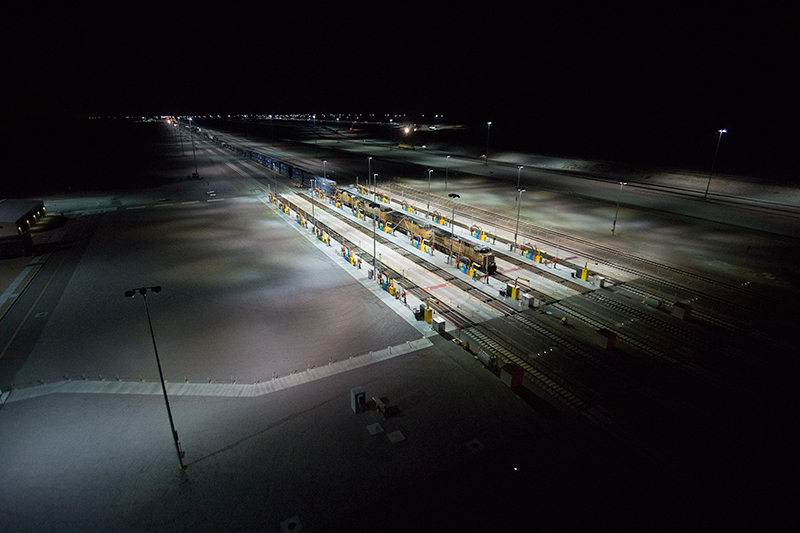
Rail Service Yard at Night. What Kester and Oxnard may look like for the next 100 years.

Option A is a Metro Los Angeles plan to construct a rail maintenance yard on 33 acres of industrial land currently occupied by 186 businesses employing as many as 1,500 people. The location radiates from the NE corner of Kester and Oxnard and will demolish every single building from Kester to Cedros along Oxnard, Aetna, Bessemer and the south side of Calvert.

Family run businesses, enterprises utilizing high tech computers to fashion exquisite cabinetry, decorative metals, and music recording studios, will be gone. Destroyed as well: low cost rentals for vintage Vespa restoration, boat yards, exotic mushroom growers, glassmakers, sauna builders, and Ford Mustang restoration.

The Option A area is walkable, diverse, affordable, and near downtown Van Nuys. If it is obliterated it will become a vast zone of emptiness, high security cameras, fences, walls, and rob Van Nuys of its last industrial area which serves as a creative incubator for artists, builders and skilled craftsmen.

Metro: In attempting to increase density, variety, diversity and walkability why would you destroy the very thing you wish to create?

Metro has three other option sites which are B, C, and D. The September 28, 2017 Daily News article explains.

Options B and C are on either side of Van Nuys Boulevard at the Metrolink Train Crossing.

Option D is at 7600 Tyrone Ave, 55 acres of land owned by the Department of Water and Power. It said it will NOT relinquish the land.

B, C, and D do not involve the displacement, destruction and eviction of 186 companies.

Options B, C and D
Option A: Destruction of 186 companies and 58 buildings and 1500 jobs.

Silence of the Nury

Despite the suffering and anxiety of so many men and women in Van Nuys, Councilwoman Nury Martinez has been completely silent on this issue since the official announcement of the Option A scheme was announced in mid-September.

Some in her office have conducted meetings with the worried owners in the Option A area. But she has not publically stood with the afflicted businesses. She has not voiced her support for them and she has not taken a stand opposing the vast hole of a train yard just steps from her office in Van Nuys.

Her Facebook page shows many photos of her attending events in the past few weeks.

  • She recognized a project to fund breast cancer research.
  • She welcomed a Panorama City project to mentor young people in work.
  • She supported National Food Day to promote nutrition.
  • She joined cops and politicians to oppose domestic violence.
  • She celebrated the retirement of a 30-year LAPD veteran.
  • Latino Heritage Month got a photo with her.
  • Dodger Manager Tommy LaSorda got a 90th Birthday photo with her.
  • The International Day of the Girl got a photo with her.
  • LA Family Housing got a photo with her.
  • Girls Empowerment got a photo with her.


“My Nury, my Nury, why have you forsaken me?”

Ivan Gomez, Pashupatina

Ivan Gomez, son of Mexican immigrants, grew up poor with his four siblings on Friar Street, dodged gangs, bullets, drugs and went on to self-mentor in the art of making fine metals, eventually opening a highly respected and technologically advanced company, Pashupatina, inside a restored building on Aetna St. He merits no photo op with Nury Martinez.

Peter Scholz, Showcase Cabinets

Peter Scholz, cabinet maker, lifelong resident of Van Nuys, owner of Showcase Cabinets, in business since 1987, employing skilled craftsmen who also live in Van Nuys, he has no photo op.

Scott Walton, Uncle Studios

Scott Walton of Uncle Studios, established 1976, legendary recording studio on Kester and Aetna, he may be obliterated, and he has no public support from Ms. Martinez.

Kristian Storli, Bar Italia Vespa.

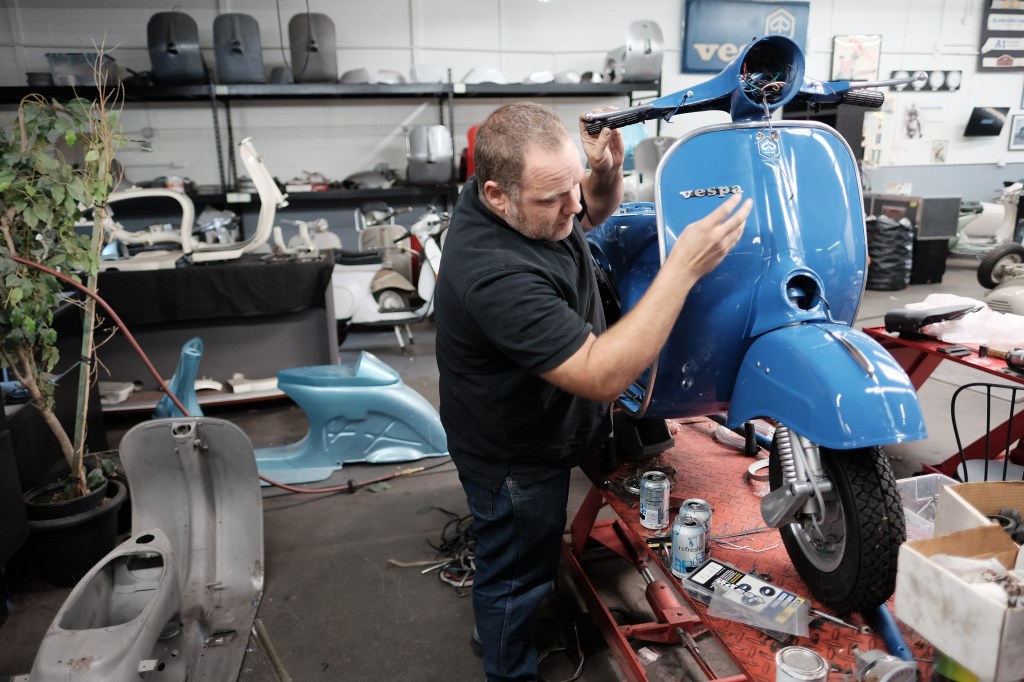
Kristian Storli, who restores vintage Vespas and has been evicted from two places on Calvert and Bessemer, and only finally found a home last year on Aetna, only to learn his shop may be wiped off the map. He has no photo op with Ms. Martinez.

Steve Muradyan of BPM Custom Marine

Steve Muradyan of BPM Custom Marine, who supports a wife, two children and two aged parents, rents a facility on Calvert St. (down the street from  MacLeod Ale) and he may lose his 6,000 SF space. Where will he go? There are no affordable, local industrial sites for 50-100 foot long racing boats. Does his plight matter to Ms. Martinez?

Skilled worker at Pashupatina

There are 1500 others who are obscure but working hard, trying to earn a living, doing the right thing here in Van Nuys.

Why is Nury silent on the plight of her most productive and contributing constituents? Why is she sticking her finger up in the wind to see which direction Metro Los Angeles blows rather than fighting for the community she purportedly represents?

Silence is not what people in jeopardy, at risk in losing everything they have worked for, expect from their elected leader.

Pashupatina: Ivan and Daniel Gomez in their shop which they completely renovated with their own hands and money in 2015.
At work at Pashupatina. Programming and designing intricate metals for decorative hardware.
Mustangs, Etc. Est. 1976
Pashupatina.

SaveSave

SaveSave

SaveSaveSaveSave

Option A: The Vespa Whisperer.


After WWII, Italy was poor, the roads were torn up by war, and the new democratically elected government was prohibited to build military hardware. Industrial revitalization was a must. So innovative militarists turned to consumer products to employ workers and restart the economy.

The Vespa (“Wasp” in Italian) grew out of this era.

It was designed and built by aerospace engineers to satisfy postwar transportation needs economically. They created a scooter, with all the mechanical parts enclosed, and a tall frontal splashguard, features which appealed to Italian men in suits and women in dresses. There was no grease to splatter on well-tailored woolens, and the versatile, small, well-engineered bike travelled well on narrow, pockmarked streets.

Piaggio & Co. introduced it and still owns and manufactures Vespa.

After its debut in 1946, it sold slowly, if solidly.

Then “Roman Holiday” (1952) starring Gregory Peck and Audrey Hepburn, filmed on location in Rome, skyrocketed the Vespa’s popularity. Suddenly 100,000 a year were selling. The popularity of films such as “La Dolce Vita” (1960) and the neo-realist Italian cinema of the 50s and 60s made all things Italian seem fast, young and glamorous. The mid 1960s Mod Subculture in Britain, dudes in Ben Sherman shirts and skinny ties and tapered trousers, furthered pushed the Vespa into pop culture.

The Mods, Britain, mid-1960s
In the US, even Sears imported Vespas and renamed them Cruiseaires. By 1981, the bike had lost popularity due to environmental laws. Yet again, in the early 2000s, Vespa restarted its American sales effort, opening its first boutique on Ventura Boulevard in Sherman Oaks, CA hoping to capitalize on our four CA freedoms: sunshine, mobility, novelty, and fun.

According to Wikipedia, there have been 34 different versions of the Vespa. Today, five series are in production: the classic manual transmission PX and the modern CVT transmission S, LX, GT, and GTS.


About 4 miles north of the Vespa retail store, at an unmarked building at 14819 Aetna St. in Van Nuys, Kristian Storli, 39 is quietly, diligently and artfully restoring Vespas, at his company, Bar Italia Classics, established 2006. According to Mr. Storli, it is the only shop of its type from here to Pennsylvania.

You pass through a gate into a courtyard packed with tools and bikes, all under some sort of repair, but then you enter a stylish, air-cooled, gray-painted, 3600 SF shop, unlike any you’ve ever been to, with vintage illustrations, glass shelves filled with awards and medals, antique framed advertising for Vespas, and a very large movie poster of Angie Dickinson atop a Vespa in “Jessica” (1962) directed by Jean Negulesco. 

Sicilian women plan to rid their village of a sexy American midwife (Angie Dickinson) by making her job obsolete.”

Angie Dickinson, 1962.

Obsolete is what haunts Mr. Storli, a stocky, blue-eyed, mechanical minded man of Norwegian descent who went to school to study musical composition, and ended up investing his life savings into his Vespa passion. He has had three shops in the last ten years: first on Calvert, then Bessemer, and now Aetna.

C, B, A….. Ominously for him there is no letter preceding A.

Each time, rents and leases ended. And this time, he fears, he may become redundant by Option A, if his shop, and 185 others are demolished by Metro Los Angeles for a 33-acre rail service yard.

Nevertheless, there is a rhythmic beat and output of bikes at the shop. Many restorations take 12-18 months and require each machine:


  • To be disassembled and inspected,
  • Stripped of old paint on engine and body parts,
  • Hardware sent out for plating,
  • Reassembling the machine to peak condition in both function and appearance.
  • Full payments are dependent upon delivery of the finished product to its owner.

It is a painstaking job, only undertaken by devotees and acolytes in the cult of Vespa, but the result, as one can see in a finished product, is the absolutely breathtaking beauty of the timeless and completely Italian product. The smooth and shiny gracefulness of a finished bike exudes sensuality and speed.

One day a few weeks back, working inside his dream factory, Mr. Storli was jolted with a bomb of an announcement: He might have to move to make way for a 33-acre demolition project bulldozing 186 businesses for a future light rail maintenance yard operated by Metro Los Angeles.

He had only moved into his third, and presumably final shop, this year, 2017. He lost over a year of income when he had to move the second time. Now he was threatened with new economic ruin, not by a downturn in business, but by an aggressive action of a government agency using Eminent Domain powers to evict lawful enterprises.

He told me that he is deflated, worried, and panicked. He has started, grudgingly, to look for other affordable space in Los Angeles. But the rental vacancy rate for industrial property is only one percent. And the competition is marijuana growers paying three times the asking rate to landlords.

To lose so many businesses is sad.

But it is doubly tragic to see a completely original and unique craftsman, Mr. Storli, thrown out of his space. It is one more step in the homogenization of Los Angeles, where shortsighted bureaucrats fail to protect unique and skillfully constructed products and services when they are operated by small businesses. But every corner store is CVS or Starbucks.

We need excellent public transport.

But grotesquely destructive and obliterating plans to build a light rail yard through viable and productive industrial tracts only harms Los Angeles -by destroying the real and the good -by promising the imaginary and the perfect.