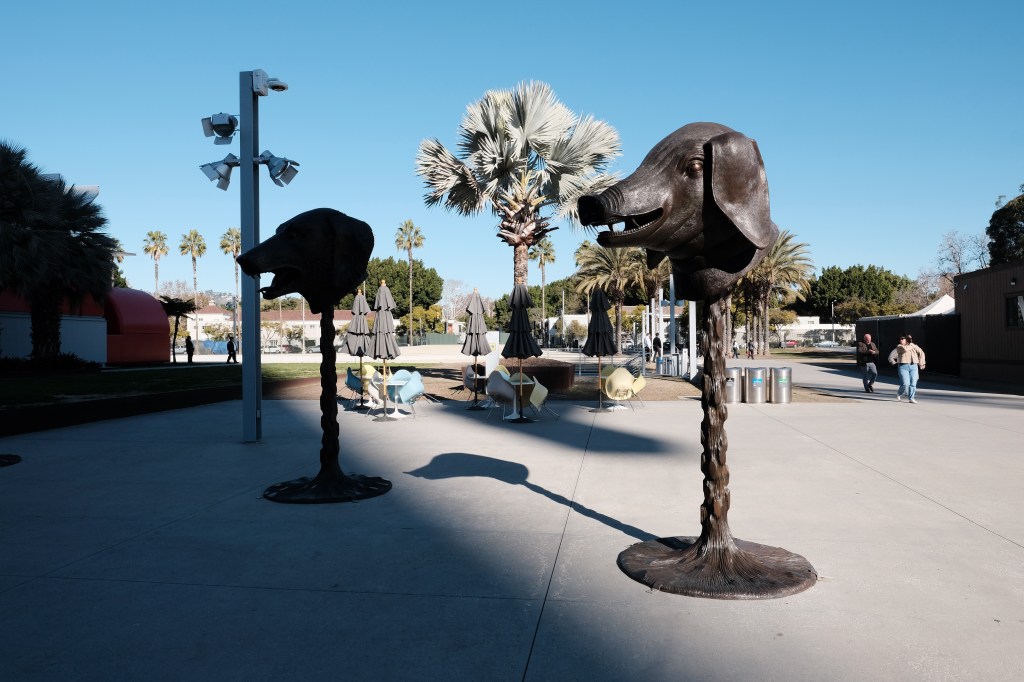
Scenes Around the La Brea Tar Pits


Before the rains came, we went to visit the La Brea Tar Pits and the outdoor grounds adjacent to the Los Angeles County Museum of Art and the new Academy of Motion Pictures.

Despite having lived in Los Angeles, close to 30 years, I don’t remember ever walking around the La Brea Tar Pits.

It was Christmas Eve and there was parking along 6th Street just east of Fairfax, past many homeless tents. We pulled into a free spot, got out of the car and walked into the park.

The first thing we encountered was a man under the giant rock screaming his head off while two amused security guards watched him from a distance.

We walked on, into a sculpture garden of enormous steel animal heads on steel posts arranged in decorative circles around a concrete patio. (The Zodiac Project by Ai Weiwei, his first major public sculpture.) It felt like a religious installation but the gods were animals, toylike and comical. Their creator is currently in prison in China. We are free to laugh at his genius and liberated to be ignorant of its meaning.

Further we went along the red columned walkway that connects various art galleries and the new Academy of Motion Pictures built inside the old May Company Department Store where Bette Davis played a washed-up actress working as a sales clerk in “The Star” (1952).

There were nice looking families dressed in nicer clothes, out for a holiday walk or visit to the museums or motion picture halls. You could believe right there that LA was a normal city with civilized citizens taking part in the arts like people do in any other city outside of the United States, forgetting the woman on life support shot in her car, December 17th, on the 101 in Tarzana, a kind of gruesome violence that is our everyday normality, and nothing special to speak of, only one human life.

The crazy screaming man walked past us still screaming, trailed by two security guards, and there were so many security guards in every part of the property, inside museums, at the entrances, around the park, and you knew they were there to provide security in an insecure city where mad people wander and sleep in tents and on bus benches in the tens of thousands. And drivers fire guns at other drivers.

We saw many smiling, delighted Indonesian tourists taking pictures next to the decorative lampposts on Wilshire near Ogden. Their bus waited with open door as the happy group posed in the sunshine. What did they think of this city and this nation, so much abundance, so much squalor?

The future of Wilshire was all around us: the demolished museum buildings and the new construction for the concrete exhibition rooms that will catapult over Wilshire and connect via an indoor sky bridge filled with rooms of paintings. 

The new subway is pummeling along below, and there will soon be underground trains taking people from east to west and west to east just like every other modern city around the world where people take public transport to get around. But here it was a novelty, opposed for years by the most powerful and influential leaders in politics and business, but somehow, now, in the 2020s, we are getting a subway along the most important boulevard in Los Angeles.

Priorities of this city. So meaningful and so confounding. What we hold dear, what we think matters.

Traffic, car chases, murders, helicopters, homeless.

We walked west and saw the ugly but beloved, closed down coffee shop on the corner of Wilshire and Fairfax where Senator Bernie Sanders had a campaign office in 2016. His name and murals still decorate the building. 

Into the Academy of Motion Picture Museum we went, past more friendly, young security guards, (aspiring screenwriters?) guiding us to a gift shop where they sell “The Godfather” memorabilia and nice sweatshirts, t-shirts, film posters and music albums.

The Renzo Piano designed lobby is perfectly proportioned modernism with crisp polished concrete floors and exposed steel ceilings, pipes and vents. There are also many precisely hung blood red signs to bring life to all the gray steel and tan concrete.

It’s all very well done, very architectural and quite elegant. In Copenhagen or Stockholm this would probably be a subway station. 

There are some very nice restrooms and we went down to use them, past many masked security guards who ensure that urinating visitors come, like us, from the proper stratum of society. (I have a BA from Boston University.)

After peeing and handwashing we went outside in the La Brea Tar Pits Park walking past fenced in oil pools with signs explaining the stories of animals who walked here 10,000 or 20,000 years ago and were caught unwittingly in the tar for eternity.

Almost all the old LACMA buildings from the 1960s, 70s, and 80s have been torn down to make way for the latest incarnation of faddishness, but they somehow allowed one of the ugliest to escape death: the Pavilion for Japanese Art, a monstrously grotesque, green rocked assemblage of artificiality, concrete ramps and gigantic shoji screens; asymmetric, tangled up, psychotic and tortured, mumbling to itself, whose only real quality is being outdated.

The George C. Page Museum at the La Brea Tar Pits was our last stop. “A fiberglass frieze depicting Pleistocene mammals runs around the top of the building, held up by a black aluminum web called the “space frame,” writes the LA Conservancy.

It is also a 1977, Charlie’s Angels era building sunk into the ground and rising up with a sculpted mural along the horizontal façade, kind of monumentally casual and pop art significant in the mode of Hall and Oates in concert or Kristy McNichol skateboarding.


1977, 1957, 1937, 2001, 1985, 2022, 2032, 2055, 2077, 15,000BC.

What are these years and what do they matter? And what are the plans for Los Angeles and what do they matter? 

Tear down, erect, tear down, erect, tear down, erect. Make big plans, wait a few decades. Discard. 

Spend millions, spend billions, spend it lavishly, tell a story about a story and what have you got for a city?

The dead animals in the tar, the homeless on the streets, and the fenced in realm of enlightenment.

This is our civic space: a tar pit, an old department store, and a policed park. Maybe one day it will evince as much humanity as it aspires to, but for now, the answer to what Los Angeles will become is buried with the fossils.

The Puppy, The Lobster and The Mad Woman


California Lobster two-piece swimsuit, swim trunks, and man’s shirt Mary Ann DeWeese 1949 LACMA

Last week, mid-week, it rained. A storm started the way storms do in Southern California, by announcing its front three days before arrival.

It came down slowly, from the north, and the skies darkened, ever so perceptibly, on Sunday, and by Tuesday the rains poured.

When the storm blew out, on Wednesday, the air was clean and refreshed. And doughy white clouds marched across blue skies.

Three small trees, all oaks, arrived from the city, ready to plant. There was room for only one on our property: a Coast Live Oak, which will look quite magnificent on my 100th birthday.

The Puppy

I went down to my brother and sister-in-law’s house on Saturday and took photos and videos upon the arrival of their new brindle boxer puppy.

These are videos that will show a 2012 Prius on the driveway, and these are videos of my 7-year-old niece and my 5-year-old nephew and a two-month-old puppy.

In five years or ten or twenty years, people will watch these and marvel at unwrinkled and smiling faces of youth, beauty and innocence; days we all have and days we spend in childhood never knowing how ephemeral and passing and short it all is.

General Quarters

I left the Marina and drove east across Culver City on Saturday, along Washington, and turned north on Robertson and went east on Pico and ended up on La Brea at Blair Lucio’s store General Quarters.

Mr. Lucio, on his own, without partners, has opened a concrete floored, iron and corrugated steel men’s shop decorated with black and white photographs of motorcycles, Steve McQueen, and images of postwar life in Southern California.

He is a young, well-groomed man with impeccable taste and good manners who favors plain front khakis, single needle cotton dress shirts, worn leather and canvas knapsacks and pure pine athletic soap.

He worked at Nordstrom’s and that retailer’s high standards of etiquette and service seem to have been branded with a burning iron into Mr. Lucio’s character.

If I had more cash I would spend it here because everything is high quality, classic and well edited.

LACMA

LACMA has installed a show, Living in a Modern Way, devoted to the same place and era that Mr. Lucio adores: the post-WWII years, when California innovated in the arts, home furnishings, architecture, textiles, graphic design, automobiles and industrial products.

The exhibit has a full-scale reproduction of Ray and Charles Case Study House No. 8 in Pacific Palisades as well as an Airstream trailer and Avanti car.

Most interesting are the people who attend these events. They have artful, creative, charmed and haunting faces and they don’t look anything like the rest of the people who live in Los Angeles.

Wilshire Corridor

I went to see Luke Gibson’s architectural photography exhibit on the 8th Floor of the Wiltern on Saturday night.

It was dusk and the sun was setting and you could look north and see the Hollywood sign; and in the east the hills and houses were bathed in a sweet and gentle melon light.

The steel casement windows were open and I sat on an indoor ledge and looked down at a revitalized and busy Koreatown intersection with its new glass tower across the street and crowds pouring out of the Western/Wilshire Metro station; walking, using the city as a city should be used, on foot; with vigor, purpose and joy.

Luke’s aunt, an older and beautiful blond woman, came up to me and introduced herself. She was carrying an Ipad and remarked how proud her family was of their photographer nephew.

She had come up from Lake Forest in Orange County that evening, along with her daughter, son-in-law and two very tall young ladies, her granddaughters.

I told her that I lived in Van Nuys and she said she had graduated from Van Nuys High School. Her father had come from North Dakota and the family had lived on Ventura Canyon in Sherman Oaks.

We spoke about the mythical and magical days of yore, the California that really existed but really exists no more: orange groves and walnut groves; clean streets and unlimited opportunity for all. It was all gone now, except on DVDs and in our minds. And she was sweet and smart and savvy and even at seven decades, the ideal California girl.

And she knew how to how work that Ipad and had uploaded online Scrabble and Yelp.

Sunday

I had some work to do on Sunday and I went to meet someone at the Marriott across from the Burbank Airport, but before our meeting, I walked around Fry’s Electronics where the most advanced and latest technology is sold to the least educated and most obese.

Outside Fry’s, in the parking lot, the sun was brilliant, the heat was dry, the mountains were radiant, and the planes flew across the sky and down into airport, gliding into an atmosphere of calm, glistening, radiant, and intense light.

There was hardly any traffic on sun-bleached, treeless Empire Avenue, the service road that runs between the south side of the airport and the railroad tracks.

I thought of Amelia Earhart and Charles Lindbergh and all of the lesser-known war workers who once assembled planes here under a fake city blackout cover. Times past of productivity and progress.

After my meeting, I drove on that road, and over to Van Owen and down Vineland.

I was unaware that a few hours earlier, a distraught man, despondent over his finances, brandished a bb gun, called the police and told him he was armed. The cops came and asked him to disarm and when he refused, they shot him dead in front of his family.

The Madwoman

Hours later, I went to Ralphs on Vineland/Ventura to do some Sunday grocery shopping and got on the 101 at Tujunga, traveling west, back to my home here in Van Nuys.

I was in my Mazda 3, with my friend Danny, watching the road, navigating the heavy traffic, and preparing to exit the 101 near Sepulveda.

I wasn’t going fast or slow, just driving defensively, cautiously, courteously, speedily, not excessively, within reason, as one does when approaching an exit ramp.

And then the dissolve, the madwoman in the rear view mirror…

A wildly gesticulating female driver, in her white SUV, held up her two fingers in a double fuck you to me from her driver’s seat.

Her hands were making digit signs, signs that she emitted in a mad, contorted, deliberate, accelerating, irrational, insulting spastic performance. I watched her gesture fuck you, fuck you, and fuck you again from her car as we got off the ramp at Sepulveda.

And then I pulled up next to her. Again she pulled up her hands to signal numbers, fives and ones, supposing that I would know that she alone knew how fast I was going and it was not fast enough for her. And how angry, enraged and beyond reason she was. She was unashamed, unembarrassed, unhinged.

And tragically, she is what is called average or normal these days. An insane and out-of-control driver, furious when her 90-mile-an-hour motoring is temporarily impeded by another auto.

We waited at the light next to her. We yelled at her and my friend said she was “cuckoo” and then the light changed. And I turned right and she turned left onto Sepulveda, but I would not be lying if I said at that very moment I too was enraged. I was ready to assault or kill this woman who had destroyed my peaceful Sunday afternoon with her madness on the 101.

It has happened to me several times before when I was the target of a woman, always a woman, always white, always showing their fingers and their fuck-you on the road, behind the wheel, when I, obeying the law and doing absolutely nothing wrong, was just driving and being courteous.

I am not a person, I believe, who goes around with a vast arsenal of fury inside of me. I talk things out. I listen to Chopin and Bach and I exercise and run and drink wine and beer and laugh a lot.

But this is California these days. There are no rules for how to behave in public. The Grossest Generation: that is what this generation is.

She is the reason that I also sometimes hate Los Angeles and wonder if all of the nostalgia for the greatness of our past can make up for the uncivil awfulness that passes for civil society in the Golden State.

Well, at least we can remember how golden the Golden State once was.
It was a delightful weekend until I got on the 101.

Lamps.


2183863701_73067f03bc_o

January 10, 2008

LACMA

Installation of new lamp sculpture

Wilshire Blvd.