After the catastrophic fires in January 2025 that burned down over 6,500 structures in Pacific Palisades (and over 9,400 in the Eaton Fire), I restrained my photographic urges and did not run to shoot images of someone else’s loss.
Today, I reasoned that photographing the ongoing rebuilding in the Palisades was not immoral or exploitative, only documentary.
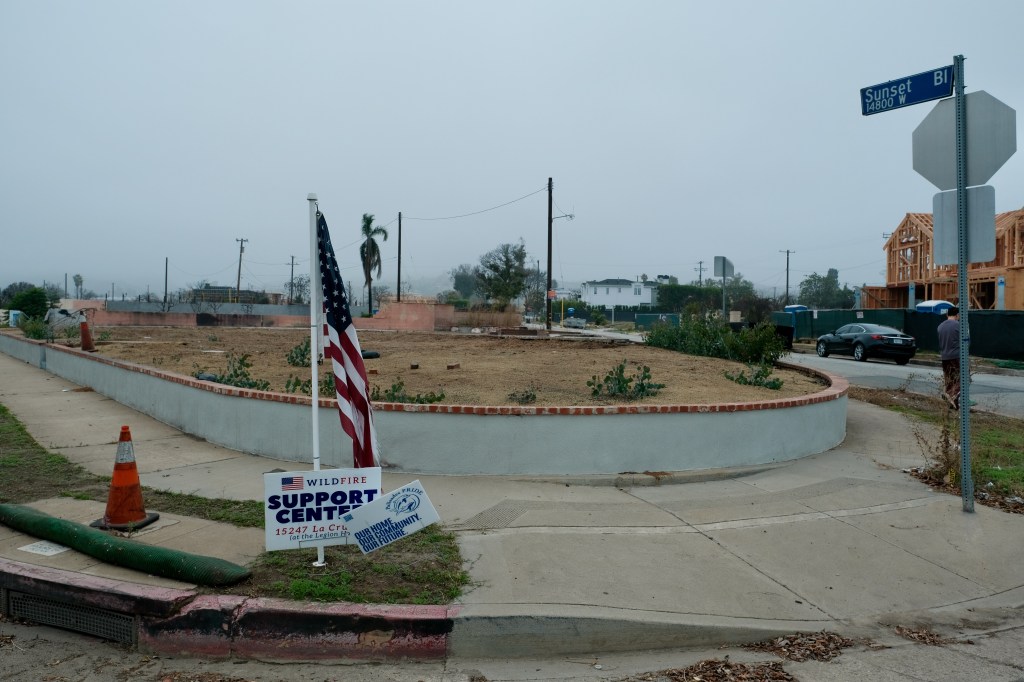
It was a cool, foggy Sunday morning with almost no traffic along the 700 Block of North Hartzell St, just off Sunset. I could stand in the middle of the road without fear.
Around me was a vast emptiness of empty lots, but with quite a few houses under construction, not only on Hartzell, but on nearby streets like Drummond, Carey, and Calloway. You could see through to many streets beyond the one you were standing on, looking at lumber boards on joists hundreds of yards away, just as if you had gone back 100 years to the very birth of Pacific Palisades.
Though there were no people, only a few construction workers hammering and drilling, the presence of the law was everywhere. There were signs against trespassing, US Army Corps of Engineers “California Wildfires Response Debris Removal Support,” NOT FOR SALE, PROTECT THE PALISADES, “This Home Will Rise Again,” #palistrong, Palisades Patrol. I felt the security presence of cameras, cops and Mr. Rick Caruso.
Everywhere there were signs for construction companies, architects, interior designers, garden designers, and realtors. Everyone with a skill to sell had a sign to show.
American flags were planted in soil like a Veteran’s Day cemetery. United in mourning, resolved in moving forward, the spirit of the Palisades shined. Or perhaps it was the spirit baptized in buckets of insurance money.
On all the blocks I walked today the metal street signs on posts survived. No burn marks, no damage, nothing but white letters on dark blue metal.
How could the fires incinerate automobiles, trucks, refrigerators, washing machines, and hot water heaters? But somehow leave the proper names of the avenues, drives and roads intact? It is one of God’s strangest mysteries, perhaps she knows better than us the value of these named lots.
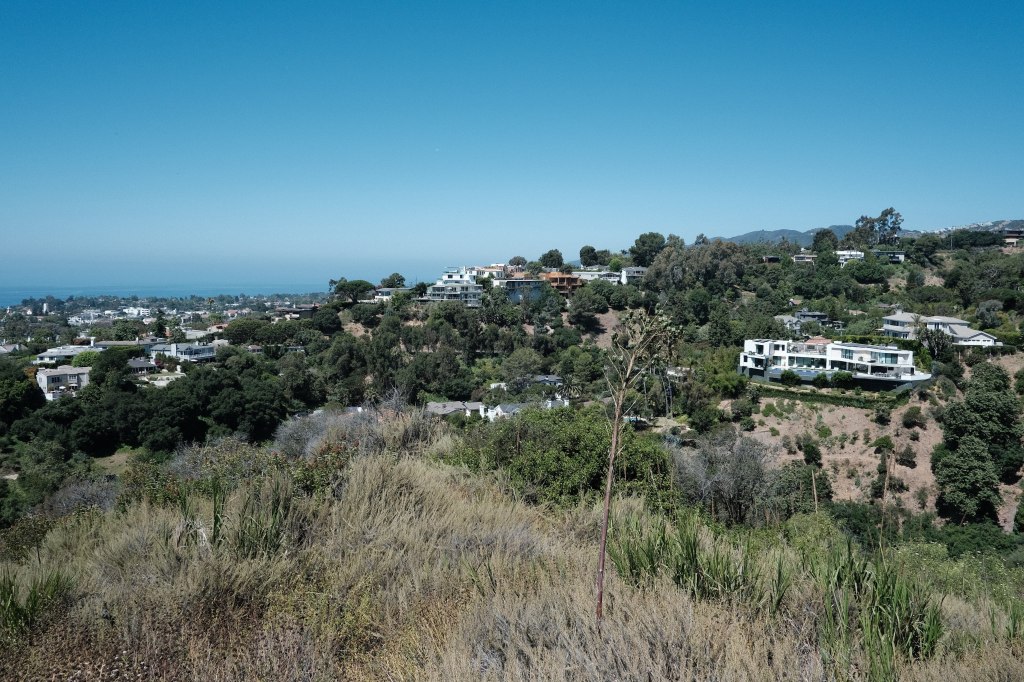
Further west on Bollinger Drive were some burned up vehicles with a big white house across the street. Every other house was consumed, and the lots everywhere were cleared, save for some with front door steps leading up to the sky; empty driveways, brick chimneys in fields, and sediment logs along the edges of lots to trap debris before it clogged drainage systems.
Walking in districts obliterated by now extinguished flames is a ghostly privilege of survivors. The living can never know the whole truth of what this was before. I hope I was respectful to those who lost everything. I am in no position to know their pain.
And now that the new houses are coming up, who knows what they will endure in the coming years, and even if the American nation and government that they are born into will endure and survive an epoch which seems more horrific each passing day.
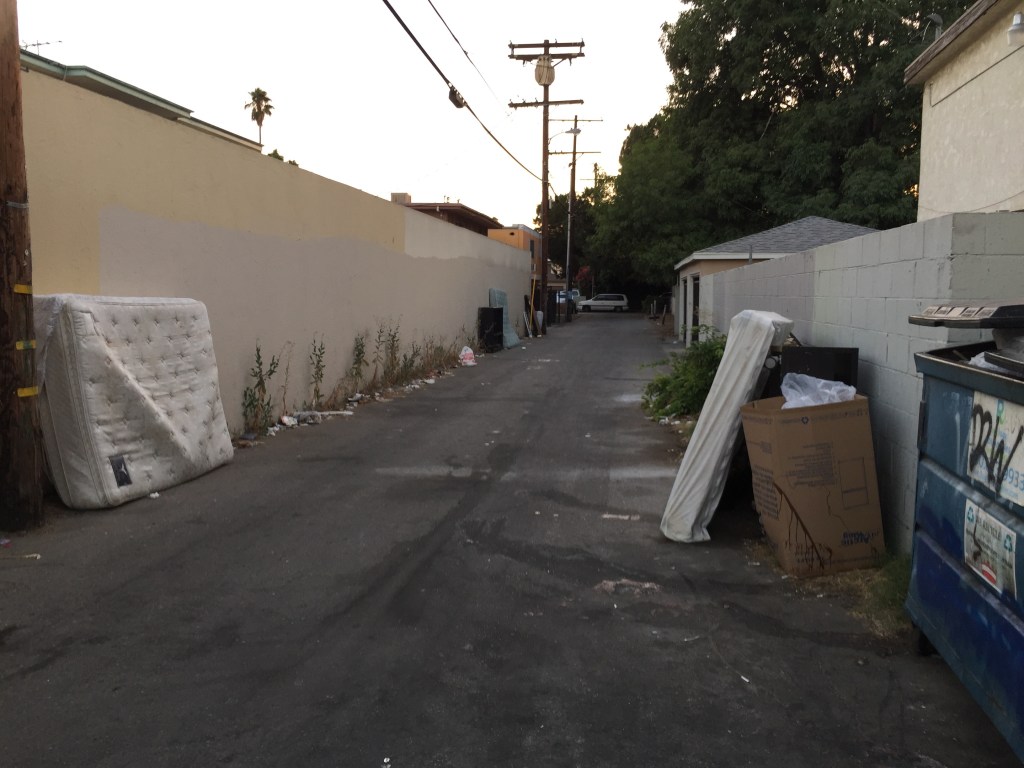
In all the days since the disastrous fires destroyed vibrant and sparkling communities of people and their houses and businesses in Altadena and Pacific Palisades, flat and socially unpopular Van Nuys, miles from any combustible forests, sat silent, its empty parking lots and vacant stores along Van Nuys Boulevard mute and abandoned, its daytime as empty and lifeless as its nighttime.
You live here and just like people anywhere yearn for the same normal things that civilized places provide: safety, cleanliness, affordability, and lawfulness. But all you get are sirens, speeding cars, helicopters at 2am, Woodley Park set ablaze monthly.
After nearly 25 years here I see nothing but decline in the environment around Van Nuys.
3/5/18 Bessemer at Cedros.Van Nuys, CA3/5/18 Bessemer at Cedros.Old Post Office
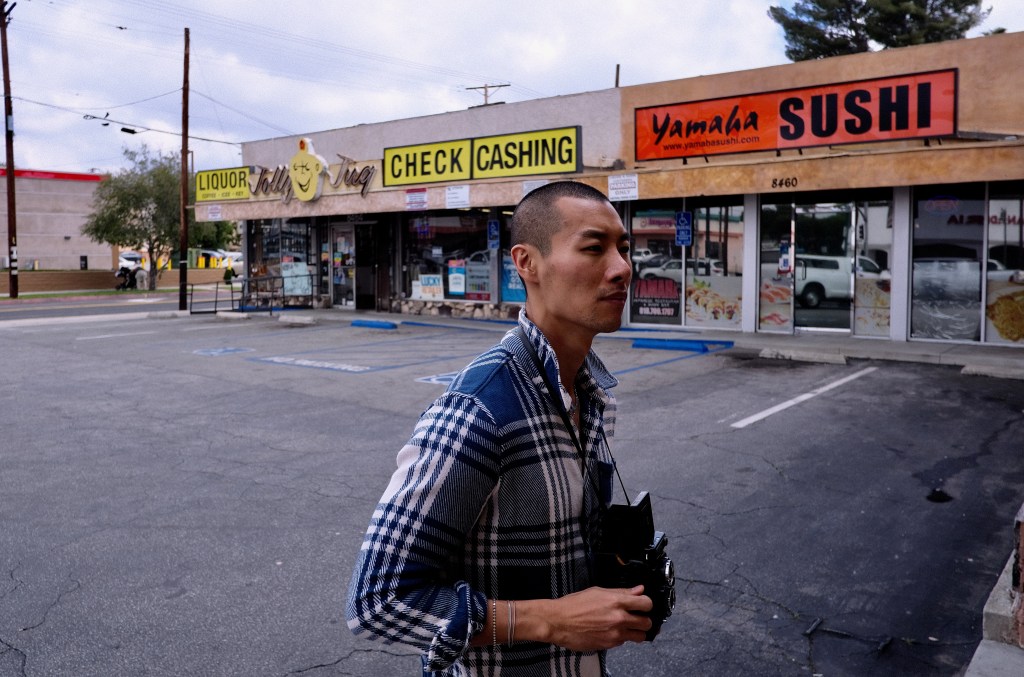
The same neglected mini-mall that I complained about in 2009 is still the same trash strewn dump it always was. Its owner used to live in Bel Air. He complained about my criticism when all I asked him to do was hire a $10 an hour worker to sweep the sidewalk weekly and install a security light on the side of the building so people didn’t sleep and urinate and tag the walls.
The stores that line Van Nuys Boulevard from Vanowen to the Oxnard are largely empty, many are built with gigantic parking lots behind them that are also empty, parking for thousands of cars that once shopped here, but those shoppers have left or died.
The Valley Municipal Building is where CD 6 Councilwoman Imelda Padilla reigns over the neglect and the ugliness. She replaced Nury Martinez who had to resign in disgrace after she was recorded by covert means saying ethnically insulting things about other Angelenos. Martinez came after Cardenas who went to Congress where he now serves.
Cardenas, Martinez, Padilla. It sounds like a nursery rhyme with its melodic Spanish surnames. It might well be a soundtrack set to an ever- present social disaster of Van Nuys with its hundreds of homeless sleeping in the plaza, along the Orange Line, or in the parking lot of the CVS on Erwin Street.
How is it that the so-called heart of the San Fernando Valley, the place that once bustled with prosperity and good infrastructure, including light rail and neatly tended homes and businesses, has been allowed to die for so many decades?
Victory Bl. east of Sepulveda, Van Nuys, CA 5/10/18
Is it callous to also point out that Van Nuys is less prone to fire than other areas that have boomed in recent decades? Would Van Nuys Boulevard, lined with 13-story tall Park Avenue apartment houses be a higher fire risk than thousands of wooden McMansions shoved up canyons in Bel Air, Brentwood, Malibu and the Palisades?
And when Van Nuys gets light rail, might it be possible to imagine a walkable, pleasant, less expensive part of Los Angeles where the vaunted word diversity can be used equitably as all types of inclusion would occur with young, old, well-off, not so well-off, living in nice apartments with patrolled and orderly parks and streets?
Perhaps some of the displaced people would live in well-maintained buildings if such a thing existed in Van Nuys.
With so much focus on rebuilding Los Angeles a good place to start an experiment in civilization would be Van Nuys. It’s the only corpse that has been screaming for rescue for decades.
The first job I had in Los Angeles was working at Barley Corn Entertainment, a small documentary production company in Valley Village.
It was the summer of 1994. OJ had just not killed his ex-wife and the young waiter who was returning her sunglasses. I was living in Studio City for $400 a month, and the new job as a PA paid $450 a week.
The woman who hired me, Lisa, was in her mid 30s, married to one of the owners, Sean. She was green eyed, tall, broad shouldered and drove a dark green Range Rover from her home in Pacific Palisades.
She brought along a little white Pomeranian dog to the office every day, a novelty to me, being from the Middle West and the East Coast where dogs were large and stayed at home.
Lisa was a line producer, a job she mastered in daily calm, always even tempered, even when she got cross. She commanded runs and released funds, met with producers, writers, editors, and researchers, and still had time to walk across the street to Gelsons for a cup of coffee and a large spinach salad. Her day ended at 5 or 6, and she would go down to the parking garage and drive an hour back to her enchanted life on Enchanted Way in Pacific Palisades.
There was a Christmas party at their home in 1994. I arrived at the 1960s ranch house, built on a terraced lot, like every other house, little plots of splendor overlooking the Pacific, lots along a hilly street stacked and placed like many dinner plates on the arms of a hash house waitress.
We were all young and in awe at the $600,000 home with sliding glass windows that opened to a small patio that overlooked the mist and the ocean.
I drank a lot, and Lisa forbade me to drive home.
I went to bed on the white sectional in the living room, and awoke under a baby blue cashmere throw with a headache. Lisa made coffee, and then Sean invited me to leave “when it was convenient.”
Lisa and Sean, Sean and Lisa, Pacific Palisades. Range Rovers, small dogs, lovely houses that always sat in the temperature range of 58-68 degrees.
My co-worker, Julie, was the daughter of two negligent Marin County hippies and had gone to live with her maiden aunt in Santa Monica during high school. She adored Lisa and Sean and hoped that one day she too would live in Pacific Palisades, perhaps leveraging her BA from UCLA and weekly production check to buy a house on Enchanted Way.
A few years later Julie met Aaron, a wealthy man who lived on Lachman Lane in the Palisades. She moved into his house, and they made plans to marry. I went to their house, sat by the pool, and talked with Julie about a reality show idea we never produced.
Aaron wanted Julie to sign a prenuptial agreement before marriage. Julie asked her friends what they thought, and the consensus was “he doesn’t really love you.” They broke up and Aaron married someone else, a compliant wife who signed an agreement, and they may have lived happily ever after.
Julie met a hard drinking Missouri man on a production shoot in Wisconsin, married him, had a baby girl, moved to Kansas City, got divorced after a year, and spent the next 15 years in Missouri pining for the lifestyle she lost. She and her teen daughter moved back to the aunt’s condo in Santa Monica last year.
Kevin, circa 1995, was a producer at Barley Corn, a year older than me, married to Cori, and they lived in a house in Pacific Palisades.
He looked like a young Dick Nixon, was kind of a dick swinger at times, bragging about his $400,000 house bought with the wife’s parental endowment.
I hadn’t seen him in 28 years, but there was a reunion of Barley Corn folks last summer. I asked him about his house, his $400,000 house.
“It ain’t $400,000 anymore! We sold it and bought a much larger place near the village in Pacific Palisades!”
In the 1990s I also took a comedy writing class at the home of Bill Idelson on Brooktree Lane in Rustic Canyon.
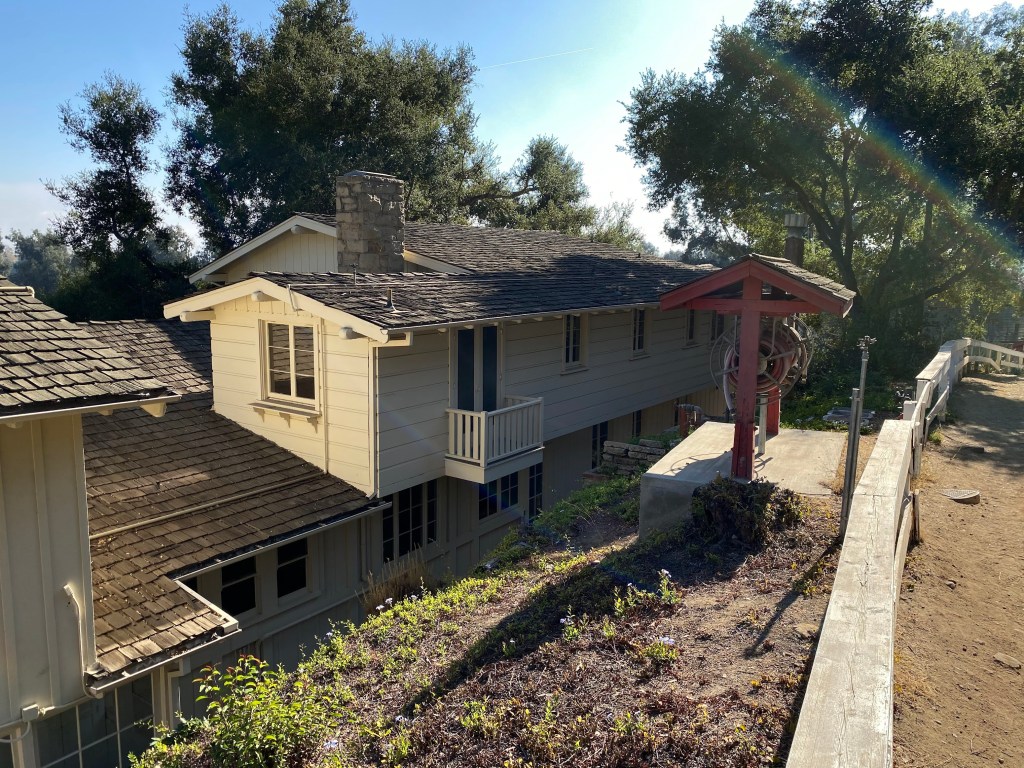
It was a mid 1950s wood house in a redwood grove next to a creek. It was designed by Mario Corbett and photographed by Julius Shulman. (his photo below).
Idelson, an actor, also had a successful career penning sitcoms, and he had a formula, much of which I forgot, except for his drawing of a man and a moon. “How he gets to the moon is your story!” he said.
We would sit on the patio next to the creek, and with the sounds of water and nature, get instructed.
Idelson had a grown son, a handsome, athletic blond guy who said he would ride the creek during rains in his raft straight down to the ocean.
That was Pacific Palisades: the successful sitcom, the gorgeous house, the beautiful surroundings, the happy-go-lucky son who rode the rain water for fun.
Pacific Palisades does things to people who live there and people who don’t.
For those of us who only live there vicariously, it is sprinkled with celebrities, hiking trails, valet parking, croissants, gourmet coffees and cheeses, blond boys in collared shirts, hot yoga, scented candles, soccer matches, Will Rogers, polo ponies, Eucalyptus trees, gardeners and caterers, brand new big white houses with black windows and electric steel gates, and smooth faced women in sunglasses driving large SUVs 60 miles an hour down Sunset on their way to Lululemon. There is never smog, heat, homelessness or obesity. The maids commute two hours to clean 10,000 square foot houses that are empty because their owners live in New York City.
It was, until a few days ago, something you venerated and worshipped, like Harvard University (before October 7, 2023), Berkshire Hathaway, or inheriting ten acres of land atop Mulholland. If only you had that Ivy League degree, or ten $677,000 Berkshire Hathaway shares, or lived on El Medio Avenue so you could walk to the Temescal Canyon Trailhead. You might someday hit it big, marry that blonde girl, date the personal trainer stepson of that HBO celebrity with a lot of fame and money, sell that show, invent that software sold for millions to Meta, or become a partner of that law firm in Century City, if only you had one of these or that you could be the happiest person on Earth and live in Pacific Palisades.
Since I moved to LA in 1994, there was always a sense to me that people migrated to places rather than improve the ones they lived in. They sometimes did this by changing names, from North Hollywood to Valley Village, or Valley Glen; or converting West Van Nuys into Lake Balboa.
To this day, Los Angeles, for miles and miles, is neglected, filthy, violent. It has no nice parks, hardly any real neighborhoods to walk around. It costs a fortune to live here, to rent or buy is oppressive. People sleep in tents, or on bus benches, they rob stores, and start fires because they are so lost and miserable.
Seemingly not so in Pacific Palisades. Charming, safe, family friendly, delightful. Nothing catastrophic or out of control. The powers that be lived here and kept it well-tuned and well-functioning. Until January 7, 2025.
Once in a generation weather. Except it happens around the globe every week in different horror scenes. One month it’s Lahaina, the next month it’s Greece, Spain, Western Canada.
But Pacific Palisades? Our Pacific Palisades? Where we go for hikes, where my nephew goes to school, where my gentle, wine sipping bosses lived, where I brought my parents to Rustic Canyon so they could see “the real California?”
We kid ourselves thinking our good luck is our own doing, that we may escape losing our health or our home. We really do live by the whims of fate.
There is one migration that seems innocent, but it is, in a sense malignant, many people of means seeking to escape the bad air hellhole of greater Los Angeles, and it leads to Sunset at PCH where there is no more land, paradise promised at the end of the continent.
Now it is temporarily destroyed.
Thank God for those who have survived. Life matters most.
We have seen these fierce wind driven fires and their atomic destruction.
How one small spark can end one era and perhaps usher in another one that may be more humane and sustainable.
Yesterday, after eating lunch at Myung Dong Noodle House on Wilshire, we got into our car and drove south on Irolo St. and went east, along West 8th Street, for about two and a half miles.
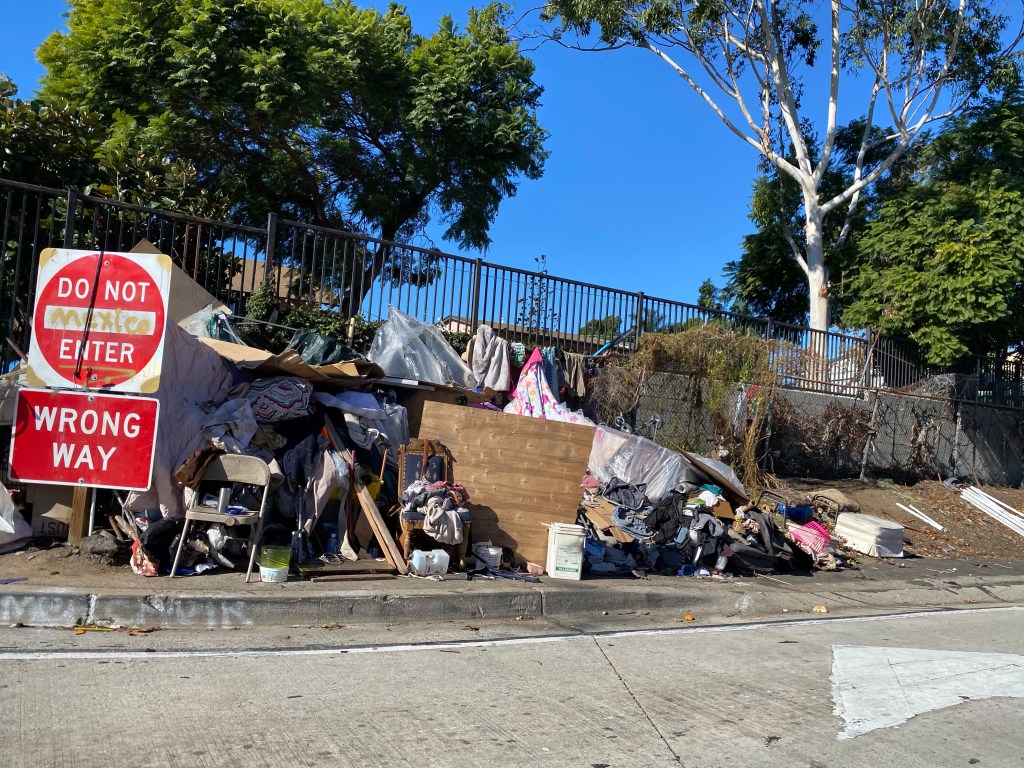
Words cannot produce images that could equal the utter filthiness, horror, inhumanity and decay of the street. There were 10 foot high piles of garbage in alleys, people sleeping on sidewalks and bus benches. Shopping carts of trash in front of every store. Lost men and women, high, drunk, dirty, forgotten, mixed in with others who were not. And sidewalks full of new arrivals in the city, walking, working, eating; selling clothes on blankets or food from carts; pushing kids in strollers; striving to get by and survive in one of the most unpleasant and dystopian cities in the Western world.
As the road curved into the underpass that runs under the 110 freeway, dozens of people were living in encampments on each side of the street. A Ritz-Carlton luxury hotel glass tower loomed in the nearby downtown. Was this a joke?
It seemed that God had taken a leave of absence and left Satan in charge.
This is Los Angeles. This is California. This is the United States of America. In 2024.
What kind of government that is even half-awake, half-sentient and semi-moral allows an entire city to fall into a condition that might only exist in a place of war or extreme impoverishment?
There’s a baseline of governance. You keep the streets clean. You try and employ a sense of order and reason to public activities to ensure that life is reasonable, safe and decent.
You don’t allow chaos to reign knowing that revolution will surely follow.
In the depths of the Great Depression, in the 1930s, when 25% of this country was out of work, Los Angeles, west of downtown, the same place we drove in yesterday, looked like this:
Photograph of West 9th Street and South Hobart Boulevard intersection, Los Angeles, CA, 1931. “S. Hobart [ilg]” — intersection signage.
Photograph of intersection of West 8th Street and South Carondelet Street, Los Angeles, CA, 1932. “[ilg] Market” — signage on building. “[South] Ca[ronde]let St[reet]” — on street sign.
Photograph of the intersection of West 9th Street and South Berendo Street, Los Angeles, CA, 1940. “[ilg]feway; M[a]rgy’s” — signage on buildings. “S. Berendo St., 900 Blk.” — on street sign. “7C 54 10” — on license plate.
Photograph of intersection of West 6th Street and South Hobart Boulevard, Los Angeles, CA, 1932. “safety first” — on road.
Photograph of intersection, West 6th Street & South Grand View Street, Los Angeles, CA, 1933.
Photograph of intersection of West 8th Street and South Carondelet Street, Los Angeles, CA, 1932. “7V 29 81” — on license plate. “Stop, Auto Club of So[uthern] Cal[ifornia]” — on street sign. “Slow” — on street.
Photograph of Union Oil service station, West Eighth Street and South Western Avenue, Los Angeles, CA, 1933. “Washington B[ui]ld[in]g” — on billboard. ” ‘Stop Wear’, lubrication service, using union friction-pr[ilg] lubricants exclusively; Station no. 956; Stop your motor, no smoking; Union Co[mpany], 17 ¢ gasoline” — on signage. “Union Service Stations Inc[orporated]; – Wear, [ilg]ation service, batteries” — on station front. “Unoco gasoline, 4 tax; Union 76, 4 tax” — on gas pumps.
Photograph of building on northwest corner of West 8th Street and South Western Avenue, Los Angeles, CA, 1931. “Beverly Arms; Manhattan Market P[hon]e F15617, Challenge Butter, [ilg] Milk; Beauty Parler; [ilg] Bottle Supply Co.; Hand Laundry” — singage on building. “Asable[ilg]; Shasta, [ilg]; Western [ilg]; Drugs” — street level signage on building. “[S]tandard Oil Products; [ilg] Atlas [ilg]; No Smoking, Stop Your Motor; Standard Gasoline” — signage at station. “Keep Your Eye on Chevrolet; Arrow Hits The S[ilg], Sandwich[ilg]” — signage in background. “Stop” — signage along street.
Credit: USC Archives/ Dick Whittington Collection.
You must be logged in to post a comment.