December 1956: Disastrous Malibu Fire


As front liners, on foot or flying aircraft, are still fighting the worst fires in Los Angeles history, it is instructive to see that this is the inheritance of living in this region.

In late December 1956, Malibu was ablaze. Many homes were lost. The same aspects we witness today applied: heroism, narrow escapes, families in terror, and brutal conditions of fire fighting.

Though the vast majority of people who lost homes were obscure middle class people, the headlines then, as now, announced celebrities who also suffered property destruction.

Ralph Edwards, TV personality, loses $75,000 beachfront home!”

In 1956, one helicopter was in service, and after the fire, more were purchased. The militarization of fighting fires, and the use of the most advanced technology and highly trained professionals became the norm.

Here are some photos with their original captions found in the archives of the Los Angeles Public Library:

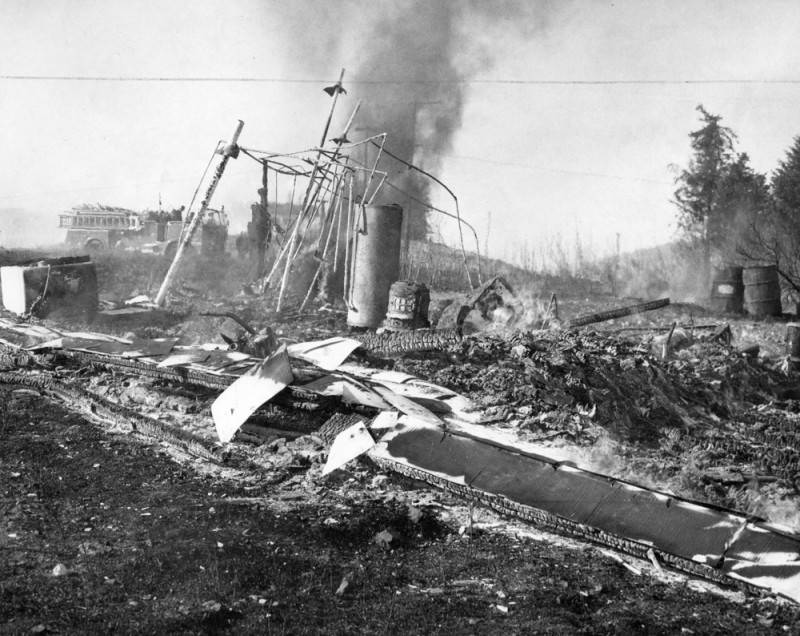
  1. Photograph dated December 26, 1956 shows debris from an unknown structure after the fast-moving mountain blaze burned through the Paradise Cove area in Malibu.
  2. “This is view of fire taken from top of Escondido Canyon looking toward ocean.  Shortly after picture was snapped, flames and smoke rolled down beach burning expensive waterside homes at Paradise Cove and Escondido Beach.  Today, flames are moving north and threaten to jump Mulholland Highway near Lake Malibu.  Army of men and mechanized equipment are massed on this highway in an effort to halt advance of flames over Santa Monica Mountains into plush lake resort area.”
  3. “Volunteer American Red Cross nurse pulls covers up over one sleeping youngster brought into Webster School which was set up as disaster station shortly after flames began threatening resort area near Malibu Beach.  Flames forced more than 1,000 persons to flee for their lives.  Evacuees with only clothes on their backs beat a path to school door to receive lodging and food for night.  Fire officials today fear that school will also be evacuated as flames loomed overhead near Malibu Canyon road.”
  4. Dennis Szigeti looks dazedly at all belongings he managed to salvage from home before it burned to ground in Latigo Canyon drive.  All six of Szigeti’s children were evacuated from home before it was consumed. Szigeti family was luckier than some which had to get out without time to save any of household belongings.”  The article partially reads, “The catastrophic fire which continued to race wildly out of control through the Malibu mountains today threatened to leap over Mulholland Highway near Malibu Lake and burn into the western end of the San Fernando Valley above Calabasas.  The fire has already jumped Mulholland Highway at Decker Canyon and advanced west into Ventura County toward the exclusive Lake Sherwood area.”
  5. “Helmeted John Durbin, 20, volunteer fireman from nearby Thousand Oaks, carries patio chair from plush $32,500 Lake Sherwood home of Mrs. Jean Robison.  Flames fueled by escaping butane gas burned all night.  Hoover home was across road and was first hit by blaze as flames moved inland from Triunfo Ranch, one-quarter mile south of Ventura boulevard near Thousand Oaks.”
  6. “Mrs. Charles Clarke, 5903 Ramirez Canyon, holds her son Billy, 1, closely as she looks up blackened canyon from Paradise Cove.  She, like hundreds of others, became refugee as brush fire inferno swallowed up more than 20,000 acres near beach area.  Her husband brought family to safety and went back to try to save home with help of firemen.”  The article partially reads, “The catastrophic fire which continued to race wildly out of control through the Malibu mountains today threatened to leap over Mulholland Highway near Malibu Lake and burn into the western end of the San Fernando Valley above Calabasas.  The fire has already jumped Mulholland Highway at Decker Canyon and advanced west into Ventura County toward the exclusive Lake Sherwood area.”

“The Malibu fire of December 27, 1956, apparently started on Backus Summit, inland from Zuma Beach. It destroyed 35 homes, killed one person, and injured thirty-three others – both firemen and civilians. Flames shot high enough to be seen from miles away, and the heat was so intense that rocks exploded, and embers and sparks showered down out of the hills across Pacific Coast Highway. Several of the homes destroyed were those of Hollywood personalities, including television’s Ralph Edwards. The Malibu fire was described as the worst Los Angeles County fire since 1938.”

  1. “Fire houses, etc. near Malibu Mountains Inn, Latigo Canyon Rd and Ocean View Drive, at head of Latigo & Ramirez Canyons.”

      2. “Groups of evacuees from S. Rambla Orieta (?) — Mr. and Mrs. Frank Hyatt, left, & Mr. & Mrs. A.W. Rebard, & family”.

      3. “Mrs. Joe Stephens Sr., right, and Red Cross nurse Mrs. Ralph Peterson, left, support Mrs. Nellie Stephens as they carry her to bed in Webster School disaster center. She and other members of family left home at 20641 Malibu Rd. as blaze came dangerously close.”

      4. December 29, 1956 reads: “Skeleton is all that remains of lakeside home belonging to Roy Hoover in Lake Sherwood fire which raced through community. More than 3,000 acres have been reported burned in this area alone. House at time of blaze was occupied by Jack Jones Jr., his wife and their three sons. They all fled to safety. Two firemen suffered injuries while fighting for lake homes.”

      5. “Reporter examines burned-out fire chief’s car”.

      The Pink Oasis: Time Magazine, July 4, 1949.


      “That amazing mechanism, the human eye, adjusts itself to Los Angeles in a matter of hours. The optic nerves grow submissive before the red glare of geraniums, the flash of windshields, the sight of endless and improbable vistas of pastel stucco. Even on his first, casual, hundred-mile drive the pilgrim achieves a kind of stunned tranquillity, and gazes unblinkingly at palace-studded mountains, rat-proofed palms, and supermarkets as big as B-2Q hangars.

      This surrender of the senses is seldom averted by the city’s more conventional scenery. Downtown Los Angeles has genuine smoke-stained old brick and stone buildings, jammed together as tightly as those of Philadelphia or Baltimore. Hundreds of old-fashioned clapboard houses stand uneasily in the sun along its older residential streets. But the visitor in 1949 is apt to stare at them less in recognition than in disbelief, like a wanderer pushing through the vine-hung ruins of Angkor-Thorn.

      They are obviously the work of a dead race—the people who thought Los Angeles was going to be a Cleveland with orange trees. After four frantic years of war and four wild years of peacetime boom, it is plain that Los Angeles will never be like anything else on earth.

      More Fish then Boston.

      By now it is probably the third biggest city in the U.S. —more than 2,000,000 people live within its far-flung city limits, more than 4,000,000 in its metropolitan area—and it has gotten pinker, more sprawling, more like a Los Angeles promoter’s dream with every advancing mile.

      It has given the lie to the starched double-doubters who had cried that Los Angeles was a gaudy but impractical contraption which would inevitably collapse, trapping swarms of blondes and bare-toed yogis in its wreckage. It has become an industrial giant, has attracted not only new people (949,585 in Los Angeles County since Pearl Harbor), but new money, new business, and $450 million in factories and machinery since V-J day.

      Its economy no longer depends directly on its basic industries—oil, oranges, motion pictures and aircraft. It lands more fish than Boston or Gloucester, makes more furniture than Grand Rapids, assembles more automobiles than any other city but Detroit, makes more tires than any other city but Akron. It is a garment center (bathing suits, slacks, sports togs) second only to New York. It makes steel in its backyard. Its port handles more tonnage than San Francisco.

      It has built 240,000 new houses and apartment units in the last four years. Whole new villages have sprung from its brown plains, some lush and expensive, others as starkly laid out as well-planned graveyards, all equipped with their own highly colored, glass-heavy shops and markets. Enormous, gleaming new branch department stores have sprung up, not only along Wilshire Boulevard’s fabulous Miracle Mile, but in virtually every suburban area. A city ordinance requires that new stores have parking lots; most are as big as football fields.

      Los Angeles has finally forced the East to go West and do business. Many firms have surrendered to it completely, have moved their headquarters to Los Angeles. Among them: Rexall Drug, Inc., Carnation Co., American Potash & Chemical Corp. With all this, Los Angeles is the richest agricultural county and the most productive dairying county in the nation. As an afterthought it raises 3,000,000 rabbits, 10,000 chinchillas and most of the country’s cymbidium orchids.

      In a Little Spanish Town.

      It has reached this state of supercharged development through a process as astonishing as a Cecil B. DeMille production. Los Angeles began life in 1781 as the Spanish pueblo of Nuestra Señora la Reina de Los Angeles de Porciúncula —a comatose village of 44 souls, surrounded by arid plains and arid mountains. It dozed for a century, hardly opening an eye when four square Spanish leagues of its dusty ground was incorporated into a U.S. city.

      Then the West-reaching railroads got to Los Angeles—the Southern Pacific in 1876, the Santa Fe in 1885. New settlers came in expecting an oasis and found none. They set out to build an artificial one. They dug wells with imported picks, planted imported palms and eucalyptus trees, cultivated lemon, orange and nut groves and a thousand and one foreign flowers, grasses and grains. They built with imported brick and lumber. They had no domestic material but sunshine.

      A city sprang up where no city seemed to belong. It built a 233-mile aqueduct, ruthlessly sucked away the water of the distant Owens River—a project which turned the verdant Owens Valley to desert and stirred its farmers to rebellion. It constructed an artificial harbor, hatched the motion-picture business and raised oil derricks and searchlight beams. Its full-voiced Chamber of Commerce ballyhooed to climate. The city gulped in armies of aging lowans, land-hungry Oklahomans and dazzled tourists.

      It grew without inhibitions. It was fascinated by space, color, the vehement sermons of real-estate sharks and the horticultural efficacy of powdered cow manure. It developed into a new kind of city—a sprawling confederacy of villages, with five branch city halls and 932 identifiable neighborhoods, in which life is dedicated to the sun, the lawn sprinkler and the backyard grill, and in which the swimming pool is the mark of success and distinction.

      Over the years it developed a new breed of Big Man. They were plungers, they were impatient of tradition, and they were fascinated by newness, bigness and the sound of battle. Director D. W. Griffith demonstrated that the jerky, flickering motion picture could be a dramatic form with sweep and magnificence. M.G.M’s Louis B. Mayer ran a cheap variety theater in Haverhill, Mass, into a cinema empire. Oilman Edward L. Doheny, a gold prospector from Tombstone, Ariz., found a fortune beneath his feet and exploited the vast oil wealth of Los Angeles. Donald Douglas and “Dutch” Kindel-berger built air armadas, and restless Henry Kaiser, fabricator of dams & ships, gave southern California its first complete steel plant.

      City on Wheels.

      Los Angeles became the first big city of the automobile age. Its citizens worship the fishtail Cadillac, use their cars for almost all transportation (there is one car for every 2.6 persons—the nation’s highest average), drive up to traffic lights like ballplayers sliding into second, and regard the pedestrian with suspicion and distrust.

      A pearly industrial smog now hangs embarrassingly over the city for days at a time, dulling the sun and stinging the eyes of the population. It is no longer the great open-shop town—labor unions, which cracked its defenses during the war, have consolidated their gains in the years since. It has a new leavening of industrial workers. But its tone, spirit and huge aspirations are unimpaired.

      Rich, booming, and afloat with dull-eyed suckers, it is an irresistible target for shady operators, con men, burglars, jewel thieves and tired Eastern torpedoes—all of whom slip into sport coats and slacks on arrival. Murders are often bizarre. Elizabeth Short, nicknamed the “Black Dahlia,” became the most highly publicized corpse in the country after a citizen left her slashed body on a vacant lot. A Mrs. Mary James was dispatched with more finesse—her husband thrust her foot into a box containing a rattlesnake, gave her a drink of whisky and then drowned her in the bathtub.

      Los Angeles has its own odd set of local customs. It has few basements and fewer furnaces and almost every house has an “incinerator” in the backyard—a reinforced concrete stove with a screened stack for burning rubbish and gaper. Its real-estate men still hang up strings of flags to advertise a house for sale. Its love of the unusual extends even to the young —high-school boys at Van Nuys began dyeing their hair green this spring, to the dismay of parents and teachers.

      It is movie struck, and its residents imitate and envy the stars of the screen— though members of “downtown” society and the rich of Pasadena enjoy bristling at them and Los Angeles society pages go out of their way to avoid printing a motion-picture person’s name. It is a city full of people from somewhere else and it still has little sense of tradition or of unity.

      Dreadful Joy.

      It has hordes of critics, and they damn it like Victorian belles stabbing a masher with hatpins.

      Intellectuals, Easterners and British writers, many of whom have lived happily in its sunshine for decades,of Dreadful Joy [where] conversation is unknown.” H. L. Mencken handed down a one-word verdict: “Moronia.”

      But Los Angeles has its own brand of magnificence. It is amazingly clean, awesomely spacious. It has ramshackle houses, but in comparison with other big cities, no slums. Its great boulevards wind through miles of windblown trees, bright flowers and sweeping, emerald-green lawns. It is a Western town, with the memory of Deadwood and Virginia City in its bones; in its love of display, its detachment from the past and its obsession with its own destiny, it is simply striking the attitude of the gold seeker and the trail blazer.

      Nothing about the city is more surprising, at first glance, than the man it has elected and re-elected its mayor. This week he will be sworn into office for the fourth time.

      Peace & Quiet.

      At 61, after ten uninterrupted years in office, plump, greying, long-winded little Fletcher Bowron often seems oddly like a preacher running a wild-animal act. He is obviously appalled by the way his charges snap and yelp, and he says so—his remonstrative cliches have antagonized not only the City Council (a group which he is certain is plotting the city’s Downfall), but virtually every civic organization in town.

      In throbbing, booming Los Angeles, he is a man who hankers after peace & quiet. Said he, sadly, last week: “The good Lord didn’t intend this to be an industrial city.” He is still apt to speak of automobiles as “chug wagons” and to recall with a reminiscent sigh the good old days when Santa Monica Boulevard was nothing but a dusty lane running between outlying farms.

      He is the antithesis of the type which even Los Angeles fondly believes typical of its executives—the flamboyant figure in a shaggy sports jacket who barks decisions into three telephones. Fletcher Bowron wears dark suits, black shoes, and rimless spectacles. His desk, in Los Angeles’ 32-story City Hall (the 13- story limit in earthquake-conscious Los Angeles was relaxed to make it the highest building in town) is a hopeless clutter of papers and reports.

      He is the slow-moving despair of complaining citizens, committees intent on getting information and newspapermen with deadlines to make. Three red chairs stand at attention before his desk: interviewers often sink into them like dental patients steeling themselves for a long, tedious inlay job.

      Bowron listens politely to a question, tilts back, forms his hands into a steeple on his paunch, and answers —sometimes for half an hour without a stop. He seems to forget time, and his voice rises and falls as soporifically as the sound of distant surf. Said one defeated interrogator: “Asking him questions is like trying to bail out the ocean with a teaspoon.”

      But for all this, Fletcher Bowron is the people’s choice. The town often ignores him—only three days before he was re-elected last month, the Los Angeles Examiner put him and his campaign back on an inside page, ran a Page One banner line which read ALY KISSES RITA’S FOOT. But his constituents know he loves them.

      He is a fiercely honest man, and is eternally intent on protecting Los Angeles from itself. Last week, when one Brenda Allen, queen of Hollywood’s call girls, charged (from jail) that Los Angeles cops had accepted bribes from her, Bowron reacted less like an injured politician than a father whose children have been caught smoking cigars behind the barn.

      Despite his misgivings about its didoes, he is fantastically proud of the city, and works 14 hours a day at his trying job. He seldom sees his wife, or his 15-year-old adopted son, Barry, except at breakfast. His most vehement critics agree that he would scrub City Hall down with a toothbrush if he decided, after thorough investigation, that the gesture would help Los Angeles.

      Honest Mayor.

      He became mayor almost by accident. A native son, he had started out in the world as a reporter on the San Francisco Sun after graduating from the old Los Angeles High School (now being torn down to make way for Hollywood Freeway) and spending two years at the University of California at Berkeley. He achieved his biggest youthful ambition in 1917; after years of studying law in his spare time, he was admitted to the California bar.

      He joined the Army in 1917, served through World War I in a San Francisco Army office. In 1922 he got a job as a state deputy corporation commissioner; it seemed that he might jog on through life as an inconspicuous public servant. But California’s Governor Friend Richardson, impressed by his thoroughness, appointed him to the Superior Court bench. In twelve years as a judge his homely virtues and his obvious distress at civic corruption attracted the interest of Los Angeles reformers.

      On Jan. 14, 1938, a tough, red-faced private detective named Harry Raymond indirectly did Bowron a good turn. Raymond, who had been loudly threatening to “blow the lid” off the city, walked out to his car, got in, stepped on the starter and detonated a bomb which someone had unkindly hidden under the hood. Bomb, car, detective and all went up in a fearful explosion. Raymond was not killed—although surgeons had to dig 122 separate slugs out of his torso.

      Enemies. A police captain named Earle Kynette and another officer were sent to San Quentin for the crime, and the administration of Mayor Frank Shaw was doomed. Bowron was pressed into service as a reform candidate; he was elected on his 16th wedding anniversary in 1938,

      Cautiously, but conscientiously, he set out to clean up a Los Angeles that had 300 gambling houses, 1,800 bookies, 23,000 slot machines and 600 brothels. He waited for seven months before he took steps to remodel the police department, but when he did, he kicked out 23 high-ranking officers. He appointed a college graduate as police chief, and a Rhodes scholar as fire chief.

      He banished slot machines and pinball games—though most of them reap peared outside the city limits. He abolished other municipal evils—the sale of civil-service promotions and the use of the city zoning ordinance to squeeze bribes from commercial enterprises.

      None of this was accomplished without Bowron’s tramping on sensitive toes; he made scores of enemies. He was accused of being arbitrary, tactless and indecisive, and was variously described as ‘Chubby Cheeks,” “Fumbling Fletch,” and “Bottleneck Bowron.” He was even attacked by Cafeteria Owner Clifford Clinton, a vociferous reformer and the man who spent $72,000 to put Bowron into office. “Drab . . . colorless … far from inspiring . . .” cried Clinton. “We were misled . . .” Clinton ran against him;—and lost.

      To the majority of the citizens Bowron seemed to be just the fellow for City Hall —a man who would keep the city clean, cry out at its enemies, real and imaginary, and stay up nights worrying while it went about its noisy and exuberant business.

      Last week, for all the forced-draft accomplishments of the years since V-J day, the city and its satellite towns were still grappling with a multiplicity of problems. The prosaic business of supplying new homes with gas, sewage lines and electricity had taken on the breathless urgency of a serum flight to Nome. Under Bowron’s administration 50 miles of cast-iron water mains had been laid every month to keep up with the city’s mushrooming growth. Los Angeles had built 34 new schools in ten years and still needed “a new one every Monday morning.” Though the Pacific Telephone & Telegraph Co. had installed 416,338 telephones since V-J day, it was 41,405 orders behind last week.

      Los Angeles still had a vast supply of its most precious and vital commodity—water. It drew 255 million gallons a day from the Owens River. With its adjoining towns it sucked too million gallons through a 392- mile aqueduct from the Colorado River; despite the bitter interstate dispute between California and Arizona over the river’s output, Los Angeles expected to tap the Colorado more freely in the future.

      But in common with the rest of arid Southern California, Los Angeles lusted for more. Its County Board of Supervisors eyed the ocean—it suggested a prize of a million dollars for the man who could provide a process for distilling sea water cheaply enough to make its use practical. It got letters from prison inmates, housewives, inventors, crackpots, from all over the country, from Holland, India, England, Australia and half a dozen other foreign lands.

      None of them gave the right answer. But Angelenos were sure that the problem —and all the rest of the city’s problems—would be solved in good time. They had to be. City planners expect a population of 6,000,000 in greater Los Angeles by 1970. Less cautious citizens call the planners pikers, are certain that the city will eventually be the biggest in the world. And after that? Undoubtedly, its boosters mused, it would have another boom.”

      Copyright 1949, © 2014 Time Inc. All rights reserved.

      Speaking of Ruins: The Hollywood Advisor


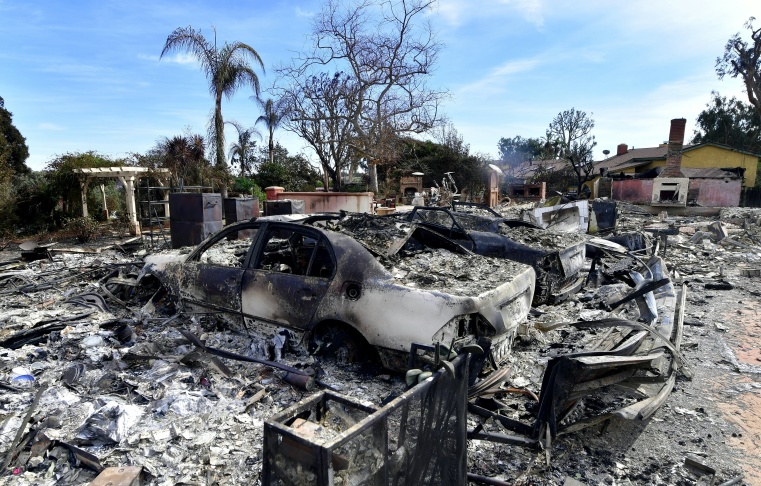
      “The remains of burnt down homes and vechicles resulting from the Woolsey Fire are seen on Busch Drive in Malibu, California on November 13, 2018. – At least 44 deaths have been reported so far from the late-season wildfires and with hundreds of people unaccounted for the toll is likely to rise, as thousands of weary firefighters waged a pitched battle against the deadliest infernos in California’s history. (Photo by Frederic J. BROWN / AFP) (Photo credit should read FREDERIC J. BROWN/AFP/Getty Images)”


      “The fire was roaring down the canyon. We had already stocked the car with our papers, our family photos.  Carla was so good, so organized, getting the kids into the car. And it was 3:30AM and we were ready to get the hell out in our 2018 Range Rover. The smoke was thick, of course. Then over the hill we saw flames.  Carlos, Esmerelda and Arturo ran up to the car.  Carla begged them to leave, mandatory evacuation, but they said they were staying. They would take garden hoses and buckets and fight the fire. So they did. They saved our house. The garage, where they lived, burned, but the main house, thank God, is still standing.”

      Jason, The Hollywood Advisor, was sitting on a deck overlooking the ocean, talking to me, weeks after the deadly and horrific fire that consumed Malibu. We were alone, drinking wine. He wore strange little sunglasses shaped like Forever Stamps, rectangular and beady; he wore them even after the sun dropped below the horizon. I guessed to hide his tired, sad eyes.

      Carla and the kids, Samantha, 13 and Igor, 11 were in Montserrat waiting out the reconstruction, and Jason was staying in Malibu, at a $6,000 a week AIRBNB, to attend to the repair of his semi-destroyed rustic cabin, worth millions.

      The fire was only the latest setback in his life. 

      He had spoken of lost projects, stolen ideas, friends who betrayed him, opportunities that evaporated quickly like afternoon rains in the summer desert.

      “I had the original script that belonged to Steve McQueen in The Towering Inferno. I bought it at auction when I was 18 years old in 1989. It was $400. And it burned too. God I loved that. It was Steve McQueen’s!” he said.

      That incinerated script was merely a metaphor for other charred, ruined and once-adored life attachments.

      The latest outrage was a friend of 20 years, Dean Meagrer[1], a big deal in the film world, a director and producer who had partnered with Jason, but then went behind Jason’s back to sell the film project to another company, and then denied he had done so.

      “People suck. Carla had nursed him through his relationships. She even sat up all night with Claire Foy talking her out of breaking up with him, and so basically Carla saved their relationship. And of course, Claire will star in their film, so everything was saved, jobs and love and money. And now he just lies to me and betrays me. So fucking unbelievable,” Jason said.

      He talked, seemingly with insight, about the world of fakery and insincerity that he once thought he belonged in, lorded over. He never took the circle of lost friends as a sign that perhaps none of these people had ever truly been true friends, but merely transactional relationships that were formed to bring goods and services to Jason and Carla and their kids.

      “Best Friends” was how Carla once described Lois and Johann who owned White Now, an ultra expensive tooth whitening process which the owners provided free to Jason, Carla and the kids, a $4,000 value. Every few months, the family got free whitened teeth, brighter and whiter than Dunn-Edwards Precious Pearls, a very white paint.

      Arnaldo and Noma, two Beverly Hills landscape architects, became the new best friends for a while, and designed, gratis, a sloping scheme of native plants, water-saving trees, artfully placed rocks and an herb garden. Noma was a set designer in her previous life, and Arnaldo was a Urauguayan film director, so that landscaping couple assumed a free outdoor makeover would lead to other entertainment opportunities, but that, of course, fell out. 

      And undocumented Guatemalans Carlos, Esmerelda and Arturo moved in, free, into the back garage, near the creek, and were allowed to stay, in return for light household chores like brush clearance, carpentry, painting, and cooking. That family lived like old plantation workers, grateful for a roof over their heads and enough food to eat, and they earned it by unofficially joining firefighters and risking their lives to fight the massive wildfire last month.

      Always Carla spoke of her conquests, her connections, her exploits, as a mother might speak of her children, with care and concern. There was a callousness to the bartering  where Jason and Carla used their positions to promise results which never materialized. “We helped a refugee family and our home was a sanctuary.”  A scrim of kindness masked the manipulations.

      But Jason was unaware.

      His self-pity was the major event that preoccupied him last week. He imagined that he had gained sad wisdom into the human condition, seeing in his own lost dreams a truly gripping tale of impoverishment, wandering and dazed, a defeated winner walking along Pacific Coast Highway in a smoked, soaked James PerseT-Shirt.

      I had not the courage to call him out, to point out his lies, his denials, his false sense of friendship and how temporal and shaky all of his foundations were. At the heart of his life, he had constructed a tale, a story, a narrative of sacrifice, truth, unselfishness and caring. 

      His adjectives were indeed something to treasure.


      [1]Invented name, privacy protected by anagram.

      Dinner With the Hollywood Advisor.


      The other night I went to dinner at the home of The Hollywood Advisor, “Jason” who owns a little cabin (“Worst home in Malibu” his wife calls it) nestled into a canyon, mockingly rustic, but worth millions.

      They had just returned, from their yearly six-week jaunt across several continents. The family skied in Switzerland for a few days, then dad flew them to Peru, and they ended up in Brazil and came back home to Malibu.

      “By the way, the food sucks in Peru. Bourdain is fucking wrong,” Jason told me.

      Wife is Selena, a toned, Bulgarian born woman in her late 40s fond of red wine and yoga. Her stunning daughter Samanatha is 13 and goes to school at a private academy near the Pacific. The boy, Igor, is also handsome and quite scientific, showing off his new telescope on the back deck within the gurgling sound of the creek.

      The aura of the evening, sounds, on paper, relaxing, yet Jason, who directed an Oscar winning film in 2000, had clenched teeth and some annoyance at what’s been happening with his life. He was tense, perhaps because he strictly abstains from alcohol.

      “This whole town is fucking nuts. I take meetings, sometimes two a week, and I meet with A list people, and then projects seem to get off the ground, and I’m attached for big bucks, and then they pull the rug out from under me,” he told me as he stir fried tofu and organically harvested shrimp.

      A doorbell rang and Jason commanded aloud, “Alexa open the front door!”

      The front door opened by wireless butler, and in walked Carla, a tall, long-haired actress in her early 40s who was carrying a small white dog in her arms. The dog and the actor excited Selena who hadn’t said a word to me yet ran up to Carla and the dog and embraced them.

      “Do you love Fergie? Isn’t she amazing?” Carla asked blue-eyed Samantha.

      “Yes! She’s like the most amazing dog ever!” Samantha responded.

      Selena, the wife, who had been curled up on the sofa, jumped up and asked Carla if she wanted something to drink.

      “Do you have any red wine?” Carla asked.

      “Yes, try this. It’s so amazing!” Selena said as she poured two-buck chuck into a glass.

      Selena patted Carla’s hair. “I love your hair. The color is so amazing.”

      “Thank you. I go to Ronnie. Your guy in Venice. He is so amazing,” she said.

      “I know. He is just like the most amazing haircutter ever. Amazing,” Selena said.

      “Is Pushkin coming?” Carla asked.

      “He’s supposed to,” Jason responded.

      Pushkin was their friend, a 5’6, NJ born, reality TV producer who reinvented himself mid-life, painting $7,000+ artworks out of Crayola crayons, which featured renderings of 6 foot high, childlike disciplinary commands from grade school, “I promise not to throw spit balls in class!” which were drawn 20 or 30 times on one oversized canvas and were now beloved by all of Abbot Kinney and that 30ish crowd from the Church of Amazing.

      “Pushkin just spent $40,000 on succulents at his new house! And then they had to rip them all out because his new girlfriend hates them,” Jason said as if he were recounting a story of horrific tragedy.

      “This is my buddy from Reseda,” Jason said to Carla, introducing me.

      “Oh hello! I heard about you. Don’t you do watches or something? You design them and sell them online?” she asked.

      I had given Jason a wristwatch in November, which somehow was now on Carla’s wrist. “I love this! Jason gave it to me! It’s your company right?” she asked.

      It was the watch I had given Jason as a gift, which he re-gifted to Carla.


      It was like that with Jason, you found out about something he did by accident, his duplicity was never an outright lie, just an omission of fact. You were never quite aware of the whole honest story with him.

      A few years earlier we had been together on a Sunday morning for breakfast in Santa Monica. I asked him what he was up to for the rest of the day. “Oh, nothing. Probably go home and crash on the couch,” he said. A few days later on Facebook were photos of his daughter’s birthday party that day with some of our mutual friends.


      “It’s such an amazing watch. I wore it to the art show and Pushkin complimented it. If Pushkin likes it, it must be gorgeous!” Carla told me.

      We nibbled at various small plates that Jason produced. He was enamored of a certain French butter that came in a small straw tub and he insisted we all dip our potato chips into the butter and savor its exquisite foreignness.

      “This butter is amazing!” Carla said.

      Selena and Samantha also dipped their potato chips in and said, almost in unison, “Oh my God. This butter is amazing.”

      Carla spoke about her home in Sardinia and she invited Jason and his family to come visit her in July. “We probably will stop over in Sardinia because we are going to Egypt, Russia and Japan in August.”

      “Do you think Pushkin will be in Sardinia too?” Carla asked.

      “I know he is going to the art show in Rome so I assume he will be able to go. But “The Slob” is going into production in August so I’m not sure he will be able to.

      “The Slob” was a new reality show with Britney Spears where she transformed slobs into stylish men and women. It was, sadly, going to be Pushkin’s final Executive Producing job in Hollywood. His art career was taking off, and he was starting to sell each Crayola creation for $15,000.

      “I think the concept is so fucking brilliant. I mean it’s so amazing to take a slob and make him look great. Only Pushkin would think of that!” Jason said.

      We drank a few more glasses of wine and then Jason took out a jar of olives. “Try these. They are so amazing!” he said.

      Towards the end of the evening, Igor came up to me, rather empathetically, and asked if I wanted to look up at the moon through his high-powered telescope.

      We went out onto the deck and peered into the heavens, contemplating a universe above and beyond Los Angeles.

      Stories From Our Landscape.


      Deborah Geffner
      Deborah Geffner


      bcflyer

      This writer and three others will have their short stories read aloud at the Annenberg  Community Beach House on Tuesday, August 16, 2016 at 6:30pm.

      My story, “The Bright Shop”, concerns a  European refugee who designs a new life in 1960s Los Angeles only to see it crumble on the edge of the Pacific Ocean. Actor Deborah Geffner will perform it.

      Tickets are free but require reservations.


      Malibu Near Trancas


      Malibu Near Trancas, originally uploaded by Here in Van Nuys.