Navigating Public Space in Marina Del Rey.


In the 1960s, the swamps of south Venice became a multi-million dollar building project that culminated in what we now call Marina Del Rey.

Pleasure boats, yacht clubs, nautical facilities, circular high rises with balconies overlooking the harbor, landscaped roadways with palm trees, office buildings, pharmacies, tennis courts, a hospital, a fire station, a library; and many restaurants overlooking the yachts, sailboats and motor boats.

A district devoted to tanning, drinking, carousing, love making, and living the good life amongst airline pilots, stewardesses, restaurant workers, aspiring actors, and retirees. The 1960s dream of accessible pleasure for anyone white with a convertible.

They even built the 90 Freeway to get people in fast, before the boat left the dock. Imagine the high quality of life 60 years ago, when a new freeway was affordable and considered the highest and best use of land.

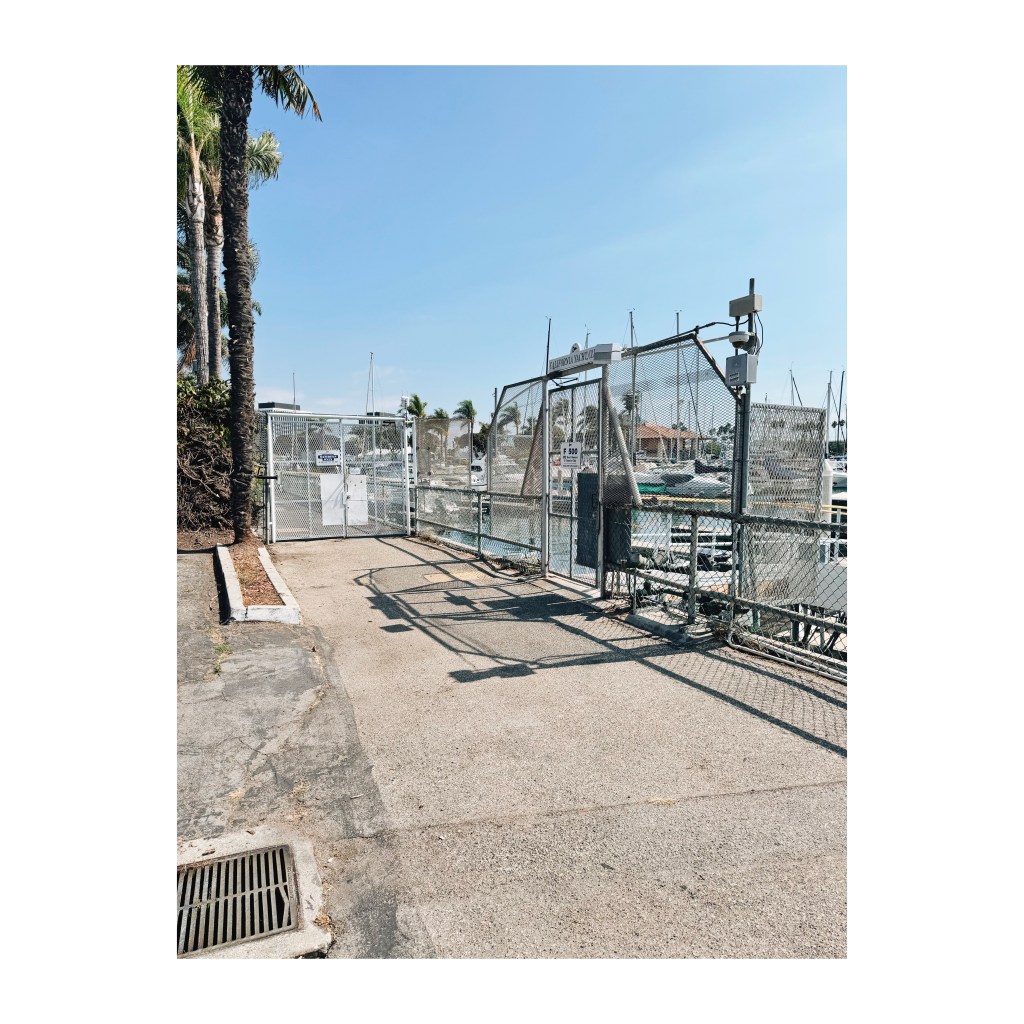
From its inception, Marina Del Rey feigned a public purpose while raking in the dollars fencing off the best parts for private use of yacht clubs and apartment dwellers. Docks are locked up and there are many barriers to prevent the use of the harbor for the general public unless you are there to purchase a dinner and drinks on a boat, bar or restaurant.

Over the years, there have been community projects to create usable public space, such as Yvonne B. Burke Park on the north side of Admiralty Way which has athletic equipment, bike roads and jogging paths. That park too has recently been incarcerated when Bay View Management built a cinder block wall that closed a public access point behind a Ralph’s store on Lincoln Boulevard. 

God forbid a pedestrian in a park might access a supermarket on foot.

Other luxury apartments, understandably fearful of crime, vagrancy and violence, have illegally built obstructions along their land to prevent the park from becoming a way to enter their properties.

Every few hundred feet, the green parks become parking lots. An athlete running, riding a bike or rolling skating will eventually stop at a busy road where vehicles speed by at 60 miles an hour. And other cars and trucks will be entering the parking lots or exiting, creating additional hazards for the non-driver.

The big, popular restaurants, anchored in seas of asphalt, offering seafood, steak, alcohol, valet parking, and private parties to corporate diners and red nosed, melanomatous men in Tommy Bahama, have all gone out of business. Café Del Rey and Tony Ps with their crumbling, dated, Brady Bunch style restaurants are empty. The cigarettes, cigars, Aramis and lounge singers gone with the wind.

The great pandemic meltdown which has stolen our lives, taken our movie theaters, pillaged our department stores, and defecated upon our civic dignity, has now obliterated the big dining establishments of Marina Del Rey.

These popular places, that seemed immune to time, forever serving enormous plates of grilled lobster, prime rib, baked potatoes, cheesecake, ice cream sundaes and voluminous cocktails are now dead. Silent as Hiroshima after the bomb, these outposts of high on the hog, intoxicated living were ailing, out of fashion, and are now exiled from our spartan, self-consciously healthy era.


For a pedestrian who is trying to stroll one mile of the harbor west from Bali Way to Palawan Way, with the boats in view along the south walkway, there are several private obstructions that make it impossible to complete the walk.

I speak from experience as my friend Danny and I did the walk today.

The California Yacht Club locks up the walkway with their own use of the property. 

One is forced to detour to Admiralty Way with the unused parking lots of the long-gone restaurants on one side, and the near-death experience of speeding cars on the other.

To reenter the harbor walkway, you find the Los Angeles County Fire Department Station #110 (4433 Admiralty Way) and walk behind the building to rejoin the path along the water to once again enjoy the public recreational qualities that are supposedly there for everyone to enjoy, not just yacht members.

The Marina City Club encompasses three early 1970s high rises which are entered securely by several guarded driveways on Admiralty Way. This complex has swimming pools, tennis courts, a convenience store, but is threatened by similar structural defects that brought down the Surfside, Florida condominium in 2021, killing 98 persons.

For now, residents who own property there pay high HOA fees, and even those who bought in cheaply face repairs that will surely cost collectively in the hundreds of millions of dollars to make these three, 55-year-old buildings safer in a location where tsunamis and earthquakes are always visiting unexpectedly.  

Concluding the walk today, we went north along a dirt path on the west side of the Oxford Basin “Wildlife Refuge” which connected to Washington Boulevard.

As we passed a vagrant man sprawled on wall, shopping cart and garbage nearby, my friend Danny shouted, “Get going, walk faster.”

Danny had spotted a handgun in the vagrant’s hand.  

Just another reminder, if any is needed, that nobody should assume that this is a safe area, regardless of how much homes sell for. The demoralizing and unsanitary aspects of Los Angeles are all around, because we live in perhaps the dirtiest metropolis in the United States, one that believes public trash camping is a civil right and mental illness is only a danger after it kills.

How this city will present during the 2028 Olympics is something Orwell would have pondered.

Sunday at the Marina


DSCF0269

Yesterday, I went down to photograph Darren, a friend in the Marina who just took a new apartment on Tahiti Way, one with water and boat views.

Sunday.

In the Marina.

I had been here many Sundays before.

When my Mom was alive, before cancer, still walking and living at 4337 Admiralty Way, I often pushed my visits to Sunday. I went down there, just as I did yesterday, and took her shopping, to get her car washed, into Target. We might stop at Ralph’s, pick up food, and I would broil pork chops, open a bottle of red wine, and watch “Mad Men” with her.

When it came time for me to leave, around 10, she would get up, stooped over, stand near the door and implore me to “please, please call me when you get home.”

And when I drove along the 90, up onto the 405, and passed those long stretches of green signs with fabled names; Washington, National, Santa Monica, Wilshire, Sunset; and descended, in speed or crawl, on that wide highway, back into the Valley, my goal was to always make it out of my car alive, without incident, to get back home and call up my mother and tell her I was home safe.


The winds were strong, the light was glittering, the cirrus clouds blew, the bent palms bowed.

Yesterday at 3, as I crossed Tahiti Way at Via Marina, I was back in melancholy, heavy-hearted, traversing the places I had spent the year last walking, pushing a wheelchair.

Three weeks before she died, I took her on a water taxi that navigated the man-made fingers of the harbor.

That day, her mouth hung open, oxygen starved. She was wrapped in blankets, her eyes were watery, she could hardly see.

The boat had turned up Basin B, along Tahiti Way.


This week is Thanksgiving, a day sacred and special, and the first where I have no mother or father.

I thought of that last night when I left the apartment on Tahiti Way and walked in the winds past places where flat screens and lights and laughter poured out of open sliding doors, a California night.

The Retraction From Life


Weaker, yet still alive, still able to speak, Louise M. Hurvitz was in her wheelchair, in the sunshine near the glistening Marina boats, when she told me she wanted to eat a steak.

That was on Monday, August 18th. She ate a hamburger that night, and a slice of pizza on Tuesday night. She was 8 months into her Stage 4 lung and bone cancer.

Nurse Linda said she was looking great.

Then on Wednesday she began to call for her sister “Millie”. She was up all night, and then asleep all day by morphine and Lorazepam. In periods of wakefulness, her glazed eyes no longer looked at me, but out into nothing.

She was no longer able to speak. I went every other day to see her, knowing she was entering death.

A blue booklet left by hospice, Gone From My Sight, explained how the bedridden dying walked out of life. We noted her symptoms mirrored in the book.

The late afternoon sun was bright in her bedroom on Friday, August 22nd. She screamed that her head hurt, her back hurt, everything hurt. She wanted me to shut all the drapes. I abided and put the room in darkness. Foreshadowing.

She was in her last days. Nurse Bertha said if she ate she would stay alive. And then on Friday, August 29th, Labor Day weekend, hospice came and said, “no more food or water”. She was given 72 hours.

All weekend were the pleasures of Los Angeles, the beach and the beer, the walks along Abbot Kinney, the barbecues, I partook of some haunted by an upcoming phone call.

And then on Sunday, August 31st at 11:30 PM we were called and told she was breathing irregularly. We got in the car and rushed down to the apartment. My brother and sister-in-law were at her bedside. A nurse helplessly held the nasal end of the oxygen tube against her open mouth.

She was gray faced.

She was gasping for breath.

I replaced the nasal oxygen with a whole nose/mouth mask. Nurse Linda arrived. The hospice nurse came. It was about 2am and we did not know how long she would live. Exhausted we left. And an hour later I was in bed when my brother called.

“I hate to tell you this but Mom has passed.”

All the fighting for her life, all the medications, the food, the physical therapy, the chemotherapy, the consultations with UCLA medical doctors, the cat scans and the other radiology, the organic smoothies packed with nutrients; all the equipment, the oxygen, the ointments; everything done to keep her alive and going. Done.

Her body was pronounced dead by a doctor. The cremation company came to the apartment to wrap up and remove her.


DSCF1114

We held a home service for her, almost a week later, on Saturday, September 5th.

Andreas Samson, my friend who writes Up in the Valley, attended and wrote a touching description of the bittersweet “party”.

There was food and drink, old photos on the flat screen television, a Spotify soundtrack of her beloved music (Frank Sinatra, the Fifth Dimension, Herb Alpert). Relatives who had never seen her sick, showed up to pay their respects.

And her life was presented selectively, with an emphasis on the young, beautiful, vivacious, pranking, intelligent, subversive sorority girl and network executive.

She, who died at 80, mothered a retarded boy, took care of an epileptic and ill husband, worried and fretted over children, finances, nightly meals, laundry and cleaning, her daily travails were wiped away or spoken of in one sentence salutes at our remembrance.

For 52 years, I had grown up and grown old with her. I knew her love and her craziness, her exasperating circular questions, her sparkling memory for names, faces, and events.

She, who drank vodka and grapefruit juice, and later switched to red wine, was probably an alcoholic. She was full of shame over events she had no power over, castigating and punishing herself.

But she fought hard to protect and to nurture, and daring to venture out of Lincolnwood, IL, moving to suburban NJ where she set up a new life with her family at 47, exploring Manhattan, New England and the East Coast with the curiosity and passion of a young woman starting out life.

2714559104_e8fd12d4a0_o

She sold airplanes with a male friend, a pilot and airplane broker who lead a life outside of norms, a man who was later convicted of stealing money from his customers. He flew Louise and our family, often, to Albany, Boston, Martha’s Vineyard, Manahawkin Airport, Miami, East Hampton, Nantucket, Block Island, all around the Eastern Seaboard. American life was seen from 8,000 feet, little houses and little lives across the vast expanse.

She went into the city to see plays with my father, to walk neighborhoods, to buy groceries at Fairway, see exhibitions at the Metropolitan, attend concerts and events at Lincoln Center.

She read the NY Times and Bergen Record voraciously, keeping herself informed on culture and politics. The papers piled up in wet and musty mountains stacked in the garage.

2650903946_43c1926371_o

She loved her new home in the woods, a place where the windows were always open and the rooms smelled of rain and leaves and florid humidity. In the spring, summer and early fall, the back deck, suspended on the second story of the house, was her outdoor space, a place of reading, eating, entertaining and midnight conversations by candlelight.


275609573_2d9e3f1b83_o

She lost my father after his long and agonizing brain disease, an illness that took 4 years to progress, rendering him an invalid.

But after he died, in her apartment in the Marina, she became a devoted grandmother and somehow earned the respect and awe of children who had once only seen sadness and burden in her exhausted eyes.

She was valiant onto the end; never giving into death, never acknowledging that life was less than the entirety. An iron dome of denial was her shield.

She was more than she ever admitted to being. She was magnificent in her life force, in her refusal to die, in her love for life.


Prayers and Pharmaceuticals.


What day was it on the calendar?

I did not know.

I only know I was speaking with my mother, pushing her along in the wheelchair along the Marina path. The sky was bright, the boats were anchored along the dock, she said she was hungry and wanted a steak.

It was last Monday, August 18th and Linda brought her a burger from In N’ Out. My mother said it was delicious.

The next night she asked for pizza.

The steroids that she had gone back on seemed to be making her hungrier, putting food for life back into the body of a woman in Stage 4 cancer.

Linda came and said mother is looking better. Vital signs were good. Blood pressure 102/59, pulse 62, temperature 98.6.


I was back on Thursday, August 21st.

Caregiver Bertha, a Guatemalan woman who is a fireball of energy and love, cooking up soups, cleaning windows, massaging oil into my mother, rolling her out of bed into the wheelchair, said my mother had been up all night screaming, “Help! Help! Help!”

I blamed the steroids. They were keeping her up.

My mother told me she was dying. She said this was it.

Bertha laughed and said “Miss Lou you are not dying. Your face has color. This is not death!”

My mother said that Anisha was in the other room. I said Anisha is gone. She said she saw her. She said it over and over again. We were conversing, but the conversation was repetition. I was speaking to her, as I had for the last half century, but the words were going into a mind going into death.

My mother said I was sick. I told her I was not. “Why are you sick?” she asked. She said something about a concussion.


On Friday, my sister-in-law Pri visited and spoke with my mother. Later I came over and found my mother asleep. When she awoke, her eyes were watery, and she asked for her sister Millie. “Millie, Millie, Millie, Millie, Millie…” And I dialed the phone, 90-year-old Millie in Chicago answered, and on speaker she spoke to my mother, “Lou I love you. You are my favorite sister.”

The nurse from Skirball came, cheery, on her last call of the day, before she went off work for the weekend. As she had, all along, the hospice nurse offered empathy and most of all, pharmaceuticals. She had no explanation for my mother’s descent into half-life. She wanted to make sure my mother was “comfortable” in her “transition”, the words as soft and false and phony and amorphous as the hospice treatment, a kind of strange medicine offering prayers from amateur rabbis, talk therapy from retired therapists, and weekly visits from drug dispensing nurses pouring morphine and Lorazepam into the mouths of the dying.

My mother asked me to close the drapes in the room. She said the light was blinding her. She said her head hurt. She said she ached all over. I pulled the drapes shut, and we sat in the dark, which felt ominous, a portent of death, shutting out light.


On Saturday, August 23rd, I went down to the apartment to welcome a new caregiver, Marta, who would be there in the last days of my mother’s life. Bertha stayed, until 3 O’Clock, training the new woman.

A blonde, middle-aged female rabbi came to the apartment, ludicrously dressed, to my eyes, in a doily lace yarmulke, offering exuberant compliments about the 8th floor view. She sat down next to my mother and asked if she was ready to go. She said it was Ok to go. My mother was now dead to spirit, but alive, incoherent, the silly, improvised, bedside portable Judaism lite blew over her like the breeze.

The rabbi left, her utterances to the all-mighty were no match for the wonders and miracles of morphine. True peace and acceptance were swallowed every four hours.

“I give your mother La Morfina. She sleep well,” Bertha said.

 La Morfina.

The patron saint of cancer.


And I returned on Sunday, August 24, 2014 to her apartment. The front door was open and a wind blew through the living room, rustling the newspapers and sucking the drapes into the open sliding doors.

Danny and I sat next to her, one on each side of her bed.

“Do you know who I am?” Danny asked.

“Danny,” she said.

“Good!” he said.

She said my name and then fell back into her world. And whatever she said next had no meaning. They were only words, coming out, weakly.

“Clicker, clicker, clicker…” referring to the TV remote.


Denial.


“She was screaming at night about her arm, her chest, her leg,” Anisha, a caregiver, said.

“She hardly slept.”

Anisha was speaking about my mother,now in Stage 4 cancer, confined to a bed for the last eight months.

Later on, when I went into her room, my mother said she had slept well the night before. “There is nothing wrong with me,” she said.

She was breathing on oxygen, then she told us to take it off. She has refused most pain medication, reluctantly asking only for sleeping pills.


I took her out on Sunday, in her wheelchair, and we ventured along the Marina. By chance, we happened to come to a dock where a water taxi was taking passengers. I wheeled her down and we rode around the harbor for a dollar.

A hospice nurse visited on Sunday night and found nothing “wrong”, only anxiety.

On Monday, another nurse came and told me later my mother’s feet were showing signs of “mottling” an impending indicator of death.


On Tuesday, I was back down at her apartment. A social worker was talking to my mother. Anisha told me that my mother had not slept the night before, and had talked of her future fear and past regret. “You should give her some hope for the afterlife,” Anisha said to me, an atheist.

When the social worker left, I went back into the bedroom. My mother was combative, annoyed. “You and your brother are driving me crazy with this system! How would you like to be under a microscope?”

I asked her if she had slept well. She said of course. She slept fine.

Again we went out to roam around the Marina. It got windy and she asked to go back inside. “I want a steak,” she said. She had not eaten more than liquids for at least a week. I corrected her and said she meant hamburger.

And then after I left the apartment, after I had two glasses of wine at a bar, I walked around Venice, shooting pictures along the canals, and then wandered back to my car.

DSCF1033 DSCF1028 DSCF1018 DSCF1016

The phone rang as I drove east on Washington. It was Anisha. She wanted to assure me that my mother had slept well last night. When she had called out, it was only in a dream.

“I told him,” Anisha said to my mother before she hung up the phone.

The Whirlpool.


Cancer, homecare, medicines, hospice, chemo, wheelchair, bone cancer, lung cancer, cough syrup, Oxycontin, Oxycodone, Remeron, Sinemet, Morphine, adult diapers, sponge baths, bowel movements, stool softeners, rehab, oncologist, nurse, radiation, constipation, oxygen, Stage Four, terminal, incurable, cremation.

For seven months I’ve swum in a whirlpool of ugly words.

Yesterday, again, I went down to see my mom at her apartment. One homecare worker was leaving, another arriving. I came in with four bags of groceries and went back to the bedroom.

She was in bed.

The TV was on. I think it was “The View”.

I sat down on the carpet in front of her bed, the only way she can see me, straight ahead.

Bertha came in with matzo ball soup. I ate two bowls. She fed my mom a few bites.

In the afternoon, I took my mom for a “walk” in her wheelchair.

I picked her up, limp and frail, and moved her from the horizontal position on the bed into her chair. Seated now, I put the pedals on, guiding her weak legs and purple feet into position over the pads.

I squeezed a pillow behind her curved back, and pulled her arms up into a zippered sweatshirt. I draped and folded a blue terry cloth blanket across her lap. Sunglasses went over her eyes, a hoodie atop her head.

I pushed the steel chair and the woman in it out of the bedroom, past the front door of the apartment, into the elevator riding down, through the dark parking garage. And out into the brilliant sun, out into the fresh and salty wind.

IMG_3614

A key opened the locked steel gate along the long dock where cruisers, sailboats and yachts were docked. Between the boats and the buildings, that’s where we went.

The hi-rise, swinging sixties apartments along the Marina, with their curved balconies, they were made for tanned stewardesses, white shirted pilots, Irish-American boat captains, cocktails on the sea, cigarettes and sex, lovemaking and laughter.

Architects and developers back then, like now, were drunk on youth, novelty and modernity.

Nobody was supposed to get old. Nobody was meant to come here disabled, wrapped in blankets, pushed along the harbor watching other people have fun. Wheels were the Red’68 Bonneville Convertible- not the walker and the wheelchair.

We walked past Killer Shrimp and crossed the asphalt to the other side where they were renting paddleboats and paddle boards. I pushed my mother to the end of a dock inside the lakelike Mother’s Beach.

DBRnR67M4qugf8lhvfmqhSLUo1_500.png

On the dock, my mother in her chair, me pushing her almost to the edge, a sinister thought entered my mind.

I thought of Technicolor Gene Tierney in “Leave Her to Heaven”(1944) where she let a crippled boy, her husband’s brother, drown in a cold lake.

If I had the evil gene of Gene I might act on hard and cruel impulse and push mom into the water, an act of mercy perhaps, saving her from the eventuality of dying in bed from fluid in her lungs or some other unforeseen killer.

Instead, I pulled back and fastened her brakes. I took out my phone and photographed my living mother motionless on the ocean dock.


IMG_3616


Hours later I was at the Whole Foods bar with Travis, drinking a Scotch Ale, listening to a ravishing real estate agent, talk about her teen son’s abusing father, and her fight to cure her child.

Pretty, like the actress Susan Lucci, she grew up in Venice and talked as if she had sold many millions of dollars of houses in the new rich bohemia.

My buddy, much younger, broader-shouldered, deeper-voiced and all man, listened to her as she massaged him with her eyes.

She showed us pin-up shots of her on the Samsung screen, sexy images that made me ask, intoxicated as I was, what exactly she was selling.

Around us in Whole Foods, was the whirlpool of beauty and freaks that swirls in the aisles among the organic fruits and vegetables: tall women, muscular men, old women in running shorts; beards, tattoos and pegged pants, rolled cuffs, razor cuts, canvas bags, kale and 90% cocoa chocolate bars.

Travis and the real estate agent left, going their separate ways, but I stayed longer, waiting for the beer to wear off. I amused myself by photographing the green-eyed young clerk Joey.

Processed with VSCOcam with a2 preset

I am not an alcoholic, but I now can see, with ease, the attraction of numbing pain, blocking sadness, loosening tension. I will willingly submit to its temporal benefits and consoling pleasures.

As I did last night for a few hours after dusk.


One day soon, I will come down here to Venice and Marina Del Ray.

And my mother will be gone.

And I will think of these months, the ones that came about in 2014, where sickness and impending death arrived without warning.

And I will remember the endless summer of insipid profundity, the strange and incongruous times of illness and fun, the months on watch seeing her decline in Marina Del Rey.

Who dares to die in a place where pleasure pushes along unimpeded on bike, in swimming pools, on jogging paths, on tennis courts, at volleyball games?