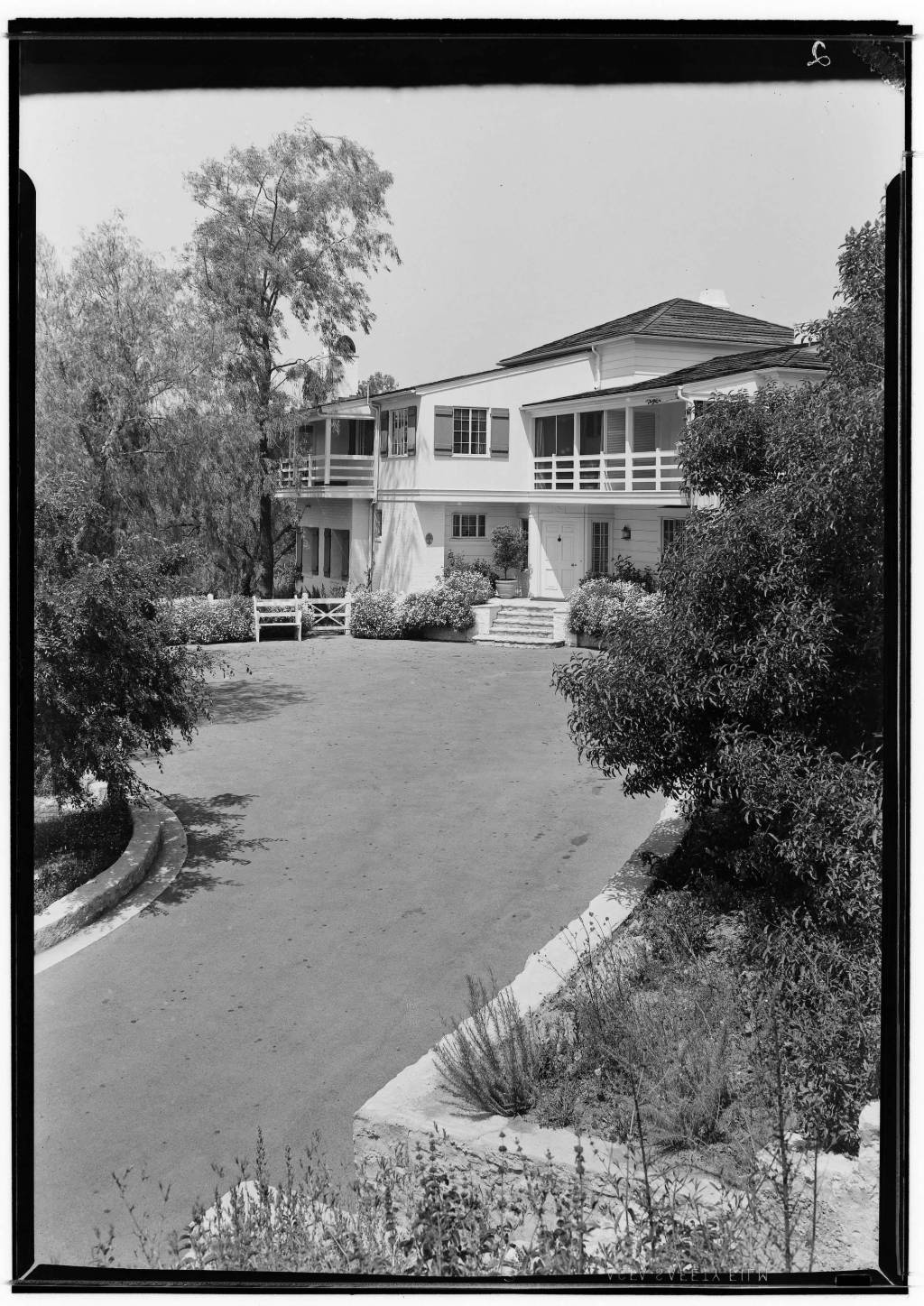
Myrna Loy and Arthur Hornblow, Jr.’s “Lime Orchard” Home 1938


The Criterion Channel is showcasing the actress Myrna Loy (1905-1993) in its August line-up.

One of the most popular and lauded performers of the 1930s and 40s, Ms. Loy was famous as the co-star of “The Thin Man” films with William Powell, characters who solved crimes in the well-dressed and liquored penthouses of Manhattan.


She was adept at underplaying comedy, always alluding to something funnier and sexier without drowning in it. Her personality was built upon allusion and intelligence. Along with “The King” Clark Gable, she was voted “The Queen of Hollywood” in the late 1930s.

Married and divorced four times, she never had any children.

But in 1938, as these astonishing photographs (by Maynard Parker) show, she was married to Mr. Arthur Hornblow, Jr. and they lived on a spectacular estate in Beverly Hills, CA with vast lime orchards, tennis court, swimming pool and a rustic, but refined, California country estate with wood siding, shaded porches and many flowers, trees, and vistas of the undeveloped mountains.

Everything about this property sparkles with the graciousness and rarified perfection of well-tended Southern California affluence. They swam, they played tennis, they drank cocktails in the wood paneled library. They might have flown with Howard Hughes to Catalina Island or gone fishing on a boat that docked in Baja California. They danced, they played music, they acted in movies, and their lives, off set and on, were theatrical, and moved, often intoxicated, with emotion, and grace.

In these photos are two opposing qualities that complement each other: restraint and opulence. This large house is well-proportioned, charming, whimsical and cozy. 

Nobody lives like this now. Nobody, even the richest, has a library of books. Nobody has servants working in the house or gardeners tending to acres of lime trees. Nobody opens their windows to ventilate their rooms. All of it, phony or real, has been torn down, and today we can only go online and drool. 

Photos are from The Huntington Library.

Architectural Digest 10, no. 1, 1938, 43–49.  Martha B. Darbyshire, “‘Lime Orchard’: The California Estate of Mr. and Mrs. Arthur Hornblow, Jr.,” Country Life & The Sportsman 75, March 1939, 45–47.  Better Homes and Gardens, September 1940, 29.

Royal Oaks, 1950


1 30 49.jpg

Browsing through the archives of the Huntington Library, I came across a set of photographs by Maynard Parker. They depict the inside and outside of a new home, one of 119 in a 100-acre development called Royal Oaks, south of Sepulveda, near Ventura, in 1950.

Back then there was no 405, no 101.

Sepulveda Blvd. was a two-lane road whose serpentine forms slithered through the Santa Monica Mountains, an undeveloped area of oaks, grasses, hills and clear skies. A 1939 view from Magnolia looking south shows its verdant ruralness.


View_of_Sepulveda_Boulevard_looking_south_from_Magnolia_Boulevard_before_improvement_November_21_1939
1939/ USC Digital Library


The 1000-acre estate of General Sherman was subdivided into various tracts, and given a pretentious name: Royal. There would be Royal Oaks and Royal Woods and Sherman Woods. These luxury homes in California Ranch, Early American, English Tudor and other styles would nestle in the low foothills of Sherman Oaks and usher in a new chapter of suburban life for the socially upward class of settlers.

The first subdivision, Royal Oaks in Sherman Woods, was a $1,100,000 investment in land and construction cost. 100 acres and 119 sites were priced between $6500-$9500 each and “fully improved with paved streets, sewer and water systems, underground wiring and ornamental street lighting.”

A December 4, 1949 LAT advertisement assured that the “smog-free” estate community was carefully restricted and protected against harmful encroachments.

12 4 49 LAT.jpg

Ironically, this same community today lives amidst the biggest encroachment of all time: the concrete, noise, fumes and traffic of the 405 and a furiously angry pack of speeding, distracted women in SUVs whose disregard for life and law afflicts and curses the roads 24/7.


Let us exit 2016, and return to the peace and quiet of 1950: less cars, no freeways, and dappled sunlight peaking through the marine layer……

The house in the photos, a model home, is, even by today’s standards, a substantial and beautiful place. There are large oak trees and a gently sloping lawn caressing a copiously large and expansive house of strong and graceful lines.

Un-ornamented and quietly self-assured, the architecture is ahistorical and gracious. A three-car garage, casement windows, large overhanging roof and a newly paved street proclaim affluence without ostentatiousness.

Page-01

Inside, there is a dining room wallpapered in faux stone and a modern ceiling fixture -not a chandelier- hanging over a light wood table with low backed chairs. Even in 1950, California design was advanced. Who, in West Hollywood today, would not kill for this room?

Page-01 copy

In the living room, there is a large, abstractly printed, sectional, rattan leg sofa. It sits against a wall of sheer drapes and floor-to-ceiling windows. An Oriental coffee table, low-armed chairs, dark shaded lamps, and a wood paneled ceiling effortlessly meld the West Coast with the Far East.

Cigarette anyone?

Page-01 copy 2

The kitchen is charmless but functional, all in white metal, illuminated by flush ceiling fixtures, and equipped with double ovens, work stations, and a sit-down, countertop desk with an upholstered chair and a dial telephone.

Try these peanut butter and celery canapés. They’re marvelous.

Kitchen.jpg

There is an indoor/outdoor casual room, probably the only type of room we don’t make anymore, paved in brick; furnished in metal, washable chairs, and served by an open brick passage where food and drinks might be passed from kitchen maid to seated guests. A hanging starlight fixture and a large, potted metal tree reference nature and the outdoors.

Back when we were on Leyte Island killing Japs we never thought we’d be sitting here a few years later drinking Mai-Tai’s!

Page-01 copy 4

 A guest room has shag carpeting, pleated drapes and sliding glass doors. There is wall-to-wall carpeting. And twin day beds with an L-shaped coffee table topped with a ceramic dove and a bowl of wax fruit, a writing desk with drawers and a decorative lamp. Here, visiting niece Helen or Uncle Homer or the Haynes Sisters stayed for weeks on end after arriving at Union Station from Chicago or Kansas City or Grand Island.

If you need anything from the linen closet ask Beulah and she’ll get it for you.

Maynard Parker


The presentation of an ideal lifestyle, the yearning for comfort and luxury, the conception and presentation of a story, these are those elements of fantasy wrought into reality and sold to us by imaginative and innovative builders, architects, designers, decorators, marketers and public relations professionals.

These are the images on the surface of Maynard Parker’s black and white photographs.

The untold story, left out of these gorgeous photos from 66-years-ago, is the enslavement of work, the onerous debt, the ecological destruction and the wanton wasting of the Golden State’s open spaces, all sacrificed under the altar of material house dreams. When we have it all how do we know when we have it all?

We still want to live here. We are just lost getting here.


405.jpg


Link

4419 Fulton Terrace


Huntington Archives

Image

Image

Image

I have often passed this apartment at 4419 Fulton, north of Moorpark, and noticed its unique and graphic address sign.  While searching through the archives of photographer Maynard Parker (1900-1976) housed at the Huntington, I came across photos he made in 1963.

Masculine and modern, the squat and flattened lettering, ingeniously aligned with the low slung horizontality of the building, is as much architecture as the architecture itself.   Almost cartoonish and leading into pop-art, it leaves behind the decorative scrolling that marked 1950s apartments whose builders slapped their daughter’s names on building fronts (“Debby Ann”, “Stacy Lynn”) or borrowed from faraway places (Tahiti, Hawaii or Fiji).  The indoor entrance, private and serene, concrete slabs floating across water, marries Japan to Southern California.

If this building is not on a historic preservation list- it should be.

Title:Fulton Terrace Apartments. Exterior. Los Angeles, CA

Architects: Burlew and Liszt.

Creator/Contributor:

Parker, Maynard L., 1901-1976.

1963 May

Contributing Institution:Huntington Library, Photo Archive