Rebuilding Photos from Pacific Palisades.


After the catastrophic fires in January 2025 that burned down over 6,500 structures in Pacific Palisades (and over 9,400 in the Eaton Fire), I restrained my photographic urges and did not run to shoot images of someone else’s loss.

Today, I reasoned that photographing the ongoing rebuilding in the Palisades was not immoral or exploitative, only documentary.

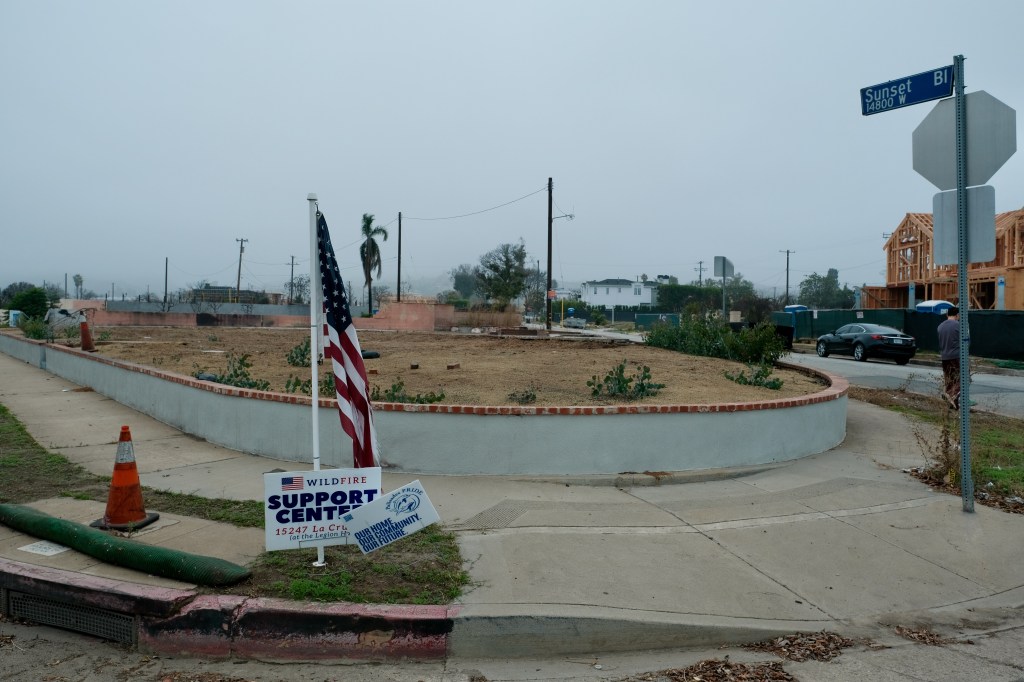
It was a cool, foggy Sunday morning with almost no traffic along the 700 Block of North Hartzell St, just off Sunset. I could stand in the middle of the road without fear.

Around me was a vast emptiness of empty lots, but with quite a few houses under construction, not only on Hartzell, but on nearby streets like Drummond, Carey, and Calloway. You could see through to many streets beyond the one you were standing on, looking at lumber boards on joists hundreds of yards away, just as if you had gone back 100 years to the very birth of Pacific Palisades.

Though there were no people, only a few construction workers hammering and drilling, the presence of the law was everywhere. There were signs against trespassing, US Army Corps of Engineers “California Wildfires Response Debris Removal Support,” NOT FOR SALE, PROTECT THE PALISADES, “This Home Will Rise Again,” #palistrong, Palisades Patrol. I felt the security presence of cameras, cops and Mr. Rick Caruso.

Everywhere there were signs for construction companies, architects, interior designers, garden designers, and realtors. Everyone with a skill to sell had a sign to show.

American flags were planted in soil like a Veteran’s Day cemetery. United in mourning, resolved in moving forward, the spirit of the Palisades shined. Or perhaps it was the spirit baptized in buckets of insurance money.

On all the blocks I walked today the metal street signs on posts survived. No burn marks, no damage, nothing but white letters on dark blue metal.  

How could the fires incinerate automobiles, trucks, refrigerators, washing machines, and hot water heaters? But somehow leave the proper names of the avenues, drives and roads intact? It is one of God’s strangest mysteries, perhaps she knows better than us the value of these named lots.

Further west on Bollinger Drive were some burned up vehicles with a big white house across the street. Every other house was consumed, and the lots everywhere were cleared, save for some with front door steps leading up to the sky; empty driveways, brick chimneys in fields, and sediment logs along the edges of lots to trap debris before it clogged drainage systems.

Walking in districts obliterated by now extinguished flames is a ghostly privilege of survivors. The living can never know the whole truth of what this was before. I hope I was respectful to those who lost everything. I am in no position to know their pain.

And now that the new houses are coming up, who knows what they will endure in the coming years, and even if the American nation and government that they are born into will endure and survive an epoch which seems more horrific each passing day.

Rebuilding for Sustainable Reasons


The fire ravaged hills of Pacific Palisades and Altadena not only cry out for rebuilding. But cry to rebuild in a better way.

Especially in Pacific Palisades, the only way back (as imagined by those in power) is to rebuild the gargantuan single family home. How these can be afforded, let alone insured, is the new mystery of 2025, for very few will want to spend the next decade constructing McMansions that may burn down in the next fire.

Insurers are fleeing California, as the pool of “safe” properties dwindles, and the rates they can charge are understandably limited. A low cost insurance would not even replace a burned down tool shed.

And then there are the philosophical and political battles raging from those who only want luxury housing to those who believe it is a moral imperative to provide a percentage of “affordable” housing to Angelenos.

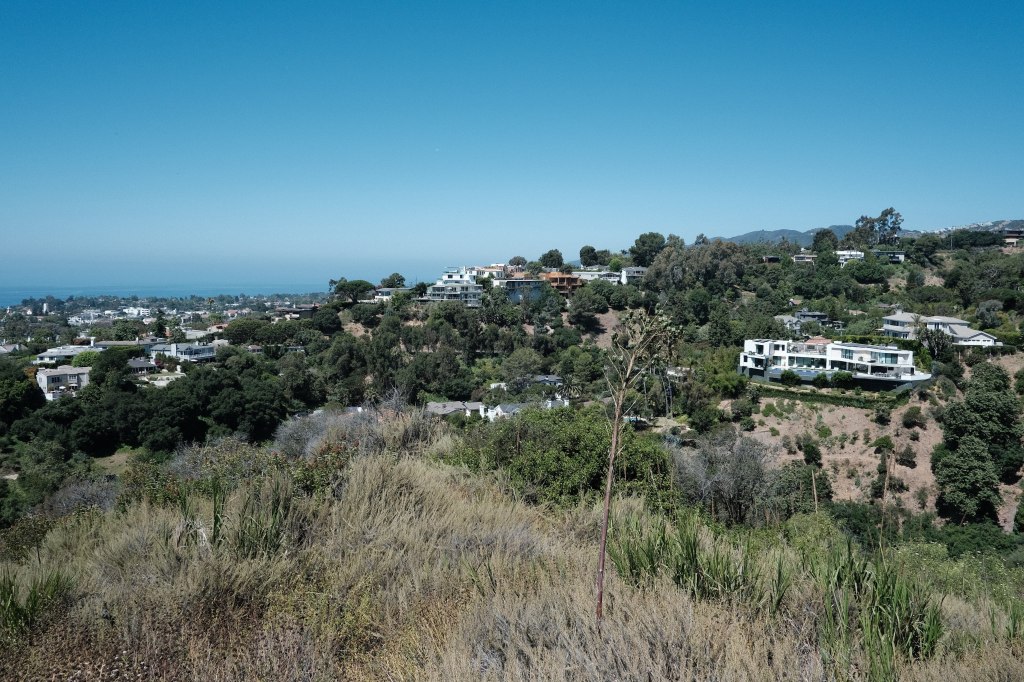
Somewhere in the middle is the moderate case to be made for developments that mix commercial and residential in the same walkable community. For here, there may be defensible lines for firefighters to use to battle the next conflagration. Up in the hills, next to the wild lands, is where the greatest danger lies.

The safer alternative is a denser community of pleasant surroundings with apartments and homes near stores, and walkable streets with cafes, restaurants, hardware, shoe repair and bookstores. Yes, we have to make room for Lululemon, Alo and skin clinics, but they should not occupy the entirety of every single commercial space.

There should be a plan for rebuilding in an architecturally coherent way, one that actually puts living residential spaces above the stores along the sidewalk, rather than fake windows as one sees in The Grove and Disneyland.

And if a plan is selected, it should be in styles that evoke what made old California beautiful.

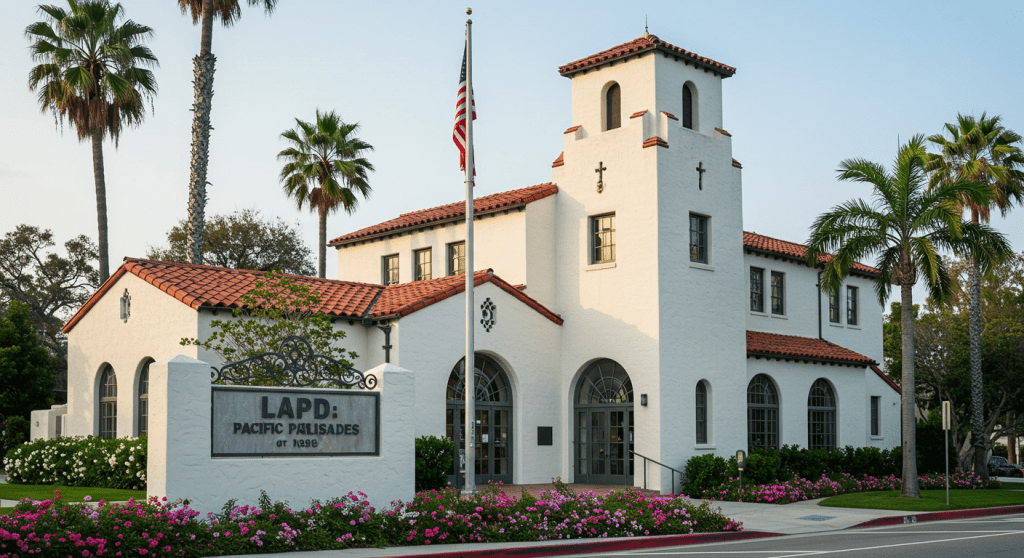
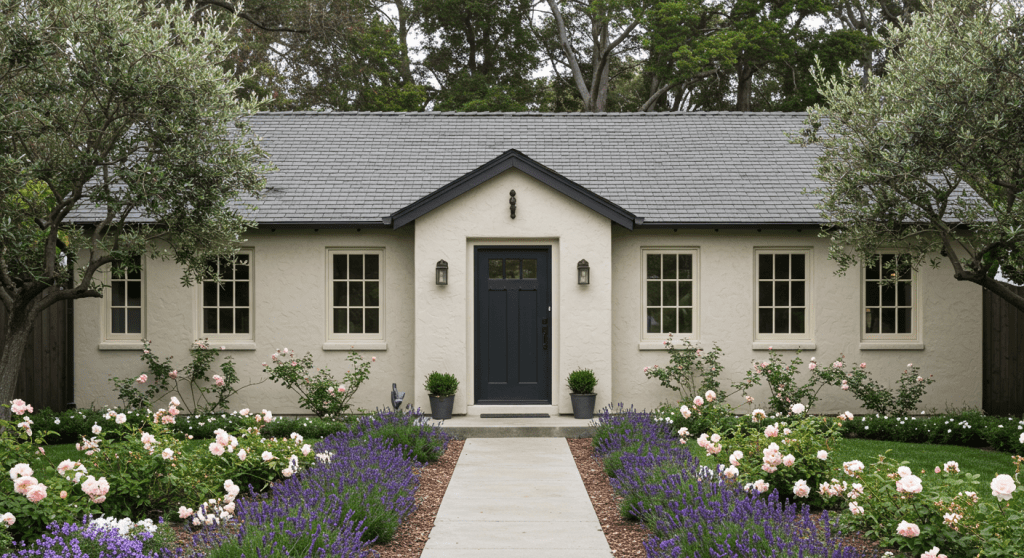
What follows are imagined architectural designs for rebuilt fire zones in Pacific Palisades and Altadena.

The Old Way of Seeing.


It’s not likely that we will live to see Pacific Palisades or Altadena constructed in a way that evokes the traditional styles that were wiped out in January’s fires.

There is first the economics of the disaster. Many people will never have enough money to rebuild their homes. Some bought them many years ago, some inherited them. They had lower property taxes whose rates are based on what the original purchase price was.

For some, it was affordable to live in a paid-off home with grandfathered low taxes, next to the Pacific. That accident of time and fortune is gone forever.

The crisis in insuring homes, the cost of materials, the fragility of the economy, the flight of good paying jobs in entertainment, all of it has added up to a disaster that will be hard to climb out of.

There is also the problem of zoning. Where multi-family houses could be built, the powerful will step in (especially in Pacific Palisades) to mandate that every home be single family. And that will invite everyone to construct the ugly, laboratory like boxes that have proliferated on small lots around Southern California in the last 15 years. White, with black windows, unused balconies for joyous parties that never transpire. And security fencing, SUVs and artificial turf.

In Altadena, the destruction is tragic for other reasons. This was a neighborhood amenable to Black residents, and a place where multi-generational households built up wealth and security which was often difficult to obtain when your parents and grandparents were restricted from owning homes in other locations.

The integration of Altadena, the artistry of the homes, the beauty of the setting in the mountains, with many trees, old gardens, and the viability of churches, schools, and craftspeople with unique creations, was stamped upon this town.

Driving yesterday afternoon in 98 degree heat, through the dusty, hot, burned out districts of Altadena, we saw the vast ruins, but also the armies of trucks and workers hauling away the debris, towing away stacks of burned up vehicles, and the neat signs from the government on newly bulldozed and graded empty lots pronouncing them “clean.”

Architecturally, what will Altadena look like in the next ten or twenty years? Will there be a plan to rebuild in a harmonious and humane way, the method that Santa Barbara used after the 1925 earthquake?

“Before the earthquake, a considerable part of the center was built in the Moorish Revival style. After the earthquake, the decision was made to rebuild it in the Spanish Colonial Revival style. This effort was undertaken by the Santa Barbara Community Arts Association, which was founded in the beginning of the 1920s and viewed the earthquake as the opportunity to rebuild the city center in the unified architectural style.”-Wikipedia

Who will protect the Black history and the Black future of Altadena, an ingredient of the larger program of reconstruction that must proceed without killing off that which made Altadena a shining exception?


I’m fairly certain that Pacific Palisades will rebuild faster than Altadena. There is always governmental assistance for the most privileged.

The atrocity of public vagrancy, however, will continue to be pervasive under the current mayoral regime. Here passivity and resignation in the midst of homelessness is considered a virtue in the progressive wing of the Democratic Party.

Mayor Karen Bass has allowed, like her predecessor, the proliferation of trash camping, and is now looking forward, obscenely, to the 2028 Olympics which will place the gruesomeness of Los Angeles in a Potemkin village face lift. She never misses a photo opportunity to speak in her melodious, soothing, sweet, dulcet tones, imploring patience, incrementalism and understanding as 1 building permit a month is approved and 5,900 are in limbo.

Mayor Bass, Billionaire Rick Caruso, Hairdresser Gavin Newsom, are all eager to showcase the vast wealth, power, glamour and celebrity of the city to aid in the reconstruction of the western district of LA. Newsom even stepped up today to actually use the law to remove the trash camps around California. After billions of dollars, the patience of the governor has worn thin, and he has decided it is not a good image for the state to host burning trash fires along the freeways.


But what will the end results of the new post-fire houses look like? Will we once again have to endure architectural experimentation in the cheap, novel, grotesque, ostentatious style that pervades every corner of the region? Will the crumpled up, aluminum foil design of Gehry be our model for the city of the future? Perhaps not, as architects are often not even present in the construction of new houses. Only the general contractor in his pickup truck with his aesthetic refinements.

Will the oppressive sterility of the white box triumph? Or can we have the kind of California dream Will Rogers built? Can we have a piece of gentleness and civilized loveliness please? Or does everything that is built have to be the choice of the sports stadiums, the shopping center developer, the studio honchos? If that is the only way forward, then California is dead; spiritually, culturally, ethically, and economically.

Will Rogers State Park, July 2024. Destroyed January 7, 2025.


Perhaps the old way of seeing, the classical way of designing, the architecture of pre-modernist California, could help heal the disfigurement of the Golden State.

Imagine if you found these types of houses in the rebuilt lots of the fire zones? Could you fall in love with California all over again?

Before the Luck Ran Out.


The first job I had in Los Angeles was working at Barley Corn Entertainment, a small documentary production company in Valley Village.

It was the summer of 1994. OJ had just not killed his ex-wife and the young waiter who was returning her sunglasses. I was living in Studio City for $400 a month, and the new job as a PA paid $450 a week.

The woman who hired me, Lisa, was in her mid 30s, married to one of the owners, Sean. She was green eyed, tall, broad shouldered and drove a dark green Range Rover from her home in Pacific Palisades.

She brought along a little white Pomeranian dog to the office every day, a novelty to me, being from the Middle West and the East Coast where dogs were large and stayed at home.

Lisa was a line producer, a job she mastered in daily calm, always even tempered, even when she got cross. She commanded runs and released funds, met with producers, writers, editors, and researchers, and still had time to walk across the street to Gelsons for a cup of coffee and a large spinach salad. Her day ended at 5 or 6, and she would go down to the parking garage and drive an hour back to her enchanted life on Enchanted Way in Pacific Palisades.

There was a Christmas party at their home in 1994. I arrived at the 1960s ranch house, built on a terraced lot, like every other house, little plots of splendor overlooking the Pacific, lots along a hilly street stacked and placed like many dinner plates on the arms of a hash house waitress. 

We were all young and in awe at the $600,000 home with sliding glass windows that opened to a small patio that overlooked the mist and the ocean. 

I drank a lot, and Lisa forbade me to drive home.

I went to bed on the white sectional in the living room, and awoke under a baby blue cashmere throw with a headache. Lisa made coffee, and then Sean invited me to leave “when it was convenient.”

Lisa and Sean, Sean and Lisa, Pacific Palisades. Range Rovers, small dogs, lovely houses that always sat in the temperature range of 58-68 degrees. 


My co-worker, Julie, was the daughter of two negligent Marin County hippies and had gone to live with her maiden aunt in Santa Monica during high school. She adored Lisa and Sean and hoped that one day she too would live in Pacific Palisades, perhaps leveraging her BA from UCLA and weekly production check to buy a house on Enchanted Way.

A few years later Julie met Aaron, a wealthy man who lived on Lachman Lane in the Palisades. She moved into his house, and they made plans to marry. I went to their house, sat by the pool, and talked with Julie about a reality show idea we never produced.

Aaron wanted Julie to sign a prenuptial agreement before marriage. Julie asked her friends what they thought, and the consensus was “he doesn’t really love you.” They broke up and Aaron married someone else, a compliant wife who signed an agreement, and they may have lived happily ever after.

Julie met a hard drinking Missouri man on a production shoot in Wisconsin, married him, had a baby girl, moved to Kansas City, got divorced after a year, and spent the next 15 years in Missouri pining for the lifestyle she lost. She and her teen daughter moved back to the aunt’s condo in Santa Monica last year.


Kevin, circa 1995, was a producer at Barley Corn, a year older than me, married to Cori, and they lived in a house in Pacific Palisades. 

He looked like a young Dick Nixon, was kind of a dick swinger at times, bragging about his $400,000 house bought with the wife’s parental endowment. 

I hadn’t seen him in 28 years, but there was a reunion of Barley Corn folks last summer. I asked him about his house, his $400,000 house. 

“It ain’t $400,000 anymore! We sold it and bought a much larger place near the village in Pacific Palisades!”


In the 1990s I also took a comedy writing class at the home of Bill Idelson on Brooktree Lane in Rustic Canyon.

It was a mid 1950s wood house in a redwood grove next to a creek. It was designed by Mario Corbett and photographed by Julius Shulman. (his photo below).

Idelson, an actor, also had a successful career penning sitcoms, and he had a formula, much of which I forgot, except for his drawing of a man and a moon. “How he gets to the moon is your story!” he said.

We would sit on the patio next to the creek, and with the sounds of water and nature, get instructed.

Idelson had a grown son, a handsome, athletic blond guy who said he would ride the creek during rains in his raft straight down to the ocean.

That was Pacific Palisades: the successful sitcom, the gorgeous house, the beautiful surroundings, the happy-go-lucky son who rode the rain water for fun.


Pacific Palisades does things to people who live there and people who don’t.

For those of us who only live there vicariously, it is sprinkled with celebrities, hiking trails, valet parking, croissants, gourmet coffees and cheeses, blond boys in collared shirts, hot yoga, scented candles, soccer matches, Will Rogers, polo ponies, Eucalyptus trees, gardeners and caterers, brand new big white houses with black windows and electric steel gates, and smooth faced women in sunglasses driving large SUVs 60 miles an hour down Sunset on their way to Lululemon. There is never smog, heat, homelessness or obesity. The maids commute two hours to clean 10,000 square foot houses that are empty because their owners live in New York City. 

It was, until a few days ago, something you venerated and worshipped, like Harvard University (before October 7, 2023), Berkshire Hathaway, or inheriting ten acres of land atop Mulholland. If only you had that Ivy League degree, or ten $677,000 Berkshire Hathaway shares, or lived on El Medio Avenue so you could walk to the Temescal Canyon Trailhead. You might someday hit it big, marry that blonde girl, date the personal trainer stepson of that HBO celebrity with a lot of fame and money, sell that show, invent that software sold for millions to Meta, or become a partner of that law firm in Century City, if only you had one of these or that you could be the happiest person on Earth and live in Pacific Palisades.


Since I moved to LA in 1994, there was always a sense to me that people migrated to places rather than improve the ones they lived in. They sometimes did this by changing names, from North Hollywood to Valley Village, or Valley Glen; or converting West Van Nuys into Lake Balboa.

To this day, Los Angeles, for miles and miles, is neglected, filthy, violent. It has no nice parks, hardly any real neighborhoods to walk around. It costs a fortune to live here, to rent or buy is oppressive. People sleep in tents, or on bus benches, they rob stores, and start fires because they are so lost and miserable. 

Seemingly not so in Pacific Palisades. Charming, safe, family friendly, delightful. Nothing catastrophic or out of control. The powers that be lived here and kept it well-tuned and well-functioning. Until January 7, 2025.

Once in a generation weather. Except it happens around the globe every week in different horror scenes. One month it’s Lahaina, the next month it’s Greece, Spain, Western Canada.

But Pacific Palisades? Our Pacific Palisades? Where we go for hikes, where my nephew goes to school, where my gentle, wine sipping bosses lived, where I brought my parents to Rustic Canyon so they could see “the real California?”

We kid ourselves thinking our good luck is our own doing, that we may escape losing our health or our home. We really do live by the whims of fate.

There is one migration that seems innocent, but it is, in a sense malignant, many people of means seeking to escape the bad air hellhole of greater Los Angeles, and it leads to Sunset at PCH where there is no more land, paradise promised at the end of the continent.

Now it is temporarily destroyed. 

Thank God for those who have survived. Life matters most.

We have seen these fierce wind driven fires and their atomic destruction. 

How one small spark can end one era and perhaps usher in another one that may be more humane and sustainable. 

Drinking from the Spring at Chautauqua.


“Chautauqua is an Iroquois word, meaning either “two moccasins tied together”, “bag tied at the middle”, “where the fish are taken out” or “jumping fish.”-Wikipedia

Over the weekend, I visited and photographed the 1950 Case Study No. 9/ Entenza House, designed by Charles Eames & Eero Saarinen in Pacific Palisades.

There was a time, just after the Second World War, when the USA borrowed from its just vanquished enemies, the German concept of machine-made modernism and Japanese living within nature, and built model homes in California that pointed to a new future for American domestic living.

Yesterday, I drove down a eucalyptus-lined road, passing meadows and grassy fields overlooking the Pacific. Here is where the elite once lived self-effacingly and modestly, making do with one or two bathrooms, and narrow steel kitchens.

No.9 is now behind a tall white wall and electronic gate, having been absorbed and subsumed by a larger house of 10,000 square feet that recently sold for $10 Million.

No.9’s former front garden: a natural forest of trees and overgrown grasses; is now a flat lawn and carved into long right angles of walls, sunken pool, statues and a boxy white mansion that commands a view of the Pacific and Catalina Island in the distance.  Enormous and egregious, the muscular mansion and its grid garden are welded onto the delicate old modernist house like a bad face lift.

Though it no longer is the sole structure on its property, No. 9 retains its original architecture and much of its furniture.  Which is good, because its survival is critical for not only historians but futurists.

The brilliance of the Case Study Houses, including #9, is not only in their subtle and measured use of proportion; nor is it found only in their judicious and economic materials; nor is it measured in the way light pours into rooms through opaque skylights, steel windows and sliding doors.

What made the Case Study group so fine was its Marshall Plan of post-war architectural renewal. It accomplished and created a vision of melding technical know-how with aesthetic principle, and placing the urban dweller into a natural environment.

Los Angeles has some hidden treasures, which require exploration and research, but when you find them, you realize what brought people west of the west.  We are a city of houses, and a city of gardens, and a city of light; and air, and sea and sun……trees and dreams.