Option A: “Memo to Metro: May We Survive?”


Mustangs, Etc.


DSCF1430
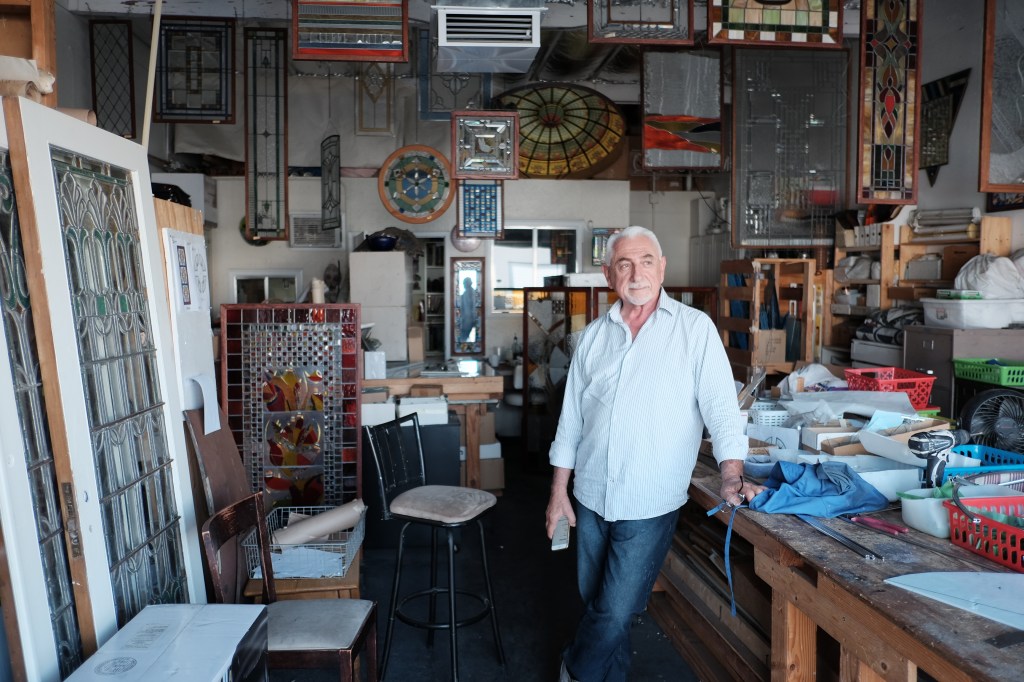
Simon Simonian, Progressive Art Stained Glass Studio
DSCF1407
Peter Scholz, owner, Showcase Cabinets.
DSCF1413
Craftsman at Showcase.


Yesterday, The San Fernando Valley Business Journal published an essay by Charles Crumpley, editor and publisher, concerning the scheme (“Option A) by Metro Los Angeles to destroy hundreds of small businesses near Kester and Oxnard for a proposed light rail repair center covering some 33 acres.

I am reprinting here for all to read. In it he castigates the insensitivity and deafness of local government, including Councilwoman Nury Martinez, who has seemingly stood by while hundreds of her constituents face financial ruin, dislocation and the upending of their businesses and economic security.  Prostitution and dumping cannot be the only constituencies that matter in City Council District 6.

If Metro is permitted to bulldoze the last vestige of small business in Van Nuys to make way for a Disneyland transportation scheme, already made redundant in the Uber/Lyft era, than we are all doomed.

Metro needs to find another site for its repair yard that does not destroy the lives, dreams, hopes and well-being of hard working entrepreneurs and working men and women in Van Nuys.


Memo to Metro: May We Survive?

By Charles Crumpley

Monday, October 16, 2017


The gulf between local government and the business community was on full display last week at the Van Nuys State Building Auditorium.

That’s where the Los Angeles County Metropolitan Transportation Authority held a meeting Oct. 10 to hear from businesses that stand to be evicted because Metro wants to clear land northeast of Oxnard Street and Kester Avenue to build a train maintenance yard to serve a new rail line.

The message from businesses seems simple and clear: Can’t you find a better place for your maintenance yard? Maybe one that doesn’t oust a train load of businesses – 186 of them, by one count.

The message from bureaucrats also seems simple and straightforward: Yawn.

Whether they know it or not, that’s the memo they sent to businesses. To Metro’s credit, it did hold the so-called informational meeting after it became clear that businesses were growing restive. On the other hand, Metro’s temper at the meeting was vaguely brusque and at times dismissive. To at least some of the businesspeople in attendance, it all came off as if Metro’s imperial overlords had been forced to travel to Van Nuys to sit through another dull meeting in which the plebian supplicants had to beg for their survival. (For more on businesses’ reaction, see the article on page 1.)

Here’s an example. The business group proposed an alternative site for the train yard. It seemed to make sense because it would only displace one business, an auto salvage yard, and a facility with some vacant land that’s owned by the Los Angeles Department of Water and Power, better known as the DWP.

But at the meeting last week, Metro Senior Executive Officer Manjeet Ranu announced: “Late this afternoon we got a letter from DWP that says they have specific plans and a construction timeline for use of that property.” So, no deal.

Well, excuse me, but are you seriously saying that DWP’s single plan is more important than the plans of 186 businesses?

Ranu did explain that eminent domain against a government entity like the DWP was difficult, you see.

Well, excuse me again, but isn’t this where we can count on our elected officials to step in and make the DWP yield? Maybe work out some compromise? Surely the DWP’s needs can be met while saving 186 businesses.

Alas, apparently not. The 186 businesses are in Councilwoman Nury Martinez’s district and she did not bother to attend the meeting. No representative from her office was announced at the beginning of the meeting, although her chief of staff said someone from the office later showed up.

The staffer sent me Martinez’s statement, which started by saying the new rail line, which will run from Oxnard Street to Sylmar, is needed and would bring economic revitalization to the area, which no one is arguing. She added this: “Metro indicates there will be some displacement due to the need for a maintenance facility, no matter which option is chosen. I will ensure that Metro continues to have an open and honest dialogue about the support, resources and assistance that will be available to these businesses, so they can plan for their short- and long-term future.”

Well, excuse me, but Martinez is missing the point. Some options for the train yard will have much less “displacement” than others. Focusing on the ones with less displacement is the point here. But I guess you’d have to actually talk to your business constituents to get that. And attend the meeting.

There’s a great gulf between local government and the business community here, and last week’s meeting displayed that.

Government officials see the need for a new train line and therefore a new train maintenance yard and that means some businesses will be evicted and that’s just the way it is. The affected businesses will complain, and part of the job is to yawn through some dull meetings and listen to them whine and patiently explain to them why their alternative proposals won’t work.

Business operators also see a need for a new train line and therefore a new train maintenance yard and that means some businesses will be evicted. But they don’t understand why government can’t be more judicious in selecting a site that is the least disruptive. They don’t understand why government officials can’t seem to see that it is not easy to relocate and could be permanently harmful, even fatal, to the businesses. They don’t understand why elected officials like Nury Martinez fail to come to their defense. They don’t understand why, if their alternative ideas don’t work, the government officials won’t help them come up with ones that do.

Surely there are other sites out there that would be less disruptive. Panorama City actually wants the train yard.

Let’s hope Metro and city officials look harder to come up with a new site that works well for the new train system without wrecking a swath of businesses.


Charles Crumpley is editor and publisher of the Business Journal. He can be reached at ccrumpley@sfvbj.com.

A Great Wall on Burbank.


“Building-to-street proportion is the relationship between the height of buildings on either side of a street and the width between those buildings. An ideal proportion between these two creates a pleasant and visually interesting public realm. The public realm, therefore, may be considered as an “outdoor room” that is shaped by 
the “walls” of the building heights and the “ floors” of the roadway.

Outdoor rooms with excessively wide roadways or short building heights tend to eliminate any sense of enclosure
 for the pedestrian.”
-Los Angeles Small Lot Subdivision Design Guide, 2014

Our city, with its sprawling boulevards and speeding cars, is often cursed with roads way too wide for pedestrians. Think of six-lane Van Nuys Boulevard, bordered by one-story high buildings, and worse, parking lots.

In some areas of the city, like on Pico Boulevard and in Studio City along Ventura Blvd. planted islands with trees now break-up the wide asphalt. New “outdoor rooms” with a sense of enclosure and protectiveness emerge. These are deliberate and designed for upgrading ugliness.

But sometimes even an ongoing construction project can enlighten and transform a bleak stretch of formerly wide street monotony.

In North Hollywood, on Burbank Blvd. just east of Vineland, DWP has been tunneling and installing a new water delivery system.

Processed with VSCOcam with a5 preset Processed with VSCOcam with e2 preset

And along part of the route where a deep, underground hole was dug, DWP erected 20-foot high, wood and metal-framed walls. It has temporarily transformed the commercial district of that area by slicing the four-lane road into a two-lane and creating, along the sidewalk, a European type shaded alley.

Processed with VSCOcam with a1 preset

Work Area #12, as it is officially known, requires a pit to launch a tunnel-boring machine that will travel south, along Lankershim Blvd. for more than a mile. A new water pipeline will replace the aging 1940s infrastructure.

While the construction is going on, some streets have been closed off, which no doubt contributes to aggravation and inconvenience for some area residents and businesses. But the rerouting and reconfiguration has some pleasant side effects.

On Burbank Blvd. cars now stop twice, before proceeding slowly, down a narrow road whose borders are shaded by high walls and low buildings.

Processed with VSCOcam with e1 preset Processed with VSCOcam with a1 preset
On the western edge of the excavation, two tanks tower above the road, as if heralding a ceremonial gateway into the neighborhood.

And on the south side of the street, the high walls come right up to the sidewalk, creating a shady and meandering path alongside area businesses.

The gift of this unwelcome intrusion allows us to experience a different LA with traffic calming elements. What emerges? Less cars, slower drivers, shaded walkways; walled off from the exhaust fumes and the aggression of speeding motorists. Industrial construction materials in steel, wood and concrete function as street sculpture.

For the time being, a stretch of Burbank Boulevard is a living experiment in rezoning by accident.

Processed with VSCOcam with a1 preset Processed with VSCOcam with a1 preset

Image

Meet Paul Krekorian