Purse Snatchers and Parking Lots. (Chinatown Part 2)


On the day we walked here, a few hours after we left, a 68-year-old woman, fighting a purse snatcher, was stabbed 8 times but survived. Her attacker was tackled by others and kept down until police arrived and arrested him.

One can sense the presence of danger here even though it may not be knifing you in the chest. You wouldn’t just rationally wander here at midnight. Maybe if you were drunk. 

North Spring Street is neglected. There are burned out buildings, empty storefronts, and lots waiting for life to return. New High Street between Alpine and Ord is made of one-story buildings and 50% asphalt parking lots. 

What a struggle to run a business in Los Angeles, especially a restaurant. How have any survived the pandemic, taxation, crime, inflation, food costs, employee wages? It’s a wonder anything is functioning.

My architectural imagination wonders why many streets in this district, adjacent to downtown, are so depleted of apartments above stores, why there are still one-story buildings and acres of parking lots all around. 

Along Alameda Street, there are gas stations, and a concrete building from the late 1960s housing The Los Angeles County Fleet Services. Against the brutal and blank façade are shrubs, a mid-century idea of environmental eyeliner. 

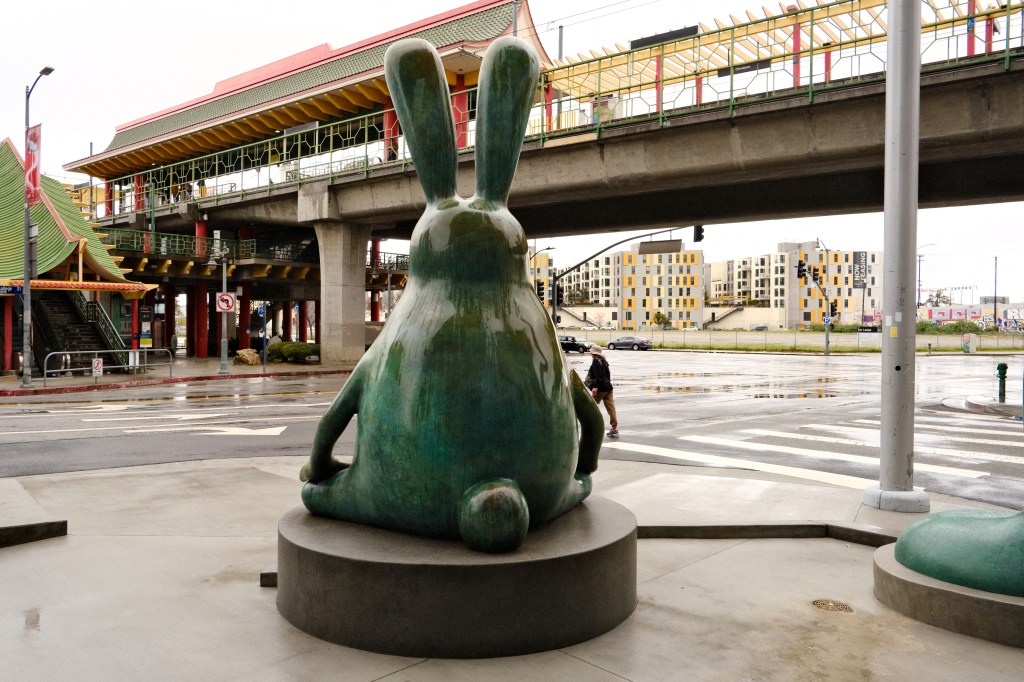
The light rail station is good looking with bright colors of red, green and yellow and decorative chinoiserie. There is a whimsical, large bunny statue on a pedestal standing guard across from the train.

There are handsome new buildings nearby but I hadn’t taken any photos of them. I will, perhaps, return here and photograph them someday. 

Winter Storm Report


There were many dramatic scenes from the “record breaking” winter storm which slammed into Southern California over the weekend: downed trees, car crashes, torrential rains, rapid water speeding down concrete channels, trees bent over in the winds, dark clouds and intermittent sunshine. 

The Southern California mountains were like Switzerland before global warming, buried in many feet of snow.

Our well-fed people went up there in monster trucks and three-ton SUVs; McDonalds, sodas and donuts on laps; to enjoy the novelty. They wore their best black sweatshirts and black elastic pants to frolic in the white stuff.

An old man driving down slippery Kester Avenue near Vanowen had to avoid an enormous tree that fell down, so he accelerated, instead, into the same apartment building where the tree toppled down. He caused major damage but escaped with minor injuries. The unfortunate apartments and its residents had to evacuate but many stayed put. Once again bad driving caused misery for innocents.

A news helicopter was kind enough to rotate around the accident early the next morning around 6am, gently waking up thousands as it chopped, chopped, chopped overhead, broadcasting yet another bad accident to a sleep deprived audience which can never get enough.

Sunday morning, 6:45am.

The power had officially turned off last Friday, February 24, 2023 at about 8pm. Then it turned on, then it went off, and then it went back on. Our internet went out, as we were marooned halfway through “You”, episode 6, season 1, a horrible, odious, superficial show on Netflix full of self-absorbed young Manhattan people which we cannot stop watching.

Though our power is now on, it is weak, and all the normal things that we rely on, lights, oven, furnace, fans, are at 50% or are not working at all. There has been no heat in the house so we used an electric space heater, but that portable device, like a 58-year-old erotic dancer, emits a pathetic and hobbled hotness. 

Yet there is nothing so tragic in our current calamity to compare to people living in war zones, under occupation, under dictatorship or without rule of law. That helps to put our LA inconveniences into perspective: the heartbreak of a cancelled yoga session, a microwaved cup of coffee that takes 5 minutes to heat up, a child without Disney Plus.

And yesterday on Sunday, the sun came out brilliantly, and the San Fernando Valley was surrounded by snowy mountains glistening against blue skies and white fluffy clouds.

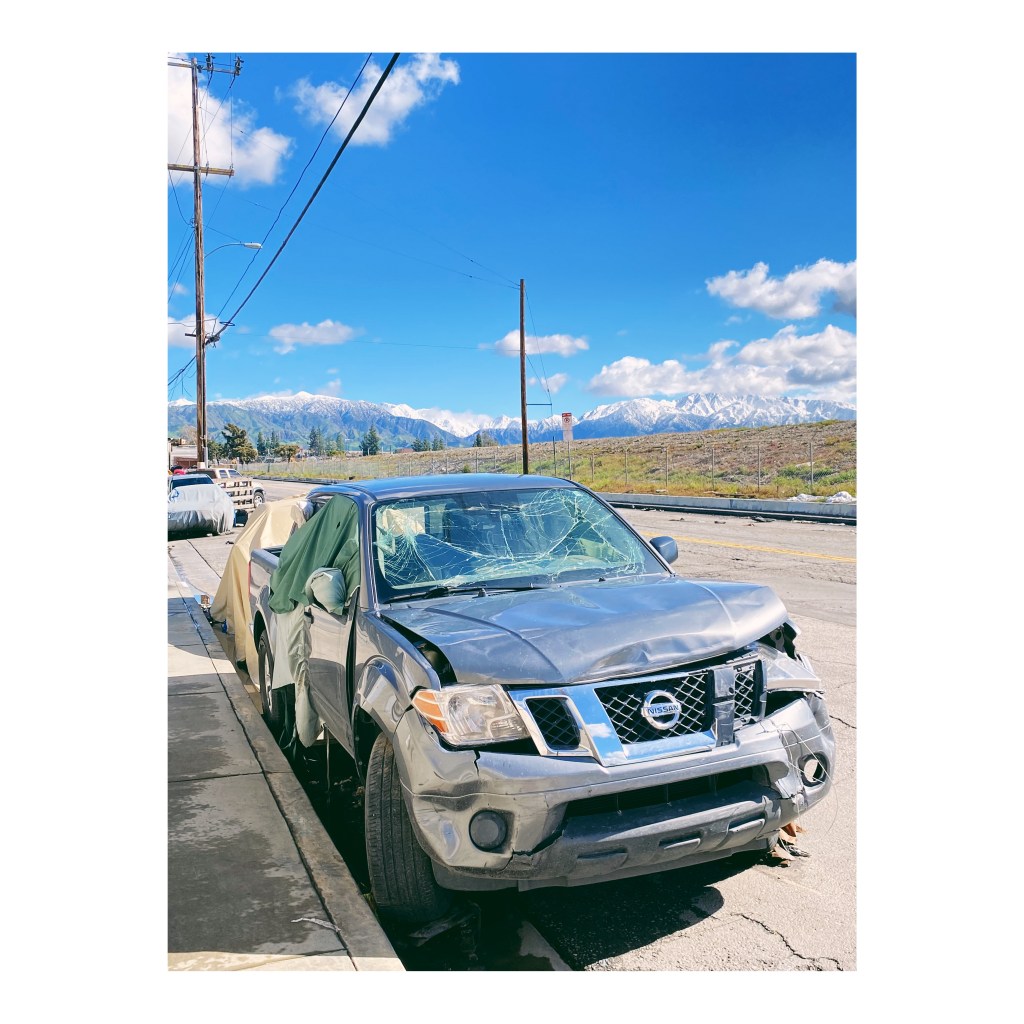
To see the winter mountains in their glory we drove to a picturesque scenic outlook, in Sun Valley, along Branford Street where Chico’s Auto Dismantler, West Coast Audi VW Dismantler, Express Metals Recycling, Hooper’s Rear End, Javi’s Auto Repair, Sheldon Auto Parts, Jak Tire Recycling, and Honda Foreign Auto Parts border the Hansen Dam Recreational Area.

Beyond the steel gates and the steel junkyards, beyond the homeless tents and the wrecked cars, beyond the speeding vehicles dodging a potholed road, we saw the glorious San Gabriel range covered in snow, pure white snow, a gift from nature to the inhabitants of California, a reminder that no matter how hard we try and destroy this land, there is still one force stronger than us.

Some Rain Shots


The Departing Storm


The ladle shaped storm that began to pound the Southland on Friday, February 17, 2017 arrived like a landing jet over the Pacific. It circled, counter-clockwise, landing onto Los Angeles, dropping horizontal blasts of wind, and pounding sheets of rain. It blew down trees, power lines, cable and telephone wires, flooded roads and carried away cars. And drowned our sinned and parched city in a cascade of baptizing waters.

A few died in strange and tragic ways. A man on Sepulveda was electrocuted fatally after strong gusts brought down a tree that hit an electrified power line. Another man was drowned in a raging creek at Thousand Oaks.

What minor choices of life, where to walk, what path to take, might bring us to death?

In Studio City, at Woodbridge St at Laurel Canyon, an aged sewer burst under water pressure and pulled out the soil underneath the road. A 30-foot wide, 20-foot deep hole emerged, sucking two drivers and their two vehicles into a subterranean river. People in those cars were rescued. Thankfully, nobody died or were seriously injured.

dscf1004 dscf1005 dscf1014

Here in Van Nuys, on Hamlin Street, late yesterday afternoon, the departing storm closed its one-woman show, packed its bags, and headed east.

Solar klieg lights were aimed on the darkened sky as its magnificent performer paraded off stage, led by a chorus line of tall, skinny palm trees, lined up to bid good-bye to the wind and the fury, the destruction and the drama.

It was a thrilling show, taking our eyes off the irrationality in Washington, and bringing us back to the true leader of the planet, one who never relinquishes power, but whose atmospheric whims are capricious, indifferent, and violent, but somehow understandable and predictable.

dscf1023

dscf1030 dscf1032

Observations Atop the 134 Bridge After the Storm.


LA River/Griffith Park

After many days of successive, concussive waves of rain swirling into Los Angeles, the hills in Griffith Park were wet, green, and soaked.

I walked there, yesterday afternoon, along the bike path, and the bridle path, at the point where the 134 roars alongside the LA River.

LA River/Griffith Park griffith-park-after-rain-6

The storm, now depleted, had moved east, sent into exile. And in the distance, under dark clouds, I saw the Verdugo Mountains, the flat roofed towers of Glendale, and all the man-made highways and power lines: showered and renewed, glistening and spot lighted by sun.

The littered homeless encampment on the island in the middle of the river was vacated. There was nobody else around but me, except for a lone man riding a child’s bike.

griffith-park-after-rain-2

A bridge over the waters and the freeway, a bridge under construction, its metal rods exposed, a messy conglomeration of concrete, lumber, fencing and plywood, that incomplete, torn-up bridge evoked others before her time destroyed by floods.

Angelenos in the 1930s and before lived in fear of the river and put their hope in President Roosevelt. Now we trust the river and fear our president.

Once we trembled under the fury of nature. Now we shudder under the drama of political malfeasance.

After 1940, the army conquered the unpredictable river, contained its fast water, and controlled its deadly fury.

Tomorrow, we trust, we hope, will fold out and reveal itself as it did in Genesis.

“Now the springs of the deep and the floodgates of the heavens had been closed, and the rain had stopped falling from the sky. The water receded steadily from the earth. And God said

never again will I destroy all living creatures, as I have done.

 “As long as the earth endures,

seedtime and harvest,

cold and heat,

summer and winter,

day and night

will never cease.”

LA River/Griffith Park

El Color de La Vida.


DSCF0656

Before the cold rains struck the San Fernando Valley late Monday afternoon, dark and menacing storm clouds went into formation.

Seen from the empty asphalt of an abandoned parking in Panorama City, the view east lived up to its name. The craggy, inky, rock-topped San Gabriels permitted fog to brush their face.

Eager to pursue the dark light show, we drove east on Roscoe where it opens up under the high voltage lines, across the valley, under the concrete freeway, cutting diagonally up Tuxford, emerging into the industrial abattoir of Pacoima where death and life, and light and shadow hunt under smokestacks and behind motels.

DSCF0668

DSCF0700

DSCF0709

The rains came down on Van Nuys Boulevard and San Fernando Road, soaking Chabelita’s Restaurant, Gallardo’s Auto Repair, Fierro’s Muffler, Franco Tires, JC and Son Welding, and the Coral Bells Motel.

And then, in the mode of Los Angeles, the sky cleared. A vast, blue vista opened up. A cold wind followed.

DSCF0689

Carrying our cameras, we passed men who eyed us with suspicion. Señor Fierro came out of his muffler shop and kindly asked us why we were taking pictures. I handed him my card and told him how beautiful the sky was. He seemed to agree.

These people work hard. They come from lands where blood soaks the cross and breaks the heart. Now they weld metal and change tires and cut hair and dig trenches. Here are these Americans whose presence makes us American.

San Fernando Road is also part of Route 66. The historic state sign says so. The old motels along the highway attest to a long history of travellers who made their way into California: on foot, by automobile, in the back of trucks, hidden inside freight trains.

They got here and slept on the floor, two or three to a bed. Some had no papers. Some had no money. They were somewhere strange and hostile, but free, free to pursue and put down roots and stop running.

But death caught some too young. Some died under trains, running across tracks after the signal, or purposely running into death to escape the misery of life.

DSCF0725

Pacoima is strong. Its buildings are painted in the deepest blues, oranges, yellows, reds and greens. There is no room for ambiguity in hue. The choices are laid out in bright sunlight. The devil and the angel battle here. You can eat well or go hungry. You can get pregnant and high, or go to school and study hard. You can pray or you drive drunk into a wall. Pick the orange off the tree or the prostitute off the street. It’s up to you.

On walls, adjoining muffler shops and liquor stores, are murals of mythological, cultural and aesthetic magnificence. Poor Pacoima has more beautiful public art than Beverly Hills. And there is even a wall-sized portrait of that savior and scoundrel El Niño. Artist Levi Ponce is the Michaelangelo of this district.

DSCF0787

DSCF0755

DSCF0759

VSCO J3

El Niño, as we all know, is in town for a few weeks. He may pay up or he may skip town without leaving payment. Nobody knows.

But Pacoima will carry on.

Processed with VSCOcam with e4 preset

Processed with VSCOcam with e4 preset