Rebuilding Photos from Pacific Palisades.


After the catastrophic fires in January 2025 that burned down over 6,500 structures in Pacific Palisades (and over 9,400 in the Eaton Fire), I restrained my photographic urges and did not run to shoot images of someone else’s loss.

Today, I reasoned that photographing the ongoing rebuilding in the Palisades was not immoral or exploitative, only documentary.

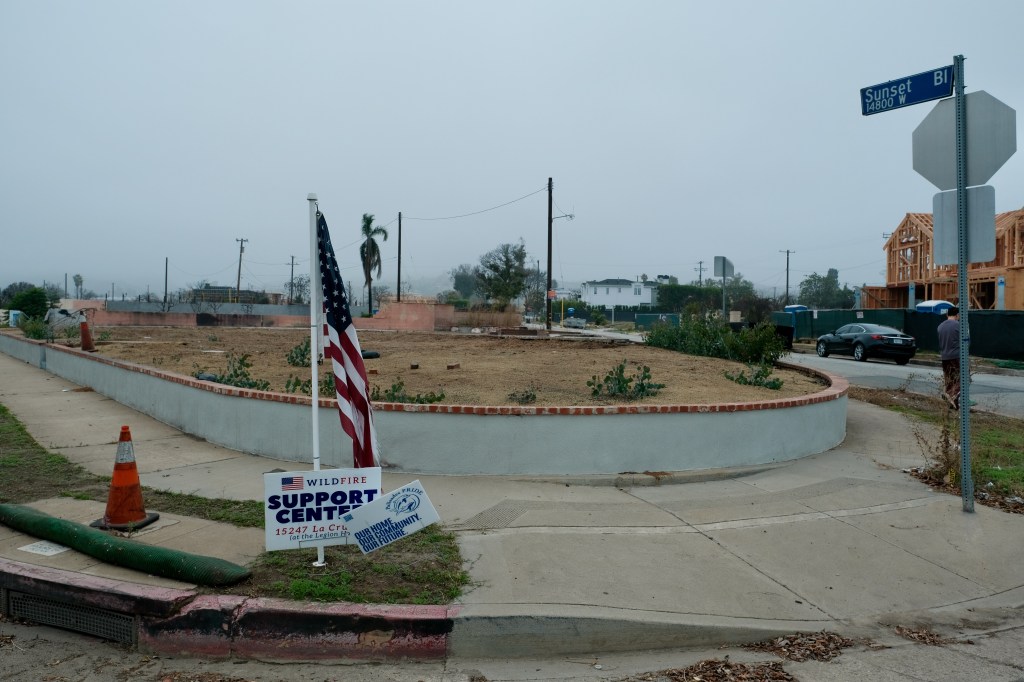
It was a cool, foggy Sunday morning with almost no traffic along the 700 Block of North Hartzell St, just off Sunset. I could stand in the middle of the road without fear.

Around me was a vast emptiness of empty lots, but with quite a few houses under construction, not only on Hartzell, but on nearby streets like Drummond, Carey, and Calloway. You could see through to many streets beyond the one you were standing on, looking at lumber boards on joists hundreds of yards away, just as if you had gone back 100 years to the very birth of Pacific Palisades.

Though there were no people, only a few construction workers hammering and drilling, the presence of the law was everywhere. There were signs against trespassing, US Army Corps of Engineers “California Wildfires Response Debris Removal Support,” NOT FOR SALE, PROTECT THE PALISADES, “This Home Will Rise Again,” #palistrong, Palisades Patrol. I felt the security presence of cameras, cops and Mr. Rick Caruso.

Everywhere there were signs for construction companies, architects, interior designers, garden designers, and realtors. Everyone with a skill to sell had a sign to show.

American flags were planted in soil like a Veteran’s Day cemetery. United in mourning, resolved in moving forward, the spirit of the Palisades shined. Or perhaps it was the spirit baptized in buckets of insurance money.

On all the blocks I walked today the metal street signs on posts survived. No burn marks, no damage, nothing but white letters on dark blue metal.  

How could the fires incinerate automobiles, trucks, refrigerators, washing machines, and hot water heaters? But somehow leave the proper names of the avenues, drives and roads intact? It is one of God’s strangest mysteries, perhaps she knows better than us the value of these named lots.

Further west on Bollinger Drive were some burned up vehicles with a big white house across the street. Every other house was consumed, and the lots everywhere were cleared, save for some with front door steps leading up to the sky; empty driveways, brick chimneys in fields, and sediment logs along the edges of lots to trap debris before it clogged drainage systems.

Walking in districts obliterated by now extinguished flames is a ghostly privilege of survivors. The living can never know the whole truth of what this was before. I hope I was respectful to those who lost everything. I am in no position to know their pain.

And now that the new houses are coming up, who knows what they will endure in the coming years, and even if the American nation and government that they are born into will endure and survive an epoch which seems more horrific each passing day.

Neo-Classical Houses


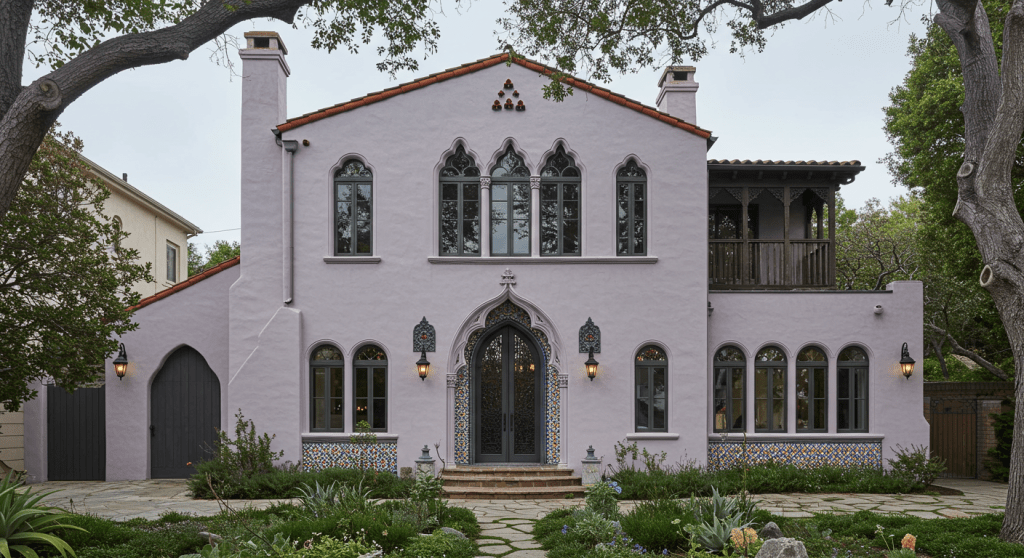
When you have a house that is classical, symmetrical, ordered; architecturally many different styles can fit inside the geometry of the facade.

Architects knew this up until the Second World War. Old neighborhoods in Pasadena, Hancock Park, and many survivors in the West Adams, Hollywood and even Beverly Hills districts carry an eclectic and imaginative grouping of ingredients: Italian, Moroccan, Spanish, French, English, etc.

The gruesome invasion of oversized boxes without any balance, proportions or beauty is an ugly fact of life in modern Los Angeles. These atrocities pop up everywhere, and whole sections of once charming Studio City are now shoulder to shoulder, oversized, white Cape Cods or oversized white coke dealer McMansions. The last type always has a flat roof for parties that never happen and enormous rooms with egregiously visible wine galleries for sober owners, multiple flat screen TVs and no books for their Ivy League educated residents.

It’s probably fantasy to imagine that wealthy people will read this blog and see the lovely houses below and decide to build in this style in Pacific Palisades.

But maybe (in the vein of wishful thinking) the ten wealthiest Angelenos can get together and fund the construction of Neo-Classical houses in Altadena. 1,000 of these would cost $100,000,000 and would also be a welcome addition for the next 100 years.

Ok guys, how about it?

Patrick Soon-Shiong ($20.4 billion), Sean Parker ($16.9 billion), David Geffen ($14.2 billion), John Tu ($11.1 billion), Edythe Broad ($9.2 billion), Edward Roski Jr. ($8.7 billion), Steven Udvar-Hazy ($6.8 billion), Bobby Murphy ($7.9 billion), Stewart Resnick ($7.2 billion), and Evan Spiegel ($6.7 billion). (source: LA Business Journal)