Glassland: A Photo Essay.


I rode the bus and the train to downtown Los Angeles today. And later sat, with feigned enthusiasm, for a job interview inside a concrete-floored, high-ceilinged art gallery.

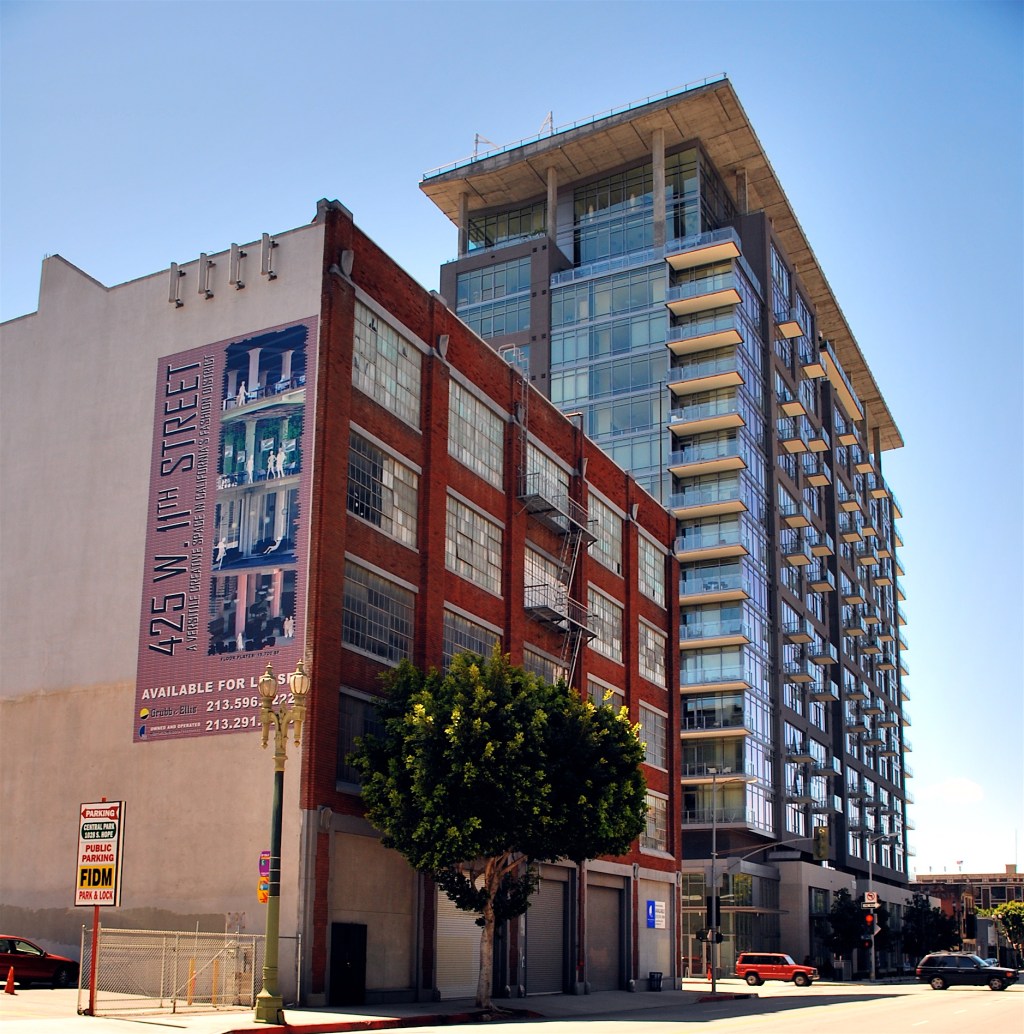
The subway exit was 7th and Hope. The weather was violently windy, blindingly sunny. White fluffy clouds tore fast across the sky. I walked into a shimmering, sparkling, glassy, washed and Windexed world of brand-new, spotless, sleek, shiny and radiant glass towers.

I was in an area east of Staples Center, south of Olympic. Yet its structural newness and callow glibness felt like jejune, milk-fed, blond-haired, salty-breezed San Diego.

Amidst the asphalt, glass, steel and aluminum, I discovered a fair-sized green-park surrounded by tall, right-angled, balcony faced skyscrapers.

Inside the grassy park: an estrogen feast.

Women students from a nearby fashion college, FIDM, smoked cigarettes as they sat along benches and on top of concrete walls. Brimming with energy and youth. A parade of citrus perfumes, vanilla scented shiny hair, shaved and polished slender legs owned by naïve young faces.

Laughing, running, hurrying.

At an empty retail space, intended for future yoga use, I stopped to talk with a workman, renovating and cleaning. He told me he stood on the sidewalk everyday and watched these gorgeous girls walk by.

“90% of them are hot,” he said.

The strong winds continued as I reached the gusty corner where the art gallery stood. Next door, I discovered a Danish bakery where the smell of butter, fruit pastries, chocolate-topped cookies and hot coffee blew out onto the sidewalk.

I arrived at the appointment an hour early, so I continued walking around the neighborhood and found more newness.

Epic spic and span newness.

This slideshow requires JavaScript.

It was Noon, here in downtown Los Angeles, and there were few cars and almost nobody on foot.

Buildings reflective, orderly, tidy: landscaped with fabulously colored flowers, prickly succulents, willowy grasses and rows of upright young trees, water fountains, and little pocket parks unpopulated with humans. Amidst this constructed urban paradise were rows of empty benches.

A wine bar, with outdoor seating, was open on a corner. And not a single person occupied any seat.

A great concept, a superb image, a winking nod to richness, that’s what they built around here.

Those great hypes, of 2004 and 2005: the unlimited prosperity, the exploding stock market, the cheap money, the hustle and con of the hucksters who sold America real estate, stocks, derivatives, credit. These empty, fresh, unfilled, immaculate, twinkling edifices of glass, these are tactile creations and hard monuments of a false and corrupt national binge. Blessed by tax breaks and corporate lies. Unpunished by Washington. Unconscionable billions for bail outs.

Now these resplendent, lustrous buildings sit here, underused and unfulfilled, their once loud voices and enthusiastic promises of urban excitement, muted.

This is just one district of downtown Los Angeles: a great glassy area of spacious, broad streets and tall, unspoiled, spotless, reflective vertical condominiums.

Like everything in this city, it starts out young and full-of-promise.

Dire Situation at Van Nuys Airport.


Employment Survey Shows Unprecedented Job Losses at Van Nuys Airport

Posted by marin2008

Sunday, 20 December 2009
“Tenants at Van Nuys Airport (VNY) today requested relief from increasing rental rates and charges that have contributed to unprecedented job losses at the airport and left many businesses struggling to survive in the midst of the most severe economic downturn in the history of private aviation.

An independent survey conducted by the Valley Industry and Commerce Association of 15 major aviation companies at VNY indicates a net loss of 383 jobs since December 2007, a 41.21 percent decrease among the largest employers at the San Fernando Valley airport. Since the survey reflects job losses mainly among VNY’s major tenants, the actual percentage of employees lost due to downsizing and relocation at small- and mid-size businesses is projected to be even more alarming.

In a letter to Los Angeles World Airports (LAWA) Executive Director Gina Marie Lindsey and Board of Airport Commission President Alan Rothenberg, the Van Nuys Airport Association – a collaboration of tenant representatives committed to helping businesses run successfully – requested to suspend negotiations of five-year rental rate adjustments pending an independent financial audit and contract management evaluation study.

Although there is overwhelming data to support a reduction in rental rates due to current economic conditions that have depressed land values and caused vacancies to climb, LAWA’s appraisals show an increase in fair market value. The airport authority has also taken steps to impose a mandatory airport deficit recovery payment at VNY, a rent adjustment requiring tenants to compensate for airport operating losses. The current budget projects a $2.3 million shortfall at VNY this fiscal year.

“Van Nuys Airport is on the verge of an economic state of emergency,” said VNAA member and Aerolease President and CEO Curt Castagna. “We are committed to partnering with LAWA to find solutions that will help save jobs, retain businesses and preserve the economic vitality of the region.”

The airport association’s letter declares an immediate freeze on all VNY rental rate negotiations pending the following actions by LAWA:

1. Conduct an independent financial audit to determine the necessity of
expenditures associated with operating and managing VNY, including the
level of staffing and overhead costs charged, and taking into account
VNY’s value as an FAA-designated reliever airport to LAX.
2. Report its findings on the recommendation that management of VNY be
contracted to a private company as included in the 2008 Industrial,
Economic and Administrative Survey of LAWA conducted by KH Consulting
Group.

“Any increase in rates and charges at Van Nuys Airport during an overwhelming period of negative economics would result in increasingly harmful impacts on the entire aviation community, from master leaseholders to small aircraft owners,” Castagna said. “In fact, the Port of Los Angeles recently approved a relief package for its terminal operators that includes rent credits and reductions. Identifying opportunities to outsource services traditionally performed by airport employees is also consistent with our City leadership’s efforts to reduce costs, retain and create jobs, and achieve economic growth.”

Ranked as one of the world’s busiest general aviation airports, VNY had 28,748 aircraft movements in September 2009 compared to 41,376 in September 2002, a year in which operations were still depressed by the events of Sept. 11, 2001. Fuel sales at VNY are down by 30 percent compared to a year ago.

Other factors contributing to a decrease in fair market value at VNY include aviation leaseholds that have remained vacant for the past decade; the possible early phase-out of Stage II aircraft; an increase in the airport’s fuel flowage fee; and the loss of U.S. Customs service.

Declaring the situation urgent, VNAA has requested a response from LAWA within the next 30 days.”

Source: Van Nuys Airport Association

Unemployment and Financial Ruin for Journalists.


As if we needed any confirmation that times are tough for journalists, two stories in the past few days, report on how job losses have decimated the lives of people who worked for magazines and newspapers and now are unemployed.

The Journalism Shop reports “Former Los Angeles Times journalists continue to struggle with severe underemployment, a recent informal survey of 75 former staffers found. Four out of five of the respondents reported earning half — or less — of what they were paid at the Times. Thirteen percent of the respondents reported zero income.”

The New York Times writer David Carr, wrote in an article yesterday, “For those of us who work in Manhattan media, it means that a life of occasional excess and prerogative has been replaced by a drum beat of goodbye speeches with sheet cakes and cheap sparkling wine. It’s a wan reminder that all reigns are temporary, that the court of self-appointed media royalty was serving at the pleasure of an advertising economy that itself was built on inefficiency and excess. Google fixed that.”

His last sentence, whose subject is Google, explains so very much. Google is the force that is destroying free journalism around the world by stealing the work of thousands of men and women who write for a living. Google is perhaps the greatest threat to our freedom since a certain German came to power in 1933.

Why do I write this? Because the work of keeping democratic freedoms alive and viable requires that people remain well informed about what the politicians are doing. By robbing newspapers and magazines of their content, and publishing their content online for free, Google has made it impossible for print media to survive. This is not just a fantasy, it is a visible, measurable and empirically statistical crisis of journalism where one enormous company, worth billions, uses but does not reimburse all the other independent media companies on Earth.

Why is Google allowed to get away with so much merely because it the new technology? Atomic power was the new kid on the block in 1945. Why are we so blind to the dangers of this pernicious, powerful and essentially digital bully?

Can the Rich Make it?


Photo by Andy Hurvitz March 2009 Studio City, CA.
Photo by Andy Hurvitz
March 2009
Studio City, CA.

Can the Rich Make it?, originally uploaded by here in van nuys.

For the past decade, this domestic scene was unremarkable.

An enormous modern home with a three-car garage.

Somehow we imagined that this was attainable and desirable.

The market goes down and down and nobody know where it will settle.

Speculation in stocks and housing has now proven to be good for very few, and a losing scam for millions more.

So, one has to wonder: can the rich make it?

Is Traffic in LA Easing Up?


Perhaps I am hallucinating, but there seems to be less traffic in Los Angeles in the last couple of months.

Last night, there was a crazy two-hour car chase that was televised on all the local news stations. A woman in Palmdale had stolen a U-Haul and drove it all the way from the high desert into downtown Los Angeles. She was clocked at speeds over 80 m.p.h. and managed to evade the police as she sped through such dense areas as Echo Park, Mid-City, West Los Angeles, Santa Monica and Malibu. She commanded the road, lightly traveled roads, along the 10, the 5, Pacific Coast Highway. This was during the rush hour, between 4-6pm. Finally, she ran out of gas near Oxnard, jumped out of the truck and was tackled and handcuffed by the police.

What amazed me, even more than her driving skills, which included evading a tire flattening strip on PCH, were the open freeways which she rocketed down. Where was the normal traffic that one encounters on these densely traveled highways?

Unemployment in LA is now around 10%. Many people are not going to jobs, and perhaps fewer people are shopping and eating out. Can a 10% reduction really make that big a difference? I think so.

We have all seen how much less traffic there is on Jewish holidays like Yom Kippur and Rosh Hashana. Jews make up no more than 15% ( or less) of the population of LA, yet a High Holiday will often result in much less traffic.

I drove from the barely attended Beverly Center this evening and noticed that there were fewer cars along LaCienega. Beverly Glen was not that crowded coming back into the Valley.

Maybe this is luck, or perhaps just a subjective impression, but I am beginning to wonder if the Great Recession is making a difference in how many cars are on the roads of our city.