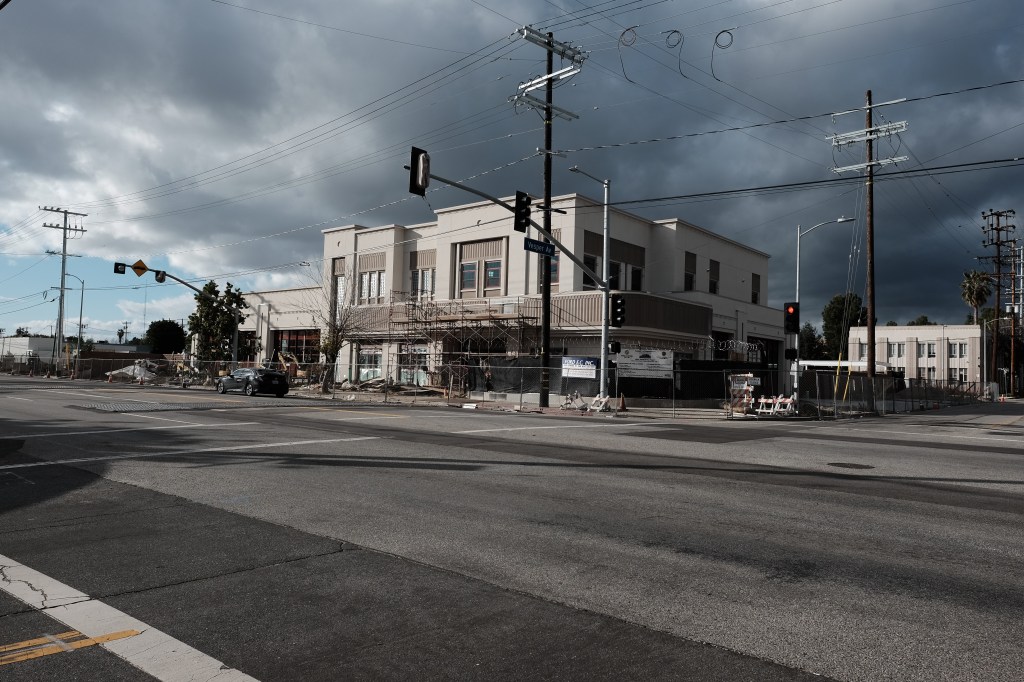
Even at the darkest time of the year, when the light echoes the mood, Van Nuys soldiers on.
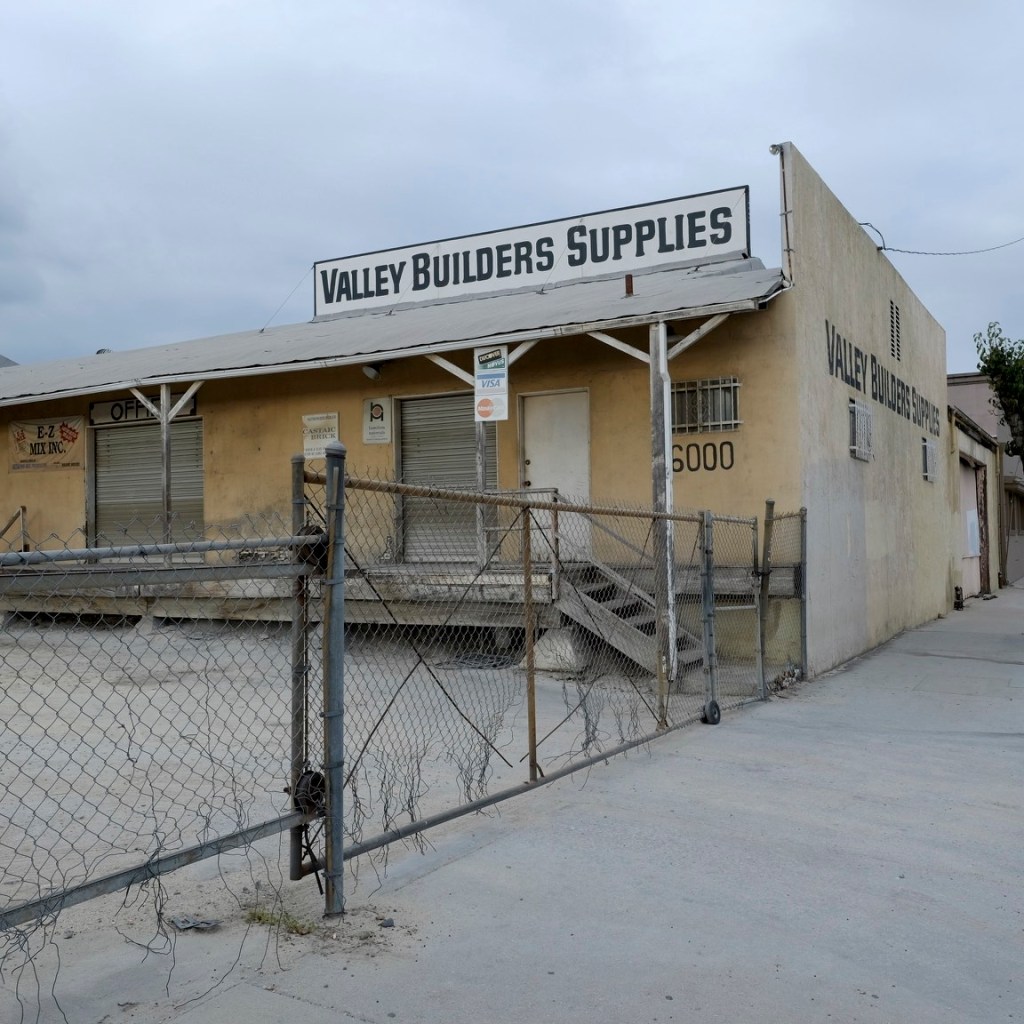
Along unpaved Columbus Avenue, where old large properties await their transformation into many boxed houses, the blithe disregard for the larger good, for neighborly niceties, is evident.
For isn’t this the representation of freedom at its finest, to do what you want, to behave as you feel, to self-destructively ruin you and your surroundings as you sit on vacant land waiting for its value to increase?
Somebody is landlord here, and somebody is absent, and in his place the trash, the overgrown weeds, the toxic cans and poisons leak out, and it is all thought normal, just the way it’s done and has always been done.
For nothing really matters except how you can exploit, make profit, take for yourself, and destroy while you can.
The New Yorker has a photo essay about Mike Mandel, who was born in 1950, studied at CSUN, and made a large body of photography here in the 1970s.
His work reminds me of the people who grew up here during that time, kids who were lucky to live a good life in houses with swimming pools, competent neighborhood schools, low cost college, and the ability to just do nothing, or everything, on foot, on bike, in car. Some are alive today, living in Encino or Woodland Hills or Studio City, inheritors of $2 million houses with $780 a year property taxes. These photos are their youth.
They had a rollicking good time in the past 70 years: getting high, going to concerts, having lots of sex, traveling everywhere and coming back to a freeway and shopping center universe in a city where only making yourself happy was considered the most profound errand in life.
The late 60s and early 70s was a subversive time with the Vietnam War, racial protests, and the Generation Gap. Anyone under 30 was thought angelic and gifted with great insights into human nature. Anyone over 30 was held responsible for all the hypocrisies and injustices of society. The Baby Boomers blamed their parents for conformity, environmental ruin, war and segregation. Yet these pissed off kids truly enjoyed a lucky period in the world, partaking of all the freedoms and leaving the bill for future generations.
The late 60s and early 70s imitated the time we live in now with cooler temperatures, unfiltered cigarettes and the insulted assurance that this country and state worked well for white people, and if everyone just got down, baby, and spoke their, like, mind, why, hey man, there was nothing that couldn’t be achieved, like even landing on the moon or dating Jane Fonda.
In the arts it was a time of blunt honesty, just showing things as they were, in music, movies and photography. There was group therapy, of just saying what was on your mind, no matter how embarrassing or crude or cruel. “Bob, Carol, Ted & Alice” captured that quintessential Southern California moment with its wry satire and takedown of the sexual revolution within married couples.
But there is nothing malicious or mean in Mandel’s work. It’s childlike in its openness, sweetness and curiosity.
If you had a camera, and practiced photography professionally, you went out and shot photos of suburbia, of people driving in cars, or you were goofy and put yourself, like Mike Mandel, in the middle of the photo with strangers. You saw the humor in ridiculous juxtapositions of people and environment: the shirtless slab of guy in the butcher shop, the suede coated beauty next to the space laser game, the old lady on her driveway with her boat and garbage can, the double cowboy hatted dude with a box of popcorn next to the bumper cars.
Now these images are a historical record of a lost time. And we value their freedoms, dearly, as we endure temporary incarceration and social isolation during this pandemic.
One of the fastest growing categories of business in 1950s Van Nuys, CA, was the modest priced furniture retailer.
The opening of a store on Van Nuys Boulevard was an event for the whole family. Mom, Dad, Janet, Billy and Sally would come down to see dinette sets, bunk beds, and wall-to-wall carpet that would soon cover the San Fernando Valley from Burbank to Hidden Hills.
Van Nuys was prosperous, white, middle-class, with excellent schools, clean streets, strictly policed, and full of new families in new houses. All these ranch houses and young families needed furniture. And here it was!
The widening of Van Nuys Boulevard in 1954 to a six-lane wide highway offered builders of furniture stores the opportunity to erect big signs atop big box stores fronting the street.
In the archives of the Los Angeles Public Library are these photographs taken from the pages of the Valley Times from 1955-61.
Photograph caption dated March 21, 1956 reads “Large Gold’s Valley furniture and appliance store will open at the corner of Roscoe and Van Nuys boulevards, Panorama City, with an all-day celebration tomorrow. Gifts, entertainment and free rides for children will be part of festivities.”
Photograph caption dated March 9, 1959 reads, “Hub Furniture Stores newest location on Sepulveda and Nordhoff in Van Nuys marks the 14th Hub Store in the greater Los Angeles area. March 14 is the opening day.”
Photograph caption dated December 2, 1955 reads “Sign features Taylor’s Furniture Mart, new name selected for store formerly known as Van Nuys Furniture Mart. Company recently opened Reseda branch, known as Taylor’s Grand Central Warehouse.”
Photograph caption dated April 7, 1958 reads, “Above shows new Barker Bros. Van Nuys store which formally opened today at 6505 Van Nuys Blvd. Store provides nearly three times the space of the former Barker store across the street at 6502 Van Nuys Blvd. The old store closed Saturday. Barker Bros. has operated a branch in Van Nuys since 1948.”
Photograph caption dated April 28, 1961 reads “Special grand opening celebration continues through the weekend at the new Douglas Furniture Mart, 6180 Van Nuys Blvd., Van Nuys. The store features a medium priced line of furniture and appliances.”
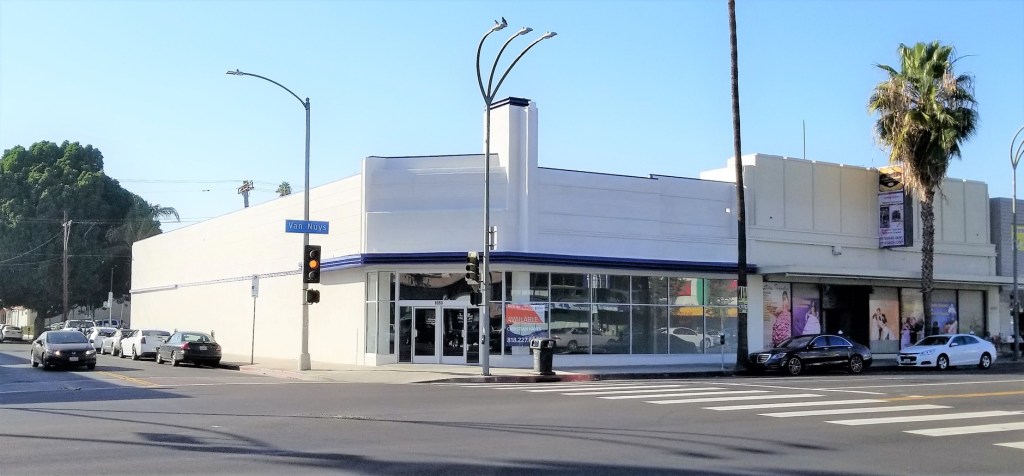
The 1958 Barker Brothers store still stands at 6505 Van Nuys Bl. It appears to be empty, along sidewalks where only the saddest and most desperate wander.
He was born in Egypt and came here when he was five. Ash lives with his mother and his 5-year-old son in Reseda. He is divorced and hurt his shoulder playing pool. Slight, medium height, shaved head, he has a kind, soft, shy demeanor.
Like most these days he has work and no work. I didn’t ask more. Nearly a quarter of the people in Los Angeles have no jobs. But Ash is sadly cheerful. He is devoted to his son and his scents. I asked my subject to wear a mask except when I photographed him.
We walked around my neighborhood, after 6, when the light was dimming and people were walking dogs and children. Some had masks, others did not.
You would never know something malign was afoot in the land.
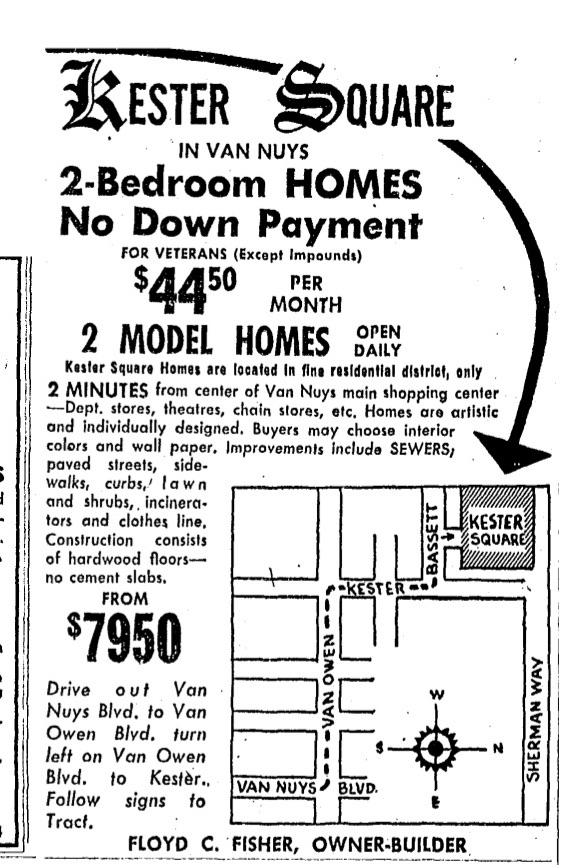
There is a mid-century calm on the blocks that radiate off Kittridge west of Kester: Saloma, Lemona, Norwich, Noble, Haynes. The houses are nearly 70 years old. Not rich enough to be torn down, not quite poor enough for decay, they are like their residents: solid, homely, neat, clean, enduring without drama.
Except for the walkers, there are hardly any people outside. Nobody gardening, nobody socializing, nobody doing anything social.
This area has been dead at night since “I Love Lucy” went off the air.
There are a couple of houses for sale. I saw one, a not pretty ranch house with an asphalt driveway and crummy design. It’s for sale at $1.2 million. Another fancy one with a vinyl fence in front is just under a million.
Who is buying these houses? Not the unemployed or the homeless.
One just sold across the street from me, a fancy Z Gallerie style redesigned Spanish home, $1.3 million. It had been remodeled, non-stop, for four years, the owner lavishing last minute changes on the property while vacationing in Turkey and Mykonos. Just when you thought the remodeling was over, a new element was added, like a chandelier in the carport, or double oversized Buddha heads overlooking the hot tub.
Earlier this week, the new owners moved in. Yesterday, roofers came to pull down all the clay tiles and re-roof it.
Some have discretionary income, others line up in their cars to get bags of donated food.
Last evening, on the streets around here, the little ranch houses from the 1950s were going into another night. A man was testing paint colors on his garage. Along the sidewalk, beside the house with the American flag and the backyard basketball hoop, an old man with a red bandana mask walked with two little girls and their dog.
And Ash from Scent Trails was leaning against a tree, perhaps dreaming of his next lilac infused adventure.
They are all ranches, built in the early 1950s, solid and compact.
Unusual for Los Angeles, the houses are all original. There are no tear downs. There aren’t any protective fences, walls or gates on any of the properties if I recall correctly. The front lawns are still grass. Not concrete, not RV, not Hummer.
Yesterday, I walked down the street, which has a real sidewalk, and on both sides of the block, two rows of identical tall trees, species unknown, currently bare of leaves, chopped up by Cortadores de árboles.
There is something midwestern about this street: sedate, well-tended and reserved. The only person I know who lived on Norwich was a blond-haired man who came from Ohio, married a woman, divorced, and moved back to Ohio.
Norwich Ave. reminds me of Lincolnwood, IL where I grew up. Especially one thing….
Each of the ten houses has a lamppost in front.
6600 Norwich
6600 Norwich
6601 Norwich
Norwich
6621 Norwich
6615 Norwich
6633 Norwich
Norwich
6645 Norwich
Norwich
6651 Norwich
You can stand on the end of the block, on the south, at Kittridge, and on the north at Lemay, and look straight down and see the lights lined up, like sentries, in front of each property.
Norwich
These exterior lights belong to mid-20th Century suburbia. They functioned, in their time, as gracious servants who lit up sidewalk paths for evening guests, paths planted with geraniums, petunias or marigolds; illuminated walkways for the wintertime mailman, dad coming home from work, and junior on his Schwinn thrown down, rushing in for his dinner of fish sticks, tater tots and Kool-Aid.
Some of the posts have address numbers attached.
Like every other block, people see what their neighbors are doing to their homes and they copy it.
The lamppost is a survivor from a domestic time seven decades passed. It has no real security value, and when it’s turned on during the day it indicates that nobody is home, thus negating its magical protection.
But walking past these homes and their lights, brings you back to the old days of bourgeois Van Nuys, when this district was neat, safe, and proud. And citizens thought that men in suits and uniforms, serving under sky god and nation flag, were looking over them and protecting their lives and family, fulfilling oaths sacred and lawful.
When the people, who always paid taxes and sometimes voted, discovered that nobody was in charge, that security was your own problem, that only wealth bought law and justice, the decorative lamppost went out of fashion.
And here we are today, in the new dark ages, monitored and terrified.
You must be logged in to post a comment.