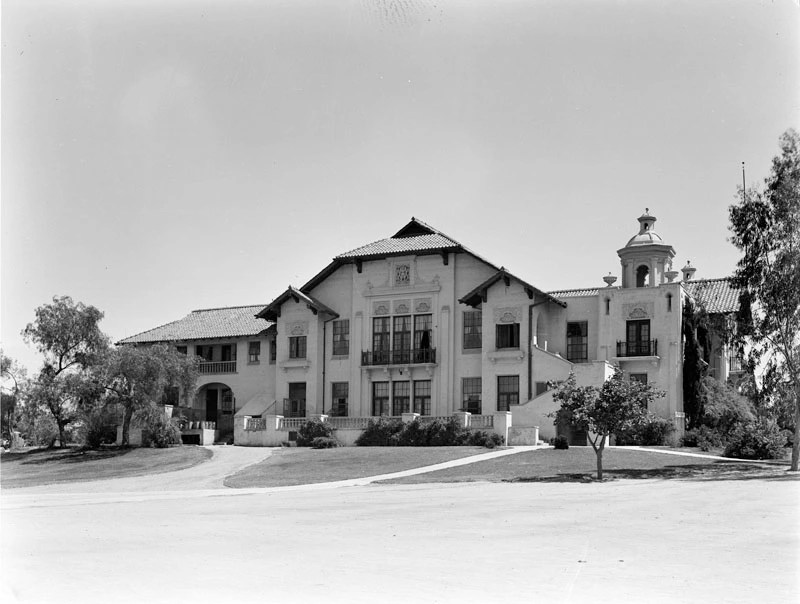
Toluca Lake and Sherman Oaks in 1948


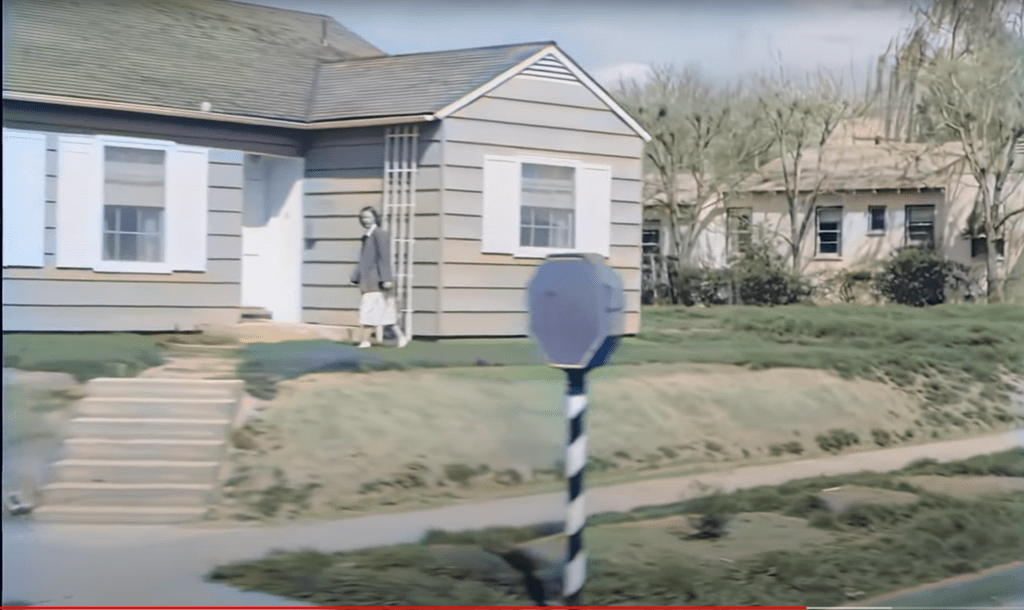
This is a 1948 colorized video, most likely filmed by a movie studio for projection background footage “process shots” in automobile scenes.

It was shot in Toluca Lake and Sherman Oaks.

Toluca Lake was the most comely, gracious and affluent neighborhood in the San Fernando Valley, handily nearby Warner Brothers, Universal and Disney studios.

Driving along Valley Spring Lane, Navajo and Forman, near the Lakeside Golf Club, the viewer sees an endless procession of estates, tree lined streets, gardeners, people on bikes, thin women in below the knee skirts. There is some open land, still undeveloped.

The architecture was eclectic, freely borrowing from Spain, France, England into a hybrid Southern California style set along enormous lawns, with flowers, trellises, window boxes, picket or ranch fencing. Cars are few and parked in driveways, occasionally on the street.

No house is gruesome, ostentatious, unbalanced, grotesque, hostile or ugly. They fit into their surroundings. And even when a Tudor house is next to a Spanish casita both houses seem proper and well-mannered. There are no steel gates, no concrete front yards, no Home Depot vinyl windows sliced into stucco.


The Sherman Oaks section of the video begins at 4:45 at the corner of Hazeltine and Greenleaf. The footage proceeds west through Beverly Glen, Van Nuys Bl. and Cedros.

Greenleaf St. in 1948 was a street of small houses, some older Spanish or Mission, some newer ranches. They were embellished with shutters, trellises, neat lawns, shade trees, classical street lights on concrete posts.

I used Google Maps Street View to try and pick out the homes which were there in 1948. Sadly, most of the houses have been torn down or obliterated with the fads of 60s and 70s, and the gigantism and massiveness that characterize modern Los Angeles.


Here is my timeline to watch the video:

Toluca Lake:

2:27 Valley Spring Ln and Navajo St.

West on Navajo St.

Turn left on Forman

3:30 Valley Spring Ln and Forman

Turn right, head west on Valley Spring Ln.

3:54 Ledge Av at Valley Spring Ln.

4:31 10451 Valley Spring Ln. Spanish house with second floor balcony and rounded tower.

4:33 Strohm Av at Valley Spring Ln. Corner house is still there but Tudor style wood on facade is gone.

4:39 10515 Valley Spring Ln. Spanish house with arched front window and arched entrance.

Sherman Oaks: 

4:45  14100 Greenleaf St.  at Hazeltine, 4204 Hazeltine background house with shutters and window box. 

4:51    4203 Hazeltine. Back of house and wooden garage, both still existing in 2022.

4:58 14101 Greenleaf St. Newly built home. (2/24/48 building permit taken out.)

5:04. 14115 Greenleaf St.

5:12  Stansbury Av and Greenleaf St. heading west.

5:15 4205 Stansbury Av.

5:32 14223 Greenleaf St

5:39. 14244 Greenleaf St.

5:52  14273 Greenleaf St. heading west

5:55 14279 Greenleaf St.

6:16 14345 Greenleaf St at Beverly Glen

6:20 14403 Greenleaf St. at Beverly Glen old mission style house with wide overhangs and trellis.

6:48 14479 Greenleaf St. corner of Van Nuys Bl.

6:58  14507 Greenleaf St

7:02  14519 Greenleaf St

7:04  14525 Greenleaf St.

7:05  14529 Greenleaf St trellis over driveway

7:20.  14567 Greenleaf St

7:26.  14579 Greenleaf St cor Cedros Av.

Lost Opportunities.


I once wrote about The McKinley Home for Boys (1920-1960) which stood on the present day land of Fashion Square in Sherman Oaks. It was torn down when the Ventura Freeway plowed through.The powers that be (bankers, developers, councilmen) decreed a shopping center to be the the only economically viable usage for that land.

What we have now, is a martian landscape of disconnected large buildings which themselves are nearing the end of their life form. The shopping mall is a fading attraction, but what might replace it?

At Riverside and Hazeltine there is an enormous project to excavate the property around the former Sunkist office building, an early 1970s brutalist structure that swam in a sea of asphalt and whose redeeming qualities were fully grown fir trees which have now been completely wiped off the landscape. The name “Sunkist” was a cruel joke referring to orange groves in the San Fernando Valley that were long ago destroyed. The inverted pyramidal office will remain in the heart of the new apartment community, now renamed “Citrus Commons” and again, real estate wins, and the community loses, except to get more “luxury” units nobody without parental inheritance or assistance can afford.

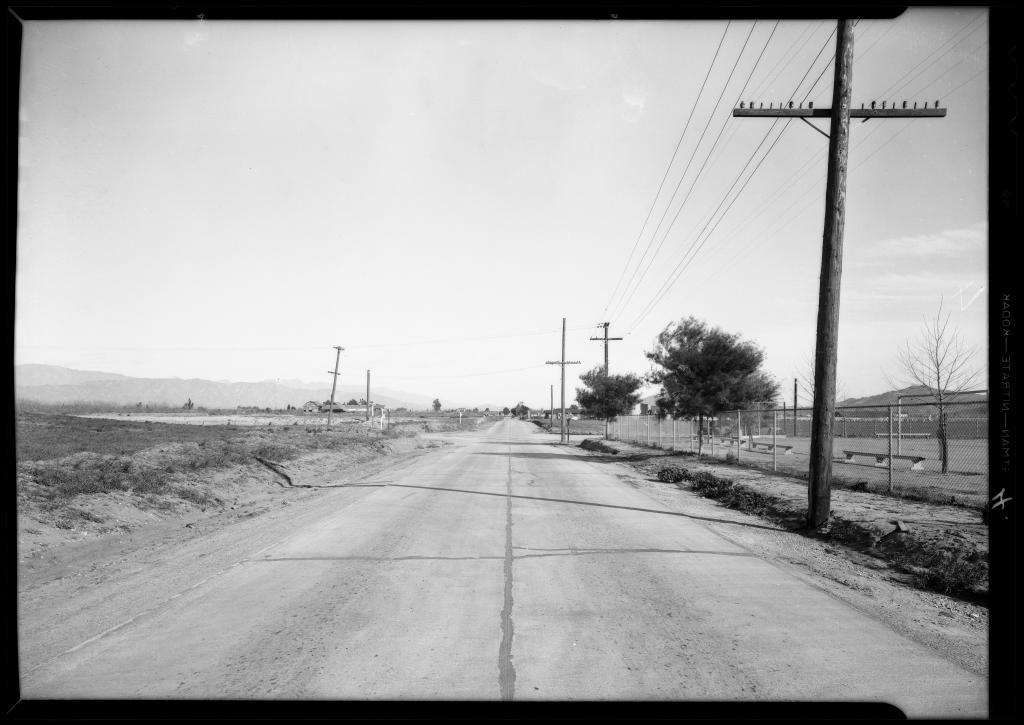
In the archives of the USC Libraries are these remarkable 1932 black and white photographs of the intersection of Riverside and Woodman when they were just rural roads in the middle of ranch lands. To the right of one of the images are benches and what might be the playing fields for The McKinley Home for Boys. Photographer was Dick Whittington.

The air was clean. Traffic was non-existent. The landscape was a tabula rasa for dreamers.

What do we have today, 90 years later?

The corner of Riverside and Woodman is four corners of disconnected “architecture.”

The NW is a late 1960s office tower in gold panels with an adjoining parking lot. Each floor of the sealed windows, mid-century “skyscraper” has unusable balconies, unaccessible from any office, just protruding forms signifying nothing, a decorative embellishment to make the tower fancier.

NE is the Spanish colonial high school Notre Dame with its good looking students from good families and good homes destined for good jobs and good colleges and good times.

SW is the ugliest shopping center in the San Fernando Valley with a covering of asphalt, outdated giraffe light posts on concrete posts, and a smattering of cheap and unnecessary stores: Bank of America, Pet Smart, Sports Authority and Ross. A parade of oversized vehicles with tinted windows and distracted drivers, and oversized people in black leggings; shoplifters, bank robbers, angry women, vapers and hucksters, actors and influencers, aggrieved SUVs, nearly deceased elderly drivers; pours in and out, all day, in the 100 degree heat, honking and pushing their way into a parking space.

SE is a 76 gas station, the kind that always has the highest per gallon price in the city, and several large billboards.

Everything else at this intersection is all about getting on or off the 101 freeway. Nobody would walk here willingly: burned by the sun, threatened by speeding cars, buffeted by air pollution and visual discordance.

What would this area look like if there had been a plan put in place for development with coherent architecture, walkable streets, trees, etc? Why do we think that mediocrity, ugliness, and environmental destruction are the best we can hope for?

Crossing Ventura.


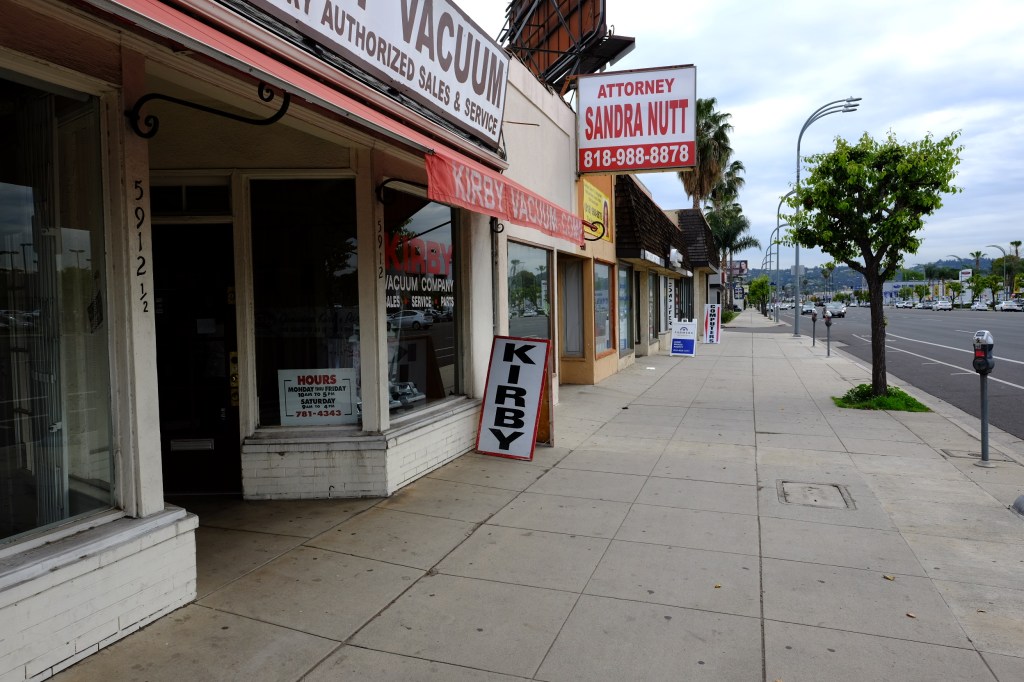
Sometime in late 2018, early 2019, I’m not sure exactly when, they created a pedestrian crosswalk, with flashing lights, across Ventura Boulevard. at Ventura Canyon Avenue.  The crossing is about a block east of Woodman and a few doors down from Yok Ramen at 13608 Ventura where I go about once a week.

This is in the heart of Sherman Oaks, where stores that paint your nails, sell used records or live birds are sprinkled along the boulevard along with massage, dry cleaners, and laser skin treatments. And Floyd’s 99 Barbershop where every customer from 18-80 is a rock star.

I’m familiar with this area and its friendly banalities.

About 20 years ago, I knew a divorced woman in her 40s, with a little girl’s voice, who spent most weekday mornings at the location where the ramen place is now. 

Back then it was a bakery and a coffee shop with big muffins and big mugs, chocolate croissants and caloric treats. She sat at a table with her journal and wrote music and poems. Today she is retirement age, married and living in rural England.  And that’s how I got to think about the time passing and the way people pass time on Ventura Boulevard. 

As Orson Welles once said, “The terrible thing about L.A. is that you sit down when you’re 25 and when you stand up you’re 62.”  

And if you spent a couple of decades eating chocolate chip muffins on Ventura Boulevard what have you got to show for it?

To keep people alive, and moving, mostly in cars, the people and “leaders” of Los Angeles have devised, through the years, the same kinds of ideas to make safer the naked and shameful stunt of walking across Ventura Boulevard.  These include longer pedestrian signals, traffic islands, and painting the street with lines or figures to indicate that humans on foot also roam in the land of cars.

We tweet in seconds about trivialities like nuclear war, impeachment or the fires in Australia but we cannot assume that six decades will correct the urban failures of Los Angeles. Photographs from the past prove my point.

On November 30, 1959, Dr. Louis Friedman, Dentist, painted his own crosswalk, with a corn broom, on the pavement at Murietta and Ventura, to protect his patients. He had unsuccessfully asked the city to do so but his requests were ignored. So he took the initiative and laid down the lines.

That same year, Carl Stezenel, 10, of North Hollywood stood at the corner of Radford and Ventura and tried to cross in the time allotted, 9 seconds. If a 10-year-old boy found that challenging, imagine the typical woman of that era in high-heeled shoes, gloves, hat and a cigarette pushing a baby buggy?

Carl Stezenel’s plight may have influenced a December 1, 1960 dedication for a new landscaped traffic island at that same location. Men in suits (a sure sign of importance) attended the event, in a district whose distinguished architecture featured auto dealerships and gas stations. 

Five years earlier, in 1955, motorists on Ventura near Dixie Canyon Avenue were warned that they were approaching a nearby school by a painting on pavement of a running boy with a ball. 

People who worked and shopped in the area did care about how it looked. Years before it was considered normal and decent to allow tens of thousands of intoxicated and mentally ill people to live on the streets with garbage filled shopping baskets, the issues of why there was no tree cover on the boulevard haunted the civic minded. 

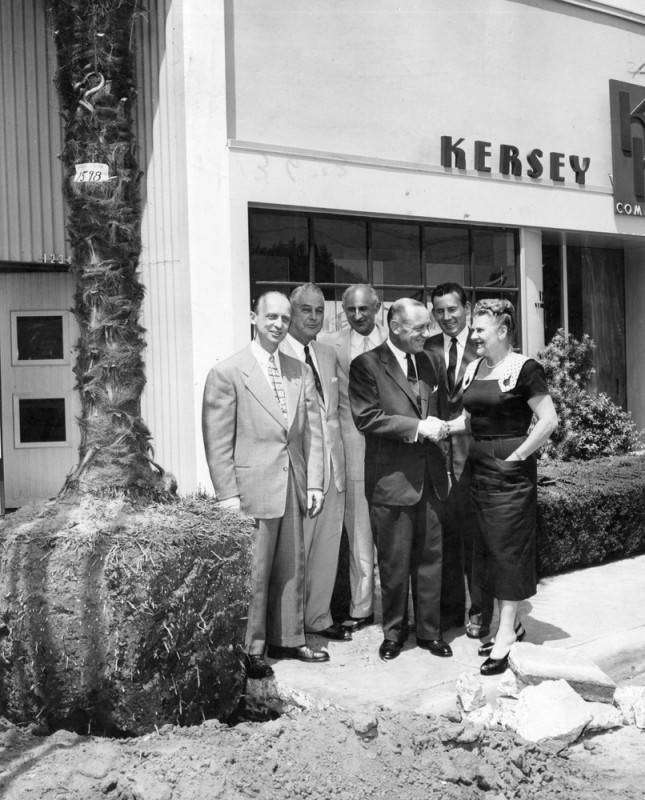
The palm tree, with a trunk so skinny it could never crowd out a Cadillac at the curb, was the obvious solution.  

Studio City is now lined with palm trees, a species that provides no shade to sidewalks that are baked in sunshine 350 days of the year. In 1954, the first palm trees were planted as part of a beautification scheme. Fully grown, their trunks look like posts without billboards, a perfect style for this city.

The sameness of businesses in the late 1950s along Ventura Boulevard presented problems. We, who are of CVS, Starbucks and Chipotle, may understand that historical plight.

Studio City and Sherman Oaks had a competitive streak. 

To bring customers between the two districts, a special free bus was introduced on February 18, 1959. If you had a watch that needed repair, wanted to purchase panty hose, a typewriter ribbon, or a cigarette case, now you had a no fare bus to take you up and down Ventura Boulevard, opening up a world of possibilities. 

That bus must have been cancelled after 10 episodes.

Further east, at Balboa and Ventura in Encino, the traffic situation was already dire in late 1953 when work-bound suburban residents were forced into only two lanes of eastbound road, while the westbound, going into less populated Tarzana and Woodland Hills was free of congestion. The solution: three lanes in the morning, and then move the cones and make it three lanes westbound at night. 

Eventually, the current road was widened into three lanes in each direction, with an advanced staring-into-the-sun design for morning and afternoon drivers. 

High rise office buildings sprung up in the 1960s and 70s, some as high as 15 stories, but nobody in the single-family neighborhoods nearby cared because the occupants were white and well-paid. Today, a four-story tall apartment with 130 apartments, and 3 affordable units is considered social engineering and overcrowding by many in Encino.

We are now into the third decade of the 21st Century and Ventura Boulevard still lacks safe pedestrian crossings because most drivers and pedestrians are looking into their mobile devices.

Photo Credits: LAPL/ Valley Times Collection

The Perfect House


In early 1993, I was visiting Larry and Kay, who lived in a beautiful home in Woodland Hills, south of Ventura, of course. They were around the corner from the last large orange grove in the San Fernando Valley.

They were Hollywood people, who had moved out to the SFV, in the late 1960s, from Michigan. 

The husband was a TV producer who had success on ABC in the 1970s. The wife played tennis with “Happy Days” star Marion Ross. They had three children. I was friends with their middle daughter Beth, who I had gone to college with.

Their house was up on a hill, atop a long driveway, in a bed of ivy and surrounded by mature trees. There was a large, life-sized cow in front, so you were assured this was a place of wit and irony.

The expansive, beamed, rustically casual interior with a wall of patio facing French doors was paved with polished bricks. A two-story tall front hall, with plants growing up to the ceiling along an open riser staircase, extended back into an amorphous pool that was surrounded by terraced, green hillside and more vintage signs from old roadside advertising.

That year I was considering moving from New York City to Los Angeles. And then, the next year, I did. 

The husband was a gregarious, self-confident, big Midwesterner who liked practical jokes, loved making television, and loved Los Angeles. He would have made a good poster child for the LA Chamber of Commerce: family man, in a spectacular house, having fun earning a living in entertainment.

During one conversation Larry said he liked LA because when you drove to the airport “you never had to go through a bad neighborhood.”

Kay said she loved LA because she loved her house, “It’s paradise here in my home and garden,” she said.

I thought then, 26 years ago, how odd and how normal these remarks were, how characteristic of Los Angeles, and a certain kind of person these impressions of life here were. For who would argue, especially in 1993, that a nice home was not the entire object of life and the culmination of Los Angeles dream? 

Who cared if there was nowhere to walk, if “Main Street” was a 15-mile-long wreckage of parking lots, junk food, car washes, shopping centers and ugliness; and your downtown was a vacated, forgotten and despised urban renewal zone, strangled by bad air and wide freeways, where lost people wandered aimlessly?

And you never knew your neighbors’ names, and you only saw them from behind your tinted, electric windows.

If you bought a nice ranch house south of Ventura Blvd. you were really set. The city and its attributes or lack thereof were of no importance. The sun always shined on your pool and your garden.


I have lived in this city more years than other city, and still I wonder what I am doing here.

Like Larry and Kay I have a nice house, perhaps not on the scale of their house, but it’s a good, clean, comfortable house, and I like it.

But beyond this house, a few houses down, here in Van Nuys, one encounters a city where 58,000 people live on the streets, and traffic, billboards, mini-malls, illegal dumping, air pollution, and crime are profuse. 

A great house would be a great if it were in a great city that took great care of its environment. 

But our city lets people camp out along the freeway, and defecate in the take-out line next to Wendy’s. It cannot stop it when drivers cut off in traffic kill each other and it cannot predict if a madman with a gun will shoot to death some random man at the Orange Line bus in Lake Balboa.

The Perfect House could never exist in a city where 90% of the people who can, drive their children to schools in other school districts, because the local schools are inferior, because the nearby, walkable schools are populated by less advantaged kids. What fine city sends its’ kids far away to go to schools in other places?

In our city, desperate for housing, people with homes protest housing for homeless seniors. It reminds me of a man with epilepsy, and an autistic boy, who protested a memory care facility for Alzheimer’s patients near his home in NJ. 

The Perfect House would not exist in a city with scattered, garbage-filled carts on sidewalks. And a bus bench shelter was not for bus riders, but a bed for a man without a bedroom.

Los Angeles promotes self-destruction of self and city as public policy. It allows vagrancy, dumping and human defecation into local rivers that empty into the ocean.  And its leaders ask you to understand and accept the degradation of a city as the natural order of business.

Straws are banned, smoking is banned, but tens of thousands of trash campers can set up their tents anywhere in Los Angeles.

How are we not calling this an emergency?


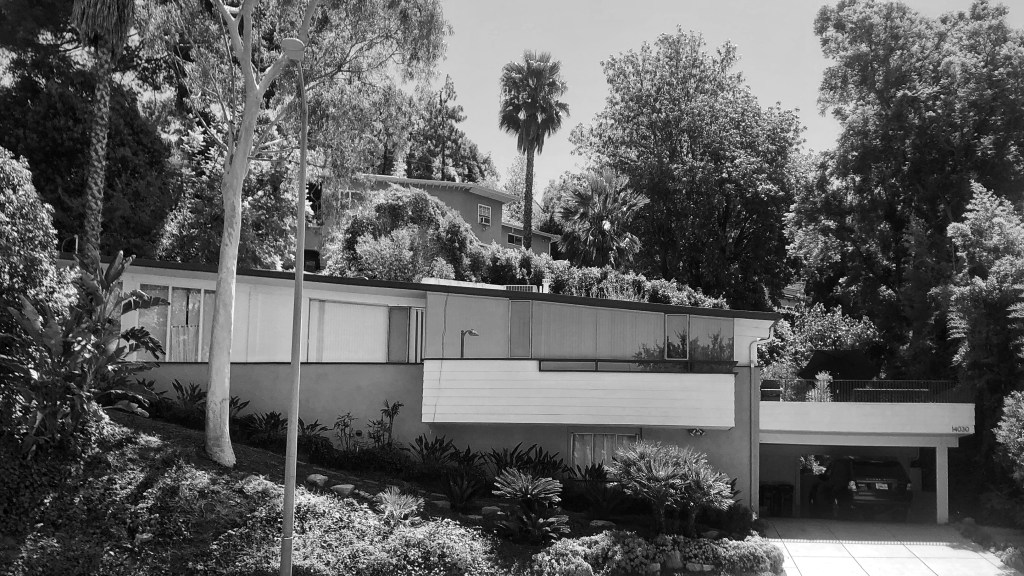
In the photo above is a version of The Perfect House at 14030 Valley Vista, Sherman Oaks, CA by Gal Harpaz, photographer.

The architect was born in Ferrara, Italy, a Jew who escaped when Mussolini came to power. Edgardo Contini, (1914-90) who was a founder of Gruen Associates and a planner in many projects in this city including the Pacific Design Center, the Fox Hills Mall as well as President of the Urban Innovations Group, the practicing arm of the UCLA Graduate School of Architecture and Urban Planning. He worked with Architect Charles Moore and participated in the Grand Avenue proposal for California Plaza on Bunker Hill.[2]

And during his lifetime in Los Angeles, Mr. Contini seemed to think that this city was in need of urban preservation, reuse of older buildings rather than outward sprawl. He wanted to end our wasteful, continual destruction of historical structures and our voracious consumption of wild lands and agricultural fields beyond the city.

He saw Los Angeles as more than the ideal house. He imagined a city where the health and well being of all was the optimal.  

What would he think of Studio City today where $3 million dollar houses are constructed steps away from people sleeping on mattresses along the LA River? Or of Van Nuys Boulevard with its’ boarded up businesses, homeless encampments, and dismal condition?

In 1972, he wrote, “We should place the emphasis on recycling, no further withdrawl from our resources of open land would be required/ and we will not leave urban litter behind.”

Are we better off today than we were in 1972? Or are we still, like Mayor Garcetti, just talking a virtue game and living in a cesspool? 

Where are all the big plans for humane and just architecture to heal all the atrocities of modern Los Angeles? Can we just survive and continue to build a city of flat-topped McMansions, backyard garage add-ons and $3500 a month apartments?

Is any large city in America as dirty as Los Angeles? Is any booming and billionaire saturated city in Europe? One looks to India to imagine our dystopian future.

The Perfect House is beyond most of our reach, but the better city should not be.


[2]Obituaries: Edgardo Contini, Architect, Urban Planner; by Leon Whiteson; LA Times, May 1, 1990.

A Twelve-Acre Parking Lot


Erwin at Sepulveda, Metro Orange Line Parking Lot.

When the Metro Orange Line opened in October 2005, it was a stunningly different type of transport system which combined a bus only road with a landscaped bike path that ran alongside. It cost about $325 million.

It connected North Hollywood with Woodland Hills, and eventually carried over 30,000 riders a day. Since 2015, due to Uber and Lyft, ridership has fallen to about 22,000 a day.

Hundreds of homeless encampments have sprung up on the bike trail.

But Metro forges ahead!

There are plans to create gated crossings at intersections to speed up bus travel. There are long-term ideas to convert the entire system to light rail and also build elevated bridges over Van Nuys Boulevard and Sepulveda.

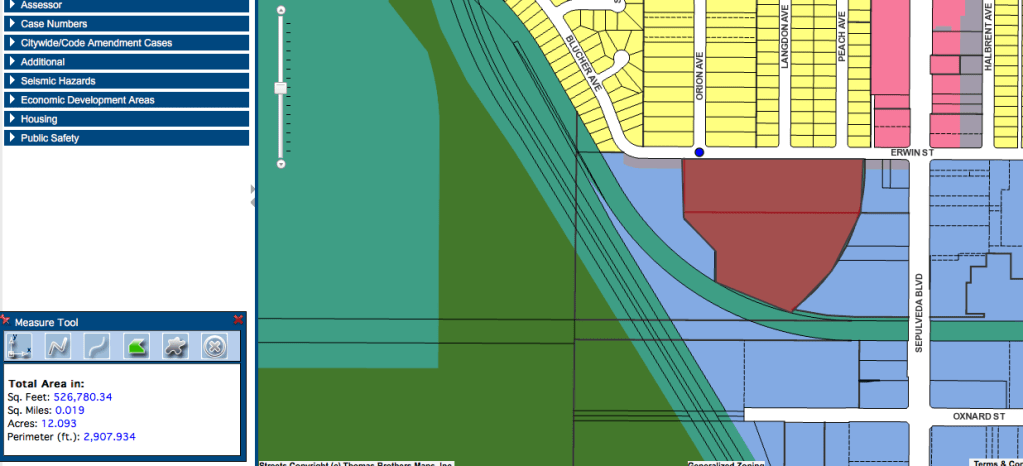
In Van Nuys, at Sepulveda and Erwin (north of Oxnard), there is a car parking lot for the Orange Line Metro riders. It is over 526,000 square feet, paved in asphalt, planted with trees and shrubs, and comprises over 12 acres.

Today, over 2/3 of it is used as an outdoor storage lot for Keyes Auto.

Red area is the parking lot of the Orange Line. It is now used predominately to store autos from Keyes Audi. (Source: ZIMAS)

The Sepuvleda/Erwin site is “Exhibit A” in the DNA of Los Angeles, because the right thing to do would be constructing 10-20 story apartments along the public transit route and creating incentives for residents to ride buses, take trains and use bikes for daily commuting.

Singapore Housing Estate with parks and nearby public transportation.

If LA were Singapore, Tokyo or Toronto we would do that.

Instead our city languishes and fights and wishes to preserve a 1950s idea of everyone going somewhere by car. 

And thousands of new cars are lovingly housed on land paid for by public taxes which should be used as housing and parks for the greater good of this city.

Nothing beneficial for Los Angeles ever happens overnight. It takes years of planning and legal battles, for example, to build assisted or low cost housing, or parks. 

One can imagine the fury and fear that might arise if a 12- acre park and housing development were planned on this parking lot ranch.

Imaginery view from Sepulveda and Erwin looking west. In reality, Singapore.

What, by miracle of God, might be possible here in terms of a park or high-rise group of apartments, placed near the bus line, with a buffer of trees, water features, and gardens between the new residential city and the single-family houses to the north of the site?

Yet here, alongside a public transit route, taxpayer funded Metro Los Angeles chooses to rent its land for an auto dealership. How does that benefit the surrounding residents?

For people who are obsessed with traffic, imagine that thousands of vehicles are parked here ready to be turned on and put onto the roads. How does that feel Van Nuys?

If the new planned housing estate were policed, regulated, secure, and it also provided a new park wouldn’t that be an improvement?

Orange Line Metro Parking Lot at Sepulveda/Erwin

“Once on a High and Windy Hill….”


Over the weekend, I was invited to a wake held in a family home somewhere up high in the hills of Sherman Oaks. 

The house was set at the end of an ascending private driveway.

But it was not an exclusive house, the intimidating kind we imagine these days. I saw no cameras or threatening signs. There was no menace, only hugs and handshakes.

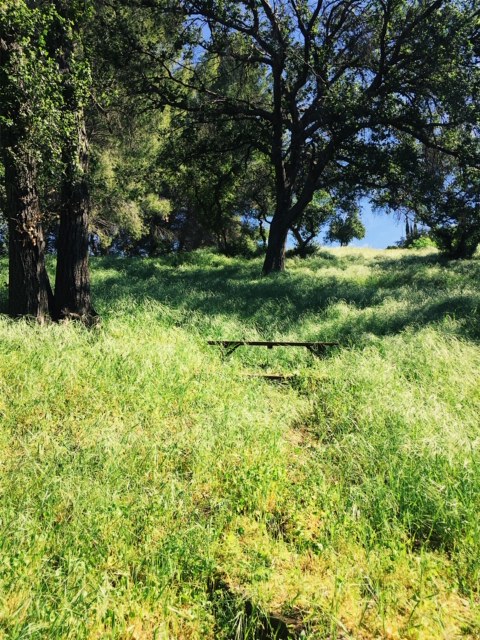
It was a 1952 ranch, un-gated, welcomingly decrepit, covered in shingles, set atop a ridge overlooking The San Fernando Valley, and a view to a vast, wild nature preserve. It was, indeed, charming, an adjective now banished from most residential dwellings in Los Angeles.

Inside was a dark, sprawling, old house with mourners, family members and friends, a table set with food, and more people sitting out on a flagstone patio, on plastic chairs, or, around the corner, drinking beer and smoking cigarettes. A lazy hammock sat in a dirt yard under many trees; a yard that lead up into a steep trail, also a part of the property, with mature oaks and wild grasses and an open steel trash can with discarded bottles and cans. 

Back inside the house, I walked into the kitchen, still furnished with the original knotty pine cabinets, and a 1970s Tiffany lamp that hung over a small breakfast nook.

There was a pamphlet on a table printed for the deceased, Angelica, who was born May 14, 1948 and died March 25, 2019 leaving behind a husband and two grown sons.

A photo of her, taken perhaps in the early 1970s, when she was about 25, showed a radiant, dark-haired woman.

I remarked to one guest that I expected young Natalie Wood, circa 1955, to walk out and greet us. Then, overhearing me, a very old man with a hearing aid, white-haired and frail, spoke up.

“I dated Natalie Wood,” he said. 

He went on to talk about his one date with the young actress. He called her home the next week to take her out again. But her mother said her daughter “was out with Jimmy.” 

And that was the end of a beautiful friendship.

I spoke again with the widower, smartly dressed in an old, well-made, V-neck cashmere sweater, in a heft and weight no longer made, and I offered my condolences.

Unsure of where to go, I wandered out into a tool shed in a room neither indoor nor outdoor. Decades of equipment was hung on walls, piled up on tables, and stacked six or seven feet deep. There was multiples of everything: clippers and rakes, ladders and screwdrivers, hammers and spray cans.

This was a house where you might have gone to a wild high school party one weekend at 16 or 17. There would have been 50 or 100 people, a live band playing, kegs of beer, people sneaking off into dark trails or behind closed doors to get high or get off. Vomiting, burgling, breaking, burning, the party would have ended with police cars, screaming parents and fistfights.

Our California Dream, a nostalgia for it, is a fantasy so intoxicating and so mesmerizing that we lust for it, we fight for it, and are consumed with getting it, but yet we must not devour it all at once, for it will eventually devour us.

How I miss those thrilling years I never had here.

Two days ago, I was wandering here, around the California I never knew, but the one that existed until very recently, a place where people never threw anything away, a region where houses were intertwined with wild nature, a state of life where people were high, intoxicated, sensual, creative, and building; an industrious land where leisure was work and work was leisure and no grown man ever outgrew childhood, happiness was just one hit song away, and every night at six a cold bottle of Chablis was uncorked.

Two days ago, Sunday, I took a platonic liking to a (middle-aged, how I hate that word) woman who looked like she was born inside a VW van, grew up in Malibu, and went to school barefoot near a rocky stream. She had the glazed look of someone who had too many compliments and too much stimuli thrown at her, so she withdrew, behind vagueness, to a guarded, opaque sensitivity in an emotional jewel-box.

I took her photo in the little hallway behind the kitchen. She was one of the cousins. 

Two days ago, I stopped to sit down with those not so young, boyish guys drinking beer and smoking cigarettes. My plastic chair kept bending, like it was about to snap, so I got up and went out to the driveway, and started to say good-bye to the host. We hugged and promised to get together soon.

But that house, a type marked for extinction, built for $16,000, purchased for $88,000, it haunts me. 

A verdant, natural, nestling, cozy refuge from the city, destined for the bulldozer and the investor. Why can’t it just stay the way it is? Why must people die? And why must their houses, their stories and their hearts fall into oblivion?  

Rise up dead people and sing again!

Last Sunday, up on Marble Drive, I was somewhere special. I met a ruined beauty still singing the old songs. She sang for me too, and I listened. And I hope to go back soon to hear her sing again.