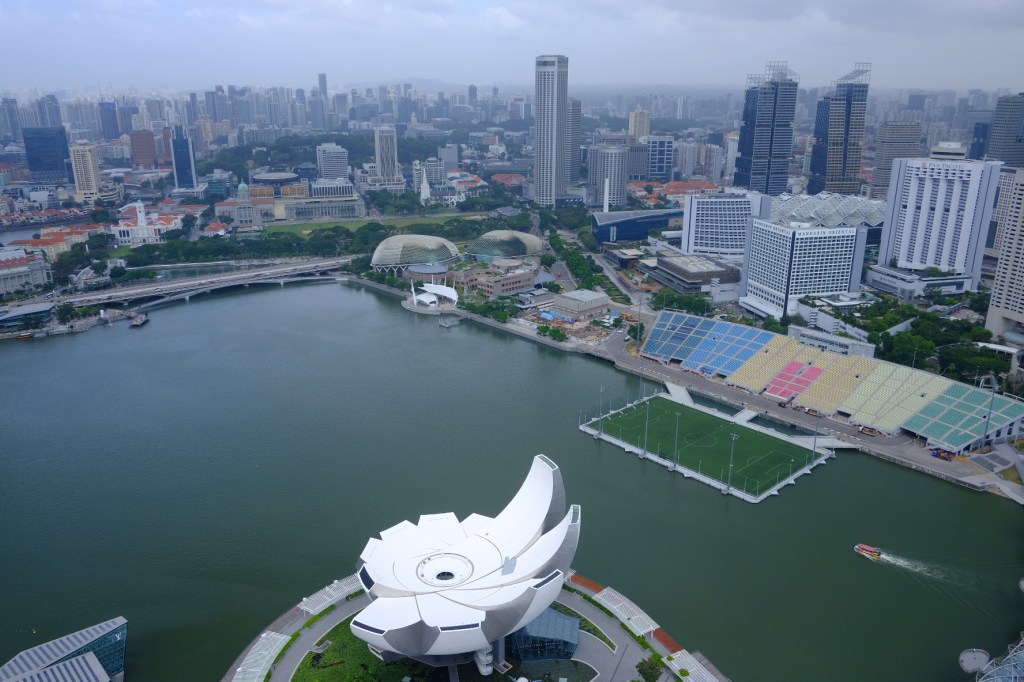
In Singapore, which I just visited for four days, I do not remember seeing any decorative streetlights, but I might have been looking, instead, at spotless plazas, copiously planted parks with enormous trees and bright flowers; or perhaps I was riding the air-conditioned MRT, easily navigating between scrupulously clean stations, labeled in easy-to-read signs, navigable by newcomers and citizens alike.
One day we walked up to the MacRitchie Reservoir where students, in the water, directed by coaches, were practicing and exercising rowing. They worked hard and still smiled. At the clubhouse I saw posted rules and regulations and fines for violating the laws of the recreation area, and still, all around me, everyone was peaceful and happy. Why shouldn’t they be? They were surrounded by order, nature, and safety.
I was unaware, until I returned to Los Angeles, that our city was removing fines for overdue library materials.
In Singapore, next to transit, are great food halls, called “Hawker Centres” which gather, under one roof, superb eating establishments: affordable, delicious and regulated by government inspectors. We ate at two: Tiong Bahru and Old Airport Food Centre.
In 2019, Los Angeles made it LEGAL to sell food on the street, so the lady who just finished cleaning her cat’s litter box and will shortly make your guacamole, can also sell it from her blanket next to MacArthur Park and not get arrested.
Often when people talk about Singapore, people who don’t live there, they bring up draconian laws that sound utterly terrifying. Death for drug dealers, chewing gum is illegal, and a recently enacted “fake news” law that might curb free speech.
Singaporeans I spoke to didn’t think about these laws, or believe they hampered their freedoms. Perhaps they were too happy enjoying the liberties of crime free streets, or sidewalks without homeless encampments. They probably were also feeling good while availing themselves in superb health care or government subsidized housing.
Incidentally, Singapore has public housing. Rules are that the residents must be legal citizens or permanent residents. 82% of the housing in Singapore is government run. So here we have a refutation of the tired conservative/liberal ideology that poisons American minds. There is such a thing as desirable government housing. And there is such a condition as limiting the use of these buildings to those who are lawfully in the country.
Singapore is rated number one or number two in education for its schooling. An 8-year-old boy, a son of a friend, helped me program my mobile phone so I could get internet coverage all over the city. Just one example of intelligence at a very young age that comes to mind.
What else can be said to praise laws, rules, order, safety, and yes, penalties, punishments and respect for social order? Can our nation, and our city, emulate Singapore? Or should we look to Mississippi, El Salvador and New Delhi for our future plans in transit, education, housing, health care and sanitation?
On the day we came back to Van Nuys, two men were shot and wounded nearby. Four were killed here in 2019 according to the LA Times.
“According to UN data, Singapore has the second lowest murder rate in the world (Data excludes tiny Palau and Monaco.) Only 16 people were murdered in 2011 in a country with a population of 5.1 million.”-BBC News In 2017, 11 people were killed in Singapore.
Am I freer in Los Angeles or do I live inside a city prison of another kind?
Western Avenue Off Ramp, Hollywood Freeway, December 15, 2019.
For almost twenty years I’ve made a home in Van Nuys, CA.
And since 2006, I have published this blog: walking, photographing and writing about a peculiarly blessed, and unjustly afflicted section of Los Angeles.
Here are some 11 ideas that I am proposing to better Van Nuys, especially Van Nuys Boulevard:
Kjellandersjoberg_salabacke_view-courtyard.
Create Walkable, Garden Court Housing
We need, desperately, little, affordable, small housing units that share common garden areas. These were built all over Los Angeles up until the 1960s when dingbats took over with their car-centric designs.
Such garden courts would be most effective within walking distance of major bus and light rail streets.
LAPD Koban (Japanese Style) booth at The Grove.
Relocate the Van Nuys LAPD to Van Nuys Boulevard
The Van Nuys LAPD is buried deep behind the Erwin Street Mall, way back from Van Nuys Boulevard. What this accomplishes is removing the police from active interaction with pedestrians, shops and the action, good and bad, on Van Nuys Boulevard. Putting the police station back on the boulevard where it belongs would send a message to the community that law enforcement is on active duty: watching and patrolling, enforcing the law.
Reduce the Size of Wide Streets and Plant Trees
When drivers see five lanes of road in front of them, but every single lane is packed with cars, or conversely, when there are wide-open lanes with few vehicles, both scenarios create frustration. The speeding, the road rage, the frustration of having so much space for cars and hardly any for bicycles or light rail, has caused the decay and decline of Van Nuys Boulevard, as well as Victory.
The heating up of our climate, the constant hot weather, is creating a meltdown of mood, with more anger, more violence and more irrationality. Trees would help cool down the street and provide shade. Narrower streets, lined with cafes, pedestrians, activity, would build a sense of community decency.
58277232 – singapore – march 18, 2016 : maxwell food center is the maxwell road hawker food centre is well known for its affordable, tasty and huge variety of local hawker food.
Hawker Centers Like Singapore
Singapore has “Hawker Centers” which are groups of different food merchants housed under one roof. A Singaporean can get off a train and within a few feet find delicious, cheap food in clean areas which are protected from the elements but still open air.
By contrast, Los Angeles has nothing like this other than Grand Central Market which is not next to a train stop. Van Nuys Boulevard would greatly benefit from one, large, enclosed, regulated building full of food sellers. This would bring the pushcart under control and provide a clean, reliable, fun, sociable place to eat and meet.
Billboard: Sepulveda at Victory
Give Commercial Buildings Without Billboards Tax Breaks
Billboards are so ubiquitous that we have wearily come to adjust our eyes to them. Yet their ugliness, their cheap, desecrating, looming presence brings down property values even while providing landlords with some income.
On every corner where there is a mini-mall with a billboard, the property owner who removes the signs should get a tax benefit because they are helping the community improve aesthetically.
A Monument When Entering Van Nuys
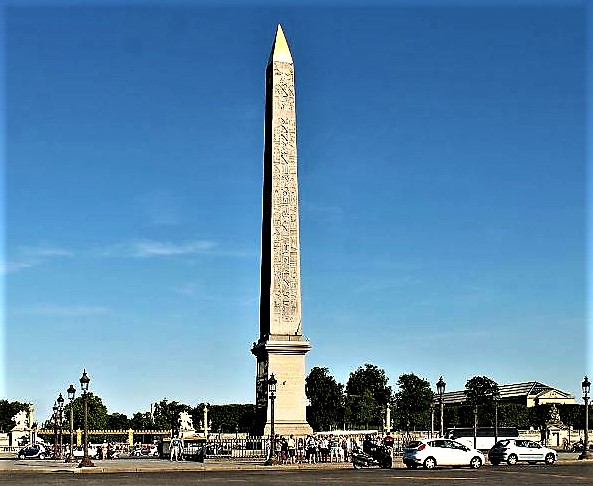
Why is there no marker, like an arch, an obelisk, or a gate when one enters Van Nuys Bl. at Oxnard Street?
Imagine a Washington Monument type obelisk in the center of Van Nuys Boulevard to make evident, proudly, commemoratively and architecturally, the fact that Van Nuys is a historic and proud area of Los Angeles deserving its own marker of identity and purpose.
Seen for miles, an obelisk perhaps 150 feet tall, should stand in the center of the boulevard, a booster of morale and an instigator of commerce and civic pride.
Santa Barbara, CA.
Pick a Unifying Style and Stick With it.
Paris, Santa Barbara, Charleston, Savannah: certain cities have an archetype of architecture which provides the base for how a city is constructed and designed.
In recent years, we have seen the onslaught of non-conforming, strange, computer-generated frivolities in architecture such as those which have marred and destroyed the beauty of London, England.
Yes, it is great to have one Disney Hall, but a street of melting blobs, narcissistic designs, starving-for-attention buildings, does not engender a district wide identity.
Strange Shaped Building: Vienna, Austria.
A classical Van Nuys would actually be revolutionary because it goes against so much architectural dogma these days and restores the primacy of community standards and group identity.
Tear Up the Parking Lots and Plant Orange Groves
One of the tragedies of Van Nuys since 1945, indeed of all of Southern California, has been the loss of agriculture.
Once we all lived near local fruit groves, and their soothing, healthful, beneficial trees provided not only big business for the state, but gave a mythical, blessed countenance to Los Angeles which was exported around the world.
There are hundreds of acres of unused asphalt sitting behind empty stores along Van Nuys Boulevard which could be torn up and planted with citrus trees.
Perhaps an innovative architect could design housing that is combined with citrus groves?
Kester and Aetna
Kesterville
This blog has actively supported the preservation of an area of 33 acres, containing light industries, near the corner of Kester and Oxnard.
“Option A” would have destroyed 58 buildings, 186 businesses and thousands of jobs in a walkable, affordable, diverse district and replaced it with an open air, light rail service yard.
It would have been disastrous for the revitalization of Van Nuys. If it had succeeded it might have been the final nail in Van Nuys’ coffin.
Instead, happily, the Metro Board, with the support of Councilwoman Nury Martinez and others, objected to the Option A proposal. “Option B” was chosen, near the already existing Metrolink train tracks, thus preserving the Kesterville area.
So now is the time to put Kesterville on the map and make it a harmonious, vibrant destination of little apartments, stores, restaurants, cafes, all along the public transit corridor next to the Orange Line.
Pashupatina: Ivan and Daniel Gomez in their shop which they completely renovated with their own hands and money in 2015.
Create Gateway Signs to Welcome People to an Area. Kesterville could use one of these!
9 Houses and 24 bioclimatic collective housing units by Fleury, Benjamin / Photo: Emmanuelle Blanc
Paris-Housing-by-Vous-Etes-Ici
9 Houses and 24 bioclimatic collective housing units by Fleury, Benjamin / Photo: Emmanuelle Blanc
Remove Onerous and Expensive Regulations on Housing
Builders are required, by law, to do so many expensive things that they are dissuaded from building.
One example is parking. The average building must spend 30-40% of its construction costs to provide space for vehicles.
Thus we have the paradox: not enough housing. And the housing we have becomes more expensive because there is not enough of it to bring prices down. And each rentable unit only becomes affordable if four working adults, with four vehicles, split the rent!
So now we have less housing, more cars, more cars parked on side-streets because we have, by law, made the construction of apartments so expensive.
Remove parking minimums and stop catering to the car as if it were the ONLY important thing in city planning.If a building were built with 200 apartments and only 100 parking spaces, would it really harm Van Nuys?
Is NYC harmed by scarcity of parking?
Homeless on Aetna St. Feb. 2016
Regulate Homelessness
California is often the destination for anyone living unhappily in any part of the world. Thus our state, because of its warm weather, attracts people coming here to escape.
Van Nuys, long considered the unofficial dumping ground of Los Angeles, is now under onslaught from homeless men and women sleeping everywhere, on bus benches, under boxes and tents, behind buildings and in RVs parked along the street.
We need to regulate where people can sleep by providing safe, clean, sanitary areas, to park RVs and where people can wash themselves, and get help so they do not have to sleep outside.
To talk about this is not to attack people who are in need. Rather, it is to assign us the proper legal and moral task of ending homelessness by not permitting it to exist in the first place.
They were young when we boarded Singapore Airlines at LAX, bound for Tokyo. 22 men and women, flight attendants, smooth skinned, well mannered, and slim, women with hair pulled back wearing Sarong Kebaya. Graceful, smiling, polite, they maneuvered in and out of the aisles, pushing carts, pouring tea.
The flight left on time and touched down in Tokyo as silently and softly as a Kleenex falling on a pillow.
The airports were dazzling, slick, architectural and inviting: Tokyo Narita, Singapore Changi, and KLIA. Customs officials in every nation were polite, well-spoken, welcoming. Everything they are not in Los Angeles.
The skyscrapers were young, newly built, tall, dropped into every corner of Kuala Lumpur: Icon Mount Kiara, Charigali Tower, 60 floors tall, St. Regis Hotel, 80 stories tall, Menara Tradewinds, Warisan Merdeka (118 Floors Tall!), KL Tower (Menara Kuala Lumpur) 1,381 feet tall, Ilham Baru Tower (62 floors). They were clearing out jungles, paving over valleys, erecting vast suburban housing and vertical towers in Cyberjaya, Shah Alam, Bangsar, Petaling Jaya. Soon, a high-speed train will connect Singapore, KL and Bangkok.
The land was young, landfill on the west side of Melaka, thousands of acres of new commercial buildings lined up like soldiers in a future army of retail, uninhabited infants. Old classical mansions that once stood on the shore were abandoned and empty, their contents stolen, their memories wiped clean.
The KL malls were new, full of shoppers, hordes of black haired boys and girls in bright scarves and long dresses, eyes glued in their smart phones, moving through vast air-conditioned, bright spaces. The Pavilion! KLCC Suria! Star Hill Gallery!
The Malaysian highways were new, and along the new landscaped lanes, billboards shouted advertising with smiling faces, multi-cultural Malay and Chinese faces beaming in Samsung, Jasmine Rice, Panasonic, Thai Airways, Telekom Malaysia, Air Asia, Hyundai.
The Malaysian born bride was young, effervescent, intelligent, ambitious, and well connected. She owned a condo, a house (under remodel) worked for a bank and travelled to Singapore, Bali, Jakarta, Hong Kong, Shanghai, Seoul, and Melbourne. She had a lot of friends, a lot of family, a lot of generosity and much love around her. She was the future, for just this moment, of a region where education and money are exploding exponentially.
And the trains in Tokyo, the intersections of Shibuya, Shimokitazawa, Ginza, Shinjuku, they were young, overwhelmingly so, populated with hundreds of thousands of post 1985 human beings pouring off the modern perfectly run trains, into stores and shops and cafes, hurrying everywhere, acquiring purses, shoes, makeup, perfume, suits, electronics.
Inside the endless shops of Tokyo Station, the bowing and the smiling, the serving and the selling, a furious, unabated, exhausting and exhilarating controlled carnival of commerce, this was Japan.
And everywhere, in every corner, the spirit, the energy, the optimism, the faith in tomorrow and the future, a region poised to take over the world, relentless in its work, socialized to harmonize, grouped en masse into money-making and modernism, this was young Asia.
I went here on holiday, for three weeks, to attend a wedding in Kuala Lumpur, to vacation in Phuket, Thailand and stop off in Tokyo for four days.
I came back to Los Angeles in culture shock. For what I saw back there made the Golden State seem dyspeptic, backward, self-congratulatory– without merit. Our new international airport had dirty windows; the customs people were fat and shouted angrily at passport holders. The bus was late and the driver made jokes (“This bus isn’t going to Van Nuys. Long Beach! Just kidding!”) that delayed our trip.
And the news was that the government was shut down. I thought of that on the 405 bus ride home, having just seen, 10 hours earlier, postal workers at work at Tokyo Station, on Sunday afternoon.
America is no longer young, in outlook or output, and I wonder if we even have any dreams left in our national imagination.
You must be logged in to post a comment.