Lost Opportunities.


I once wrote about The McKinley Home for Boys (1920-1960) which stood on the present day land of Fashion Square in Sherman Oaks. It was torn down when the Ventura Freeway plowed through.The powers that be (bankers, developers, councilmen) decreed a shopping center to be the the only economically viable usage for that land.

What we have now, is a martian landscape of disconnected large buildings which themselves are nearing the end of their life form. The shopping mall is a fading attraction, but what might replace it?

At Riverside and Hazeltine there is an enormous project to excavate the property around the former Sunkist office building, an early 1970s brutalist structure that swam in a sea of asphalt and whose redeeming qualities were fully grown fir trees which have now been completely wiped off the landscape. The name “Sunkist” was a cruel joke referring to orange groves in the San Fernando Valley that were long ago destroyed. The inverted pyramidal office will remain in the heart of the new apartment community, now renamed “Citrus Commons” and again, real estate wins, and the community loses, except to get more “luxury” units nobody without parental inheritance or assistance can afford.

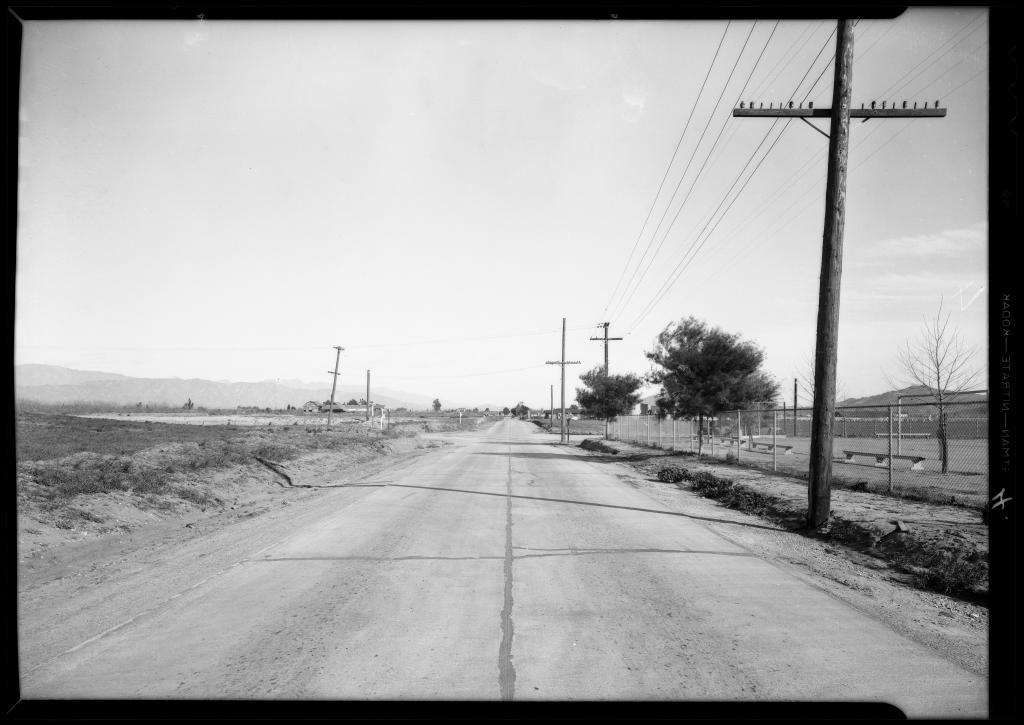
In the archives of the USC Libraries are these remarkable 1932 black and white photographs of the intersection of Riverside and Woodman when they were just rural roads in the middle of ranch lands. To the right of one of the images are benches and what might be the playing fields for The McKinley Home for Boys. Photographer was Dick Whittington.

The air was clean. Traffic was non-existent. The landscape was a tabula rasa for dreamers.

What do we have today, 90 years later?

The corner of Riverside and Woodman is four corners of disconnected “architecture.”

The NW is a late 1960s office tower in gold panels with an adjoining parking lot. Each floor of the sealed windows, mid-century “skyscraper” has unusable balconies, unaccessible from any office, just protruding forms signifying nothing, a decorative embellishment to make the tower fancier.

NE is the Spanish colonial high school Notre Dame with its good looking students from good families and good homes destined for good jobs and good colleges and good times.

SW is the ugliest shopping center in the San Fernando Valley with a covering of asphalt, outdated giraffe light posts on concrete posts, and a smattering of cheap and unnecessary stores: Bank of America, Pet Smart, Sports Authority and Ross. A parade of oversized vehicles with tinted windows and distracted drivers, and oversized people in black leggings; shoplifters, bank robbers, angry women, vapers and hucksters, actors and influencers, aggrieved SUVs, nearly deceased elderly drivers; pours in and out, all day, in the 100 degree heat, honking and pushing their way into a parking space.

SE is a 76 gas station, the kind that always has the highest per gallon price in the city, and several large billboards.

Everything else at this intersection is all about getting on or off the 101 freeway. Nobody would walk here willingly: burned by the sun, threatened by speeding cars, buffeted by air pollution and visual discordance.

What would this area look like if there had been a plan put in place for development with coherent architecture, walkable streets, trees, etc? Why do we think that mediocrity, ugliness, and environmental destruction are the best we can hope for?

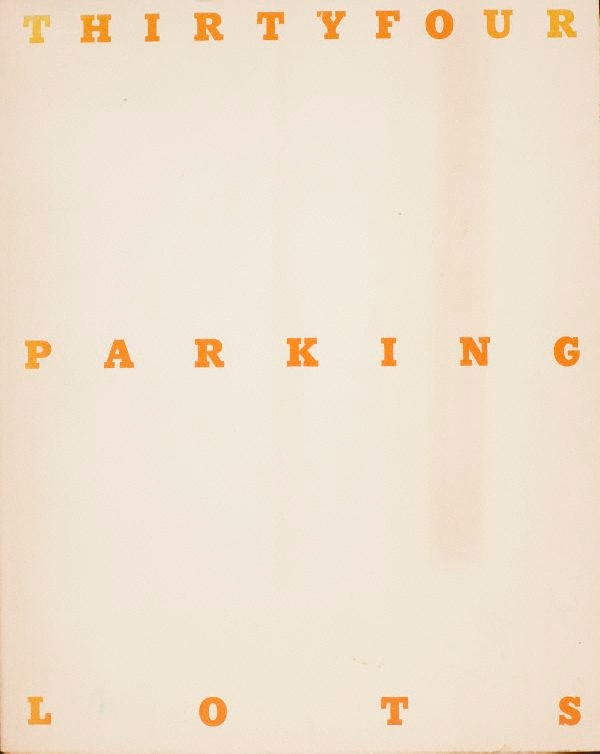
Thirty-Four Parking Lots in Los Angeles (1967)


Thirty-Four Parking Lots in Los Angeles (1967)

I previously wrote about this topic in 2014, but bring it up again as Los Angeles, and the State of California, are now in a furious debate about housing, cars, homelessness and how best to build.

All B&W photographs below are by Ed Ruscha. 


Ed Ruscha’s “Thirty-Four Parking Lots in Los Angeles” was published 51 years ago.

The artist, born in Nebraska in 1937, came to this city in 1956 to study at the Chouinard Art Institute. He also had an apprenticeship in typesetting.

Graduating in 1960, only 23 years old, he started working at an advertising agency doing graphic design. Influenced by the works of Jasper Johns, Robert Rauschenberg, Andy Warhol and Roy Lichtenstein, Ruscha was featured in a 1962 survey called “New Painting of Common Objects.”

That year he published “Twentysix gasoline stations” and later “Every Building on the Sunset Strip.” (1966)

He was the first, or perhaps the most notable artist, to create a deadpan, earnest, unesthetic photography of built Los Angeles. He looked, without pretense, at the sprawling, cheap, roadside city of billboards, car washes, instant apartments and filling stations and wrapped up his black and white photographs into little, smart, best-sellers.

Ruscha was talented and knew how to sell things, always a winning combination in the city of angles. (intentional)

The 1960s was a dirty flood of bitter reckoning that hit America and threw cold water on its made-up, powdered face.

Assassinations, sexual relations, racial issues, drugs, protests, music, environmental desecration, Vietnam: the entire decade blew up a contented self-image.

A nation, which thought itself a beacon of light onto the world, was forced to reconsider its own grotesque violence and misunderstand it.

Confronting Los Angeles, Ruscha presented a homely city with a picture book full of raw honesty.

State Board of Equalization 14601 Sherman Way, Van Nuys, CA.

May Co. 6150 Laurel Cyn NH

Inside “Thirty Four Parking Lots in Los Angeles” are some aerial shots of ordinary Van Nuys, North Hollywood and LA in 1967, with those enormous oceans of parking lots floating boat-like buildings.

Up in an airplane, looking down, Ruscha captured lines and boxes transposed upon the land, asphalt which looked, on its surface, much like the curtain-walled office buildings of that era.

Goodyear Tires 6630 Laurel Cyn NH

Good Year Tires at 6610 Laurel Canyon in North Hollywood occupies only a dot atop a long “I” shaped land-mass of parking.

Dodger Stadium

Dodger Stadium is buried deep within the hot skins of asphalt, a vaginal shaped structure where men played ball.

7101 Sepulveda, Van Nuys, CA.

And 7101 Sepulveda, a now abandoned office tower near Sherman Way, has trailers and motels on its perimeter, as well as plenty of free parking. Today, this area often hosts large encampments of homeless people, so the peripatetic ways of Van Nuys have historical precedent it seems.

Eileen Feather Salon 14425 Sherman Way, Van Nuys, CA.

14425 Sherman Way was called the “Eileen Feather Salon” and has but one long building fronting Sherman Way with parking in back.

Today, that corner is a cacophony of grossness and visual pollution including donuts and Denny’s. Signs are everywhere. And the weary eye becomes nostalgic for the simple joy of a lone building and its parking lot set down on arid land in the once less populated San Fernando Valley.


7128 Van Nuys Bl. 8/5/14

We are now engaged in a great civic debate about housing, and public transportation, and some voices hope (mine included) that denser buildings along bus and train lines will help alleviate high rents and homelessness.

Yet we never quite escape the trap set by the automobile: where to drive it, where to park it, how to best accommodate its needs.

Every single debate about new buildings always begins and ends with parking. Tens of thousands sleep on the street, families cannot afford rents or mortgages, developers are hamstrung providing parking for everyone and their guests, and Los Angeles dies a little each day from auto related illnesses.

Every time we think we are biking or busing more, something sinister comes onto the scene, and we now have 100,000 Ubers and Lyfts clogging the roads, and making our lives more hellish even as we praise their conveniences.

We plan a light rail down Van Nuys Boulevard and the auto dealers like Keyes stop it at Oxnard. They still run things. They destroy the city, and they are congratulated and worshipped for it. Thousands of their new cars are stored at outdoor transit adjacent parking lots built by Metro with taxpayer funds. Ironic.

Every time we imagine we are free of the car, we are forced back into it to chauffeur little white kids to school in better neighborhoods, to commute to $10 an hour jobs, to spend three hours every day in our vehicle so we might live in a house that consumes 50% of our income. Madness.

Ed Ruscha’s simple aerial photographs of parking lots are still a fact-based statement of what this city is. And how we are all swallowed into it.

Goodyear Tires 6630 Laurel Cyn NH

Van Nuys Boulevard: Between Sherman Way and Saticoy (Part II)


DSCF1064

Here are some additional photos from my exploration (along with “Up in the Valley” pal Andreas Samson) as we walked in the commercial neighborhood along Van Nuys Boulevard from Sherman Way to Saticoy.

John's Barber Shop

John’s Barber Shop (14435 Sherman Way Suite 105 Van Nuys, CA 91406) has only been open a year, but has garnered a devoted local following. I found them, again, on Yelp and went there today for a $15 haircut. Third generation barber Jerry said that owner John also comes from a long line of barbers. The styles adhere closely to the current “fade” trend evocative of the 1950s with greaser hair and short razor thin back and sides.

DSCF1061

Near John’s in another expansive mall, south of Sherman Way, one finds a variety of ethnic restaurants including Tacos Mexico (7140 Van Nuys Blvd Van Nuys, CA 91405) housed under a red and white taco shaped roof. Many reviewers give it high marks while some express the usual hatred for Van Nuys itself.


“The best Al Pastor tacos EVER!!! The marinated meat is heavenly and the seasoning is just perfect.”


“I know there are thousands of divey taco stands all over Southern California and I have tried quite a few, but I feel completely lucky to have found this little gem located in a shitty part of Van Nuys.”


“On this dank and dark corner of Van Nuys (with pawn shops, ATT Mobile units, and laundromats).”

7128 Van Nuys Blvd, San Fernando Valley, CA 91405(818) 780-8022

Oddly placed Korean BBQ: Duk Su Jang (7126 Van Nuys Bl.) which has been around for a long time but is not getting any good reviews from Yelp: “Extremely Poor customer service, not so fresh vegetables, ok meat, high prices, dirty and old building.”

DSCF1034 DSCF1031 Van Nuys/Sherman Way

Architecturally, logistically, aesthetically, the landscape of Van Nuys Boulevard at Sherman Way reflects the lowbrow tastes of the 1980s and 90s when small shops were cleared out and vast blacktops of asphalt and ungainly malls proliferated. On a hot day, this is one of the hottest places to walk, un-shaded by trees, drowning in exhaust fumes, and a nightmare for pedestrians to navigate with lumbering buses and speeding cars.

Van Nuys reaches the acme of ugliness at this point: cheap, crass, tacky, devoted to car and fast food, obesity and environmental degradation.

But within this suburban hell, there are many small businesses that are making money, employing people, and greasing the economic engine of the San Fernando Valley. A largely Latino population runs and patronizes the stores, shops, services and eating establishments, often paying cash for everything from transmissions to groceries.


DSCF1027 DSCF1059 DSCF1041


Matt Jalbert on North Hollywood and the Toxic Arrangements of Streets


North Hollywood.

Matt Jalbert writes:

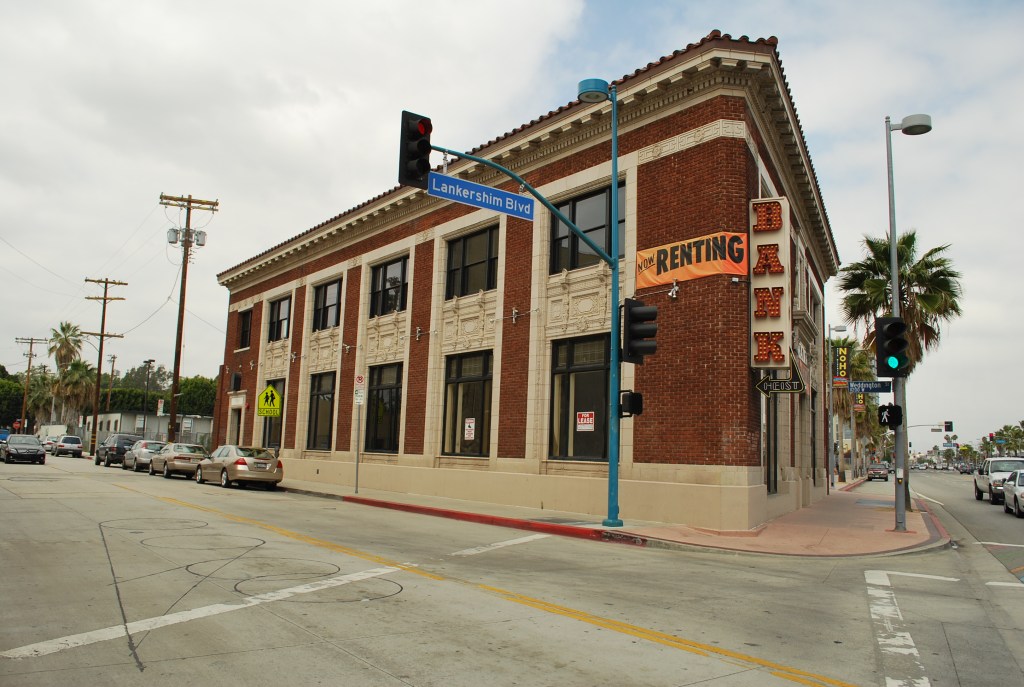
“I recently spent a short time in “NoHo,” aka North Hollywood (around Lankershim and Magnolia) where I was reminded of how utterly hopeless the sprawling project of Los Angeles is. There, in a “neighborhood” marketed to a new round of real estate suckers as an “arts district,” my overriding sense was of endless pavement, aggressive drivers, frightened and forlorn pedestrians, mostly lousy food choices, and a huge oversupply of commercial space. The same holds true for much of the San Fernando Valley.

Whatever promises were made to the American middle class by the developers of such living arrangements have been proven to be outright frauds. The L.A. pattern of car-centric living, especially in the post-WWII San Fernando Valley, is a cancer on society, evident on most of the citizenry, even some of those who profit from this arrangement.

North Hollywood in 2010 is yet another example of the failure of automobile-suburbs to result in healthy communities. Unfortunately, a few pretty buildings do not save this area, like the rest of the San Fernando Valley, from the toxic arrangements of streets designed for one mode only: vast flows of automobiles. That these areas are only a few generations old, yet are well advanced in their decay and social dysfunction, is all the proof any of us should need to recognize that the great experiment has failed and it’s time to make other arrangements now.

My sense is that people are starting to wake up to the lie they’ve been fed through the mass media — the lie that their car would set them free. (Stimulated by endless AM radio advertisements for leased Mercedes that would somehow make driving more bearable?)

Drivers are frustrated and angry, because no matter how rich they are, no matter how fat their asses grow, no matter how black and shiny their car is, no matter how witty the texts they write while negotiating the racecourse that is Lankershim Boulevard — they are imprisoned in a mobile prison cell, living an attenuated existence where every action they take is bludgeoned on both ends by a soul-killing automobile trip.

Better to rip the whole place down and rebuild it in a smaller, denser space. Keep a few of those fine old buildings, but otherwise, start from scratch, because what’s left on the ground for us all at this moment is simply not worth keeping.

God help Los Angeles. 26 years into my California experience and I’m finally understanding just how truly awful that place has been handled by the hands of man — in the service of automobiles. “