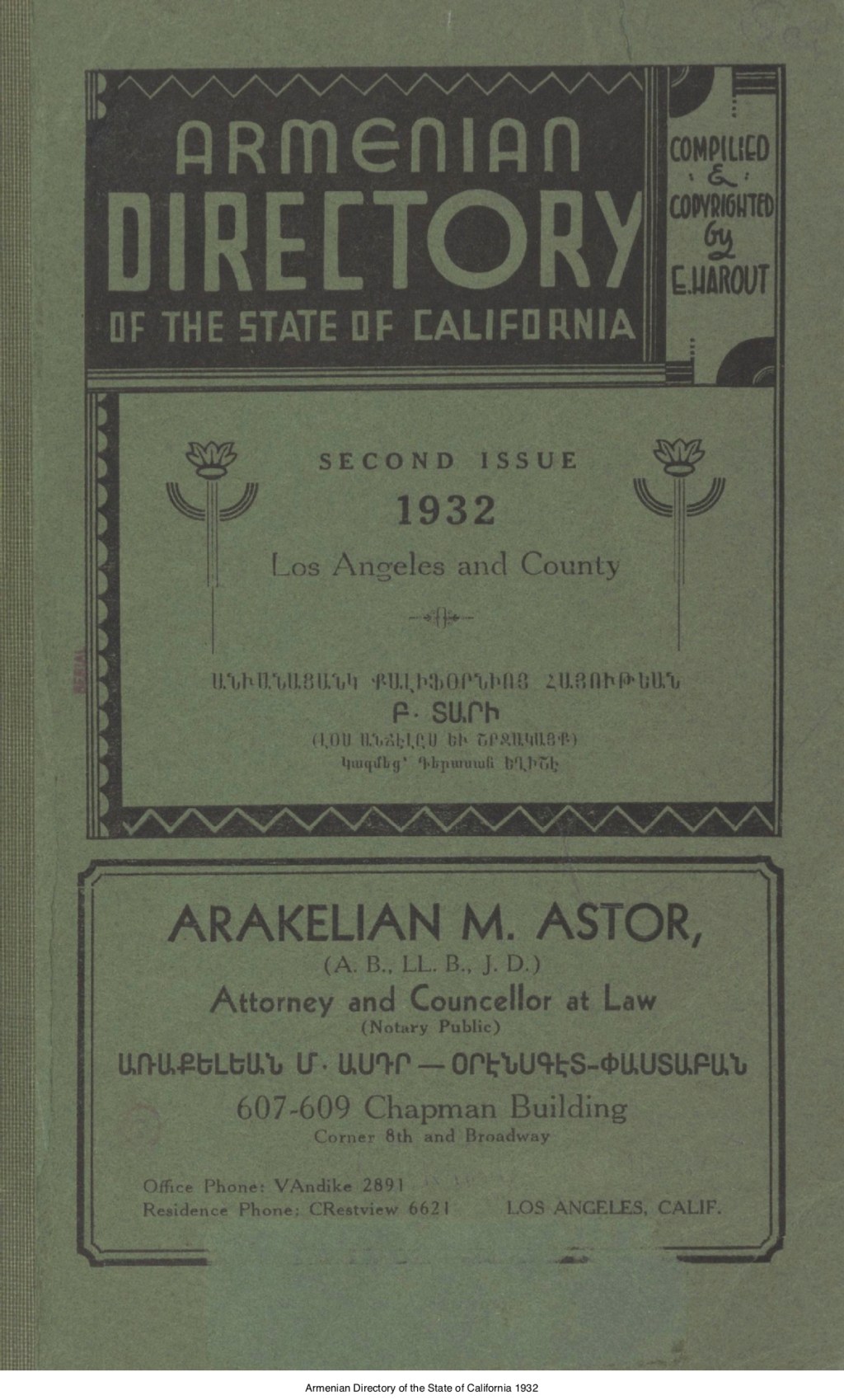
The Armenian Directory: 1932.


Within the collections of the Los Angeles Public Library there are city, business and phone directories going back to 1873.

Among the historic books can be found The Armenian Directory of The State of California, 1932, related to the Armenian community of Los Angeles, at that time, numbering a few thousands, many of whom were settled in Pasadena, and throughout the Southland.

The first wave of emigration from Armenia came after the First World War when Turks murdered millions of Armenians during the breakup of the Ottoman Empire. Most of the refugees came from Western Armenia near Turkey.

Here in Los Angeles they established an industrious, skilled, hard-working community. They built churches, founded benevolent societies, and created cultural and social institutions centered on music, food, and dance. 

Their professions in their new adopted city were many and varied and included dentists, physicians, attorneys, tailors, grocers, bakers and funeral homes.

The Standard Crate Co., Inc. built fruit boxes and gave “special attention to Japanese customers” many of whom grew citrus. Ten years later these same clients were rounded up and put into detention camps, a tragic and historical irony the Armenian advertisement could not foresee or imagine.

The Hollywood movie industry was already famous worldwide when the Antranik Dramatic Company advertised their actors. Mastery of frivolity has always been important in this city.

It seems that many Armenians did well here. 

The Altoonian Family, and their sedan, is seen below in a 1926 photograph. The 1933 directory lists an “Altoon Apartments” at 2405 S. Hoover, and several Altoonians who lived at that address.

At Joe’s Garage, 2505 E. 4thSt. the motto was “Once a customer, always a customer.”

A magnificent Art Deco ad for signs is a last breath of the 1920s with its rhythmic patterns and syncopated layout.

The Luther Eskijian family is shown in 1924, perhaps in front of their home at 1738 Bridgen Rd., Pasadena. Boys are in knickers, those short pants that children wore up into the mid 1930s.

The Constantinople Cigarette Shop at 356 South Broadway made special monogrammed cigarettes “which makes [a] splendid gift or present for your friends and relatives for their birthdays.” 

The International Grocery Co at 134 N. Main St. had such Armenian foods as aghy banir, lablebi, boulgour, chadana and fistuhk. Or cheese in brine, roasted chickpeas, crushed wheat, pine nuts and pistachios.  A one-gallon tin of olive oil was an enormous luxury item priced at $2.50 ($25.68 today).

Elegant tailoring was the province of Gregory H. Chashoudian at 4562 Beverly Blvd east of Western Avenue. His skills were endorsed by B.R. Ware, Attorney, who said Mr. Chashoudian’s suits were “entirely satisfactory” and reasonably priced.

The world was in the midst of the Great Depression. 

Yet looking through the pages of the Armenian Directory in 1932 one feels a sense of pride and admiration for these industrious people who overcame such grueling tragedies and unjust cruelties. 

They somehow made it to Los Angeles, CA and established stable and prosperous lives in a new and unfamiliar land.

Los Angeles.


los-angeles-slums-in-the-great-depression

Los Angeles, it seems, is often in a housing crisis.

UCLA has a collection of historic photos of our city, and from their extensive archives, I pulled out a few to show that poverty, sub-standard housing, and homelessness, are life conditions that ebb and flow in both good times and bad.

In the 1930s, during the Great Depression, some 25% of American workers had no work at all. No income, no livelihood.

Many picked up their lives and their families, escaping the Dust Bowl farms in Oklahoma and Kansas, and came to Los Angeles which promised, then, as now, some deliverance from suffering near Hollywood, under the warm sun, to get cleansed of sin and pain in salty ocean water.

But Los Angeles was not Eden. It had slums galore. Within sight of City Hall, wooden shacks housed poor people. There were many neighborhoods that still had unpaved streets, mostly inhabited by Mexicans and blacks.

wartime-housing-in-little-tokyos-bronzeville-los-angeles-calif.jpg

los-angeles-slums-in-the-great-depression-copy.jpg

1934, unpaved streets, Los Angeles, CA. “Las Olas Altas” (High Waves)

slum-sought-out-during-sera-housing-study-los-angeles-1934

In 1933, the average American earned $29 a week ($4.25 a day or $1,500 a year). A family of five, say mother and father and three children, had to live on that paltry income.

Under the leadership of FDR, the New Deal attempted to ameliorate poverty by sponsoring government work building roads, parks, planting trees, and constructing public works such as dams, bridges and post offices.

men-pose-for-a-photo-after-working-in-a-community-garden-circa-february-1934-

When FDR ran for his second term, in 1936, the aristocrat who worked tirelessly for the common poor man spoke these words about the oppressive forces who ruled the land:


“We had to struggle with the old enemies of peace–business and financial monopoly, speculation, reckless banking, class antagonism, sectionalism, war profiteering.


“They had begun to consider the Government of the United States as a mere appendage to their own affairs. We know now that Government by organized money is just as dangerous as Government by organized mob.


“Never before in all our history have these forces been so united against one candidate as they stand today. They are unanimous in their hate for me — and I welcome their hatred.”


What would Trump say to that?


It took World War II, and the enormous engine of wartime defense spending to inject money into Los Angeles. Factories, aircraft plants, steel mills, weapons manufacturers, all of them set up shop in this arsenal on the Pacific Ocean.

After the war ended, the government created housing, highway and school spending programs to provide work and prosperity for the State of California. So much of what we think of as individual initiative was created by the Federal Government so that Americans would have work and income.

Hansen Dam: basilone-homes-veterans-housing-project-in-san-fernando-valley-calif-1947

31 Years Ago: maureen-kindel-inspecting-homeless-sidewalk-encampment-on-skid-row-in-los-angeles-calif-1987

Now, once again, we are in a new type of housing crisis with people living on the streets. Our new cruelty is compounded by an opulent prosperity that has dropped great real estate riches on many who bought cheap, or inherited property, or by sheer luck ended up in the right favored neighborhood.

But tens of thousands are living in cars, sleeping on trains, camping out under bridges and along rivers.

And how we meet this challenge, which sickens, disgraces and saddens us all, will be the next great test of character in the city of Los Angeles.

Easy answers about arresting people, deporting them, rounding them up and shipping them to desert camps tempt us. We think every dirty, distressed man and woman on the sidewalk is a lazy alcoholic, a lost drug addict, a violent, crazed criminal.

Yes, character counts, that announcer on KNX 1070 intones.

And it is hard not to hate the debasement of our parks, the volume of garbage, of shopping carts, of debris, stacked up like mountains along the freeways, under the overpasses, along skid row, and in every single alley in Los Angeles. Needles, feces, and beer cans are not compatible with little children playing on the swings in Woodley Park.

It is all becoming monstrous. Our city is slipping into a kind of hell.

But where is the humanity and where is the law and where does reason meet mercy so that we come to some guiding policies to end the barbarism of allowing encampments of lost souls to wander and fall down under the blue skies in the City of Angels?

Perhaps we un-officials need to start doing work, to prepare ourselves to heal, to care, to mend, to bring together this grieving metropolis of want, while waiting for deliverance from the Mayor and the Almighty.

But what, dear God, is the way forward?


“For a brief moment I forsook you, But with great compassion I will gather you.”- Isaiah 54:7

Victory Bl. near Sepulveda., 2018.