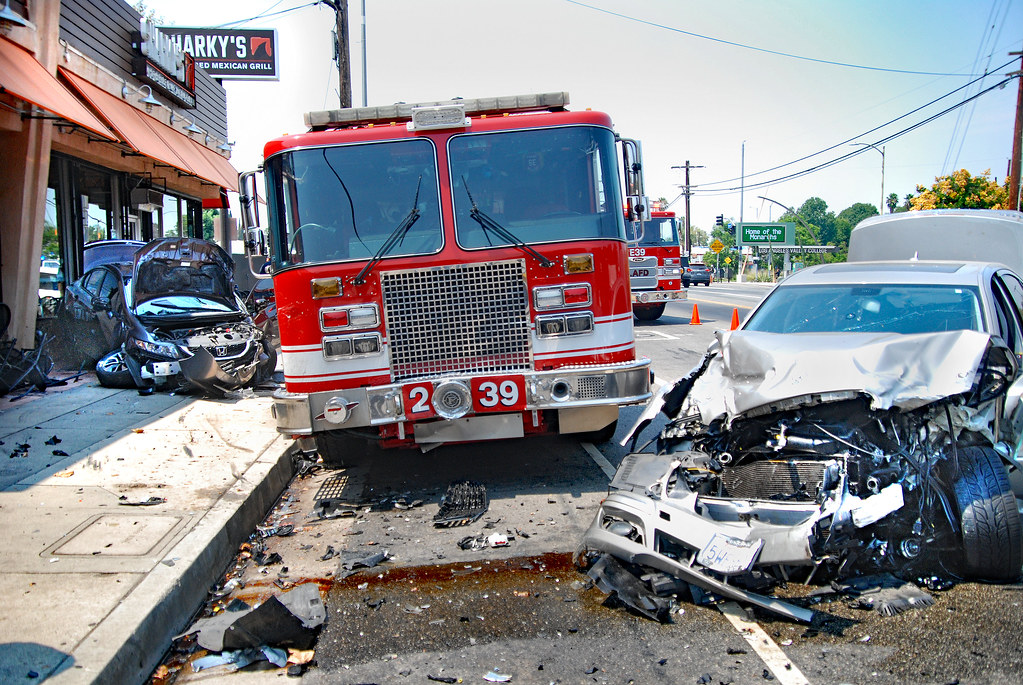
Speeding, eight lane wide streets, bike accidents, car accidents, injuries and death.


© Photo by Mike Meadows via Flickr.

Essay reprint.

Why Do Firefighters Oppose Safe Streets?

By Josh Stephens  

February 25, 2024

Ballot Measures StreetsWalkability

A few days ago, I drove from west Los Angeles to Whittier, a leafy suburb founded by Quakers on the eastern edge of Los Angeles County. Just east of downtown Los Angeles, I got on the 60 Freeway and took it to the 605.

I kid you not, every single billboard along this route advertised one of two things: insurance or accident attorneys.

I lost count of the latter. There was Jacob Imrani, Anh Phoong, Sweet James, Morgan & Morgan, and the dean of Los Angeles accident attorneys, Larry H. Parker, who’s been “fighting for you” seemingly since the days of covered wagons. Pirnia Law sponsors UCLA athletics and appeals to the fraternity crowd with the most bro-y slogan in legal history: “putting the ‘lit’ in litigation.” The Pirnia billboard I saw on Friday promised, “We run L.A.,” whatever that means.

(An aside: if you’re going to be an accident attorney in Los Angeles, it is, apparently, mandatory for you or your avatar to have facial hair, ideally a goatee.)

These billboards all make for an ugly drive. Granted, it wouldn’t have been any less ugly if they advertised something else, like soda pop, cigarettes, or, well, cars. What’s remarkable is that, in a county with a $750 billion GPD, these are the only businesses that seem willing to spend money on outdoor advertising. Sadder still: there is a robust market for their services.

Our society is as litigious as it is dangerous.

Between 2013 and 2022, Los Angeles County averaged around 54,000 fatal or injury crashes annually (the vast majority being injury-only crashes). I’m pretty sure the only people who celebrate those statistics are the attorneys. And yet, the crashes persist.

One city in Los Angeles County is attempting to do something about car accidents and, especially, the hazards they pose for pedestrians. On March 4, voters in the City of Los Angeles will consider Measure HLA, an initiative that would force the city to implement its Mobility Plan 2035, which was adopted in 2015. Backers of Measure HLA say that the city has implemented as little as 5% of the plan. Meanwhile, some 300 deaths take place annually on the city’s streets.

HLA promises a revolution in active transportation and the pedestrian realm. We’re talking about enhanced sidewalks and crosswalks; street furniture; trees; dedicated bus lanes and upgraded transit stops; bike lanes; traffic calming; and more. It’s the sort of mobility bonanza that activists and progressive planners have dream about. It could turn at least a few of Los Angeles’s ugly, dangerous thoroughfares into places that people where people just might want to hang out.

HLA will not be cheap. A recent analysis by Los Angeles City Administrator Matt Szabo estimates it will require $3.1 billion. Supporters dispute that number and, of course, argue that the promise of lives saved and streets beautified justifies a major investment.

Now, our friends on the billboards haven’t come out against Measure HLA, as far as I know. Even they aren’t brazen enough for that. And yet, someone else has — the firefighters of the Los Angeles Fire Department.

Let that irony sink in for a moment.

The firefighters claim that many of these street improvements could interfere with emergency responses. “Every second counts. The road diets slow down our firefighters,” Freddy Escobar, president of the United Firefighters of Los Angeles City Local 112, told the Los Angeles Times. “And it will be so much worse with HLA.” In other words: we don’t want a hook-and-ladder truck getting hung up on a bulb-out or squeezed by a bike lane.

I give due respect to emergency responders, and I get that the firefighters have their priorities–especially when it comes to saving lives. But the mobility plan isn’t merely about aesthetics. Its point, in fact, is to save lives: not by responding to accidents but by preventing them in the first place.

In 2023, 336 people died in traffic-related deaths in the City of Los Angeles (half were pedestrians). Meanwhile, between 2014 and 2019, the average number of deaths from accidental structure fires was 14. I hardly want to pit one sort of tragedy against another. But, let’s face it, governance is always about priorities.

And, indirectly, Measure can improve public health by promoting walking and biking and even by fostering social relationships. It’s a lot easier for neighbors to get to know each other when they’re walking down the same sidewalk than when they’re both racing to make the yellow light. And, however harrowing a fire may be, at least most of them are accidental and isolated. Measure HLA attempts to undo an entirely intentional, nationwide disaster.

The firefighters thus miss the city for the buildings.

It’s not the first time, though. Many cities’ street dimensions are already dictated by the size and performance of fire trucks. And, last year’s successful AB 835 made the case that fire codes that require most multistory buildings to include two stairways (for emergency egress) severely constrain the way residential buildings can be designed and, indirectly, make California cities uglier and more expensive than they’d be if buildings were allowed to have only one stairway.

I’m not an expert on emergency response. But I’ve been involved in urban planning long enough to know that, in too many instances to cite, the very people who are trained, paid, and empowered to design our cities somehow get shoved aside. Meanwhile, veneration for emergency responders — much of it well earned — has often given them, and their unions, unduly loud voices in the civic discussion.

Not this time, though.

What’s especially bonkers about the firefighters’ opposition to HLA is that they are almost alone. The list of groups that have endorsed it is not just long — it’s also among the most diverse you could ever imagine in Los Angeles. Plenty of other unions support it, including the SEIU and the teachers union. Elected officials have lined up in favor of it. Seemingly every mobility, environmental, and social justice organization has too. Democratic groups support it, and so does the Los Angeles County Business Federation. If ever a group could be expected to oppose a measure that de-emphasizes the use of cars, it would be the United Autoworkers — but, no, they’re on the list too.

For all of this enthusiasm, I’m not sure that the mobility plan will cure all that ails Los Angeles’s streets, even if it’s supercharged by Measure HLA. And I certainly don’t know if $3.1 billion — or whatever the true amount is — would be a sound investment. But, the fact that concepts once as obscure and forlorn as “complete streets” and “active transportation” are on the ballot in a famously car-centric city has to be good news, for planners and pedestrians alike. It has at least a chance of making the city safer and more attractive.

Of course, I don’t expect those billboards to come down any time soon, and we’re probably stuck with the freeways too. But we can at least hope that some of those attorneys go out of business.

Crossing Ventura.


Sometime in late 2018, early 2019, I’m not sure exactly when, they created a pedestrian crosswalk, with flashing lights, across Ventura Boulevard. at Ventura Canyon Avenue.  The crossing is about a block east of Woodman and a few doors down from Yok Ramen at 13608 Ventura where I go about once a week.

This is in the heart of Sherman Oaks, where stores that paint your nails, sell used records or live birds are sprinkled along the boulevard along with massage, dry cleaners, and laser skin treatments. And Floyd’s 99 Barbershop where every customer from 18-80 is a rock star.

I’m familiar with this area and its friendly banalities.

About 20 years ago, I knew a divorced woman in her 40s, with a little girl’s voice, who spent most weekday mornings at the location where the ramen place is now. 

Back then it was a bakery and a coffee shop with big muffins and big mugs, chocolate croissants and caloric treats. She sat at a table with her journal and wrote music and poems. Today she is retirement age, married and living in rural England.  And that’s how I got to think about the time passing and the way people pass time on Ventura Boulevard. 

As Orson Welles once said, “The terrible thing about L.A. is that you sit down when you’re 25 and when you stand up you’re 62.”  

And if you spent a couple of decades eating chocolate chip muffins on Ventura Boulevard what have you got to show for it?

To keep people alive, and moving, mostly in cars, the people and “leaders” of Los Angeles have devised, through the years, the same kinds of ideas to make safer the naked and shameful stunt of walking across Ventura Boulevard.  These include longer pedestrian signals, traffic islands, and painting the street with lines or figures to indicate that humans on foot also roam in the land of cars.

We tweet in seconds about trivialities like nuclear war, impeachment or the fires in Australia but we cannot assume that six decades will correct the urban failures of Los Angeles. Photographs from the past prove my point.

On November 30, 1959, Dr. Louis Friedman, Dentist, painted his own crosswalk, with a corn broom, on the pavement at Murietta and Ventura, to protect his patients. He had unsuccessfully asked the city to do so but his requests were ignored. So he took the initiative and laid down the lines.

That same year, Carl Stezenel, 10, of North Hollywood stood at the corner of Radford and Ventura and tried to cross in the time allotted, 9 seconds. If a 10-year-old boy found that challenging, imagine the typical woman of that era in high-heeled shoes, gloves, hat and a cigarette pushing a baby buggy?

Carl Stezenel’s plight may have influenced a December 1, 1960 dedication for a new landscaped traffic island at that same location. Men in suits (a sure sign of importance) attended the event, in a district whose distinguished architecture featured auto dealerships and gas stations. 

Five years earlier, in 1955, motorists on Ventura near Dixie Canyon Avenue were warned that they were approaching a nearby school by a painting on pavement of a running boy with a ball. 

People who worked and shopped in the area did care about how it looked. Years before it was considered normal and decent to allow tens of thousands of intoxicated and mentally ill people to live on the streets with garbage filled shopping baskets, the issues of why there was no tree cover on the boulevard haunted the civic minded. 

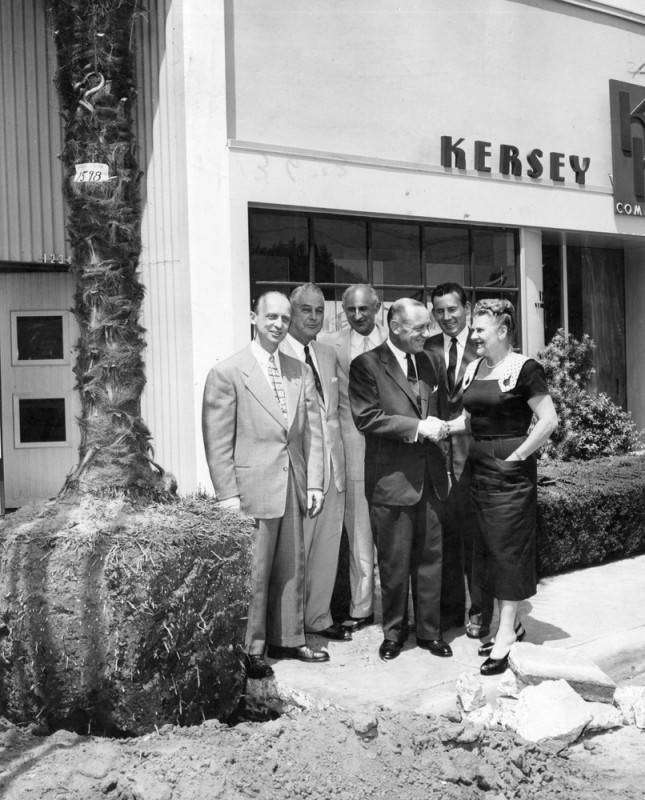
The palm tree, with a trunk so skinny it could never crowd out a Cadillac at the curb, was the obvious solution.  

Studio City is now lined with palm trees, a species that provides no shade to sidewalks that are baked in sunshine 350 days of the year. In 1954, the first palm trees were planted as part of a beautification scheme. Fully grown, their trunks look like posts without billboards, a perfect style for this city.

The sameness of businesses in the late 1950s along Ventura Boulevard presented problems. We, who are of CVS, Starbucks and Chipotle, may understand that historical plight.

Studio City and Sherman Oaks had a competitive streak. 

To bring customers between the two districts, a special free bus was introduced on February 18, 1959. If you had a watch that needed repair, wanted to purchase panty hose, a typewriter ribbon, or a cigarette case, now you had a no fare bus to take you up and down Ventura Boulevard, opening up a world of possibilities. 

That bus must have been cancelled after 10 episodes.

Further east, at Balboa and Ventura in Encino, the traffic situation was already dire in late 1953 when work-bound suburban residents were forced into only two lanes of eastbound road, while the westbound, going into less populated Tarzana and Woodland Hills was free of congestion. The solution: three lanes in the morning, and then move the cones and make it three lanes westbound at night. 

Eventually, the current road was widened into three lanes in each direction, with an advanced staring-into-the-sun design for morning and afternoon drivers. 

High rise office buildings sprung up in the 1960s and 70s, some as high as 15 stories, but nobody in the single-family neighborhoods nearby cared because the occupants were white and well-paid. Today, a four-story tall apartment with 130 apartments, and 3 affordable units is considered social engineering and overcrowding by many in Encino.

We are now into the third decade of the 21st Century and Ventura Boulevard still lacks safe pedestrian crossings because most drivers and pedestrians are looking into their mobile devices.

Photo Credits: LAPL/ Valley Times Collection

Six Decades Ago Along Sepulveda Bl. in Van Nuys.


Automobiles travel in both directions on Sepulveda Boulevard where it crosses Saticoy Street in Van Nuys; direction shown is unknown. A billboard advertises Signal Gas, pumped next door at the service station (left).

Six decades or more along Sepulveda Bl in Van Nuys, life was very different than today.

People conducted all their daily activities, from work to shopping, in automobiles. They were frustrated by traffic, and there were many accidents. This started early in the morning, before sunrise, and continued long after dark, in a slow, honking, and impatient parade of tens of thousands of trucks, cars and buses.

Photograph caption dated January 5, 1961 reads, “This modern supermarket at the corner of Sepulveda and Victory boulevards in Van Nuys is the latest addition to the expanding Dale’s Market chain which now operates 10 stores in the Valley.” (LAPL)

The buildings along Sepulveda were a motley, junky collection of fast food, auto repair, filling stations, car washes, cheap motels, hardware, liquor and supermarket businesses dropped down between billboards and wooden power poles.

There was nowhere that was pleasant, in the sense of a community, with proper landscaping, trees, amenities, or aesthetic zoning regulating signs or advertising. 

There was no trace of grace, of history, of the old Spanish missions, the orange and walnut groves, the spectacular trees, flowers, and natural beauty that characterized California. Everything was garish, commercial, toxic, selling everything that polluted and sickened human beings in a circus of raucous, blind, aggressive hucksterism.

Photograph caption dated March 9, 1959 reads, “Hub Furniture Stores newest location on Sepulveda and Nordhoff in Van Nuys marks the 14th Hub Store in the greater Los Angeles area. March 14 is the opening day.”
Photograph caption dated March 3, 1961 reads, “Sherman Way and Sepulveda.” This intersection tied with Century and Airport boulevards for fifth worst intersection, each with 20 accidents in 1959.;

Even with many new, lovely ranch homes, built after the war, on the residential blocks nearby, the general appearance of Sepulveda was ratty, unappealing, low class and frightening.

Mr. and Mrs. Audie Murphy and son, 6233 Orion Ave. Van Nuys, CA, 1953

Holdups at liquor stores, kidnappings, harassment of women by men driving past, littering, dumping, intoxicated drivers; in every respect related to civilized life, mid-20thCentury Sepulveda Bl. was so very different than today.  

Billboard: Sepulveda at Victory, 2018.
Photograph caption dated May 19, 1955 reads “All State Carpets, 5900 Sepulveda Blvd., is one of the many stores participating in Van Nuys Friday and Saturday Dollar Day sales event. This is the home of All State Carpets where fine quality carpeting is available.”
Photograph caption dated March 3, 1961 reads, “Cars whiz through the Valley’s most dangerous intersection. Victory and Sepulveda boulevards listed 22 collisions.


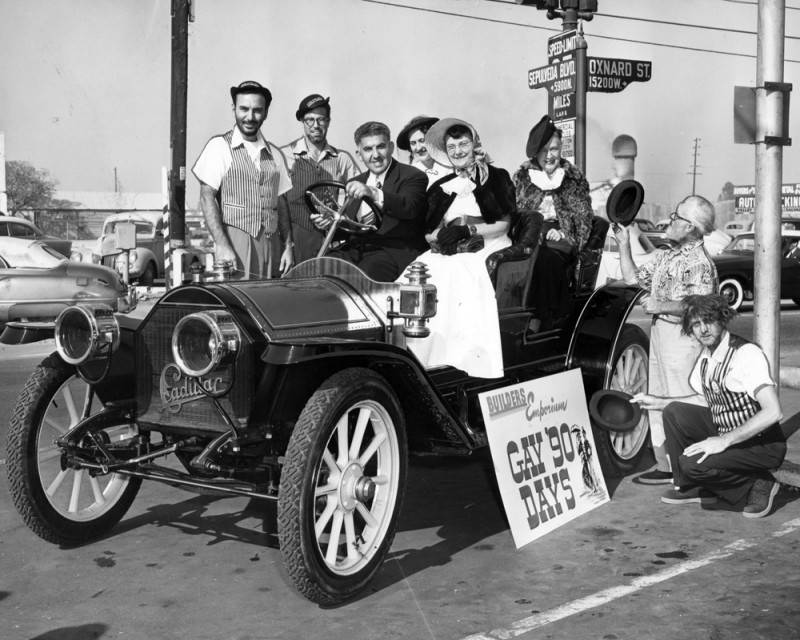
The only thing that remains the same is the presence of openly gay events, something that was even advertised on a sign in 1954.

Photograph caption dated October 20, 1954 reads “‘Gay Ninety Days’ at Builders Emporium, Van Nuys, is opened by Victor M. Carter, at driver’s seat of early-day Cadillac, firm’s president. Featuring month-long event is ‘good old fashioned prices,’ bearded salesmen, and 5,000 derbies to be given customers. In picture, left to right, are Jay Delia, Mel Goodman, Carter, Margaret Porth, Marthie Ferderer, Helen Ireland, George Blum and Lou Johnson.”

The Bus Bench


“Despite a growing population and a booming economy, the number of trips taken on Los Angeles County’s bus and rail network last year fell to the lowest level in more than a decade.

Passengers on Metropolitan Transportation Authority buses and trains took 397.5 million trips in 2017, a decline of 15% over five years. Metro’s workhorse bus system, which carries about three-quarters of the system’s passengers, has seen a drop of nearly 21%.”- Los Angeles Times, Jan. 25, 2018.


Let’s imagine a 62-year-old woman, Berta Gonzales, who lives in Van Nuys, near Victory and Sepulveda, who still works, as she has for the last 55 years, doing whatever she can to bring in cash for herself, her husband,  her two adult children and six grandchildren.

She works as a housekeeper, and she takes the #164 bus, every morning, at 7am, from Victory/Sepulveda to her job near Warner Center, a commute of 33 minutes.

When she gets off the bus in Woodland Hills, the temperature these days is around 80, but when she leaves her job, after cleaning bathrooms and vacuuming floors, doing laundry and dusting, around 2pm, the thermometer might be 110.

Last year she twisted her ankle when she slipped on a freshly mopped floor.  She hobbled around on a special shoe, using a crutch to walk, and she tried to stay off her feet if she could. She has no medical insurance, of course.

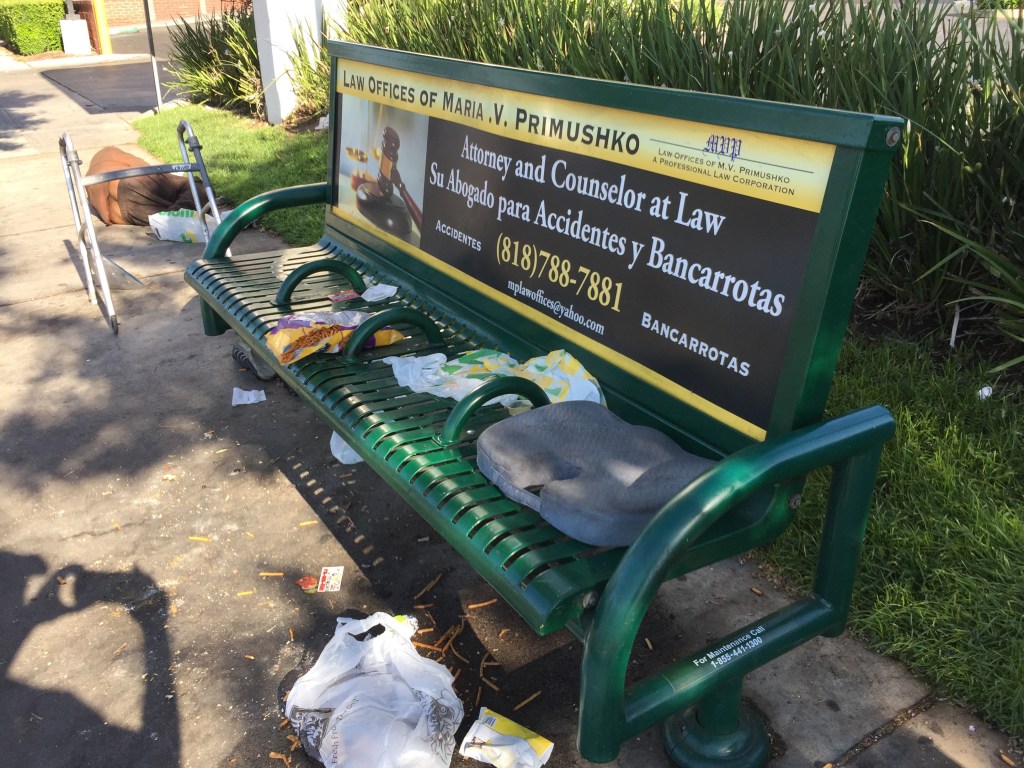
In the morning, when she waits for the bus, next to the bench without any sun protection, she is made to stand. Because there is a drunken, sick, filthy man sleeping on the bench, with all of his dirty clothes, his smell of urine, feces, body odor and beer, as well as half eaten and discarded food such as spaghetti, pizza, and empty alcoholic cans.

This is his spot. All the legitimate and necessary uses of the bus bench must be thrown out because his sickness and his selfishness, whether deliberate or accidental, is the most important thing catered to.

He has been here for months, if not years. Last year he fell down on the sidewalk and paramedics came to gurney him away. Then he came back for good.

This homeless person, multiplied by thousands, living on bus benches, is not an inducement for increasing bus ridership. Thousands of potential riders will see this lawless, unsanitary and unsafe barbarism all over LA and make up their minds to do anything to NOT TAKE A BUS.

Berta is like dozens, if not thousands of people who encounter this situation every single day. They are hard-workers, struggling to earn money, riding public transit as their well-meaning, liberal political servants wish them to do.

But put yourself in Berta Gonzales’s shoes and ask yourself: if you had a choice would you want to ride a Metro bus when this is the first sight you see every single morning?

Because Los Angeles does not enforce quality of life laws, there is a cascading affect impacting every other activity: traffic, air pollution, and longer commutes.

It is surprising that the plight of bus riders, many of whom are Latino, has not seized the identity politic podiums of those in city government who are always screaming loudest about injustices suffered by whatever is trending on Twitter that day.

Does grotesque, citywide neglect of sick people and working people and commuting people merit no outrage?

Who is responsible for keeping mentally ill people in dire need of treatment off bus benches and getting them into permanent hospitalization and shelter?

Who?

I know it’s not this blog.


A Great Wall on Burbank.


“Building-to-street proportion is the relationship between the height of buildings on either side of a street and the width between those buildings. An ideal proportion between these two creates a pleasant and visually interesting public realm. The public realm, therefore, may be considered as an “outdoor room” that is shaped by 
the “walls” of the building heights and the “ floors” of the roadway.

Outdoor rooms with excessively wide roadways or short building heights tend to eliminate any sense of enclosure
 for the pedestrian.”
-Los Angeles Small Lot Subdivision Design Guide, 2014

Our city, with its sprawling boulevards and speeding cars, is often cursed with roads way too wide for pedestrians. Think of six-lane Van Nuys Boulevard, bordered by one-story high buildings, and worse, parking lots.

In some areas of the city, like on Pico Boulevard and in Studio City along Ventura Blvd. planted islands with trees now break-up the wide asphalt. New “outdoor rooms” with a sense of enclosure and protectiveness emerge. These are deliberate and designed for upgrading ugliness.

But sometimes even an ongoing construction project can enlighten and transform a bleak stretch of formerly wide street monotony.

In North Hollywood, on Burbank Blvd. just east of Vineland, DWP has been tunneling and installing a new water delivery system.

Processed with VSCOcam with a5 preset Processed with VSCOcam with e2 preset

And along part of the route where a deep, underground hole was dug, DWP erected 20-foot high, wood and metal-framed walls. It has temporarily transformed the commercial district of that area by slicing the four-lane road into a two-lane and creating, along the sidewalk, a European type shaded alley.

Processed with VSCOcam with a1 preset

Work Area #12, as it is officially known, requires a pit to launch a tunnel-boring machine that will travel south, along Lankershim Blvd. for more than a mile. A new water pipeline will replace the aging 1940s infrastructure.

While the construction is going on, some streets have been closed off, which no doubt contributes to aggravation and inconvenience for some area residents and businesses. But the rerouting and reconfiguration has some pleasant side effects.

On Burbank Blvd. cars now stop twice, before proceeding slowly, down a narrow road whose borders are shaded by high walls and low buildings.

Processed with VSCOcam with e1 preset Processed with VSCOcam with a1 preset
On the western edge of the excavation, two tanks tower above the road, as if heralding a ceremonial gateway into the neighborhood.

And on the south side of the street, the high walls come right up to the sidewalk, creating a shady and meandering path alongside area businesses.

The gift of this unwelcome intrusion allows us to experience a different LA with traffic calming elements. What emerges? Less cars, slower drivers, shaded walkways; walled off from the exhaust fumes and the aggression of speeding motorists. Industrial construction materials in steel, wood and concrete function as street sculpture.

For the time being, a stretch of Burbank Boulevard is a living experiment in rezoning by accident.

Processed with VSCOcam with a1 preset Processed with VSCOcam with a1 preset

2015 is Different.


2015 is a different year.

Not only is it the first year I have ever entered without my mother, but around me, on the roads, in the skies, Los Angeles is changed.

The economy, we are told, is back. There are more cars on the road. The air is acrid, and brown, and smelly.

Gas is cheaper. Undocumented Californians can now drive legally with license.

The white-flowered Magnolia trees are blooming on Magnolia Boulevard.

Coughing, sneezing, wheezing, nose blowing all around.

Everywhere there are trucks of painters, tile setters, electricians, window installers, gardeners, pest controllers. It takes 20 minutes just to drive to the next stoplight.

The parking lots are packed with new SUVs.

Every other car ignores the rule against hand-held devices.

30 year olds and younger drive the slowest.

The Waze App is slicing speeding drivers, evading jams, down residential streets. Cars go 50 mph on 25 mph roads.

There is a boom going on, but it is a boom with low-paying jobs.

Houses cost a fortune. Apartments rent for ridiculous prices. Old people who own property subsidize their children who cannot afford to live.

Studio City is getting torn down, the little houses are replaced by massive two million dollar “Cape Cods”.

The people are without direction, but looking for somewhere to go. They get in their cars to go somewhere, to get to a place that none  really want to get to. But foot on the pedal, they move on.

2015 is a different year.

The recession is vanquished.

The go, go, go times are in the air.

Which brings us back to 2007.