Who Can Imagine This?


The continuing obliteration and destruction of the Sepulveda Basin area, with daily encampment fires, the hundreds of addicts camping out in garbage dumps of trash;with dogs, vehicles, bicycles, and shopping carts; is still ongoing.

Does anyone remember that this is a bird sanctuary, a watershed area, a lost jewel for the preservation of the ecology of the San Fernando Valley, and a park created for the recreational enjoyment of the community?

The sainted mayor with the dulcet voice, Karen Bass, had shown up last month for one of her photo ops, as the other trash camp on the east side of the 405 near Oxnard was cleared after five years.

50-75 people had been living there in Burning Man style until the orders came from City Hall that the news media was making a story out of it. This being LA, a problem that couldn’t be solved for five years, was magically disappeared in one bulldozing day.

The mayor spoke intellectually and philosophically, articulating something that perhaps nobody had noticed before:

“This is a notorious encampment,” Bass said. “This is such a dangerous location. I saw propane canisters all over the place. This has been a place of fires. This is dangerous.”

Yet she did nothing about it until it hit Instagram, KCAL and provided yet more catnip for her political enemies.

To live in Los Angeles right now is to inhabit a mental asylum where all officials, from the police, courts, and local government, all deny that they have any legal control over the removal of lethally destructive vagrants from public property. They are powerless, simply without any authority, to stop what any cop on the beat would have jailed in 1962.

Of course, the dark cloud over all this, is the spector of Trump sending in some army to “clean up the city.” The tanks and the soldiers will arrive, and then they’ll be stationed around federal buildings, and the trash camp parties of the Sepulveda Basin will continue. People will launch protests, and the mayor will say, “How dare he [Trump] send in federal troops to patrol LA when we are doing just fine without them!”

The obese ones of the City Council standing behind her will nod in agreement, proclaiming their legal and constitutional rights to run Los Angeles the way they have always run it, with liberty for anyone, all the time, no matter who they are, what they’ve done, or if they even have the legal right to stand on American soil.

Liberty to burn parks! Freedom to destroy public property! Let our glorious experiment in city government live for eternity!

The Trump Re-Election Campaign in Los Angeles.


On foot to LA Fitness on Sepulveda this morning, I passed Wendy’s near Erwin. 

It was about 7:30 AM, and the restaurant wasn’t opened yet. There were no cars in the takeout lane. 

But there, in the alley, sitting along the curb, across from the takeout window, was an old woman squatting and peeing. Her urine came out and ran down towards the sidewalk. I just kept walking.

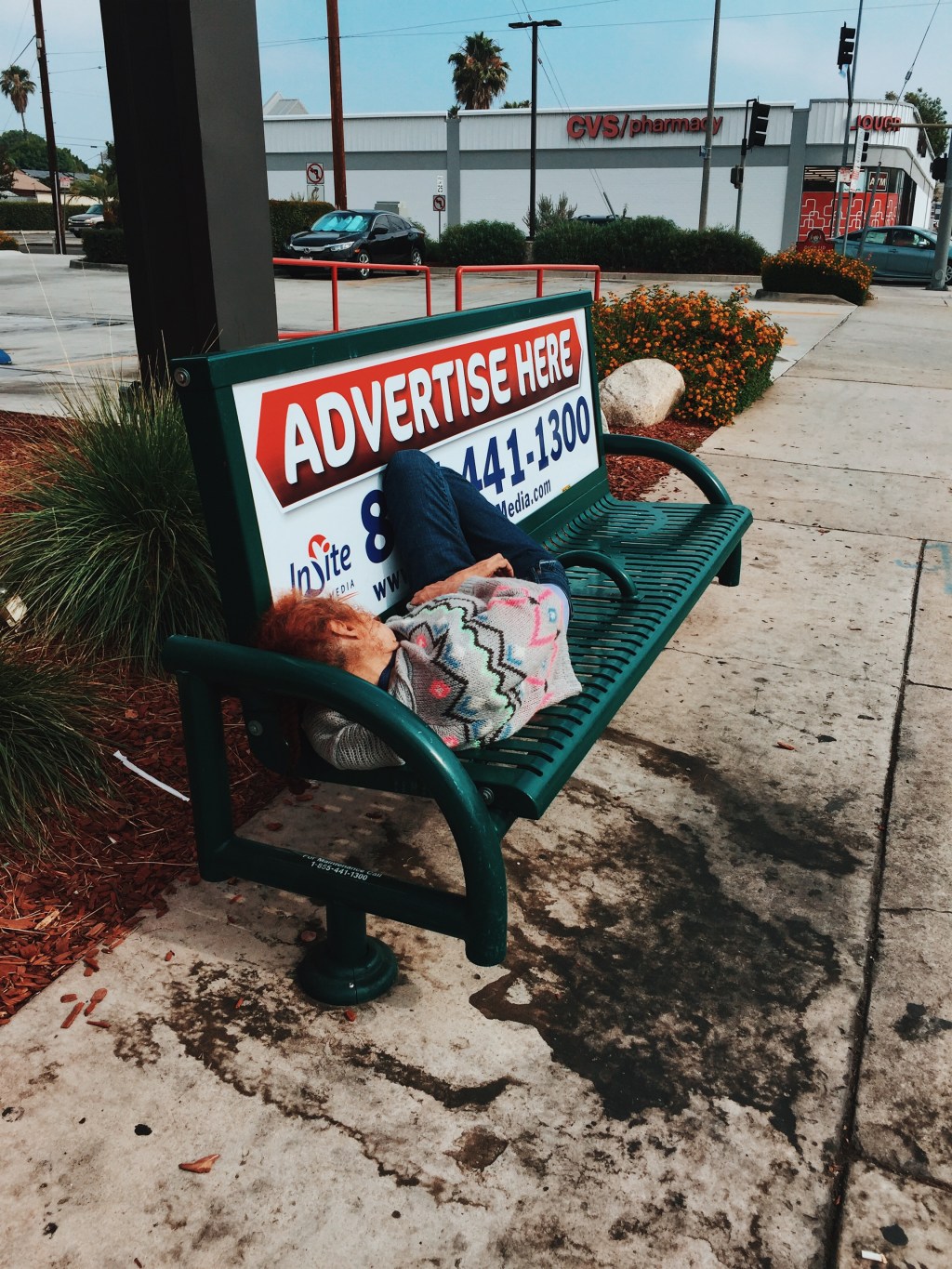
Later on, after the gym, she was asleep on the bus bench.

A temporary home.

There are no adequate words to describe the degradation and humiliation that public defecation brings to both the perpetrator and the witness.

Her normal biological action did not rank up there with the tens of thousands who live in group tents, in trash camps, along sidewalks, under bridges, within public parks in the City of Angels on Hiatus.

Just one of many living in the filth and neglect of our city.

But this is reality in LA and in so many other cities like Seattle, Portland and San Francisco that once thought such acts unthinkable. All these cities hate Trump. And all these cities call themselves sanctuaries.

A sanctuary to me is a holy place, a reverent place, a place kept scrupulously clean because people worship there and respect the ideals that make a place a sanctuary from all the evils of life, all the injustices. Inside a sanctuary there is quiet, and calm and peace and you go there to pray and find solace. There are churches, there are mosques, there are synagogues, there are temples, there are parks and courtyards that are sanctuaries all over the world.

What kind of sanctuary is present day Los Angeles?

We don’t have a single public park un-desecrated by trash, shopping baskets, sleeping drunks, tents. Perhaps 30% of the bus stops are makeshift homeless homes, pushing out legitimate bus riders who wait on their feet in the blistering sun.

Woodley Park, 2018.

We have a hapless and synthetic mayor, Mr. Garbageciti, whose public pronouncements are so ineffective that they carry the weight of a meme.

In every car and in every kitchen across Los Angeles people of every political persuasion are asking: how can this be happening?

As hated as Trump is in this state, with every illegality and breakdown of law and order, ordinary liberal minded and tolerant people in California are moving away from the Democratic Party ideals of understanding, empathy, government regulation or government program, and hankering for a strong man or woman who will take drastic, emergency and militant steps to stop the disease of allowing people to live and do everything publicly they should be doing privately. 

The surprise that awaits liberals in 2020 is that anyone should be surprised when Trump is re-elected. .

A Clean, Well-Cared For City.


Bridges and Parks and Skyline: Cleveland, OH.

I recently spent a few days in Cleveland, OH on an exploratory trip, visiting a city I’ve never been to before to see how I liked it.

Cleveland has had a long, slow, drain of population, and it is now about 270,000. Less than the size of Glendale (200,000) and Pasadena (142,000) put together.

I stayed in Cleveland Heights, outside of the city, in an AIRBNB run by two guys who bought a half acre estate for $146,000 four years ago, and make some extra income hospitably renting out rooms in their home.

For me, I relished the time away from Los Angeles in an environment of lush greenery, green lawns, deer, and clean streets.

Overlook Rd. Cleveland Heights, OH.

$599,000 asking price for home in Cleveland Heights, OH.

Lee Rd. Cleveland Heights, OH.

Sign in window on Lee Rd. Cleveland Heights, OH.

Homes in the Mayfield Heights section of Cleveland Heights.

Mayfield Heights section of Cleveland Heights.

Cleveland Heights is also a historic city, full of blocks of homes from the 1880s to the 1940s, a rich, well-maintained, lovingly cared for collection of architecture, punctuated by churches, parkways, and museums. Case Western University and Cleveland Clinic are just outside its borders, to the south is Shaker Heights, an elegant town developed in the 1920s, laid out with nature preserves, winding streets, gracious mansions and a languid Midwestern grace.

There are many homes for sale in Cleveland Heights and you can buy one for as little as $79,000 with most in the $140,000-$250,000 range. If you are starved for a Hancock Park type mansion there is one I liked for $599,000.

Many miles of interior Cleveland are empty. They were abandoned, bulldozed and cleared away. And what’s left are vast green spaces where the grasses and woods are reclaiming the land.

Even in the poorest neighborhoods, I did not see garbage dumps, shopping carts full of trash, littered streets, graffiti, or dumped furniture.

Lakewood Park, Lakewood, OH.

Lakewood, OH.

Wedding in Lakewood.

In Lakewood, OH, just west of Cleveland, a little town on Lake Erie has rows of neat bungalows, leading up to a gorgeous park on the lake where a wedding (between a man and a woman) was taking place in the sunshine overlooking a bluff. I walked around the park, full of bicyclists, walkers, joggers, tennis players and people sitting on benches socializing. Nobody was intoxicated, high, homeless, destructive, or neglectful. And if someone were, I have no doubt they would be arrested.

Lakewood is also “gay friendly” with rainbow flags, anti-Trump posters, tolerance banners, welcoming immigrant signs. I saw liberalism all over Cleveland, but it did not need to co-exist with uncared for mentally ill camping out on bus benches, mountains of debris, urinating and defecating and injecting.

You can hate Trump and still have a clean park system.

Anti-Trump demonstration in Market Square, Cleveland, OH.

Tremont section of Cleveland.

Ohio City, Cleveland, OH.

Ohio City, Cleveland, OH.

You can champion diversity and still enjoy people who say hello to you on the street and sweep their sidewalks every single morning.

In Cleveland, they still prohibit using the sidewalks and parks to sell old underwear and moldy shoes and sweat stained t-shirts and rancid socks on blankets. Nobody calls it discrimination to adhere to a standard of sanitation and order completely absent in cities such as Calcutta and the MacArthur Park district of Los Angeles.

I went to the Rock and Roll Hall of Fame. I ate cannoli in Little Italy. I visited the historic West Side Market with its food sellers and ethnic hawker stands. I went to Ohio City, a restored section of Cleveland with brick houses, and Victorian mansions, loft buildings and yoga studios.

I didn’t step over feces, walk down alleys that smelled like toilets, stare at intoxicated men on the ground. And nobody asked me for money.

How cruel to enjoy such freedoms away from the rot of Mayor Garbageciti’s Los Angeles.

West Side Market, Cleveland, OH.

“The Black Pig” pub and restaurant in Ohio City.

Ohio City, Cleveland, OH.


6/22/69- Fire on the Cuyahoga River.

Cuyahoga River

Ohio City.

Spotless streets in Ohio City, Cleveland, OH.

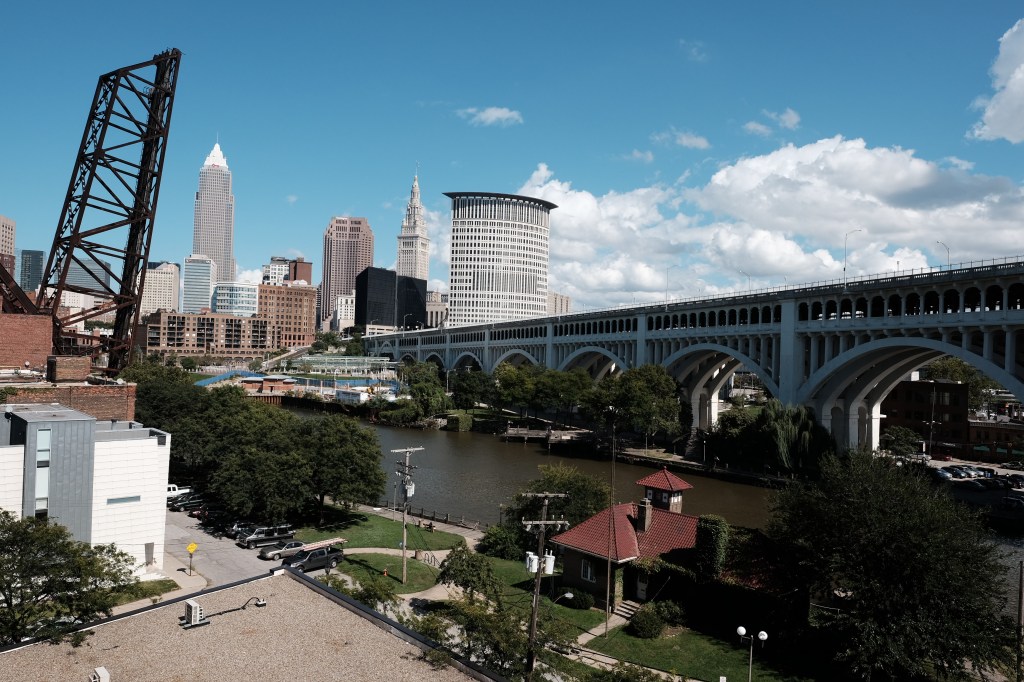
Bridges and Parks and Skyline: Cleveland, OH.

I walked down to the Cuyahoga River, a body of water that infamously caught fire on June 22, 1969, spurring a cleanup.

In September 2018, I watched a race of college rowers in the now sparkling waters.

Crossing the river are many bridges, a spectacular symphony of rail and road, steel and concrete, which once provided Cleveland with efficient delivery systems of raw materials and finished goods.

Today the industries are gone. One might expect decay, litter, neglect, and illegal dumping to move in.

Yet the parks were pristine. They were clean. There were no visible homeless. There were no mattresses, sofas, or piles of garbage as one sees in every single neighborhood of Los Angeles. I did not see tent cities of despondency in Cleveland.

I was impressed with the civic pride of the city. I was taken with the normalcy of expecting that parks, streets and neighborhoods would be well kept and looked after.

Could I live happily in Cleveland?

Cautiously, advisedly, I think so.

Little Italy, Cleveland, OH.


Ohio City, OH. Yard sale.


Four Days After the National Cataclysm.


dscf0055

Four days after the national cataclysm, uneasy inside, tentative, mourning for my nation and its political immolation, I took advantage of a partially overcast Saturday morning and walked on those quiet, well-kept streets north of Valley Presbyterian Hospital.

Tom Cluster’s emails had introduced me to the area, and I wanted to see for myself what it looked like.

On Columbus Avenue, where Tom had grown up, the street was still lined with trees, with neatly kept houses, and well-paved sidewalks. In front of his childhood home at 6944, where he lived from 1955-62, a gravestone next to the driveway read: “Beneath the Stone Lies Squeaky 7/13/61.”

I assumed a pet, but have not asked Tom yet. But I am sure he will fill in the mystery.

dscf0056 dscf0056-2

If you walked just three streets, Halbrent, Columbus and Burnet, you might be forgiven for believing that virtuous, middle-class, hard-working, Ozzie and Harriet Van Nuys was still the norm.

dscf0068 dscf0070

There is hardly any trash, the curbs are swept, the lawns are cut, and it seems that the hospital itself is as sanitized on the exterior as the interior. There is a calm, a self-assurance, an illusory orderliness conveying control. The buildings, dating back to 1958, drum shaped towers, share the grounds with more recent concrete ones; but unlike Cedars or UCLA, there is no affluence in the architecture, no preening for impressiveness or garish technological materials. This is a plain Protestant place, stripped down and frugal.

At Valley Presbyterian, there is also a long driveway leading from Noble, west, into the main entrance of the medical facility. The edge is lined with raised, planted beds under a 1950s modern, illuminated overhang. Welcoming and efficient, it conveys a public language of progressive health care and community.

dscf0053


The Edsels and the Oldsmobiles and the Pontiacs wait patiently at the entrance as the medical staff bring out wheelchairs. Dad, always calm, lights a cigarette and turns on the radio to hear how Don Drysdale is doing. Mom, in labor, is brought into the hospital by nurses as Dad goes to park the car and walk back into the hospital to wait, in the maternity area, for his wife to give birth to their third child.

Volunteer girls in red lipstick and white uniforms hold trays of apple juice in Dixie cups. They walk the floor and offer refreshments.

Dad took the afternoon off work but will be at the GM plant in the morning. His wife will spend a week in the hospital and they will pay their $560.00 bill in $15.55 monthly installments over the next three years.


For a few blocks, a section of Van Nuys, its homes and hospitals, is still preserved in a formaldehyde of memory and architecture, a Twilight Zone where hospitals were up-to-date and affordable, great schools were within walking distance, jobs were plentiful, work was secure, streets were safe, and houses reasonably priced.

Beyond these streets, the real, harsh, angry, misery of another Van Nuys in another America plays out.

And we Californians, we Angelenos, are caught in a vise of fear, hoping for the best, fearing the worst, and seeing the day of demagoguery descend over Washington and the world.

In preserved pockets, like the one north of Vanowen, some cower and hide from a restless surge of irrationality in search of scapegoats, chasing myths down dark alleys of the mind. The state, if it comes to it, may join the vigilante in enforcing the law. Or the law, if it is just, may return us to a semblance of sanity.

The best and the worst, the past and the future, it is all here in Van Nuys.


Evangelizing Cask Ale.


IMG_1738

Yesterday was the two-year anniversary party at MacLeod Ale, here in Van Nuys, held at the brewery on Calvert St.

It coincided with one of the hottest days of the year.

A hot wind baked the concrete front yard set with white tents for ticket sales, another tent housing a barbecue preparation area.

IMG_1832 IMG_1839 IMG_1844 IMG_1849

A black cook loaded meats into a black steel smoker under a cloudless blue sky.

Inside MacLeod, workers, guest workers and guests hunkered down in dimness, air-conditioned. 30 or more firkins from various breweries were built into groups of six, laid down on inclined, mobile lumber units on wheels. Each cask was plugged on top with cork. And at the bottom each one employed a white plastic faucet for pours.

The Pasadena Scots Bagpipers warmed up in preparation for their opening march through the brewery.

Owner Alastair W. Boase made a last minute run in a small Mini Cooper and came back with bags of ice unloaded by the guest workers and brought in and laid on top of each cask to keep them cool. The drooping, dripping ice kept the beer coldish with the weak efficacy of wet towels on the sweaty heads of Indonesian soccer players on the field at halftime.

IMG_1821 IMG_1816 IMG_1788 IMG_1784

Last year, MacLeod held its one-year anniversary.

To me, hyped up on IPA, a lover of Full Sail and Lagunitas, MacLeod served a weak, warm, sweet, low alcohol malty authenticity called British Style Ale.

To my uninformed palate and to my unschooled-in-beer mind, the brews were something new but not always enjoyable.

The ideology of MacLeod Ale was firmly entrenched by a young and serious head brewer who rigidly and strictly obeyed his self-imposed dogma of what constituted proper British beer. Dour and dressed in leather braces and a tweed-driving cap, he affected a uniform of anti-social seriousness. He was obstinate, at times argumentative, sometimes on the warpath with owners. Others respected and admired his fastidiousness, commitment and exactitude. The truth of his tenure at MacLeod is subjective.

At 27, he was the head brewer of a new brewery. So that alone made him an object of envy. And maybe some of an element of Schadenfreude popped up when he fell down and was thrown out.

There was an upheaval within the brewery in late 2015 and the young cultist was fired and replaced with a new brewer.

The happy result, seen in profits and popularity, has been an artistic renovation melding historic beverage preservation with robust technological innovation.

New Head Brewer Josiah Blomquist came from an engineering background but he also had made his own alcoholic beverages, including beer, whisky and other exotic intoxicants. With investment in new equipment, and a new investor named Jerry Cohen, MacLeod now has advanced water purification, new tanks, and new filters to remove impurities. But there is also a fervent energy and openness to allow for colder, stronger, more aggressively flavored beers to come into the fold.


Last year, the one-year anniversary seemed to revel in presenting discussions, where brewers sat on a podium and talked in a panel about their various beers. There were two or three of these, lasting several hours.

This year, there was just one set up and it was dismantled after an hour. Afterward came a variety of jazz performers, including one terrific, 1920s inspired trio of musicians. The choice of music: individual, idiosyncratic, whimsical, embodies MacLeod.

MacLeod Ale today is no longer the ingénue. It occupies sort of a higher ledge above the goofiness of American, macho-man, craft beer. If it were a fragrance house it might be Diptyque or Le Labo where whispers of greatness spread quietly among the cognoscenti, and the scent of cultivated, curated success enters the room confidently without shouting.


IMG_1782 IMG_1772 IMG_1770

Yesterday afternoon, I met one gentleman, Ryan Bell, who worked as a sales rep for a downtown brewery,  Iron Triangle. He was dressed in a dark black shirt with company logo and a straw hat over his bearded face.

We walked over to try his company’s ale which was rich, deep, malty and reminded me of Old Rasputin. He said (if I remember correctly) it was somewhere between a porter and a stout and had an ABV of about 9%.

I expected the discussion to continue about beer.

But after I asked him what he did before he was a beer rep he told me he had been a 7th Day Adventist Pastor. And he was now, fully, committedly, devoutly, an atheist.

He said he wrote a blog, “Year Without God” and was the founder of “Life After God” where he wrote, spoke and consulted the happily godless on their journey of self-enlightened rationality un-poisoned by the imagery of the all mighty.

I was in the company, once more, of an evangelist, another hybrid in the spiritual community of Los Angeles whose own self-awakening constituted a new reality and a new philosophy for explaining and understanding existence. That it might be done by imbibing beer and abandoning faith seemed utterly logical to me, especially inside that hot, crowded brewery party after six or more ales.

My mind wandered from the packed brewery to the national scene and back again to the heat wave.

I was thinking of God and God’s successor, Nothingness. I was looking at Men and their Gods: beers and beards. I was wondering about intelligence and stupidity and how they were so often interchangeable. I was uncertain about what I should believe in or fear: Donald Trump, Radical Islamic Terrorism, certain atheism or certain faith, the NRA or Orlando, porter, ale or IPA.

Lubricated by alcohol, surrounded by many flavors of casks, some beers flavored with chiles, vanilla and rosemary, nothing seemed wrong or right, just there for the taking. I was elated by the possibilities of dropping long held beliefs, and flying into new consciousness by picking up new flavors, guided unintentionally by the atheist pastor beer salesman.

On that Sunday summer sirocco I was on the verge of a breakthrough. Or I might just collapse from alcoholic dehydration.

Fortunately, outside, there was Amy Crook, in a peach pleated skirt, whose hyena laugh and flirtatious giggle danced around the driveway as I recorded her. I joined her under the hot tent and helped check in guests. I tore off tickets, and peeled sticky armbands onto arms gleefully carrying glasses into a raucously animated party, one I knew I would later misinterpret truthfully.