The Insane Present


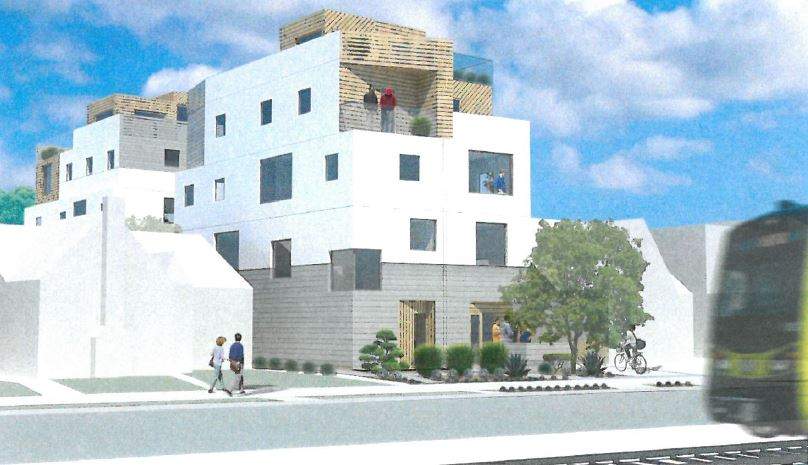
“Next week, the South Los Angeles Area Planning Commission will consider an appeal of Buckingham Crossing, a proposed small lot subdivision near the Expo Line.

The proposed development from Charles Yzaguirre, which would replace a single-family home at 4011 Exposition Boulevard, calls for the construction of four small lot homes.  The houses would each stand four stories in height, featuring three bedrooms, two-car garages, and roof decks.

Los Angeles-based architecture firm Formation Association is designing the project, which is portrayed as a collection of boxy low-rise structures in conceptual renderings.

The appeal, which was filed by residents of a neighboring home, argues that the project does not comply with the City of Los Angeles’ Small Lot Subdivision guidelines, and have bolstered their case with a petition signed by nearby residents, as well as a letter of opposition signed by City Council President Herb Wesson, who represents the neighborhood. 

However, a staff response notes that the project was filed with the Planning Department before the new regulations were adopted, and are thus not subject to them.  The staff report also rejects claims that the four proposed homes would increase traffic congestion and create a “‘wind tunnel’ spreading toxins” through the passing of Expo Line trains.”-Urbanize LA

_____________________________________________________________

As this blog has shown, many times, we live in a city of homelessness for those who cannot afford a home, or are too sick to attend to the normalcy of paying rent.

At the same time, the dire need for housing continues to be opposed by vast segments of the city who will take any proposed multi-family dwelling, even one as small as four stories, and attach some fear-mongering lawsuit against it.

The condition of Los Angeles in 2018 is comedic in its insanity, with ostriches of all sorts screaming about “overdevelopment” inside the second largest city in the United States, a spread out sprawl of parking lots and shopping centers where residents complain about lack of space, lack of parking, and too much traffic. Yet lack the political and moral will to remedy an ongoing tragedy.

These same NIMBYs oppose even the tiniest increase in density, along light rail lines and public transport, refusing to allow the city to progress economically and logistically, and also, quite cruelly and callously, perpetuating the expensiveness of all housing, by limiting its supply.

One-hundred years ago, Los Angeles was a much more modern and progressive city than today, a place where tall apartments were welcomed, possibly because they looked aristocratic, well-proportioned, and they brought economic growth and well regarded architecture to a growing city starved for development.  They wore their best European tailoring, even if they were overdressed, because they had pride and self-worth and a city which respected those qualities.

By contrast, many of today’s multi-family dwellings are self-effacing, timid, obsequious, broken up into many little pieces to ward off attackers, erased of any individuality or identity.  So even when the architects surrender to the bullies, that cannot mollify the attackers. The NIMBY mob wants the city to stay exactly as it is, even if that means that 100,000 people sleep on the sidewalk every single night.

Imagine the screaming in Encino or Palms or West Adams if anybody proposed the old styles seen below next to any existing single family homes. (source: LAPL)

Chateau Elysee


Riots of Color


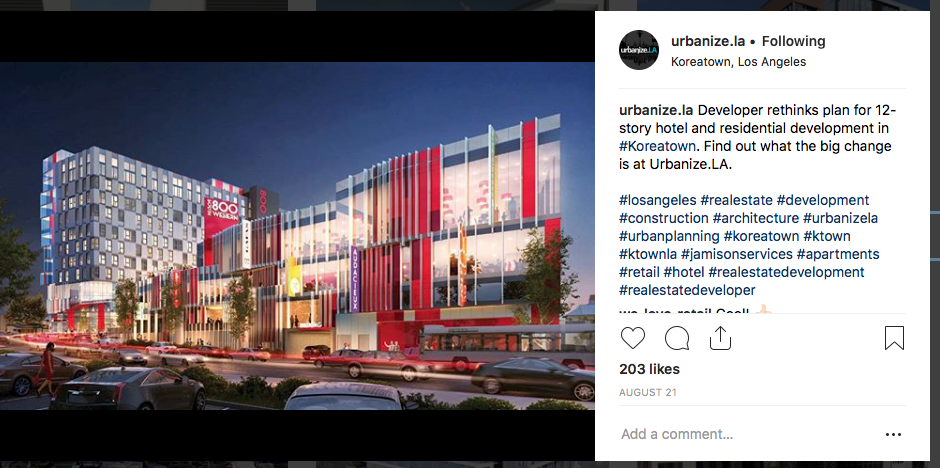
Urbanize LA is a website showing new development around our city. I get updates from them and see what architecture is going up and what it looks like.

In residential multi-family buildings, modernism is triumphant.

Today, every building is uniquely ahistorical, without any reference to past classical styles, which, in a way is good. Los Angeles, especially in the San Fernando Valley, suffered from 20 years of Neo-Mediterranean buildings, a style that still afflicts much of residential, single-family Beverly Hills.

But the modern styles going up are nervous, jittery, full of multi-colored sections of various colors, so that many buildings do not exude calm or confidence but insecurity. Sections of four, five, or eight story apartments are broken up into light/dark/red/green/white/blue/wood/yellow/purple….. sometimes on one building.

I’m not sure how to psychoanalyse the stylistic quirks of mediocre apartment architecture. I think some of it is due to trying to sell buildings to neighborhoods which are hostile to them. By dividing up larger buildings into many colors, the effect is to reduce the apparent total size.

An apartment building with 40 windows on a wall 160 ft. long in one color appears large. 40 windows in 8/20-foot long sections with 8 different colors seems smaller.

Compare these two examples below. The new Expo Line is 7-stories, while the older one is 5-stories.

Sycamore apartments, northwest corner of North Sycamore Avenue and Beverly Boulevard

An Ugly Example at a Prominent Corner

One of the ugliest of the newer buildings is the retail/apartment built on the SE corner of Wilshire/Labrea which is not only multi-colored but cheap looking as well. LA Curbed called it “possibly LA’s most hated” in 2013. “The building’s facade is a jumble of balconies and discordant frontal planes with the northern and eastern faces designed differently, united by a central tower that seems to lack any elegance or even much design,” wrote Julie Grist of Larchmont Buzz. “It’s a shame the design team couldn’t at least try to borrow some of the sleek lines from other streamline or deco architecture still standing along Wilshire Boulevard.”

Tragically, it occupies an important corner of Los Angeles but has an H&M quality where a fine building belongs.

LA architects and builders built one color apartments from roughly the 1920s through the 1960s with no degradation to the aesthetic fabric of the city. How was that possible?

Southwest corner of Pico Boulevard and Union Avenue

Sycamore apartments, northwest corner of North Sycamore Avenue and Beverly Boulevard

Apartments_on_Grand_Avenue_Bunker_Hill

Guardian_Arms_Apartments_Hollywood

Brynmoor_Apartments

Whitsett Av. Studio City, 1964.

New_apartments_West_Adams

Gaylord_Apartment_house_front_view, 1924