Van Nuys: We Harley Knew Ye


Recently, a multi-family property, one lot west of Kester Street, came up for sale. And I saw it on Redfin.

14914 Sylvan Street was built by Mr. Leroy Dondelinger in 1954 and has a smart, Mid-20th Century modern look with solid brick, deep eaves and an angled roofline. There are multiple units on the property, making it suitable for owner rental income.

The asking price is $1.3 million.

Who would have built such a stylishly architectural building in this now forlorn neighborhood?

The bold design intrigued me.

I took a trip on Google to find out more.


70 years ago, this part of Van Nuys, west of Kester, which had been covered in orange and walnut groves before WWII, was in the midst of a furious building boom. The old, walkable town, centered around the Valley Municipal Building, was no more. In the middle 1950s, the streets were widened. Victory Blvd became six lanes wide, old pepper trees were ripped to chips, and Van Nuys Boulevard was expanded to its current width and the streetcar tracks yanked out. 

70 years of toxicity, speeding, accidents, death, aggression and mayhem is our inheritance.

We all live in 2024 now and have various explanations for the decades long, dystopian fall of Van Nuys. 14914 Sylvan is in one of the less expensive parts of the San Fernando Valley, and in this area, residents go about their lives behind iron gates, accompanied by big barking dogs, chopping helicopters and avoiding those wandering, lost people who have no home to call their own. 


The 1937 San Fernando Valley Directory listed DWP lineman Leroy Dondelinger (b.4/15/1902, Colfax, NE/d.10/27/85 Santa Barbara, CA) and his wife of 12 years, Mary Ellen (nee Fridell; 1902-1980) living at 14545 Vanowen St.

The US declared war on December 8, 1941. Leroy would have been middle-aged, a father of two girls, and probably did not enlist for active duty.

The 1945-46 Van Nuys City Directory had Leroy Dondelinger at 14211 Friar St and mom Lovina Dondelinger (1876-1951) at 14217. But the 1950 US Census listed Leroy, wife Mary Ellen, and daughters Pauline and Joann at 14545 Vanowen.

In 1954, Mr. and Mrs. Leroy Dondelinger built a two-family $21,000 house at 14914 Sylvan St. for their family. Building permit says, “possible future triplex.” Practicality and financial astuteness won out for the power line technician and his progeny.

He seems to have done fine with his new house, and in 1957, 55-year-old Leroy built a $4,200 addition to 14914 Sylvan which included a back lot kitchen, living room and bedroom.


I searched newspaper archives for Dondelinger references, and by wacko coincidence, the fancy home of my neighbors at 14937 Hamlin was the subject of a 1948 Van Nuys newspaper story about “Impressive Fly-Up Ceremonies” conducted by Brownie Girl Scout Troops at the home of Lucile F. Days. Mrs. Mary Ellen Dondelinger was the leader of Troop 716. 

60 parents and friends attended the twilight ceremony.

This home on Hamlin is still lovely, on spacious grounds. I’ve eaten Thanksgiving there a few times and walked through the landscaped estate with its fruit trees and swimming pool. 

It once typified the aspirational possibilities of what could be achieved in American life if you were born of the right stock and knew the right people and applied yourself accordingly and carefully and diligently to work, family, education, and morality.

We are all lost now, damned and defined by something we cannot control, our identities.


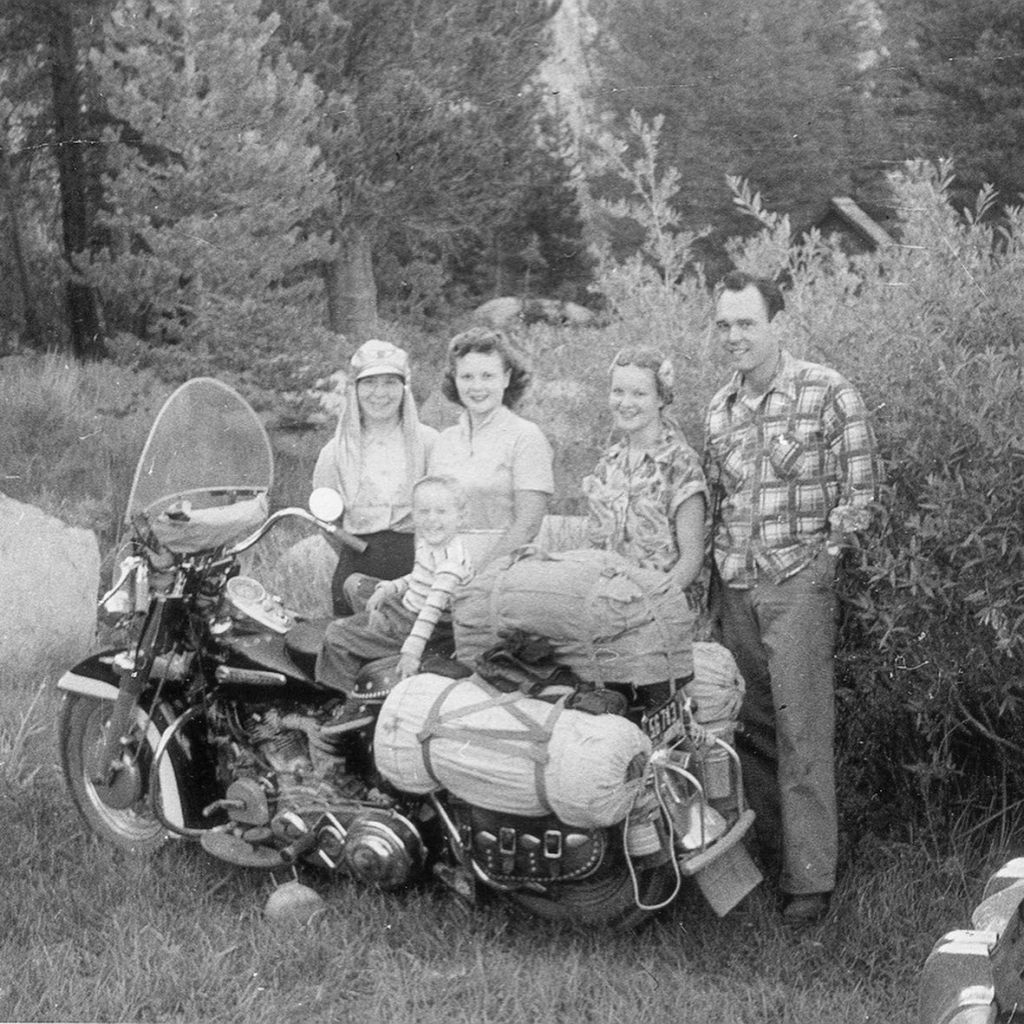
The Dondelingers were motorcycle riders and owned the brand new Hydra-Glide Harley Davidsons. On August 15, 1955, Mary Ellen and LeRoy Dondelinger and daughters, Pauline Ellen (1936-93), and Joann (b.1938) set out on a California vacation aboard their Hydra-Glides.

In the April 1956 issue of The Enthusiast, Mary Ellen Dondelinger shared details of her and her husband’s 1,480 mile California road trip. 

Leaving from Van Nuys, they packed their Hydra-Glide with a pup tent, air mattresses, sleeping bag, stove, white gas, dishes, food and clothing. She wrote about visiting their children and grandchildren, camping sites, scenic roads, and some of “the different expressions with which we were regarded by other tourists as we rode down the highway. Some looked at us in amazement, some in disbelief and occasionally in envy.”  

Postwar Harley Davidson introduced the telescoping hydraulic shock absorbers to smooth long-distance rides. Industrial designer Brooks Stevens reconfigured the suspension, front fenders and headlight to achieve a look of grace, power and elegance for a mode of transport which many associated with low lifers, rebels and angry young men. 

The Dondelingers, a wholesome looking family from Van Nuys, CA. submitted their road trip to The Enthusiast and gave Harley-Davidson a different image for their products, one that may have countered that which leather jacketed Marlon Brando projected in his hit bike flick, “The Wild One” (1953).

Harley-Davidsons became ever fancier in 1956 with the introduction of luggage racks, saddlebags, windshield and a tandem seat which increased sales and expanded the consumers to include traveling families like the Dondelingers.


Four years after their epic road trip, a wedding was held at 14914 Sylvan for Mr. and Mrs. Robert Maurice Fleming (Pauline Ellen Dondelinger). 

Bride and groom honeymooned in the new state of Hawaii.

The bride was a graduate of Van Nuys High School and her husband was in school at USC majoring in biochemistry.

There are certainly other stories of the Dondelinger Family since 1959. I featured one small tale.

This is just a glimpse of a family, a house, another time in America, and a Van Nuys whose people and customs seem as different as a foreign country. 

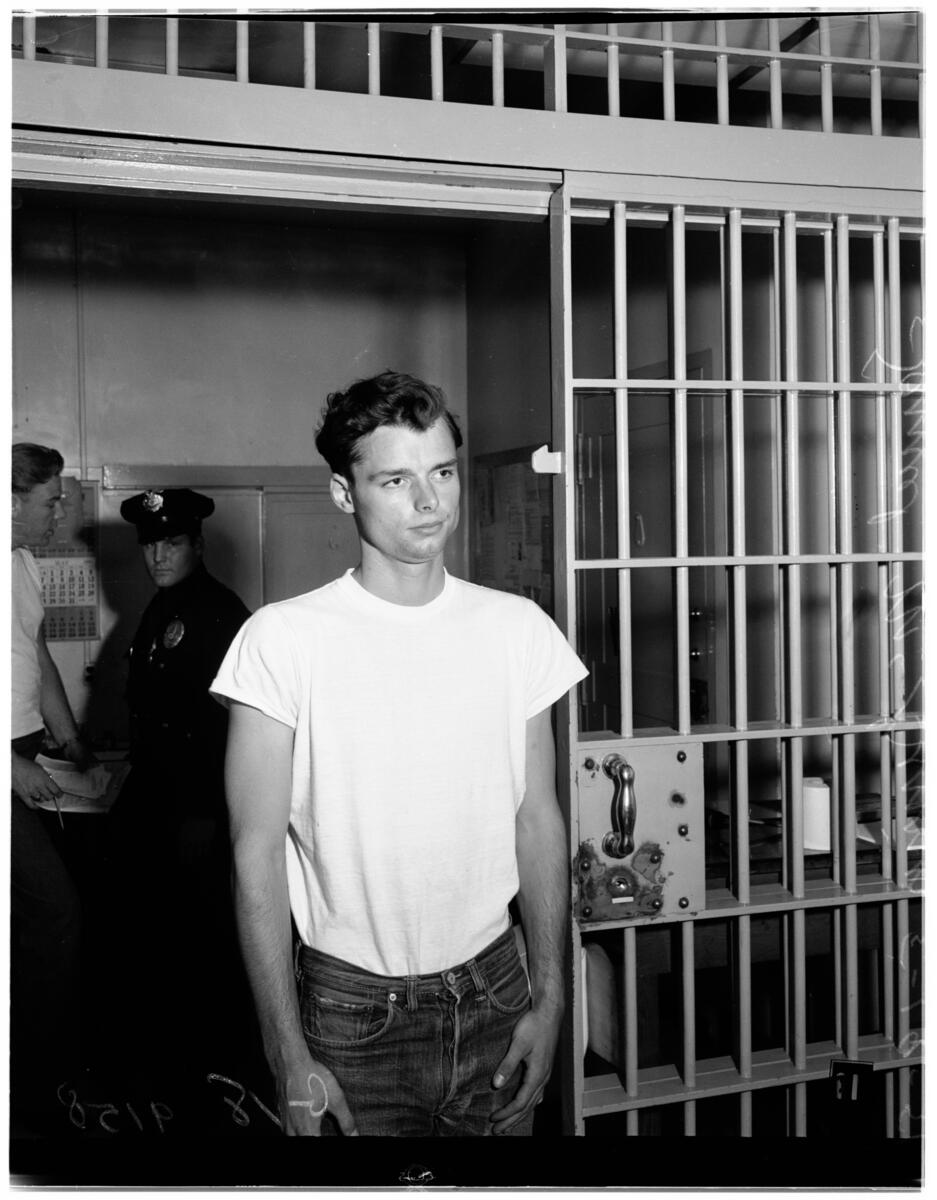
Market Holdup Suspects in Custody, 1951


On May 19, 1951 there was a holdup of a grocery store on Burbank and Van Nuys Bl.

The robbers were caught, booked and taken up the street to the jail in the Valley Municipal Building.

Two of the three suspects are pictured here, and are quite a handsome bunch: Samuel McGinnis; Charles Gordon; John Maroney.

John Maroney wears a tight white t-shirt tucked into unbelted jeans. Curly haired, brown-eyed, lean bodied, he had engaged in something stupid and could not have known how lucky he was to live in a time when the best selvedge loomed jeans were $3 and made in America. He could have worked as a house painter and bought a nice little ranch house around the corner with $500 down. He also wore his leather bomber jacket ($15?) in another photo.

His buddy (McGinnis?) is also a nice looking red haired guy in a wool camp shirt, finely tailored and elegant for an afternoon of armed robbery in Van Nuys. He looks almost like the son of the cop handcuffing him.

Source
Los Angeles Examiner Negatives Collection, 1950-1961 (subcollection), Los Angeles Examiner Photographs Collection, 1920-1961 (collection), University of Southern California (contributing entity)

Greedy Developers: Los Angeles in the 1920s.


dw-1926-611-19-5819-x2
Completely out-of-scale building towers over one story house next door.

dw-1926-611-19-5809-x2
In a neighborhood of single family homes, a greedy developer built this apartment populated by people who selfishly can afford to live here.

dw-1930-03-17-14510-x2
A true monstrosity, more appropriate for Manhattan than Los Angeles.

dw-1926-611-19-5808-x2
A towering colossus of land exploitation without any surface parking lots.

dw-1926-611-19-5806-xl
Disguising something as European does not hide that this enormous building is completely out of scale with the little houses only a block away.

dw-1926-611-19-5804-xl
Neighborhood Council should sue to take down this enormous theater whose builder put it right on the street without any parking lot. Sign is too bright and too big and disturbing to spotted frogs who live in the park across the street.

All photos from the Whittington Gallery at USC Digital Archives.

Los Angeles’ History: the Whittington Photo Collection.


This slideshow requires JavaScript.

“The “Dick” Whittington Studio was the largest and finest photography studio in the Los Angeles area from 1924 to 1987. Specializing in commercial photography, the Whittington Studio took photographs for nearly every major business and organization in Los Angeles; in so doing, they documented the growth and commercial development of Los Angeles. Clients included Max Factor, the Broadway, Bullock’s, and May Co. department stores, the California Fruit Growers Association, Signal Oil, Shell Oil, Union Oil, Van de Kamp’s bakeries, Forest Lawn, Sparkletts Water, CBS, Don Lee Television, Goodyear Tire and Rubber, real estate developers, construction companies, automobile, aircraft, and railroad companies, and drive-in theaters. Another notable client was the University of Southern California, which contracted with the Whittington Studios for coverage of athletic and other events. The collection consists primarily of roughly 500,000 negatives; the rest are photoprints.”