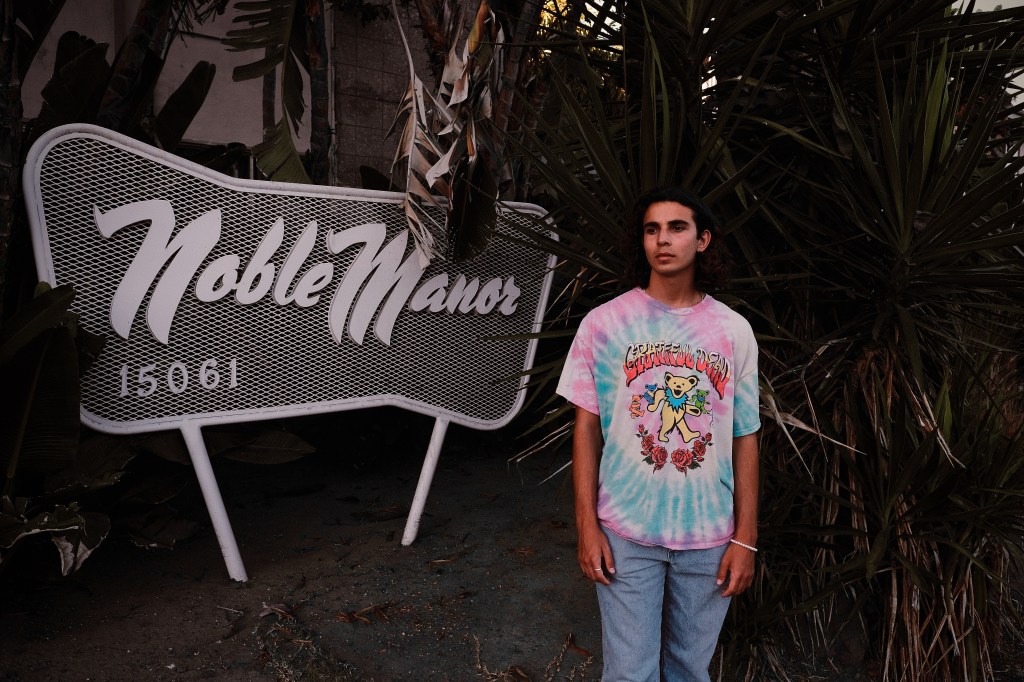
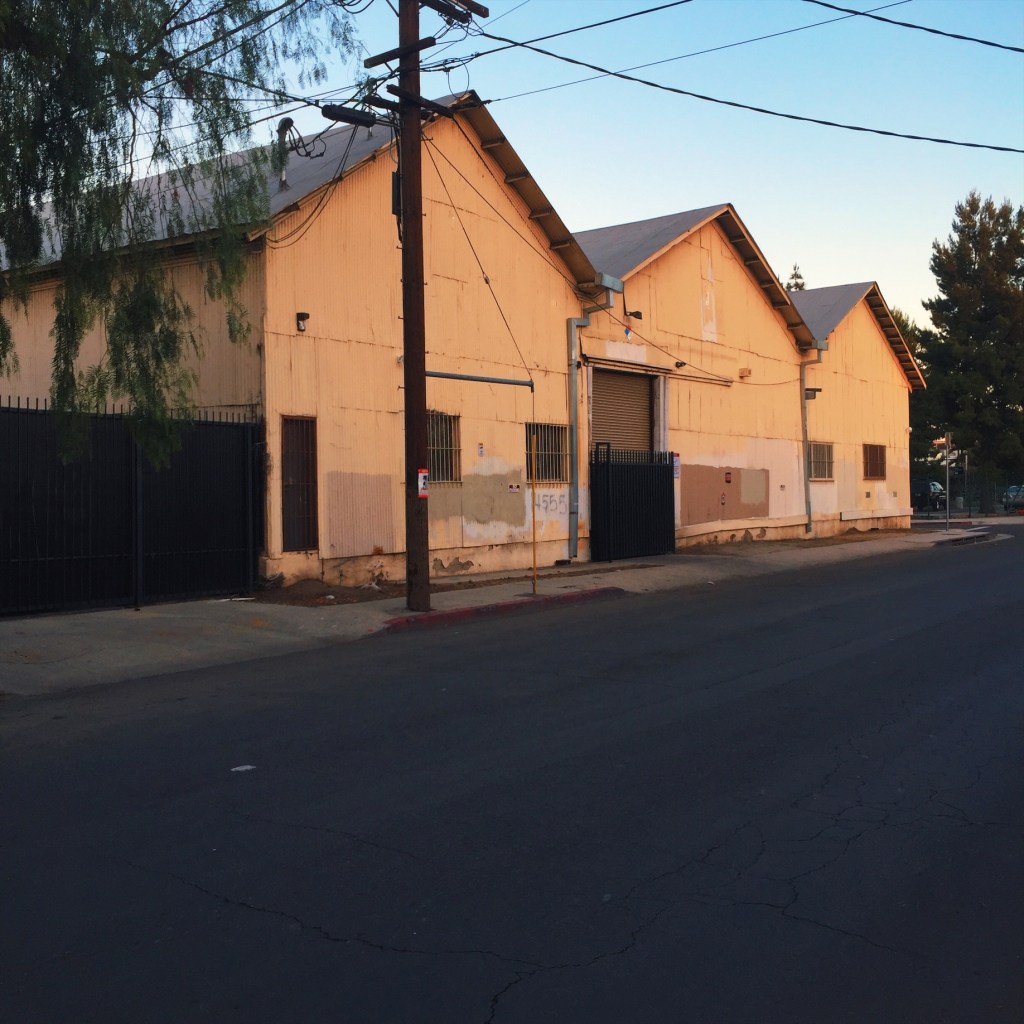
Portraits of Dovid K. and “Kester Ridge.”


Actor Dovid K. was raised in Los Angeles, and he came over to our neighborhood last week for some agency photos.

The houses in our area (Victory/Kester/Columbus/Vanowen) were built in the 1950s, and due to the modesty of the neighborhood, many look roughly the same. There are the criss-crossed windows, the board and batten siding, the pastiche of architectural decorations that mid-century developers affixed to facades to make them warmer and more appealing.

The vintage styles have weathered six or seven decades and endured as archetypes of the San Fernando Valley. This section of Van Nuys was ideal because it was walkable, just across the road from the high school, near the shopping centers along Sepulveda. Those were the days when children rode bikes and walked to school and there was always someone home to greet them at 3pm.

Times change. Children don’t walk, they are driven.

Behind the house on the right someone is building an ADU out of an old garage. They installed solar panels like many of their neighbors.

This sign belongs in the archival collections of Valley Relics.

This totem statue was erected by a previous owner and still stands.

This house will have a new ADU in front, an adaptive revitalization of a classic Valley ranch house from the early 1950s.

There is something about the middle 1950s that endures in many of the houses, a cozy casualness of not so big houses with big lawns, semi-circular driveways, trees, hedges, and decorative lampposts. A lot of it is not so up-to-date. If this were Studio City or Brentwood these houses would have been long gone, demolished and replaced with white faced behemoths and tall gates and enormous SUVs on every property.

Sadly, many of these houses sell for over a million and are not quite starter homes. But they are home for many who inherited them from parents, with low property taxes and little or no mortgage payments. For the lucky ones who got lucky, this is kind of a paradise, guarded by NextDoor and patrolled by helicopter, seemingly an American paradise on the ground.

And it makes a good backdrop for a young man who channels the 1960s.

Valley Feed and Fuel


14551 Bessemer St. (Photo by Andrew B. Hurvitz)
Map 14551 Bessemer

On the NE corner of Bessemer and Vesper, here in Van Nuys, there is a steel walled storage warehouse with three pitched roofs.

Unmarked with any signs, it seems to have been there many years, and is characteristic of structures that once stood alongside rail lines to receive and to send out produce, grains, and manufactured products to faraway markets.

I dug up information from the city and found that “14551 Bessemer St.” was built in 1922, at a cost of $4,000, for the Fernando Feed and Fuel Co. It stood alongside the freight lines and was serviced by a dedicated Southern Pacific rail spur that went right into the property.

6/22/1922: 14551 Bessemer St. Van Nuys, CA Dept of Buildings Application

By 1925, chicken ranches were a big business in the San Fernando Valley, with an estimated 1,000,000 laying hens in the valley producing some 12 million eggs at a gross return of $5 million dollars. (In 2019 dollars, about $72 million.)

A 1925 LA Times article said that the Fernando Feed and Fuel Company started in 1916 as a feed store, but grew, in nine years, to 1,500 customers, large and small. Several other facilities for warehouse storage were located in Owensmouth and Van Nuys with a crew of 45 men and 15 trucks delivering feed and other orders to customers.

Chicken ranches, on one, two or five acres were a type of housing development that sprung up all around Southern California. They allowed families to feed themselves and also make a living selling chickens and eggs. At that time, other orchards grew oranges, walnuts, lemons, avocados, asparagus, and strawberries. 

A 1916 LA Times article praised “rose lined Sherman Way” (later renamed VNB) and the white feathered leghorns that dotted recently established (1911) Van Nuys.

“White Feathered Leghorn” Chicken. (source unknown)

Scientific work to bolster the agriculture industry and  promote poultry farming was often shown. 

In 1920, a four-day poultry institute was given at Van Nuys High School, by Prof. Dougherty, head of the poultry division, college of agriculture at U of CA, under the auspices of the LA County Farm Bureau and the Van Nuys Poultry Association.  A vaccination to fight chicken-pox was demonstrated there. 

Entrepreneurs and peripatetic innovators flocked to Van Nuys to raise chickens in advanced ways.

At a five-acre ranch on Woodman Avenue, in 1925, a recently transplanted Englishman, JCF Knapp, who had run plantations in Sumatra and India, had finally realized his lifelong dream to become a poultry farmer in Van Nuys. His operation had the capacity for 4000 chicks, and Mr. Knapp confidently asserted that he had not only a successful business model but a new kind of assembly line efficiency [for producing Grade A chickens on the scale of Model A’s.]

Also in 1925, WW Todd Realty Co. reported that a new set of chicken farms, totaling five acres, were to be built on Ranchito Av. near Tulare St. in Van Nuys. Some 100,000 laying Leghorn hens were expected to arrive in the valley within six months. 

[Ranchito Av., for the geographically ignorant, runs parallel to Woodman and Hazeltine, halfway between both. I found no modern maps with a Tulare St. however]

A 1920s aerial photograph of downtown Van Nuys shows the Fernando Feed and Fuel storage warehouse and the combination of commercial buildings along “Sherman Way” (renamed in 1926 Van Nuys Bl.) and orchards that were planted right inside the middle of town. VNHS is in the upper center/right of the photo. (below)

Van Nuys Feed and Fuel 1925, view NW

The chicken farms of the 1920s, which boosters never stopped boosting, gradually died out when the Great Depression hit after 1930 and sank agricultural prices.  By the late 1930s, suburban development came to the San Fernando Valley, and during the war (1941-45), industrial and defense plants, soldiers, military hospitals and the urgencies of war supplanted the rural way of life raising chickens. 

After 1945, the San Fernando Valley was the fastest growing place in the world, and every acre of land was transformed by housing developments, shopping centers, and car centered designs. 

The chicken farm, with its odors and mosquitos was now a menace, and housewives in Reseda were scared to let their children play outside.

Lost in the stories about the chicken farms is an old America that valued challenges and thought itself capable of surmounting them.  Poor, barely educated and hard-working people came here and somehow transformed Los Angeles into an advanced city that also grew its own food and sold off the surplus to an amazed and grateful nation.

Van Nuys, once a proud and admired center of advanced agricultural innovations, committed civic suicide. It destroyed its downtown by ripping up diagonal parking, widening the road to freeway widths, removing the streetcar, tearing down old buildings and replacing them with empty plazas and zombie moonscapes of trash and concrete. It embarked upon decades of laying down asphalt and laying out the red carpet for criminals, malcontents and derelicts.

Porn, marijuana, prostitution, bail bonds and slumlords were the largest industries by year 2000. Hopelessness replaced optimism and dystopia seized this district like an incurable disease. 

And politicians were thought worthy, not for their works, but only if their last names ended in the letters S or Z.

At least we have the Internet to thank for a glimmer of what it once was.

Van Nuys Arts Festival


Last Friday Night Van Nuys was young, joyous and celebratory.

It gathered, under the spire of the Valley Municipal Building, to drink beer, watch live music, eat, and walk amidst motor vehicle works of art.

Police and fire personnel mingled with guests, in a display of civic pride.

The homeless were there too, seemingly taken care of, fed on their benches beside their belongings.

For one night, the pedestrian mall where nobody walks at night, a lost dystopia, was dressed up for a party. And Van Nuys, at its very heart, seemed to regain its footing as a good, decent, well-regarded town.


More Postcard Observations


Budweiser FrontBudweiser Back


The Joseph Schlitz Brewery on Roscoe in Van Nuys was an especially popular destination in the 1950s through the 70s.

The adjoining Busch Gardens, with its array of exotic birds and lush waterfalls, was another fantasy environment of natural artifice, like Disneyland or Knotts Berry Farm, a fake beloved world for visitors to Southern California to write home about.

I have scanned many cards (owned by Valley Relics) of the famed gardens, and one in particular caught my eye.

Postmarked March 4, 1960, it was addressed to Miss Donna Friedl, 1921 Maynard Avenue, Cleveland 9, Ohio.


It read:


Hello Donna,


I did not pay for this card they give it to you for visiting the brewery, from Grandpa Friedl.

Something in his wry comment leads me to imagine Grandpa Friedl as a white-haired, humorous, kind man who might have snuck past his wife to offer his granddaughter Donna some candy before dinner.

That was a long time ago.

Nobody has a young daughter named Donna any more.

Busch Front


Fabulous SFV Front

“The Fabulous San Fernando Valley” is another postcard unintentionally funny.

For here is a view of what looks like Sepulveda Boulevard, somewhere east of the 405, (today’s Galleria) with the dam and mountains in the distance, and thousands of cars packed into the foreground.

Fabulous? The grandiose superlatives of Southern California (best weather, best women, best bodies, best schools, best place to live) were spoken of so often, that the actual truth seemed blasphemous. It was, and is, sometimes very ugly here, boring beyond belief, polluted and blindingly plastic. An early 1960s walk up a Sepulveda, north of Ventura, would lead you past auto junkyards and tacky motels, but you were in a “fabulous” place, didn’t you know it?


Saddle and Sirloin Back


Sixty or seventy years ago, many restaurants fashioned themselves as Western places, with steaks on the menu and wagon wheels on the wall.

Saddle and Sirloin was a small chain with “steaks aged to tenderness” and at their Palm Springs location, in 1949, Daddy and Mother were sitting down to eat a steak and found time to write to their daughter Florence in Newcastle, Indiana and tell her just that.

“We’re about to eat a steak, it’s balmy outside,” Mom wrote. Her appetite and her temperature lead one to salacious thoughts. Perhaps she looked like Jane Russell, with dark red lipstick. With love and dinner and hot weather….. could the bedroom be far behind?


Otto's Pink Pig Restaurant Back


Otto’s Pink Pig Restaurant at 4958 Van Nuys Boulevard was another well-known place whose warmhearted postcard promised “Otto’s Famous Baked Ham Sandwich, Best in the US” and “Mike O’Shea’s Special Salad Supreme.”

Their motto: Big Enough to Serve You- Small Enough to Know You.

Eating out, dining in a restaurant, was not done several times a week, as is the case today. People ate at home. They ate what Mom cooked.

So it was a special treat to go to Otto’s and dine on such fare as Filet of Sole Marguery or Roast Long Island Duckling (shipped fresh by refrigerated freight train?).

Hearty, friendly, generous with drink and food, sensibly priced: was it all of those things?

Long gone and obliterated, the neighborhood, an off-ramp of banality, is now home to strips of office buildings, medical offices, and Sherman Oaks Hospital. There is nothing exotic, fun or magical here as there was when Otto’s Pink Pig lived here.


12012 Chandler.


$(KGrHqN,!oMFBlWKBW,RBQqwCPDGC!~~60_57 BRL61-0294 BRL64-0116 Honeywell Service Center Building Back Honeywell Service Center Building Front

Scanning through some of the postcards loaned to me by Tommy Gelinas at Valley Relics, I came across this 1963 postcard of a new building at  the corner of Chandler and Laurel Canyon in North Hollywood.

12012 Chandler was the home of “the first Honeywell 400 computer service center in the US.”

The Honeywell 400 was a system the size of a room, so nobody who worked with one carried it into this building for servicing. It was an early 1960s workhorse for processing payroll and other functions of business and industry. According to Kraza, Honeywell was part of a second generation of computers that came of age when transistors replaced vacuum tubes.  ” Transistorized computers were more powerful, more reliable, less expensive, and cooler to operate than their vacuum-tubed predecessors.”

The black and white photographs above show the Honeywell 400 in operation. However, they are not from 12012 Chandler.

Postcard From Van Nuys: 1940


Van Nuys HS Van Nuys HS1


Postcard courtesy of Valley Relics/ Tommy Gelinas.