On May 19, 1951 there was a holdup of a grocery store on Burbank and Van Nuys Bl.
The robbers were caught, booked and taken up the street to the jail in the Valley Municipal Building.
Two of the three suspects are pictured here, and are quite a handsome bunch: Samuel McGinnis; Charles Gordon; John Maroney.
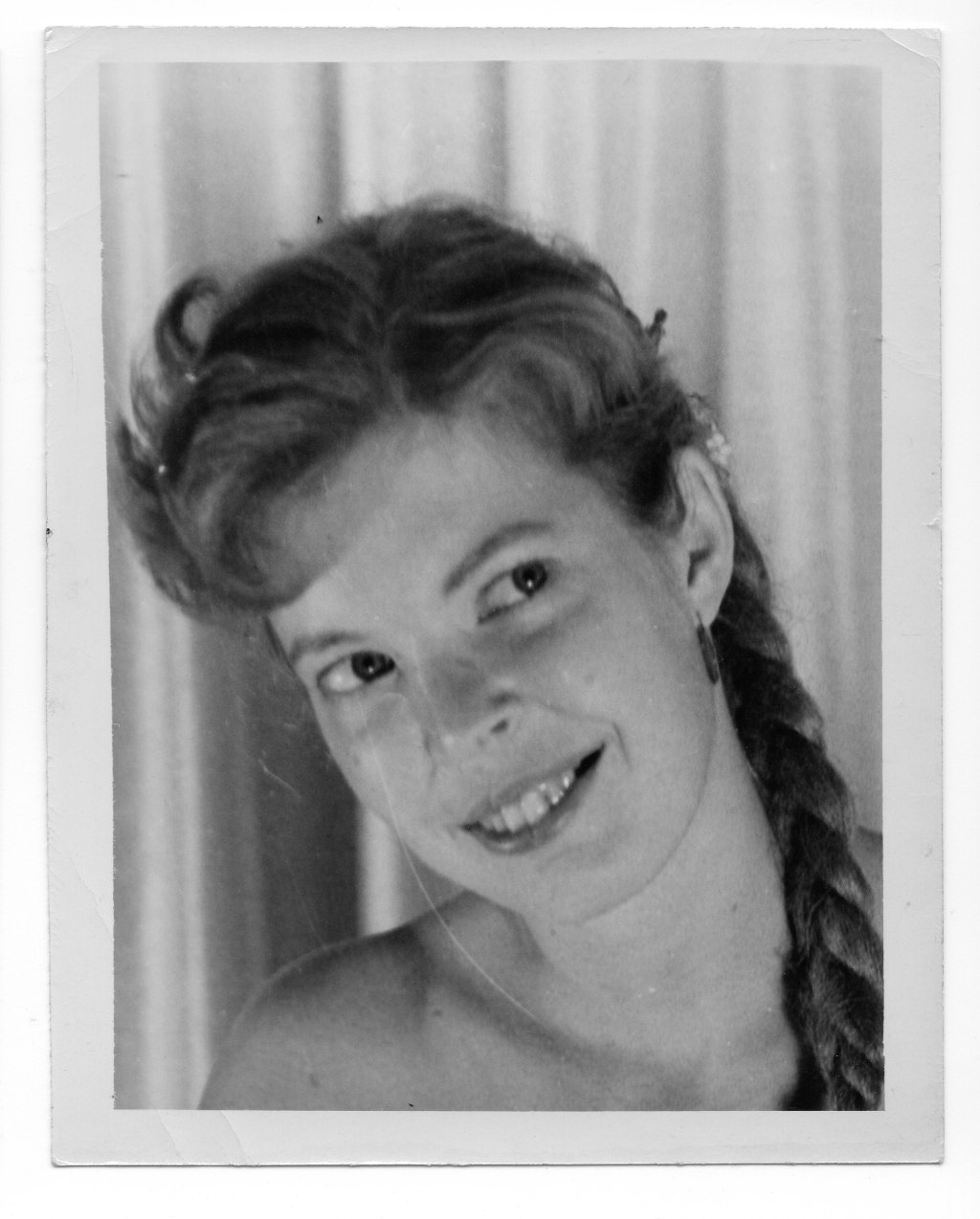
John Maroney wears a tight white t-shirt tucked into unbelted jeans. Curly haired, brown-eyed, lean bodied, he had engaged in something stupid and could not have known how lucky he was to live in a time when the best selvedge loomed jeans were $3 and made in America. He could have worked as a house painter and bought a nice little ranch house around the corner with $500 down. He also wore his leather bomber jacket ($15?) in another photo.
His buddy (McGinnis?) is also a nice looking red haired guy in a wool camp shirt, finely tailored and elegant for an afternoon of armed robbery in Van Nuys. He looks almost like the son of the cop handcuffing him.
Source Los Angeles Examiner Negatives Collection, 1950-1961 (subcollection), Los Angeles Examiner Photographs Collection, 1920-1961 (collection), University of Southern California (contributing entity)
“Photograph caption dated April 2, 1958 reads “George Fenneman, new honorary mayor of Sherman Oaks, center, places ‘Montmarte’ sign at Van Nuys and Ventura boulevards to create Paris atmosphere for community’s April in Paris Festival. Assisting him are, from left, Allen Rabinoff, Wilma Posen, Lylis Mason and Ted Levey.”
For 22 years I’ve had front row seats to the shit show that is Van Nuys.
I moved here in 2000 and started this blog in 2006. My purpose: to apply creative writing and photography to the realities around me.
I walked around and photographed Van Nuys, from the alleys to the houses to the buildings. Vanowen, Victory, Kester, Sepulveda.
At times my blog gave some visibility and notoriety, and I was brought in to observe the workings of the Van Nuys Neighborhood Council.
But I never cared to swim in sewers of public life. I saw how small minds functioned, the old fools who fought against housing, and always pushed for more parking lots and wider streets.
“Hey Andrew, what do you think about naming the Van Nuys Post Office the Marilyn Monroe Van Nuys Post Office?”
“Hey Andrew, can you help us fight to preserve that parking lot behind the going out of business furniture store? We want to make sure they don’t build apartments there!”
“Hey Andrew, they want to build a five-story apartment on Vanowen and Hazeltine. That’s too much!”
The VNNC was strangely absent with the modern representatives of Van Nuys, it seemed to be the preserve of old white people who fought to preserve in their imaginations a city that no longer existed.
“My parents bought my house for $11,000 in 1956 and I used to ride my bike to Tommy’s for a chili dog. Gosh, those days are gone forever. I still live there. Yeah I pay $312 a year in property taxes. Thank God I have a pension from the post office.”
There was Councilman Tony Cardenas. He wanted to tear down the Art Deco era fire station on Sylvan. Under his watch Van Nuys further disintegrated, a decade before this pandemic started, and from what I’ve read Van Nuys has been in decline since about 1975.
Nury Martinez replaced Cardenas in 2014, and I often communicated with her office, and met with her people, and got her help cleaning up the streets, picking up dumped sofas, pushing to get traffic lights installed, pedestrian crossings painted, or illegal cars towed.
She was a great ally in defending dozens of small businesses from the 2017 threat of demolition when Metro proposed a 33-acre bulldozing of hundreds of industrial buildings between Kester and Van Nuys Bl. North of Oxnard. This blog acted as an advocate for small business owners who employed locals serving as an economic incubator for new immigrants to prosper in Van Nuys.
Officer Erika Kirk, 2015
We had a wonderful Senior Lead Officer, Erika Kirk, the kind of woman you would want to work as a police officer. She drove around here and involved herself in matters large and small, but you felt safer with her presence.
The councilwoman, the cop, the council people: everything impersonated order, law, safety, and well-being.
But the reality of Van Nuys, (and greater Los Angeles) is that nothing nice stays nice without the constant threat of law enforcement.
You must fight every single day to keep homeless encampments out, marijuana farms from the houses down the street. You have to fear for your life from criminals robbing your house, from mentally ill people in the shopping mall parking lot, from the car speeding 80 miles an hour through the red light as you begin to make your left turn.
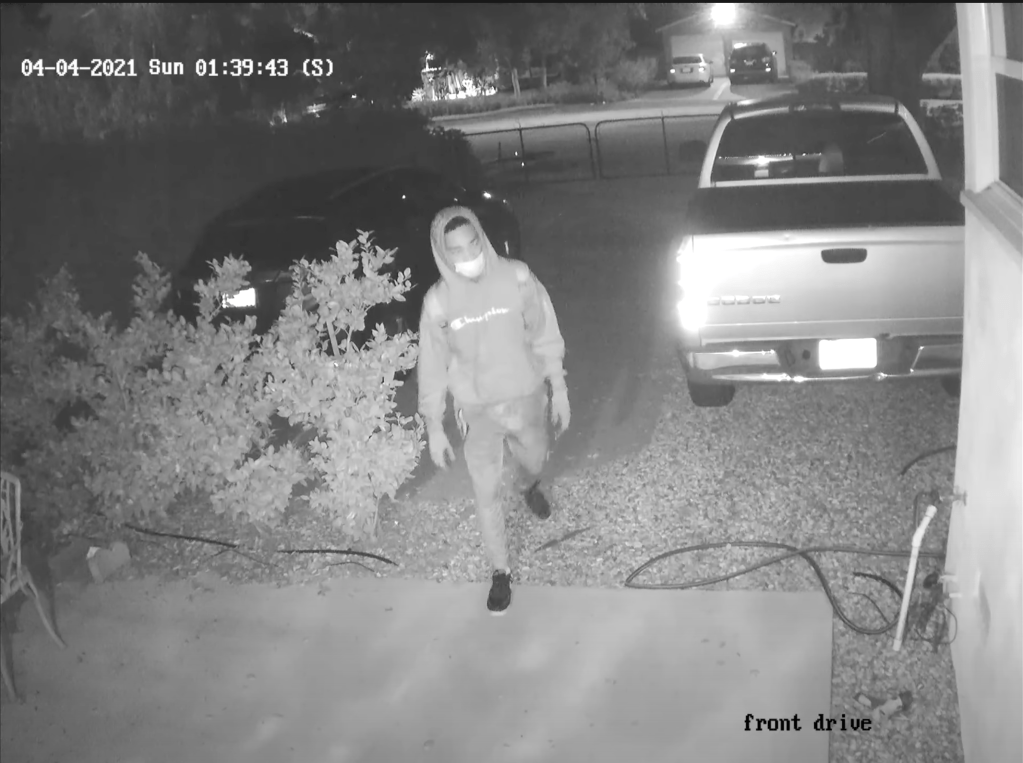
Nothing unlocked is left untouched: bicycles, decorative lights, cactuses, cars, mail, pumpkins, packages are stolen around the clock, from every lawn and every stoop, by every type of criminal. Most every crime is recorded on camera and hardly anybody is arrested.
Is this the fault of Nury Martinez?
I don’t think so.
She spoke her mind in private, in a cigar filled room with other hacks and dealmakers, and she is no worse than anybody else who criticizes her for blatant bigotry.
Is she worse than Mike Bonin who allows hundreds of violent, destructive, drug abusing and criminal people to camp out in West Los Angeles while flying the flag of compassion, and egregiously ignoring his constituents because he is on a morally higher plane of governance? When the pandemic emptied the streets of legitimate commerce he made sure that vagrants took over the sidewalks.
But in all fairness to him nobody recorded him making bigoted remarks in a room.
Hollywood Freeway Offramp, Western Av., Homeless, 2020Old Post Office
The truth is that Los Angeles is a primitive, ugly, violent, disorderly, hateful, self-centered, grotesque city of billboards, blight, traffic, fires, bad air, bad food and bad actors. It is a city that promotes promoters, celebrities, and fake makers of merriment in Hollywood.
It’s a city where the Hollywood Walk of Fame is populated by people shitting on the sidewalk, fighting with knives and guns, or walking around stoned and drunk and looking for a reason to kill.
If you are rich or famous or the child of someone rich or famous both are considered markers of high achievement.
LA takes comfort in its privileged folk in the cozy and winding streets of Pacific Palisades, Brentwood, Santa Monica and Westwood, Bel Air and Beverly Hills. People here must have been shocked that to the small minded leaders of Los Angeles the city is still divided into pieces of pie: South Central, Pacoima, Westside, White, Latino, Black, Armenian, Oaxacan, Korean, Jewish.
“Why that little bitch got LAX?”
As they say on Yelp, in every single sentence, “How amazing!”
The loudest liberals who cry the loudest about injustice drive their kids ten miles away to the whitest schools.
All the broken hearts on Twitter who heard what Nury and the bad men said about the little boy, how sad they are to know that hatreds and provincialism and ethnic warfare are the foundation of the great leaders of Los Angeles.
And why is it that we still are shocked when a Latina refers to Oaxacans as ugly and short and can call a little Black boy a monkey? Have we not heard, ad nauseum, that Nury was to be praised because she was our first Latina city council president?
“She grew up poor and her family is from Zacatecas!”
Don’t judge her.
She’s what the American Dream is all about.
And a woman too.
And a mom.
And a LATINA!
LATIN-X!
If you think it’s worthy of praise to cite someone’s accidental ethnicity as an accomplishment don’t be surprised if that same person speaks and acts as only a representative of that identity!
“The first transgender fireperson! The first movie with an all-Asian cast! The first Pacific Islander marathon winner!”
“I go to that coffee stand, even though I hate their coffee, because it’s Black owned!”
Hooray!
Is there anyone who looks at this city and wonders how it might be built to benefit all its inhabitants humanely and environmentally?
If you were in power, like Nury, wouldn’t you burn with passion to rebuild, to clean, to beautify the ugliness of the San Fernando Valley? Would you arrive at work every day like Nury and walk down Van Nuys Boulevard and think that you had accomplished something?
The conversations we heard in that room were vile.
But what we have seen with our own eyes on the streets of Los Angeles is worse.
Today, I came across this colorful poster advertising Poppy Day at Van Nuys, Saturday, April 12, 1913.
For fifty cents, round trip, you could board a Pacific Electric streetcar and ride from downtown to the new community of Van Nuys, where developer and sales manager, WP Whitsett, promised frolicking amongst the thousands of beautiful, golden poppies, a free barbecue by the famous chef Jose Romero (“served promptly at six o’clock”), free auto tours in and around the “wonder city of the valley,” music by the Long Beach Municipal Band, and athletic sports “for the amusement of young and old alike.”
Wholesome, exciting, festive, and an occasion for visitors to buy many buildable lots for $350 each.
For a few years this was an annual event, and WP Whitsett, with the assistance of the entire apparatus of government and media (LA Times) was devoted to the promotion and development of Van Nuys, not only for housing, but agriculture: beets, walnuts, oranges, lemons, limes, sugar beets, and many chicken farms. All these products would be profitably and efficiently shipped to locations around the United States on the Southern Pacific.
Schools and churches sprouted up and a very diverse population of lean and hard-working, starched and sin-free, Methodists, Congregationalists, Lutherans, Baptists, Presbyterians, and Episcopalians moved in.
Everyone was a winner in the new town watered by the Owens Valley Aqueduct.
In time, the idea of selling off every square inch of Van Nuys, paving over all the orchards, widening all the roads and cutting down all the magnificent trees, to build ever more housing; the destruction of walkable, safe and pleasant streets, all of it was actually a plan from the beginning, for Van Nuys only existed as a product for its promoters.
Photograph of palms along Sherman Way (Chandler Bl.) near Van Nuys, July 1928. The road can be seen running from the right foreground into the left background. Palms and other trees line the right side of the road, while what appear to be train tracks can be seen to the left of the road. A field is visible in the right background.Photograph of the one-acre farm of J.A. Inlaw, Kester Street and Sherman Way, Van Nuys, August 10, 1927.A street lies in the foreground while two palm trees and an evergreen stand along the far side of the street at center. Rows of crops sit in the yard behind the trees while a small home stands on the left. Trees stand behind the home in the left background.Photograph of a Model T Ford on Sherman Way (Chandler Bl.) with Deodar Trees in the background, July 13, 1928. The automobile drives along the smooth road at center. The road extends from the center foreground to the right distance. Deodar trees form wall along the left side of the road. A mailbox stands at the end of a driveway next to the automobile. The driveway leads through the trees to a house which is barely visible at left. Photoprint reads “Western Air Express”.
In 2022, living in the reality of a melting, dying Earth, we are still hostage to vehicles that kill, roads that swallow us up, backyards paved over for ADUs, front yards cemented over to conserve water and to park yet more vehicles who cannot fit into garages crammed with junk.
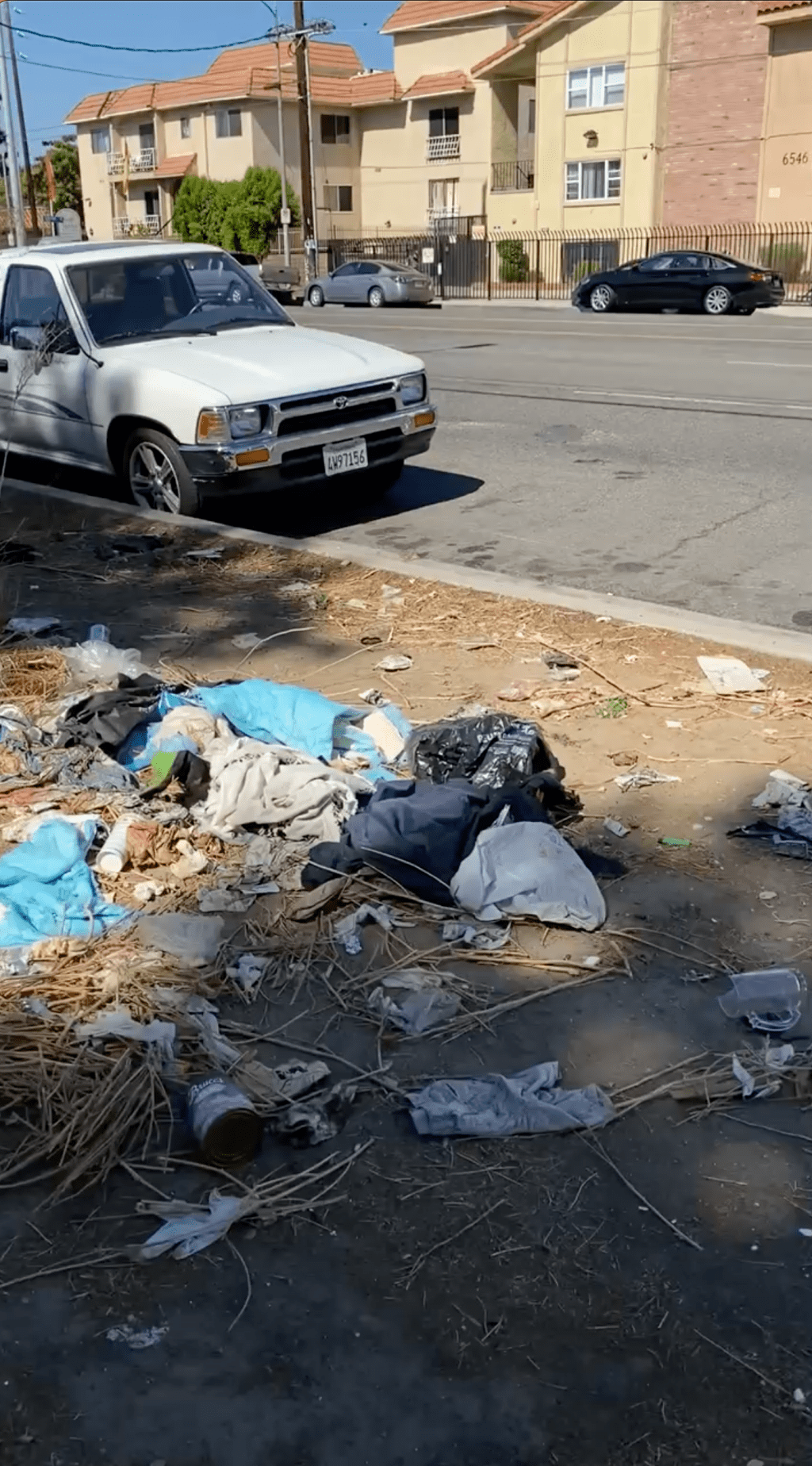
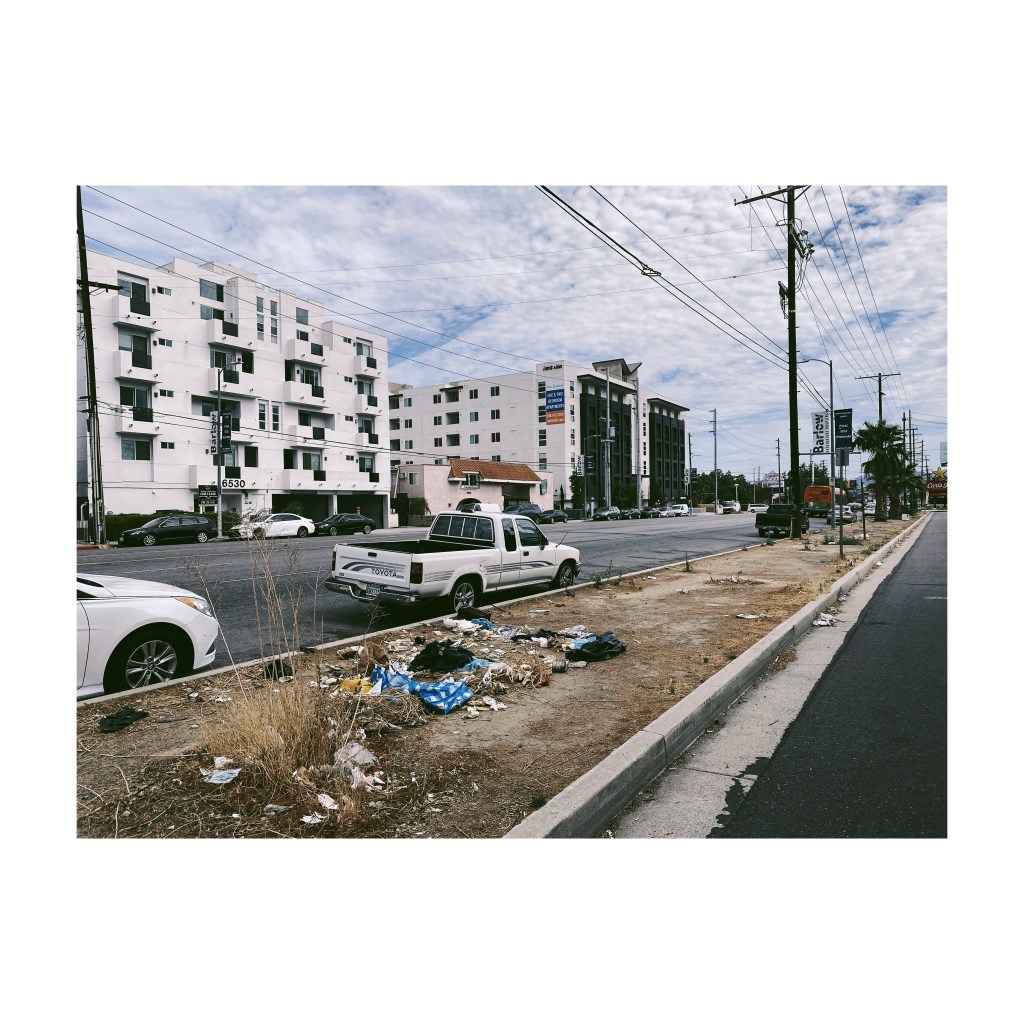
Woodley Park along Victory is a trash camp of tents and boxes and shopping carts, homeless encampments that seemingly procreate faster than the building plans of WP Whitsett. But you can’t carry your groceries home in plastic or drink from a plastic straw. You can’t burn garbage in an incinerator and haven’t been able to since 1946. Maybe we need to bring back the incinerators and clean up our parks?
How clean Chandler Bl. was in 1928! How sparkling it was before catalytic converters and filtered cigarettes. How ever did people survive when their meals came from their backyard chicken coops and fruit trees?
In 2022, the evening news celebrates the tragedy of a famous actress of multiple sexualities who drove 90 MPH into a house, nearly killing the tenant, burning it down, and we must “pray” for her to recover, just as we “pray” that the nurse who murdered 6 people in her 90 MPH adventure down LaBrea is sentenced to life in prison.
Fame, money, luck, blonde hair or black skin: Los Angeles always gives everyone an equal chance.
If you, like Whitsett, had the gumption to get water to the San Fernando Valley and divide it up into buildable lots, you have a place in time and legend that nobody will equal again. He lived well, but if he were resurrected upon this location, say Victory at Sepulveda, he would probably die on the spot from the horror of our gruesome Frankenstein of a community.
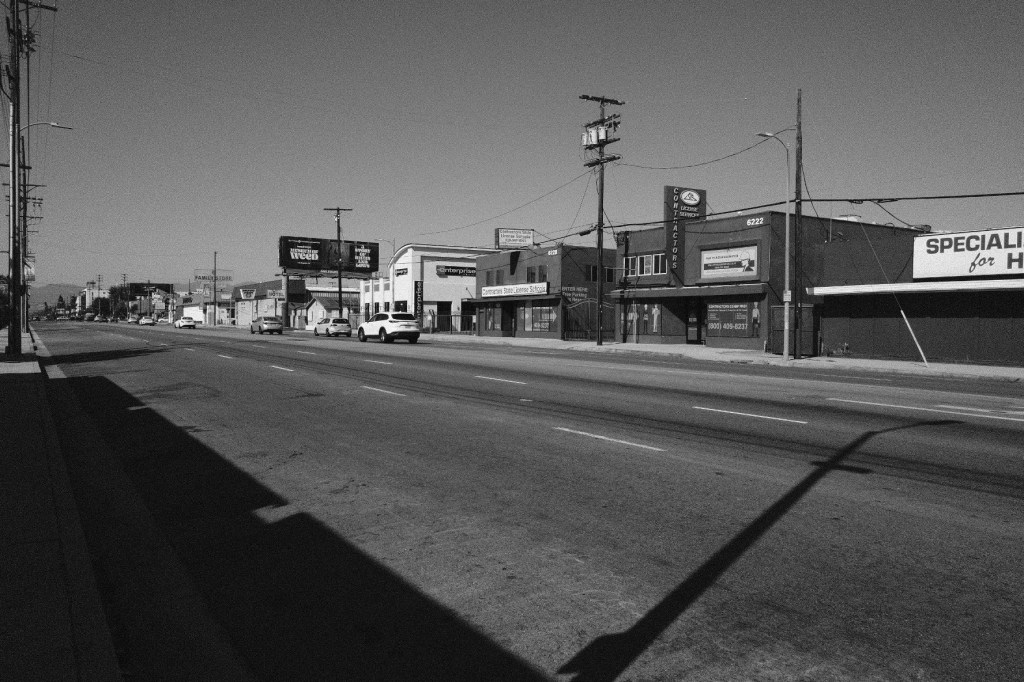
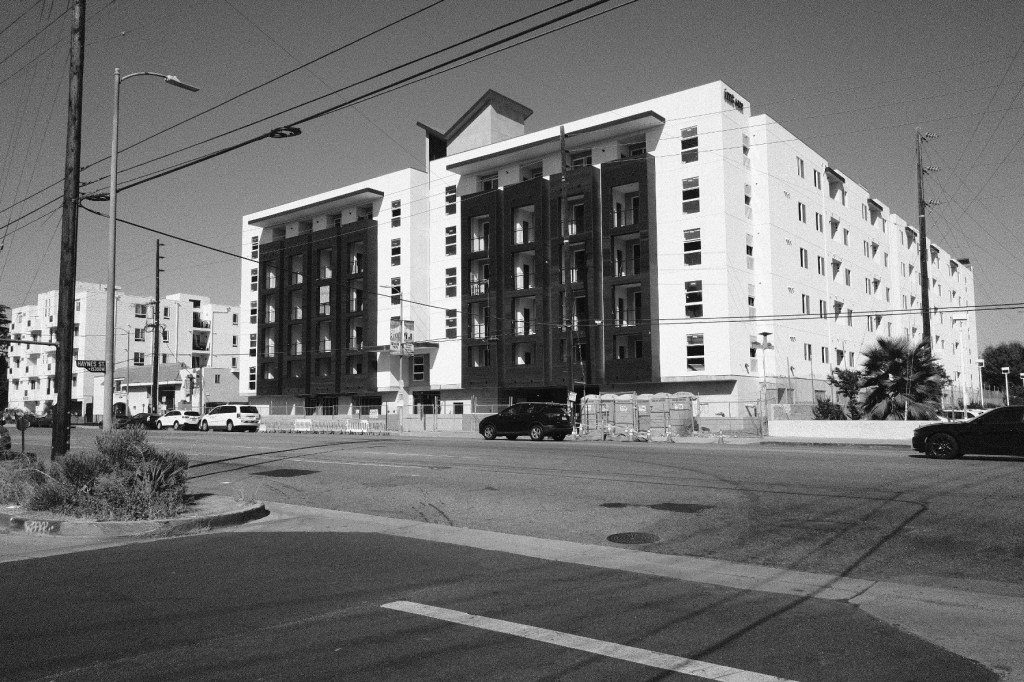
Sepulveda Near Haynes7101 Sepulveda Bl.6811 Sepulveda
As for Van Nuys, like the rest of Los Angeles, those who end up living here have to make do with whatever negligent government or avaricious investors sought for their own personal ambitions.
The public good has always been the advertisement without the result.
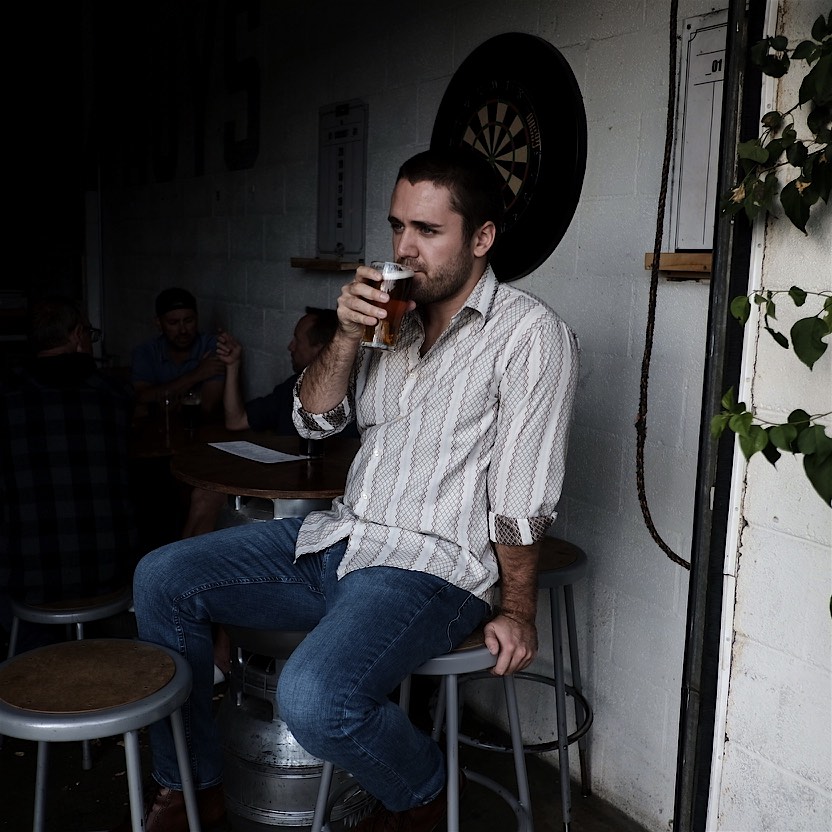
Actor Dovid K. was raised in Los Angeles, and he came over to our neighborhood last week for some agency photos.
The houses in our area (Victory/Kester/Columbus/Vanowen) were built in the 1950s, and due to the modesty of the neighborhood, many look roughly the same. There are the criss-crossed windows, the board and batten siding, the pastiche of architectural decorations that mid-century developers affixed to facades to make them warmer and more appealing.
The vintage styles have weathered six or seven decades and endured as archetypes of the San Fernando Valley. This section of Van Nuys was ideal because it was walkable, just across the road from the high school, near the shopping centers along Sepulveda. Those were the days when children rode bikes and walked to school and there was always someone home to greet them at 3pm.
Times change. Children don’t walk, they are driven.
Behind the house on the right someone is building an ADU out of an old garage. They installed solar panels like many of their neighbors.
This sign belongs in the archival collections of Valley Relics.
This totem statue was erected by a previous owner and still stands.
This house will have a new ADU in front, an adaptive revitalization of a classic Valley ranch house from the early 1950s.
There is something about the middle 1950s that endures in many of the houses, a cozy casualness of not so big houses with big lawns, semi-circular driveways, trees, hedges, and decorative lampposts. A lot of it is not so up-to-date. If this were Studio City or Brentwood these houses would have been long gone, demolished and replaced with white faced behemoths and tall gates and enormous SUVs on every property.
Sadly, many of these houses sell for over a million and are not quite starter homes. But they are home for many who inherited them from parents, with low property taxes and little or no mortgage payments. For the lucky ones who got lucky, this is kind of a paradise, guarded by NextDoor and patrolled by helicopter, seemingly an American paradise on the ground.
And it makes a good backdrop for a young man who channels the 1960s.
You must be logged in to post a comment.